Reykjavik Day Trips — the Golden Circle, Northern Lights & Iceland's Most Iconic Landscapes
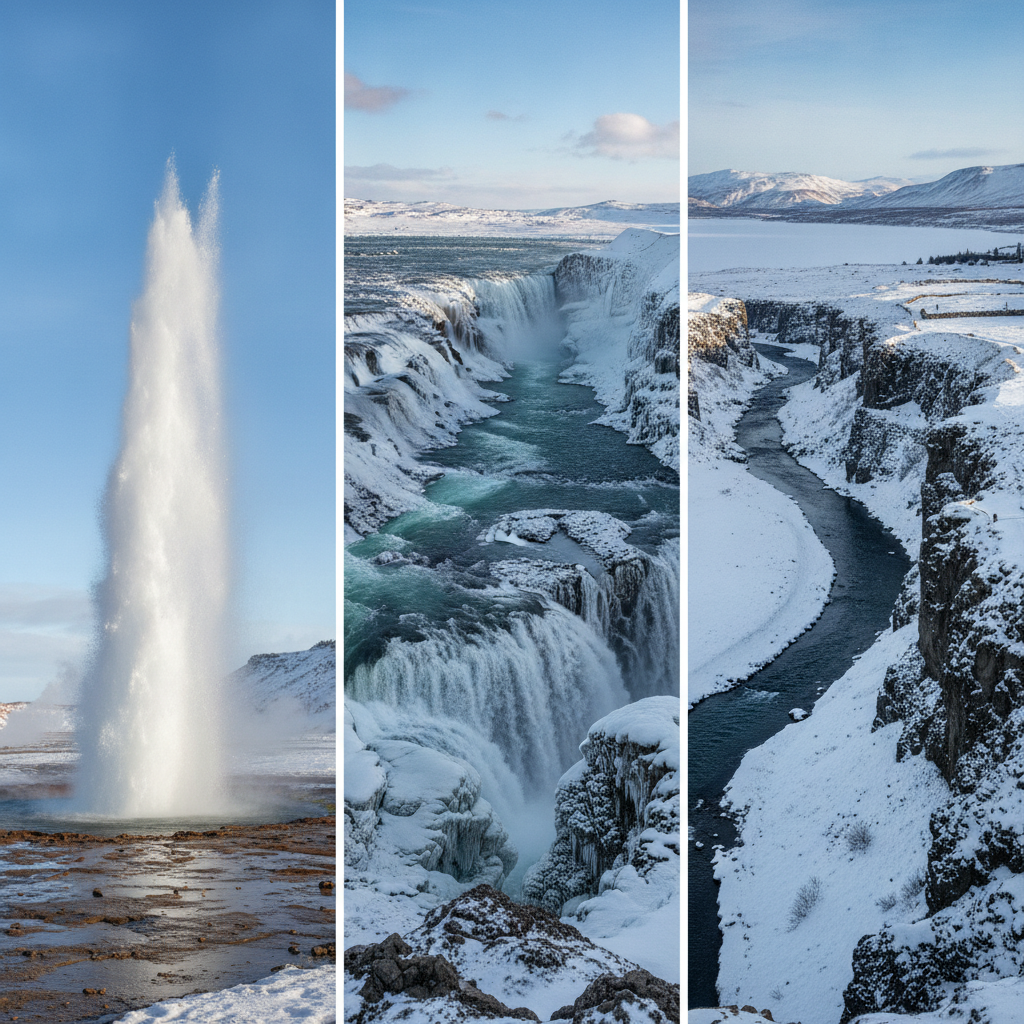
The Golden Circle (Þingvellir, Geysir, Gullfoss) is the most visited day trip from Reykjavik — the 300km route covering the tectonic rift valley, the world's most famous geyser field, and the most dramatic waterfall in Iceland, all within 2 hours of the capital.
- 1
Þingvellir National Park — the Tectonic Rift and the First Parliament
Þingvellir (the UNESCO World Heritage National Park 50km northeast of Reykjavik, the site where the North American and the Eurasian tectonic plates are visibly separating at 2.5cm per year, the rift valley between the plates the most accessible tectonic plate boundary in the world — the Almannagjá rift, the 7km long canyon formed by the divergence, the walls of the canyon rising 40m on the American side — the most dramatic terrestrial expression of the Mid-Atlantic Ridge which runs through Iceland from south to north, the park free, open daily, the visitor centre at the south end of the park at €4 adults): the Althing (the site of the Icelandic national parliament — the Alþingi — established 930 CE, the oldest national parliament in the world, the parliament meeting annually at Þingvellir from 930 to 1798, the law speaker reciting the laws from the Law Rock — Lögberg — on the rift wall above the assembly plain, the Althing the institution that gave Iceland its identity as a society governed by law rather than by kings — the current Icelandic parliament established 1845 meeting in Reykjavik, the Þingvellir site the national monument of Icelandic statehood), the Silfra fissure (the crack between the tectonic plates filled with the glacially filtered groundwater — the visibility in the water 100m, the clearest freshwater on Earth, the snorkeling and scuba diving in the fissure the most popular adventure activity from Reykjavik at €50-90 per person including wetsuit, the operators departing from Reykjavik, the water temperature 2-4 degrees year-round) and Þingvallavatn (the lake below the rift valley, the largest natural lake in Iceland at 84 square km, the Arctic char fishery the most exclusive in Iceland).
- 2
Geysir — the Original and Strokkur
Geysir (the geothermal field 100km from Reykjavik in the Haukadalur valley, the field that gave the world the word 'geyser' — the Old Norse geysa meaning 'to gush' — the Great Geysir the original from which all geysers take their name, the Great Geysir erupting since the 13th century and documented since 1294, the eruptions reaching 70m in height before the geyser became largely dormant in the 20th century, the field free to enter, the visitor centre restaurant and gift shop the only infrastructure at the site): Strokkur (the companion geyser 100m south of the Great Geysir, erupting every 4-8 minutes to 15-25m height, the most reliably erupting geyser in Europe, the eruption cycle the primary tourist spectacle at the Geysir field — the water bulging in the blue dome above the silica cone 5 seconds before the eruption, then the white column shooting to 20m, the steam cloud drifting east or west depending on the wind, the correct photography position the north side of the cone with the blue sky background rather than the south side with the parking lot, the eruption lasting 3-5 seconds per cycle), the broader Geysir hot spring field (the coloured silica terraces surrounding the geysers — the orange and brown iron deposits, the white silica sinter, the blue-green algae mats growing at the 40-50 degree margins of the hot spring pools, the Konungshver — the King's pool — the largest hot spring pool, the Blesi pool with the two side-by-side pools: one clear at 60 degrees, one opaque blue from the dissolved silica at 40 degrees, the most photogenic individual element at the Geysir field) and the Geysir Centre (the restaurant and gift shop at the site entrance, the lamb soup and the Icelandic skyr cake the standard Geysir lunch at €15-20).
- 3
Gullfoss — the Golden Waterfall
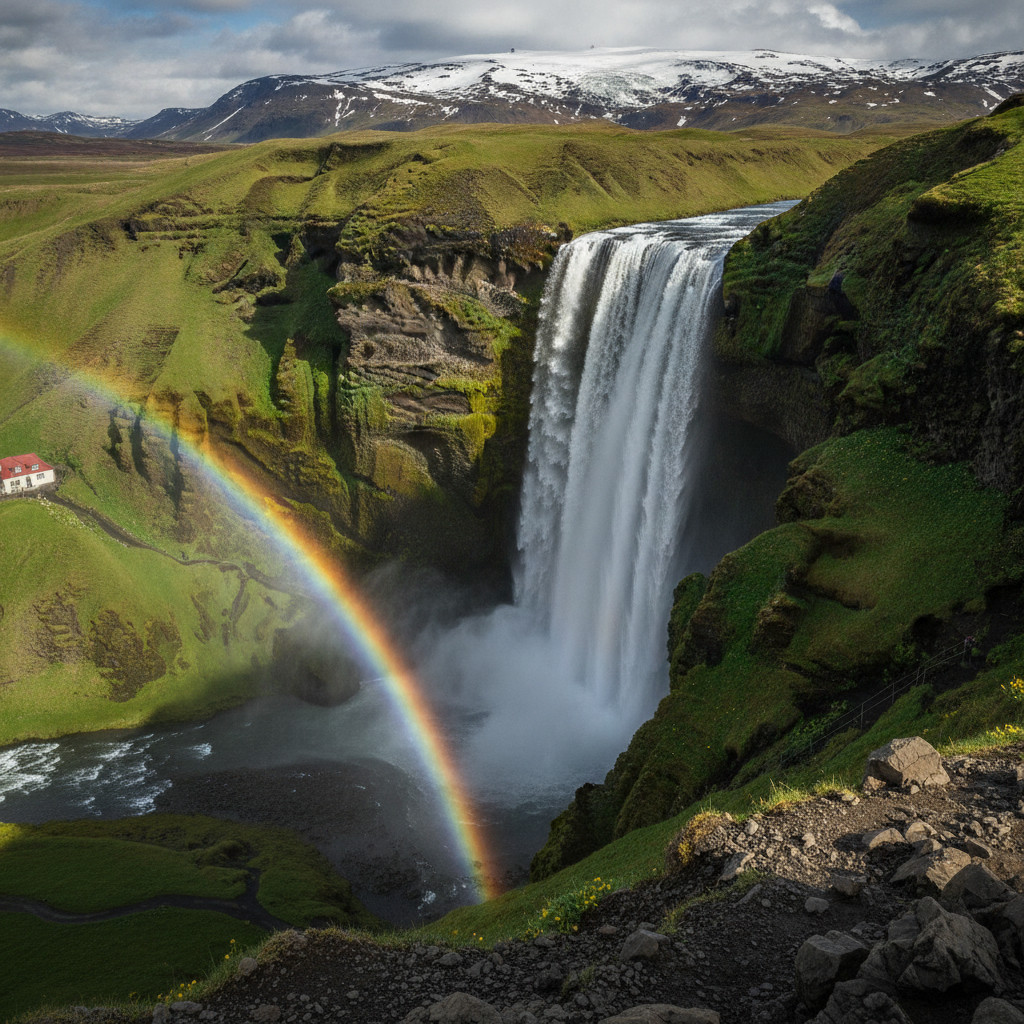
Gullfoss (the two-tier waterfall on the Hvítá River 10km east of the Geysir field, the most visited waterfall in Iceland and one of the most powerful in Europe — the Hvítá flowing from the Langjökull glacier at 140 cubic metres per second in average conditions and 2,000 cubic metres per second in spring flood, the upper fall dropping 11m over a 70m wide crest and the lower fall dropping 21m at a 90-degree angle into the 2.5km Gullfoss canyon, the spray rising 50m above the canyon on windy days, the falls visible from 3 viewpoints on the north rim of the canyon, the site free, open daily, the visitor centre with the café and the exhibition on the Gullfoss protection story): the Gullfoss protection story (the waterfall nearly sold to British investors for a hydroelectric scheme in the early 20th century — the daughter of the landowner Sigríður Tómasdóttir walking barefoot to Reykjavik to petition against the scheme and threatening to throw herself into the falls if the construction proceeded, the threat the first environmental protest in Icelandic history, the scheme eventually abandoned after the investors failed to pay the lease, the waterfall donated to the Icelandic state in 1979, Sigríður remembered by a memorial plaque and a monument at the site), the rainbow (the spray creating a permanent rainbow in the canyon on sunny mornings — the best rainbow visible from the upper viewpoint in the morning light before noon, the rainbow vanishing in the afternoon when the sun moves behind the falls) and the winter conditions (the Gullfoss frozen in the January-February cold — the spray freezing to the canyon walls, the falls themselves continuing beneath the ice, the winter conditions the most dramatic visually, the access road kept open year-round by the Icelandic road maintenance).
- 4
The Blue Lagoon — the Geothermal Spa Icon
The Blue Lagoon (Bláa Lónið, located on the Reykjanes Peninsula 48km southwest of Reykjavik, accessible by direct bus from the BSÍ bus terminal in 45 minutes at €25 return or from Keflavik Airport in 20 minutes — making the Blue Lagoon the most convenient pre-departure airport stop, the geothermal spa the most visited tourist attraction in Iceland, the capacity capped at 1,200 per session, the booking at bluelagoon.com essential 2-4 weeks in advance in the main season May-August): the lagoon (the outdoor geothermal pool of 8,700 square metres, the water temperature 37-39 degrees year-round, the milky blue-white colour from the silica suspended in the geothermal water, the silica precipitating out as the water cools creating the white clay deposits on the pool floor — the white clay the product branded and sold as the Blue Lagoon skincare range, the steam rising from the water in the cool air creating the atmospheric visual, the lava rocks surrounding the pool the black basalt of the Reykjanes Peninsula volcanic field): prices (the Comfort package: €70-80 adults for the entry, the towel, the silica and algae mask, the in-water drink; the Premium package: €95-110 adding the bathrobe and slippers; the Retreat Spa: €600+ for the private entrance and the hotel package — the correct value tier the Comfort package as the additions in the Premium and above are minor comfort upgrades), and the practical considerations (the water the effluent from the Svartsengi geothermal power plant, the minerals in the water benefiting skin conditions including psoriasis, the water safe for swimming at 37-40 degrees, the platinum dye of hair fading in the silica water — long-haired visitors warned to tie the hair up).
- 5
Northern Lights Viewing from Reykjavik
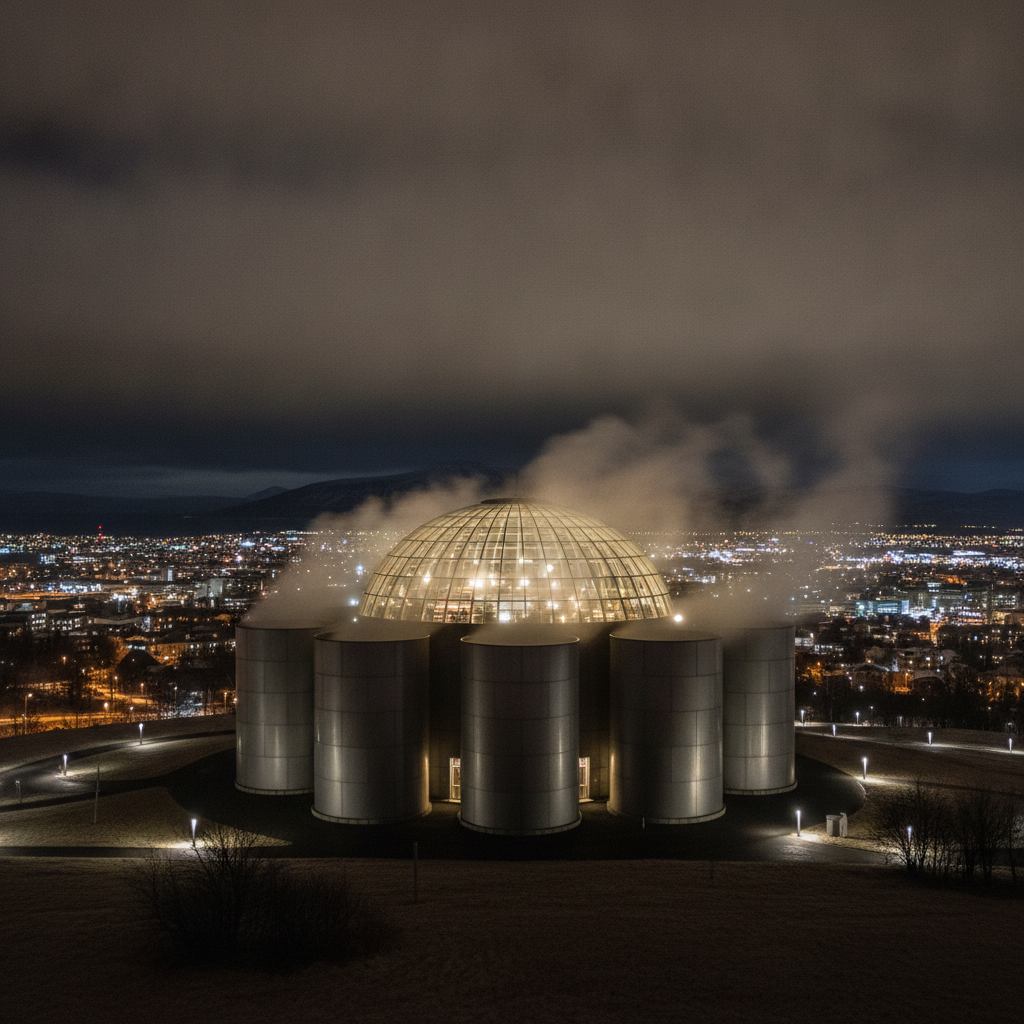
The Northern Lights in Iceland (aurora borealis, the phenomenon caused by solar wind particles colliding with the Earth's upper atmosphere, creating the curtains and waves of green, pink, and purple light in the night sky — Iceland the most accessible Northern Lights destination in Europe due to the combination of the low latitude relative to other aurora-viewing countries — 64°N, the same as Fairbanks Alaska — and the developed tourist infrastructure): the viewing season (September to April, the nights dark enough for visibility from September — the phenomenon present year-round but only visible when the night is dark enough, the Icelandic summer with the midnight sun making aurora viewing impossible June-July — the best months statistically October-February when the nights are longest and the clear weather the most likely), viewing in Reykjavik (the city light pollution significant but the aurora often bright enough to see from the Reykjavik waterfront or the Grótta lighthouse 3km west of the city centre — the lighthouse island accessible on foot at low tide, the most popular Reykjavik aurora viewing spot — and the hill of Perlan on the Öskjuhlíð hill 500m southeast of the city centre, the panoramic terrace above the geothermal hot water tanks, the darkness adequate for viewing on the most active nights), Northern Lights tours (the organized tour departing from the Reykjavik city centre when the aurora forecast is at Kp-index 3+, the tour bus driver taking the group to the darkest available location on the night, €50-70 per person, the Vedur.is website the official Icelandic meteorological aurora forecast, the 'My Aurora Forecast' app the most used mobile tool for the Iceland aurora prediction) and the Aurora Reykjavik museum (Grandagarður 2, the indoor Northern Lights exhibition with the 360-degree aurora simulation, €16 adults, the correct introduction when the outdoor aurora is not visible).
- 6
Reykjavik Practical — Getting Around, the Midnight Sun and the 2008 Crisis
Reykjavik practical: access (the Keflavik International Airport 50km southwest of Reykjavik, the Flybus direct bus to the BSÍ bus terminal in Reykjavik in 45 minutes at €17 one-way — the most used transport option, runs timed to every flight arrival — or taxi at €90-120, the airport the hub for Icelandair and WOW Air's successor routes, direct connections from London Heathrow, Amsterdam, Copenhagen, Berlin, New York JFK, Boston, Toronto, Seattle, and 30+ other cities, Iceland's unique position as a stopover hub — the free stopover programme of Icelandair allowing 1-7 nights in Reykjavik on transatlantic tickets at no additional airfare, the most intelligent use of Reykjavik as part of a broader trip), city transport (the Strætó city bus network at €2.70 per trip, the city centre largely walkable, the distances between the Hallgrímskirkja, the Harpa, and the Old Harbour 1.5km — the 30-minute walk the most practical city centre transport), the 2008 financial crisis context (the kreppan — the collapse of the three major Icelandic banks in October 2008, the banks having expanded to 10 times Iceland's GDP through aggressive lending, the collapse the largest banking failure relative to economy in world history, the Icelandic state refusing to bail out the foreign creditors — the decision generating the 'Icesave' dispute with Britain and the Netherlands — the recovery complete by 2012 through the combination of IMF support, tourism expansion, and export growth, the tourism boom after 2010 transforming Iceland from a specialist destination to one of the world's most visited countries per capita, the number of visitors growing from 500,000 in 2010 to 2.3 million in 2019 for a country of 370,000 people).
Walk this route with audio
Stories play automatically as you reach each stop — no tapping needed.
More in reykjavik
Reykjavik Summer — the Midnight Sun, Puffins, Whale Watching & the Westman Islands
Reykjavik Geothermal & Volcanoes — the Perlan, Laugardalur Hot Springs & Iceland's Volcanic System
Reykjavik — Hallgrímskirkja, the Old Harbour & the World's Northernmost Capital
Reykjavik Culture — the Icelandic Sagas, Skyr, the Music Scene & the Coloured Old Town Houses