Reykjavik Summer — the Midnight Sun, Puffins, Whale Watching & the Westman Islands
Icelandic summer (June-August) is unique in Europe — the midnight sun illuminating the landscape in an endless golden hour, the puffin colonies nesting on the coastal cliffs, the humpback whales feeding in the Faxaflói Bay, and the dramatic landscapes accessible in 20 hours of daylight.
- 1
The Midnight Sun — Iceland's Summer Light
The midnight sun in Iceland (the phenomenon of continuous daylight, the sun not setting from late May to late July in Reykjavik — the summer solstice on June 21 the peak, with the sun setting at 12:04am and rising at 3:04am, the sky remaining bright throughout — the phenomenon the single most disorientating and most exhilarating aspect of the Icelandic summer for first-time visitors): the midnight sun practically (the Icelandic summer light the most distinctive natural condition of the visit — the landscape bathed in the golden low-angle light 24 hours per day, the light quality at 1am on the summer solstice equivalent to the golden hour light 30 minutes before sunset in more southerly locations, the landscape photography at midnight the most uniquely Icelandic experience available without special equipment or tour — the hike to the Esja mountain at midnight, the drive to the Þingvellir National Park at 11pm, the walk along the Reykjavik waterfront at 1am in the full daylight, the possibilities limited only by the visitor's willingness to overturn the usual sleep schedule), the midnight sun at Grimsey (the small island 40km off the north coast of Iceland, the only Icelandic location directly on the Arctic Circle at 66.5°N, the midnight sun completely uninterrupted here from late May to late July, the ferry from Dalvík in the north of Iceland in 3 hours the only public access, the island the nesting ground of the Arctic tern — the bird that migrates the longest distance of any animal, 70,000km per year from Iceland to Antarctica and back) and the practical impact (the Icelandic hotels providing blackout curtains — the standard equipment in all Icelandic accommodation from June to August, the sleep disruption the most commonly reported challenge for summer visitors, the earplugs and the eye mask the correct packing additions).
- 2
Atlantic Puffins — Iceland's Favourite Bird
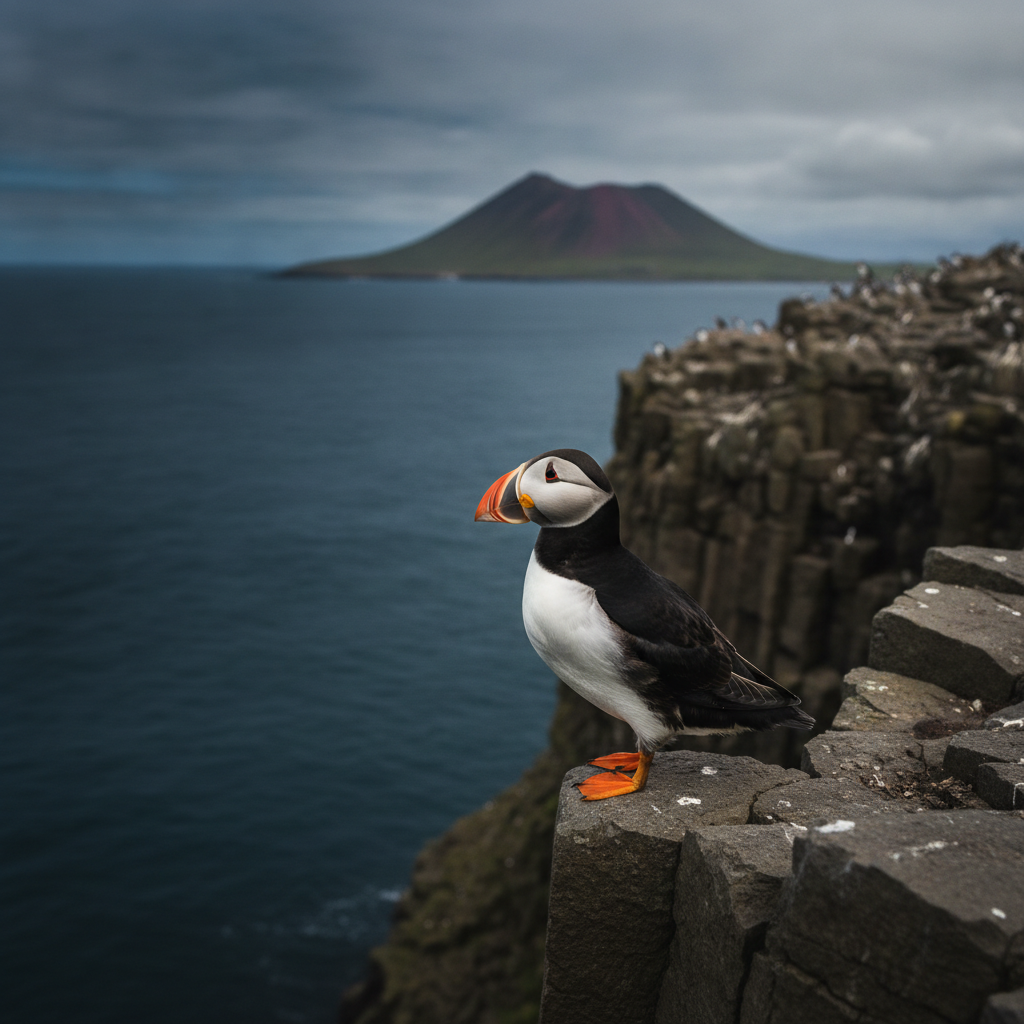
The Atlantic puffin (Fratercula arctica, the seabird with the distinctive orange beak and the black-and-white plumage, the bird nesting in burrows on the Icelandic coastal cliffs May-August before migrating to the open North Atlantic for the winter, Iceland hosting 60 percent of the world's Atlantic puffin population — 8-10 million birds — the largest concentration in the world, the Westman Islands the single largest colony): puffin viewing from Reykjavik (the puffins visible from the Reykjavik harbour wall from mid-June to August — the birds flying between the sea and their nesting burrows on the Lundey island in the harbour, the binoculars the correct equipment, the birds visible from the Harpa waterfront at 100m distance without a boat — and the puffin watching boat tours from the Old Harbour at €40-50 per person, 1.5 hours, the small RIB boats able to approach the nesting cliffs closely without disturbing the birds, the Lundey and the Akurey islands in the harbour the nesting sites), the puffin diet (the sand lance — the small fish, the puffin carrying up to 62 sand lances in the beak simultaneously thanks to the backwards-pointing spines on the tongue — the most remarkable single beak load in the bird world, the load being visible at the nesting cliffs when the parent birds return from the sea and the chicks attempt to grab the fish), and the Westman Islands puffins (see below, the Westman Islands the correct destination for the visitor specifically interested in close-range puffin observation rather than the introductory Reykjavik harbour viewing).
- 3
The Westman Islands — Eldfell Volcano and the Puffin Capital
The Westman Islands (Vestmannaeyjar, the archipelago of 15 islands and 30 skerries 10km off the south coast of Iceland, accessible by ferry from Landeyjahöfn in 30 minutes at €25 return or by Icelandair domestic flight from Reykjavik in 20 minutes at €80-120 return, the main island Heimaey the only inhabited island in the archipelago, population 4,200 — the largest Atlantic puffin nesting colony in the world with 20,000 breeding pairs on Heimaey alone and 1 million pairs across the archipelago): the Eldfell volcano eruption of 1973 (the eruption that began January 23 1973 at 1:55am on the edge of the Heimaey town — the volcano erupting with no warning from a fissure in the ground 200m from the houses, the entire population evacuated by fishing boat in the night — 5,000 people, 1 man killed by gas — the eruption lasting 5 months, the lava threatening to close the harbour — the most economically critical harbour in Iceland — before the Icelandic fire service pumped sea water onto the advancing lava front in the largest sea-water lava cooling operation in history, the harbour narrowed but saved, the new lava field extending the island by 2.2 square km, the museum at the buried house — the Eldheimar museum — the most dramatically personal volcanic disaster museum in Iceland, €15 adults, a real house preserved where the lava stopped, the household objects visible inside the lava), and the puffin rescue tradition (every August the young puffins leaving the nests for the first time are attracted to the Heimaey town lights rather than the sea, the children of the island going out every August night to collect the confused fledglings in cardboard boxes and release them at the sea cliff the following morning — the most endearing conservation tradition in Iceland).
- 4
Whale Watching from Reykjavik
Whale watching in Faxaflói Bay (the bay surrounding Reykjavik, the feeding ground of the minke whale — the most abundant whale species in Icelandic waters — the humpback whale, the white-beaked dolphin, the harbour porpoise, and occasionally the blue whale — the largest animal in the history of the Earth at up to 29m length, rarely but regularly sighted in Faxaflói): the operators (the 10+ whale watching companies at the Old Harbour, the Ægisgarður pier, the 3-hour tours at €70-90 per adult departing at 9am, 1pm, and 5pm daily May-September, the operators including Elding, Special Tours, and Whale Safari — the operators legally required to follow the whale watching guidelines of the Icelandic Responsible Whale Watching Advisory Centre, the boats required to maintain 100m distance from the whales and reduce speed when approaching), the sighting statistics (minke whale sighting rate 70-80 percent of tours in the main season, humpback whale 30-40 percent, white-beaked dolphin 20-30 percent, harbour porpoise 40-50 percent, orca and blue whale 2-5 percent — the sighting statistics improving in the period July-September when the whale feeding activity is highest as the capelin and the sand lance schools are at maximum density in the bay), the North Sailing tours from Húsavík (the village 485km north of Reykjavik on the north coast, the 'whale watching capital of Europe', the fjord of Skjálfandi Bay the most reliable humpback whale location in Iceland — the 3-hour tours from Húsavík at €95-110 per person, the sighting rate of humpback whale 98+ percent in the June-September season, the Húsavík Whale Museum the best whale biology museum in Iceland at €15 adults) and seasickness prevention (the North Atlantic swell the primary challenge, the motion sickness patches — scopolamine — the most effective prophylactic, the patches applied 4 hours before departure, available at Icelandic pharmacies).
- 5
Reykjavik Nightlife — the Runtur and the Weekend Culture
Reykjavik nightlife (the most celebrated nightlife scene in the Nordic countries relative to population size, the Reykjavik weekend — the runtur, literally 'round tour' — the Icelandic tradition of moving between bars in a circuit during the early hours of Saturday and Sunday morning, the bars open until 4:30am on weekends, the culture of late starting — Icelanders beginning the evening at midnight rather than 8pm — the pre-drinking at home or at hotel the standard first stage before reaching the bar circuit at 12-1am): Laugavegur at midnight (the 1km main street of Reykjavik the centre of the bar circuit from midnight onwards on Friday and Saturday — the bars on and around Laugavegur: the Kaldi brewery bar at Laugavegur 20b — the Icelandic craft beer on tap, the best affordable bar in the city centre; the Lebowski Bar at Laugavegur 20a — the Big Lebowski themed bar with the bowling lane and the White Russian cocktails, the most tourist-recognizable bar in Reykjavik; the Hurra at Tryggvagata 22 in the Old Harbour area — the best live music venue in Reykjavik, the programme of Icelandic indie bands and international touring acts), the Reykjavik music scene (the most internationally recognized music export of Iceland — Björk, Sigur Rós, Of Monsters and Men, Kaleo, JFDR — all originating from Reykjavik, the Iceland Airwaves music festival the annual international showcase for Icelandic music held in November, the Airwaves festival the most concentrated introduction to the Icelandic music scene, tickets at icelandairwaves.com at €120-180 for the full pass) and the cost of nightlife (the most expensive nightlife in Europe, the craft beer at €10-12 per 500ml, the cocktail at €15-18, the entry to the clubs and live music venues at €5-15, the total cost of a Reykjavik night out at €50-100 per person excluding accommodation, the duty-free alcohol import — 1 litre of spirits and 6 litres of wine or 6 litres of beer allowed on entry — the most budget-conscious strategy for visitors prioritizing the nightlife experience).
- 6
Iceland Airwaves — the Music Festival and Cultural Calendar
Iceland Airwaves (the annual international music festival held in Reykjavik in early November, the festival the primary international cultural event of the Icelandic year, the programme covering 5 days of concerts across 15-20 venues in the city centre — the Harpa Concert Hall the main venue for the headline acts, the smaller bars and clubs on Laugavegur the correct addresses for the emerging Icelandic artists): the festival character (the festival unique in combining the major international acts with the Icelandic music scene in equal billing — the 'off-venue' concerts at the bars free with the full festival pass, the off-venue programme the primary draw for the music industry professionals attending as the emerging Icelandic bands play the smallest venues, the 2024 headliners the international artist A and the Icelandic band B — the specific lineup changing annually, the tickets at icelandairwaves.com from July), the November context (the November timing making Airwaves the correct window for visitors seeking the Northern Lights combined with the music festival — the darkness established by November, the aurora forecast at Kp-index 3+ on approximately 40 percent of November nights in Iceland, the combination of the outdoor natural phenomenon and the indoor music the most culturally complete Icelandic experience available in a single trip), other Icelandic cultural events (the Reykjavik International Film Festival — RIFF — in late September/October, the 10 days of international and Icelandic films at the Bío Paradís cinema at Hverfisgata 54, the most important film event in Iceland; the Gay Pride — Hinsegin dagar — in August, the largest Pride event in the Nordic countries relative to population, the parade route on Laugavegur the most photographed street event in Reykjavik) and the Reykjavik cultural museums (the National Gallery of Iceland at Fríkirkjuvegur 7, the permanent collection of Icelandic art 1900-present, free, Tuesday-Sunday 10am-5pm).
Walk this route with audio
Stories play automatically as you reach each stop — no tapping needed.
More in reykjavik
Reykjavik Geothermal & Volcanoes — the Perlan, Laugardalur Hot Springs & Iceland's Volcanic System
Reykjavik — Hallgrímskirkja, the Old Harbour & the World's Northernmost Capital
Reykjavik Culture — the Icelandic Sagas, Skyr, the Music Scene & the Coloured Old Town Houses
Reykjavik Day Trips — the Golden Circle, Northern Lights & Iceland's Most Iconic Landscapes