Quebec City: The Bridge That Collapsed Twice and Invented Professional Engineering Ethics, the Navy Battle That Really Ended New France and Beaver Hats That Built a City
Understand that Quebec City was built entirely on European demand for beaver felt top hats and the First Nations knowledge networks that could actually supply them, find building-scale murals in a working-class quarter transformed by an art festival that started here before going to Montreal, learn that New France was not saved at Quebec in 1759 because France was more interested in its Caribbean sugar islands, stand on the Quebec Bridge that collapsed twice and killed 88 workers and directly created the Iron Ring worn by every engineering graduate in Canada as a permanent reminder of professional responsibility, ski at night on a mountain that hosted World Cup races 40 kilometres from a UNESCO World Heritage city, and see 40,000 works of Quebec art in a museum whose prison wing shows contemporary art in former cell blocks.
- 1
Quebec City Fur Trade and New France Economy
Quebec City was the commercial capital of New France, through which passed virtually all the beaver pelts that drove North American colonial economics in the 17th and 18th centuries, with beaver fur demanded by European hatmakers to produce the felt top hats that were the standard male headgear of the period. The beaver population of Europe had been hunted to near-extinction by 1600, making North American beaver pelts essential for hat production. The fur trade created an economic system requiring deep alliance between French traders and First Nations peoples who had the knowledge, networks, and winter travel skills to trap and transport furs from the interior to Quebec City. The voyageurs, French-Canadian men who paddled enormous canoes through the Great Lakes and interior waterways to trade posts in what is now Manitoba and Saskatchewan, represent one of the most physically demanding occupational cultures in North American history. The fur trade era, from Champlains alliances in 1609 to the dominance of the Hudson Bay Company after 1763, is the foundational economic history of Canada and is interpreted at multiple sites in Quebec City.
- 2
Quebec City Street Art and Public Murals
Quebec City has developed one of the most impressive outdoor mural programs in Canada through the Mural Festival which began in Quebec City in 2013 before expanding to Montreal, commissioning internationally recognized street artists to paint building-scale murals in the Limoilou and Saint-Roch quarters. The Limoilou quarter, immediately northeast of Old Quebec across the St. Charles River, is a working-class residential neighborhood whose industrial brick building stock has become the canvas for a collection of murals that attracts visitors from across Canada. The tradition of outdoor painted surfaces in Quebec City goes back further, with trompe loeil murals created in the 1990s on building gables in Old Quebec depicting historical scenes that fool viewers at first glance into perceiving three-dimensional architectural elements. The Rue Saint-Jean outside the old city walls is the primary bar and entertainment street, with cafes, bookshops, and music venues in continuous operation. The Vieux-Limoilou commercial strip on the 3rd Avenue has become a destination for independent restaurants and specialty food shops reflecting the gentrification of the quarter following arts investment.
- 3
Battle of the Restigouche and French Navy
The final naval battle of the Seven Years War in Canada took place not at Quebec but at the Restigouche River at the head of the Bay of Chaleur in June 1760, nine months after the fall of Quebec on the Plains of Abraham, when a British naval squadron destroyed a small French relief fleet that had escaped the British blockade of France carrying soldiers and supplies intended to help retake Quebec from the British. The destruction of the Restigouche fleet ended any realistic French hope of recovering New France. The wreck of the French frigate Machault, sunk at Restigouche in 1760, was excavated by Parks Canada in the 1960s and is one of the most significant underwater archaeological projects in Canadian history. The artifacts including a nearly complete 18th-century warship hull, cannon, and cargo are displayed at the Restigouche National Historic Site near Campbellton, New Brunswick. The context for understanding the fall of Quebec requires understanding that France made very limited effort to defend New France, viewing it as less economically valuable than its Caribbean sugar colonies.
- 4
Quebec City Bridges and Infrastructure
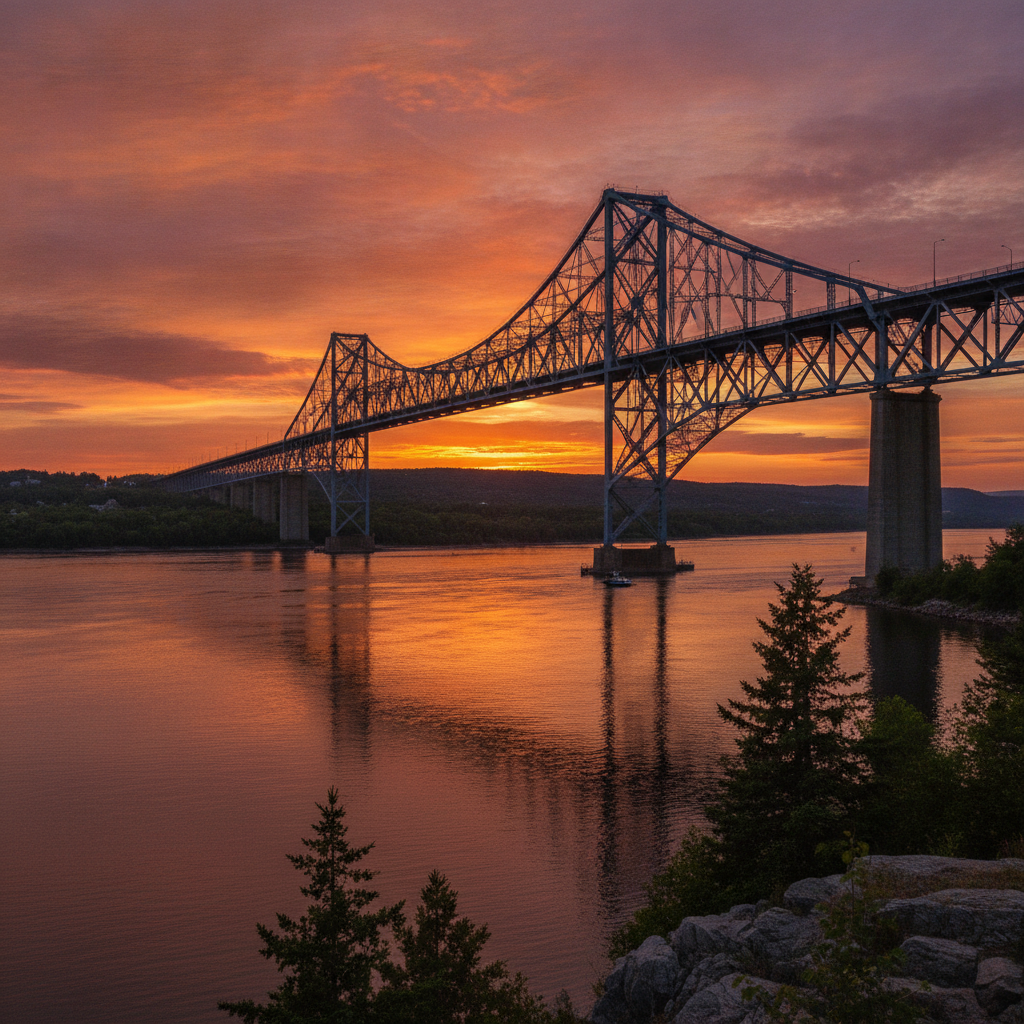
Quebec City is served by two bridges across the St. Lawrence connecting it to the south shore: the Quebec Bridge, completed in 1919 and the longest cantilever bridge span in the world at 549 metres, and the Pierre Laporte Bridge, a suspension bridge completed in 1970. The Quebec Bridge has the distinction of being the only bridge in the world to have collapsed twice during construction, in 1907 killing 75 workers and in 1916 killing 13 more, due to engineering failures in the original design that were compounded when repairs to a collapsed south cantilever arm failed during lifting. The 1907 collapse led directly to the creation of the Professional Engineers of Canada and the tradition of the Iron Ring ceremony where graduating engineering students receive a ring of iron or stainless steel as a reminder of professional responsibility and the human consequences of engineering failure. The ring tradition began in 1925 and has been adopted by engineering faculties across Canada. The Quebec Bridge is now a National Historic Site despite its collapse history, recognized as an engineering achievement.
- 5
Quebec City Skiing and Mountain Culture
Mont-Sainte-Anne, 40 kilometres east of Quebec City, is one of the largest ski areas in eastern Canada with 71 trails, a vertical drop of 625 metres, and a night skiing operation that allows skiing after dark with 16 trails illuminated. The mountain hosted the Alpine Ski World Cup annually from 1981 and the Mountain Bike World Cup in summer. The Stoneham ski area, 20 kilometres north of Quebec City in the Laurentian foothills, is smaller but more accessible and is known for consistent snow conditions and a strong mogul skiing tradition. The cross-country skiing culture of the Quebec City region, with groomed trails at the Plains of Abraham, Levis parks, Jacques Cartier National Park, and numerous municipal systems, makes the city one of the best urban cross-country skiing destinations in North America. The tradition of skiing in Quebec dates to Norwegian immigrants who introduced skis to the Laurentian Mountains in the 1880s, followed by the development of the ski train from Montreal to the Laurentians beginning in the 1930s that created a mass skiing culture in Quebec.
- 6
Quebec City Photography and Visual Art
Quebec City has been one of the most painted and photographed cities in North America since the mid-19th century, when British military officers stationed in the garrison produced watercolors of the fortifications, river, and surrounding landscape. The tradition of painting Quebec City from the Levis shore across the St. Lawrence, with the Chateau Frontenac and fortifications reflected in the river, is among the most reproduced viewpoints in Canadian visual art. The Charlevoix school of painting, associated with artists including Clarence Gagnon, A.Y. Jackson of the Group of Seven, and Marc-Aurele Fortin who painted in the Charlevoix region east of Quebec City in the early 20th century, produced some of the most admired Canadian landscape paintings. The Musee National des Beaux-Arts du Quebec, housed in a complex of three pavilions in the Grande Allee including the former provincial jail, is the largest collection of Quebec art in the world with over 40,000 works. The prison pavilion, where prisoners once occupied cells, now contains contemporary art exhibitions in the former cell blocks, a conjunction of institutional history and aesthetic experience that is uniquely Quebec.
Walk this route with audio
Stories play automatically as you reach each stop — no tapping needed.
More in Quebec City
Quebec City: The Battle That Lasted 15 Minutes But Changed a Continent, the World Largest Winter Carnival and the Tech Quarter Built Under a Chateau
Quebec City: A Bateau Pulled from Under a Building, the Narrowest Sovereignty Referendum in Democratic History and a Language Law That Changed a City
Quebec City: A Meteorite Crater That Made a Wine Region, the Ice Hotel That Melted Every Spring and the Scurvy Cure That Europe Forgot for 200 Years
Quebec City: The First University in Canada Founded 1663, Why the Ice Canoe Race Depends on a Freezing River That Freezes Less Every Decade and What 4.5 Million Tourists Do to a City of 800000
Quebec City: The Most Photographed Hotel on Earth, Only Walled City in North America and Stairs Climbed by Pilgrims for 350 Years