The Boulevard of History: Wenceslas Square & New Town
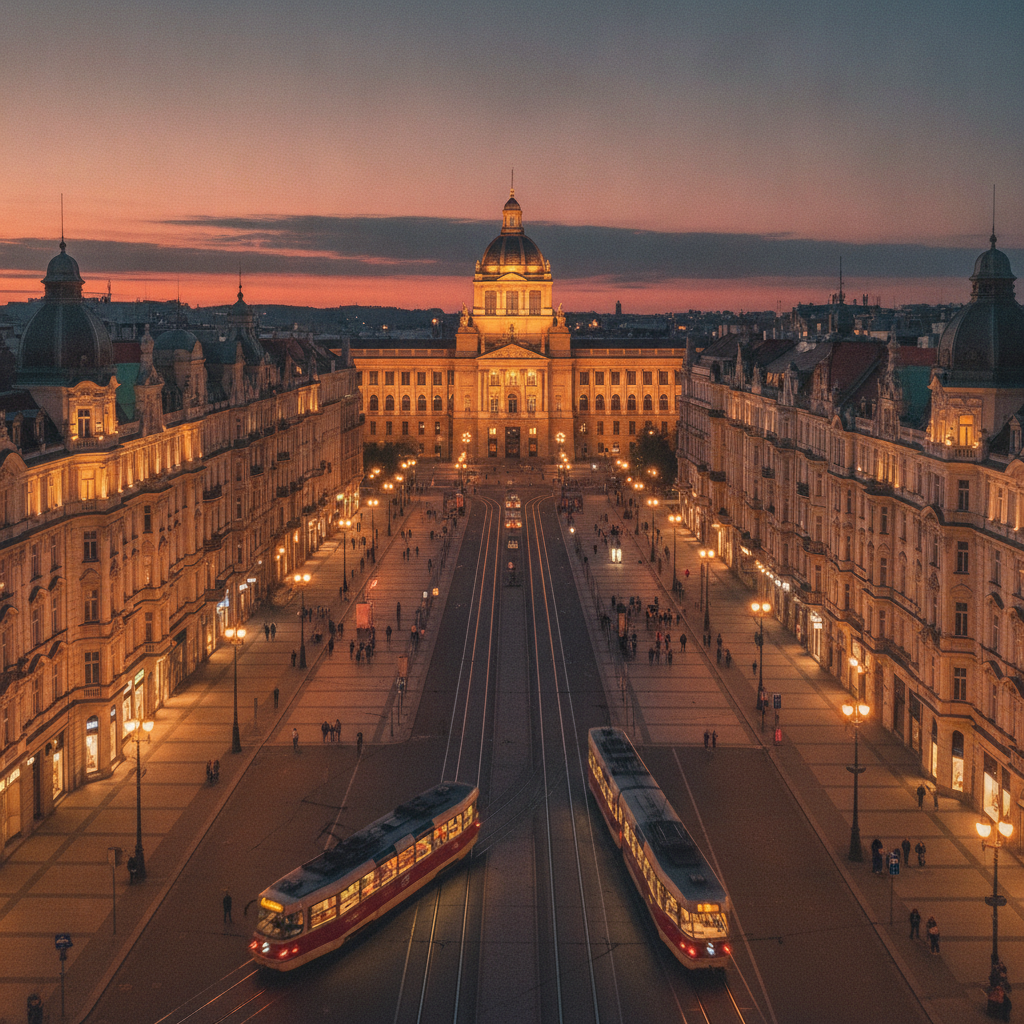
More boulevard than square, Václavské náměstí has been the stage for the most dramatic moments of modern Czech history—the declaration of Czechoslovakia in 1918, the Nazi occupation, the Soviet invasion of 1968, and the Velvet Revolution of 1989. This walk extends south from the square into the New Town, discovering the Art Nouveau grandeur of the Lucerna Palace, the soaring Neo-Renaissance National Museum, and Frank Gehry's subversive Dancing House.
- 1
Wenceslas Square
Václavské náměstí is 750 meters long and 60 meters wide—less a traditional square than a grand urban boulevard, more Paris than medieval Bohemia. At its upper end, the equestrian statue of Saint Wenceslas (patron saint of Bohemia) has served as the gathering point for nearly every major demonstration in Czech history: the proclamation of the independent Czechoslovak state in October 1918, the Nazi military parade of 1939, the student Jan Palach's self-immolation in protest of the Soviet occupation in 1969, and the massive crowds of the Velvet Revolution in November 1989, when 300,000 people packed the square to demand the end of Communist rule. The square's Art Nouveau, Cubist, and Functionalist hotel and department store facades are themselves a textbook of 20th-century Central European architecture.
- 2
Lucerna Palace
Hidden inside a block of buildings between Wenceslas Square and Štěpánská Street, the Lucerna is one of Prague's great hidden interiors—a Jugendstil shopping arcade, cinema, ballroom, and concert space built between 1907 and 1921 by Václav Havel's grandfather, Miloš Havel. The arcade's glass-and-iron ceiling floods the marble interiors with light; the cinemas have been operating continuously since 1909; and the ballroom upstairs hosts a legendary 1980s and 90s retro music night every Friday and Saturday. The arcade's most famous object is a 1999 installation by Czech artist David Černý: a parody of the Wenceslas Square statue outside, with Saint Wenceslas mounted on an upside-down dead horse.
- 3
National Museum
The Neo-Renaissance palace at the top of Wenceslas Square was built between 1885 and 1891 and is the grandest statement of Czech national identity in stone. Its famous main staircase, lined with allegorical figures representing arts, sciences, and Czech history, leads to the monumental Pantheon—a hall of statues and busts of 72 distinguished Czechs. During the Warsaw Pact invasion in August 1968, Soviet tanks fired on the building (the bullet holes were covered for decades; they have since been revealed as a memorial). The museum's recent renovation restored the original Art Nouveau interiors and reopened the building to visitors for the first time in decades.
- 4
New Town Hall (Karlovo náměstí)
Karlovo náměstí—Charles Square—is actually the largest square in Prague, though its central park makes it feel more like a garden than a civic space. The Gothic New Town Hall on its northern edge was the site of the First Defenestration of Prague in 1419, when Hussite reformers threw a Catholic city councillor and his colleagues from the windows—the act that launched the Hussite Wars. The square itself is surrounded by some of Prague's most diverse architecture, from Baroque churches to early 20th-century apartment buildings in a range of historicist styles.
- 5
Dancing House
Frank Gehry and Vlado Milunić's 1996 office building on the Vltava embankment is the most discussed work of architecture in contemporary Prague. Its two towers—one glass and wavy, one concrete and straight—were nicknamed 'Fred and Ginger' after the dancer-actors Fred Astaire and Ginger Rogers, whose swaying forms the building's silhouette suggests. President Václav Havel, who lived next door, championed the project despite considerable controversy. The top floor restaurant offers one of the best views of the river and the city roofscape. Whatever you think of it architecturally, the Dancing House announced that post-Communist Prague intended to be a city of bold ideas as well as careful preservation.
- 6
Emauzy Monastery
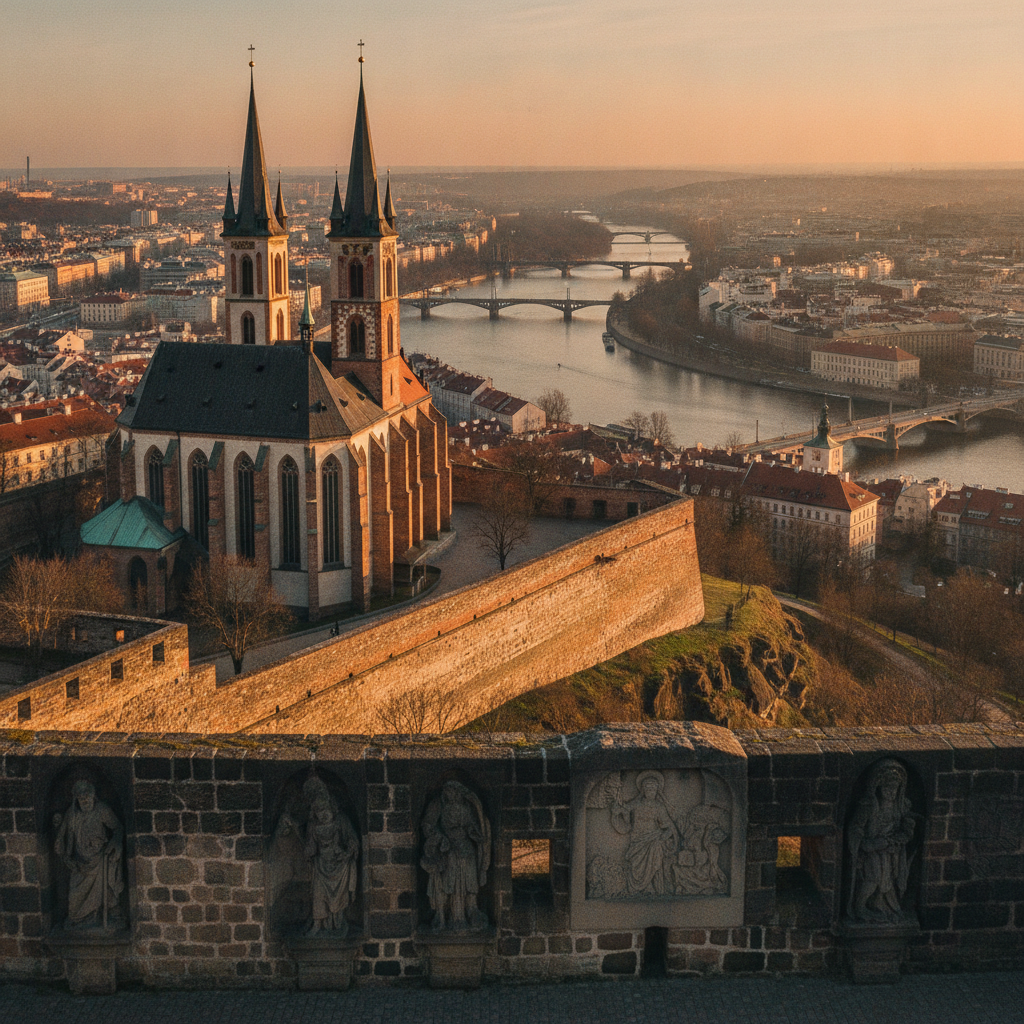
The Benedictine monastery of Na Slovanech, founded by Emperor Charles IV in 1347, is one of the oldest in Prague—and one of the most dramatic architectural collisions in the city. The original Gothic monastery and church survived the centuries largely intact until February 1945, when an Allied bombing raid (targeting Dresden) accidentally dropped bombs on the New Town, destroying the medieval spires and part of the church roof. The replacement spires—two intersecting concrete parabolic arcs designed by František Maria Černý in 1967—are among the most remarkable pieces of mid-century sacred architecture in Central Europe. The monastery library holds some of the oldest Slavonic manuscripts in existence.
Walk this route with audio
Stories play automatically as you reach each stop — no tapping needed.
More in prague
The High Ground: Letná Park, Holešovice & Prague's Creative Quarter
Memory & Stone: Prague's Jewish Quarter (Josefov)
Stone Saints & Hidden Gardens: Charles Bridge & Malá Strana
Bohemian Crown: Prague Castle & Hradčany
River & Gardens: Troja Chateau, Prague Zoo & the Wild North