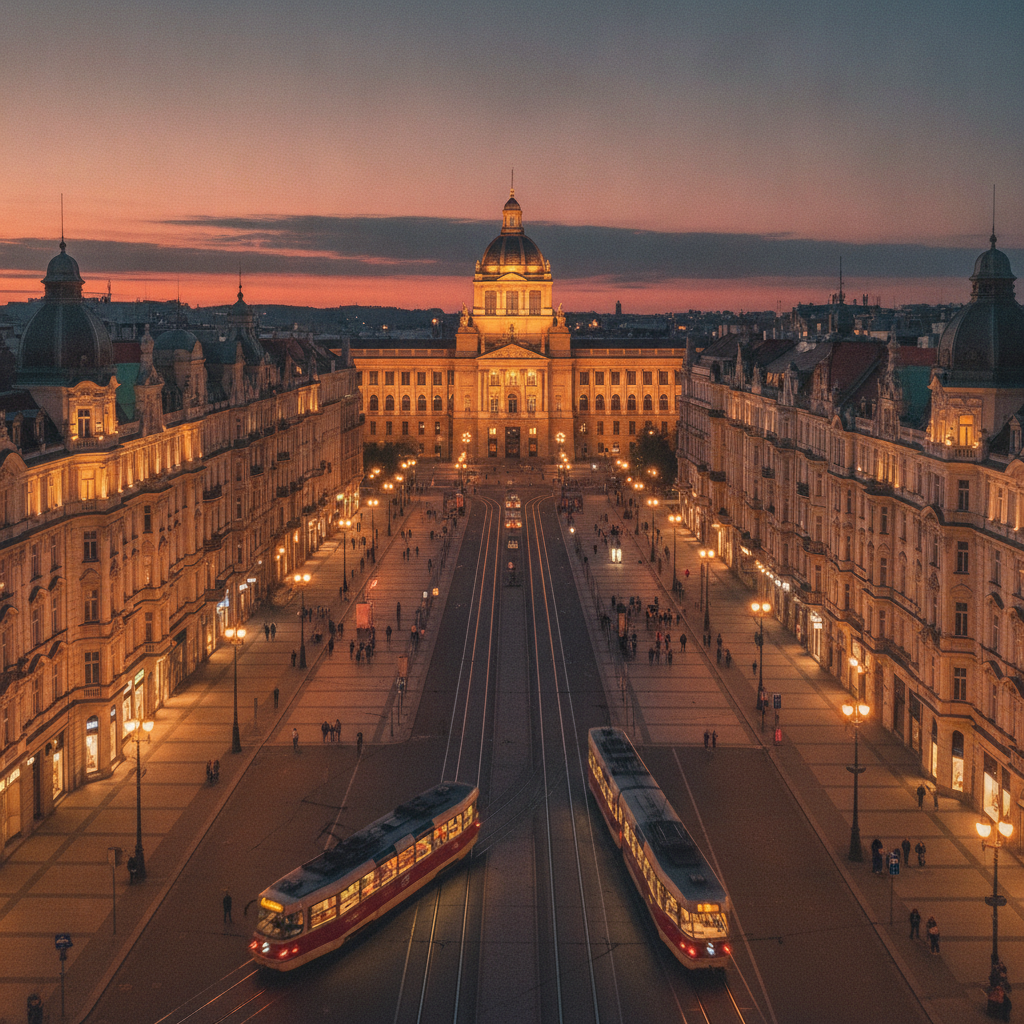
Legend & Sky: Vyšehrad Fortress & the Czech Pantheon
On a rocky bluff above the Vltava, Vyšehrad predates even Prague Castle in legend—said to be the seat of the mythical Czech princess Libuše, who prophesied the founding of Prague. The actual medieval fortress, its Gothic church, and the Slavín Cemetery—where Czech composers, artists, and writers lie buried—make this one of the most atmospheric places in the city, largely free of tourist crowds.
- 1
Vyšehrad Gate
The Táborská Gate and the inner Leopoldova Gate together form the dramatic entrance to the Vyšehrad citadel, built in the 17th century when the medieval fortifications were modernized in Baroque style. The approach through Nusle—Prague's deep valley suburb—already conveys Vyšehrad's unusual character: it sits on a peninsula of rock above a bend in the Vltava, cut off from the surrounding neighborhoods by its walls and the sheer drop to the river on three sides. Inside the gates, the atmosphere shifts instantly from city to fortress—a complete medieval enclave still occupied by a working parish and its thousand-year-old cemetery.
- 2
Basilica of Ss. Peter and Paul
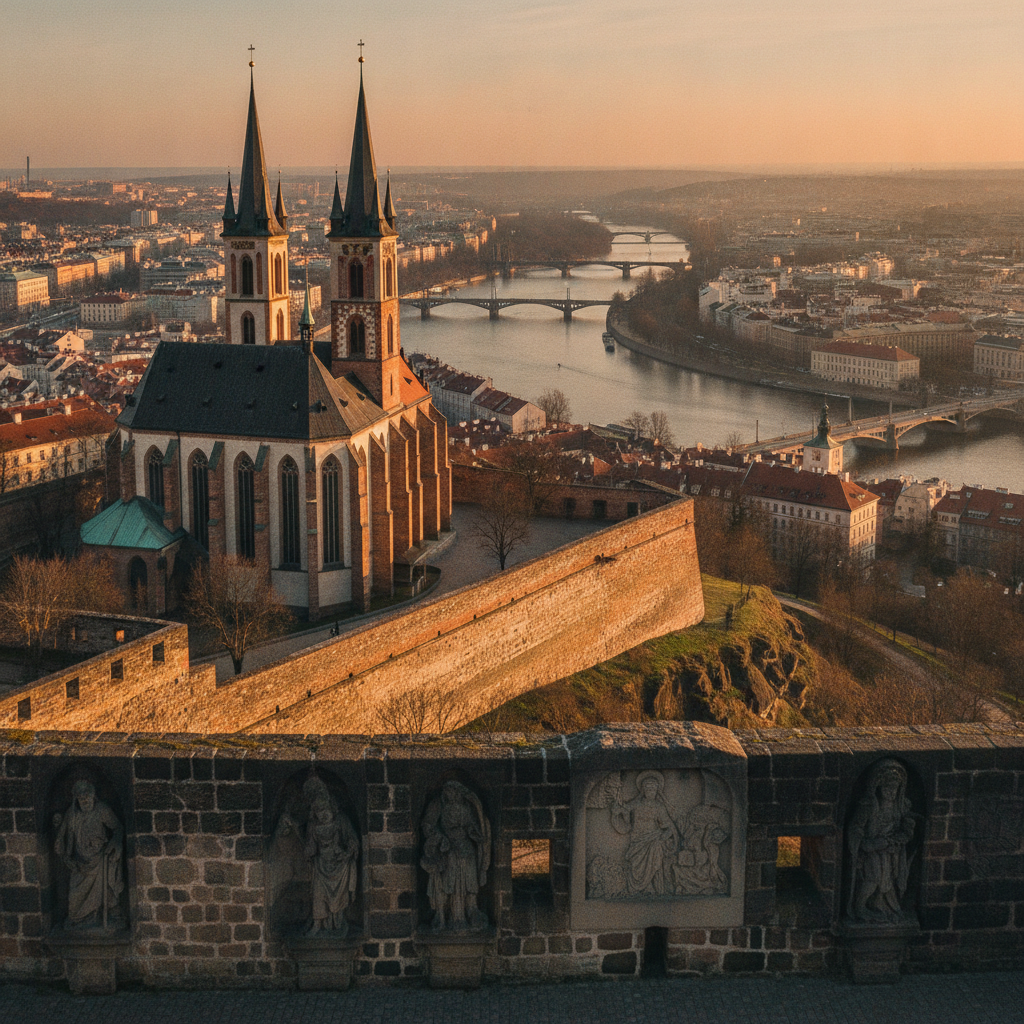
The twin neo-Gothic spires of the Basilica of St. Peter and Paul have dominated the Vyšehrad skyline since their construction in 1902–1903, but a church has stood on this site since at least the 11th century. The current building replaced a Romanesque basilica and a Baroque church, both of which were demolished; archaeologists' excavations beneath the nave have uncovered traces of the earliest medieval structure. The interior is covered in Art Nouveau murals painted by František Ženíšek and others in the early 20th century, creating a dazzling blue and gold atmosphere that is unusual for Prague's typically austere Catholic churches.
- 3
Slavín Cemetery
The Vyšehrad Cemetery, established in 1869 as a burial ground for distinguished Czechs, is one of the most beautiful and moving national cemeteries in Europe. Its most prominent feature is the Slavín monument (1893)—a communal tomb and colonnade where 50 of the most celebrated Czech artists and intellectuals are interred together, including composer Antonín Dvořák and poet Jaroslav Vrchlický. Other graves nearby hold the remains of composer Bedřich Smetana (whose grave is marked by a simple stone surrounded by visitors' flowers), Art Nouveau painter Alfons Mucha, and writer Karel Čapek, who coined the word 'robot.' Walking the cemetery is an intimate encounter with Czech cultural history.
- 4
Vyšehrad Walls & Ramparts
The Baroque fortification walls that encircle Vyšehrad were built in the 1650s–1670s when the Habsburgs modernized the medieval defenses. They form a complete circuit around the rock, with bastions projecting over the river on the western side. The walks along the top of the ramparts offer sweeping views of the Vltava valley—the river below makes a wide bend here, and from the high point of the walls you can see both the castle district to the north and the wooded hills south of the city. The walls are freely accessible and the rampart walk is one of the quietest places in central Prague.
- 5
Libuše's Bath Viewpoint
At the very tip of the Vyšehrad promontory, a rocky outcrop jutting over the Vltava has been called 'Libuše's Bath' since medieval times—named for the legendary Czech princess who supposedly bathed here and who prophesied from this spot that Prague would one day be a city 'whose glory would touch the stars.' Whether or not the legend is historical, the spot is magical: a sheer drop to the river below, the New Town's embankment stretching north, and the hills of Podolí rising to the south. Pairs of stone giants by sculptor Josef Václav Myslbek—representing Czech legendary couples including Libuše and Přemysl—guard the approach to the viewpoint.
- 6
Vyšehrad Park
The interior of the Vyšehrad citadel, beyond the basilica and cemetery, opens into a surprisingly peaceful park with lawns, ancient lime trees, and a rotunda—the 11th-century Romanesque Rotunda of St. Martin, the oldest intact building in Prague, still used occasionally for Catholic services. The park's informal atmosphere, popular with local families and joggers who seem entirely unimpressed by their setting, is a pleasant contrast to the formal grandeur of the monuments nearby. On summer evenings the park fills with students, and the café near the south gate serves cold Pilsner Urquell in the shadow of a thousand years of Czech history.
Walk this route with audio
Stories play automatically as you reach each stop — no tapping needed.
More in prague
The High Ground: Letná Park, Holešovice & Prague's Creative Quarter
Memory & Stone: Prague's Jewish Quarter (Josefov)
Stone Saints & Hidden Gardens: Charles Bridge & Malá Strana
Bohemian Crown: Prague Castle & Hradčany
River & Gardens: Troja Chateau, Prague Zoo & the Wild North