The High Ground: Letná Park, Holešovice & Prague's Creative Quarter
North of the river, Letná Hill offers the most famous panoramic view of Prague from its elevated terrace, while the Metronome that occupies the site of a former Stalin statue has become one of the city's most potent symbols of post-Communist identity. Below, Holešovice has transformed from an industrial warehouse district into Prague's most creative neighborhood, home to the DOX Gallery, a thriving market, and the city's best street food scene.
- 1
Letná Park Viewpoint
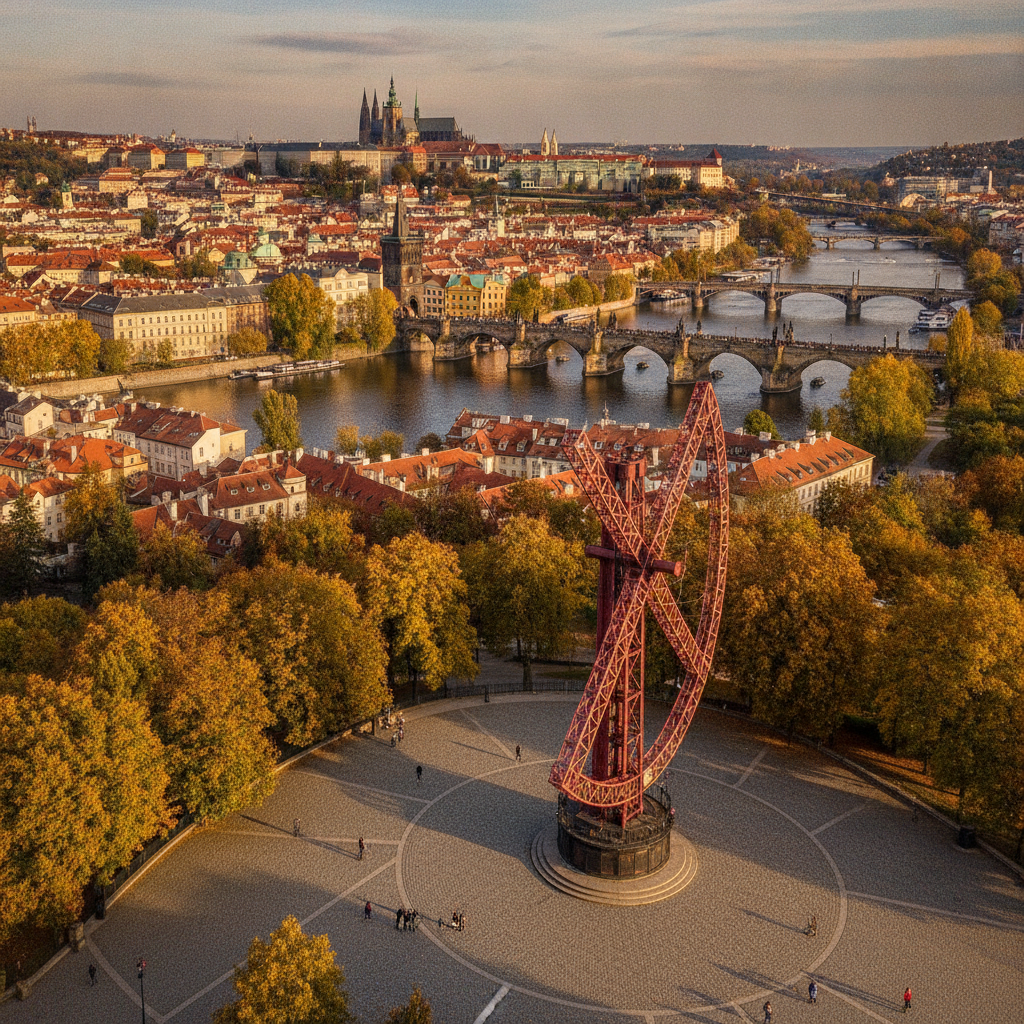
The terrace at the top of the Letná hillside — the Letná Plain — offers what many consider the finest panoramic view of Prague's historic center: looking south across the Vltava bend, you can see the Charles Bridge, the Old Town, the Malá Strana rooftops, and Prague Castle all lined up in a single frame. The viewpoint has a small beer garden that is legendarily popular on warm evenings. The hill itself was the site of the world's largest ever statue of Stalin, a monumental granite figure 15.5 meters tall demolished in 1962 after Khrushchev's de-Stalinization — the empty granite pedestal stood for three decades until the Metronome was installed in 1991.
- 2
Prague Metronome
Installed in 1991 on the empty pedestal where Stalin's statue once stood, the Metronome is a 24-meter-tall kinetic sculpture by sculptor Vratislav Novák that has swung continuously ever since, its pendulum arm visible for miles across the city. The installation was intended as a comment on the passage of time and the impermanence of power — a direct response to the statue it replaced. The Metronome is now one of Prague's most photographed objects, and the area around its base is a popular meeting point for Prague's skateboarding community. Below the pedestal, a Cold War-era tunnel built to shelter the Communist leadership in case of nuclear attack can sometimes be visited on organized tours.
- 3
Stromovka Park
Prague's largest and most ancient park, Stromovka — 'the place of trees' — was a royal hunting ground from the 13th century until Emperor Rudolf II turned it into a public park in the 16th century. Its vast lawns, ancient oaks, and ponds are a favorite weekend destination for Prague families with children, cyclists, and joggers. The park's northern edge borders the Exhibition Grounds (Výstaviště), a historic fairground with Art Nouveau and early Modernist exhibition halls used since 1891, including the enormous Průmyslový palác — the Industrial Palace — a massive iron and glass structure that still hosts trade fairs.
- 4
Prague Market (Holešovice)
The Holešovice Market — Tržnice — is one of the great urban markets of Central Europe, occupying a set of 19th-century industrial warehouse buildings that were built to serve Prague's commercial port on the Vltava. The market was completely reimagined after 2010 as a food, design, and cultural hub, and now hosts weekly farmers' markets, street food festivals, artisan workshops, and weekend flea markets inside its cathedral-like brick halls. The complex is also home to several of Prague's most interesting restaurants and pop-up food concepts. The atmosphere on a Saturday morning, when the farmers' market fills the main hall with Czech produce and homemade preserves, is one of the most convivial in the city.
- 5
DOX Centre for Contemporary Art
The DOX — Centre for Contemporary Art — is Prague's most important private contemporary art museum, housed in a converted factory complex in the heart of Holešovice. Since opening in 2008, DOX has positioned itself as a civic institution as much as a gallery, hosting large-scale international exhibitions alongside Czech contemporary art, architecture shows, public lectures, and a permanent display exploring 20th-century Central European history, including the Nazi occupation and Communist rule. The centerpiece of its permanent collection is the Gulliver Airship — a 42-meter dirigible suspended from the ceiling of the reading room — designed as a public library and meeting space that floats impossibly above the exhibits below.
- 6
Veletržní Palác (National Gallery)
The Trade Fair Palace — Veletržní palác — is one of the great monuments of early Functionalist architecture, built in 1928 for Prague's International Trade Fair and now housing the National Gallery's collection of 20th- and 21st-century Czech and international art. The building's seven-story atrium, flooded with natural light from a roof of glass, is one of the finest interior spaces in Prague. The collection includes Picasso, Klimt, Schiele, and Kupka alongside the most comprehensive survey of Czech modern art anywhere in the world. The permanent display of František Kupka's abstract paintings — he is considered one of the pioneers of abstract art — is alone worth the visit.
Walk this route with audio
Stories play automatically as you reach each stop — no tapping needed.
More in prague
Memory & Stone: Prague's Jewish Quarter (Josefov)
Stone Saints & Hidden Gardens: Charles Bridge & Malá Strana
Bohemian Crown: Prague Castle & Hradčany
River & Gardens: Troja Chateau, Prague Zoo & the Wild North
Legend & Sky: Vyšehrad Fortress & the Czech Pantheon