Pittsburgh R4: Oakland (Cathedral of Learning 42-story tallest educational Western Hemisphere, 30 Nationality Classrooms, Phipps Conservatory 1893 LEED Platinum, Schenley Park Mary Schenley 1889), Steelers dynasty (Chuck Noll 4 Super Bowls 1974 draft greatest in NFL history, Steel Curtain, Immaculate Reception 1972, Terrible Towel 1975, Yinzer Pittsburghese yinz jagoff), Penguins (Lemieux lymphoma 1993 hatrick 3 days after radiation, saved team from bankruptcy 1999, Crosby 3 Stanley Cups 2010 Olympic golden goal), Pittsburgh bridges 446 (Three Sisters self-anchored unique trio, Fort Pitt Tunnel arrival greatest urban moment, bridge engineering CMU Pitt), Roberto Clemente (18 seasons .317 BA 12 Gold Gloves 3,000 hits, died December 31 1972 Nicaragua earthquake relief, Hall of Fame 1973 no waiting period, MLB 21 retired league-wide 2023), Pittsburgh today (Google Duolingo 500M users von Ahn CMU, median home USD 200-250K affordable, carbon neutrality 2030 commitment)
Pittsburgh R4: Oakland district (Cathedral of Learning 42 stories tallest educational Western Hemisphere, 30 Nationality Classrooms immigrant communities, Phipps Conservatory 1893 Henry Phipps Jr LEED Platinum expansion, Schenley Park 456 acres Mary Schenley 1889 donation), Steelers dynasty (Chuck Noll 4 Super Bowls most coached NFL, 1974 draft greatest in NFL history Swann Lambert Stallworth Webster, Steel Curtain, Immaculate Reception December 23 1972, Terrible Towel Myron Cope 1975, Yinzer dialect yinz n'at jagoff), Penguins (Lemieux lymphoma 1993 hatrick 3 days post-radiation, purchased bankrupt team 1999 USD 32.5M equity, Crosby 3 Cups 2010 golden goal most watched Canadian TV), bridges (446 more than any world city, Three Sisters only matching trio self-anchored suspension bridges world, Fort Pitt Tunnel best urban arrival experience), Roberto Clemente (.317 12 Gold Gloves 3,000 hits, died December 31 1972 Nicaragua relief crash, HOF 1973 no waiting period, MLB 21 retired league-wide 2023), Pittsburgh today (Google Duolingo 500M von Ahn CMU, median home USD 200-250K, carbon neutral 2030 industrial city redemption arc).
- 1
Oakland - Pittsburgh's University and Museum District
Oakland (the neighborhood approximately 3 km east of downtown Pittsburgh, centered on Forbes and Fifth Avenues): Pittsburgh's intellectual and cultural center, home to the University of Pittsburgh, Carnegie Mellon University, the Carnegie Museums complex, the Phipps Conservatory, and the UPMC medical complex. The Cathedral of Learning (at 4200 Fifth Avenue, University of Pittsburgh, completed 1937): the 42-story Gothic Revival tower designed by Charles Klauder, the tallest educational building in the Western Hemisphere and the second-tallest educational building in the world (after St. Petersburg State University's main building). The 163-meter tower is the central landmark of the University of Pittsburgh campus and houses classrooms, faculty offices, and the 30 Nationality Classrooms — each room designed and furnished in the architectural style of a different nation (with contributions from the respective national communities of Pittsburgh): the Albanian, Armenian, and the 28 other rooms were donated by Pittsburgh immigrant communities between 1938 and the present. Phipps Conservatory and Botanical Gardens (at 1 Schenley Drive, Oakland, built 1893 for the Pittsburgh International Exposition by philanthropist Henry Phipps Jr.): one of the most significant Victorian-era glass conservatories in the United States, with 23 rooms and exhibition galleries displaying tropical plants, orchids, and seasonal flower shows, recently expanded with LEED Platinum sustainable facilities. Schenley Park (the 456-acre public park adjacent to Oakland): the park donated to the city of Pittsburgh in 1889 by Mary Schenley (a Pittsburgh heiress who married a British army officer and lived in London, donating the land upon being convinced that Pittsburgh was about to seize it by eminent domain), with tennis courts, baseball fields, a swimming pool, and the Schenley Park Skating Rink.
- 2
The Pittsburgh Steelers Dynasty and Yinzer Culture
The Pittsburgh Steelers dynasty: the Pittsburgh Steelers won more Super Bowl championships (6) than any other franchise in NFL history, with championship eras spanning five decades. The Chuck Noll era (1969-1991): the most successful coaching tenure in NFL history by total championships (4 Super Bowls: IX, X, XIII, XIV), built on the 1974 draft (the greatest draft class in NFL history, selecting Lynn Swann, Jack Lambert, John Stallworth, and Mike Webster in the same year). The Steel Curtain defense (1974-1979): the defensive unit of Mean Joe Greene, Jack Ham, Jack Lambert, Mel Blount, and Donnie Shell — one of the greatest defenses in professional football history. The Immaculate Reception (December 23, 1972): Franco Harris' catch of a deflected pass that fell off Raiders linebacker Jack Tatum's helmet (or possibly Steelers receiver Frenchy Fuqua's shoulder — the controversy has never been definitively resolved) to score the winning touchdown in the AFC divisional playoff: the most controversial and celebrated play in NFL history. Yinzer culture: the Pittsburgh cultural identity, marked by the distinctive Pittsburgh dialect (Pittsburghese, characterized by the terms yinz (plural you, from you ones), n'at (and that, used as a filler), jagoff (a term of mild contempt), and the unique Pittsburgh vocabulary that has been extensively studied by linguists as one of the most distinctive American regional dialects). Pittsburgh Steelers fans in the stands wearing Terrible Towels (the yellow rally towel invented by Pittsburgh radio broadcaster Myron Cope in 1975): the most recognizable fan accessory in NFL history, with the Steelers fan base (concentrated in western Pennsylvania but spread worldwide by the Pittsburgh diaspora of former steel workers and their descendants) being one of the most geographically dispersed NFL fan bases.
- 3
Pittsburgh Penguins and Ice Hockey Culture
Pittsburgh Penguins NHL (playing at PPG Paints Arena, 1001 Fifth Avenue, downtown Pittsburgh): the NHL franchise with 5 Stanley Cup championships (1991, 1992, 2009, 2016, 2017), including the back-to-back championships of 2016 and 2017 under coach Mike Sullivan and captain Sidney Crosby. Mario Lemieux (born October 5, 1965, Montreal; playing career 1984-2006 with Pittsburgh): the most gifted scorer in NHL history (many hockey historians rank Lemieux above even Wayne Gretzky in pure skill), who was diagnosed with Hodgkin lymphoma in January 1993 (during his most productive scoring season), underwent radiation treatments while continuing to play, and returned 3 days after completing radiation treatment to score a hat trick and 3 assists in a single game — one of the most dramatic moments in NHL history. Lemieux later purchased the Penguins (in 1999, when the team was in bankruptcy, converting his USD 32.5 million in salary owed to him by the bankrupt team into equity ownership) and saved the franchise from relocation. Sidney Crosby (born August 7, 1987, Cole Harbour, Nova Scotia): the Pittsburgh Penguins captain since 2007, considered by many the greatest hockey player of his generation, with 3 Stanley Cup championships, 2 Olympic gold medals (2010 and 2014), and the most complete skill set in NHL history (exceptional skating, shooting, passing, faceoffs, and defensive play). Crosby scored the golden goal in overtime at the 2010 Vancouver Olympics, the most watched moment in Canadian television history. Ice hockey culture in Pittsburgh: Pittsburgh has one of the strongest hockey cultures of any American city, with multiple youth hockey programs and PPG Paints Arena consistently selling out for Penguins games.
- 4
Pittsburgh Bridges and Engineering Heritage
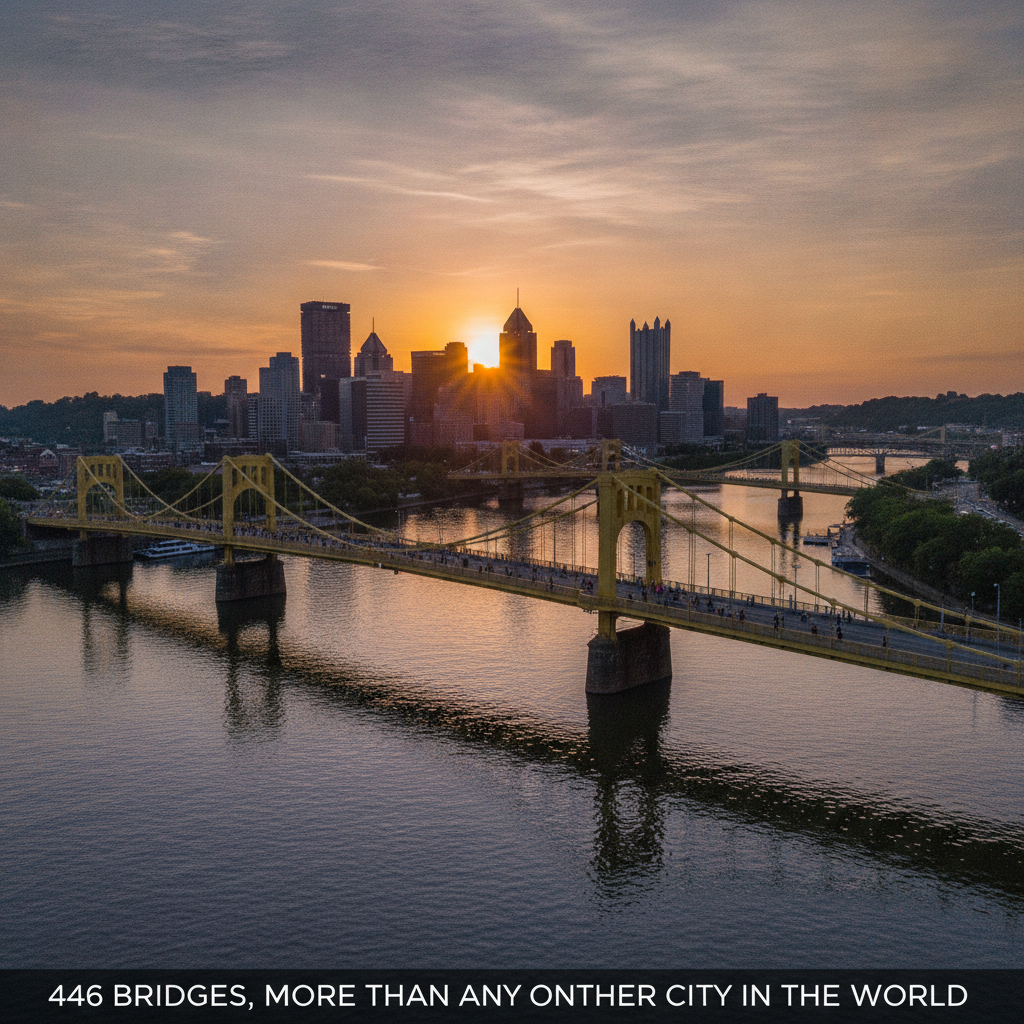
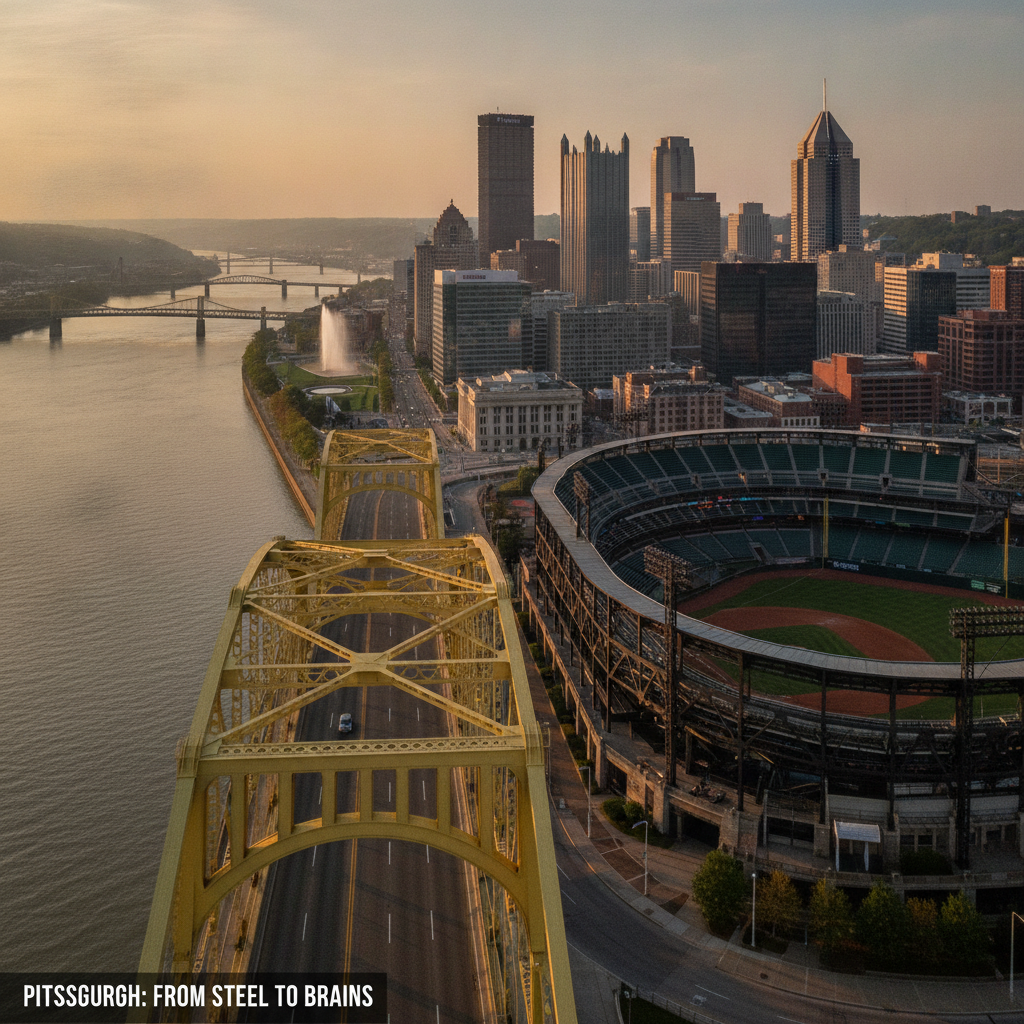
Pittsburgh's 446 bridges: the claim that Pittsburgh has more bridges than any other city in the world (more than Venice, Italy, which has approximately 400 bridges) is a matter of civic pride and has been disputed (the comparison depends on whether you count all public vehicular and pedestrian bridges in the Pittsburgh city limits, which would include small creek crossings), but Pittsburgh unquestionably has an extraordinary concentration of bridge types and engineering solutions. The Pittsburgh bridge typology: the Self-Anchored Suspension bridge (the Andy Warhol Bridge / 7th Street Bridge, built 1926-1928): one of only a handful of self-anchored suspension bridges in the United States, where the cables are anchored to the bridge deck itself rather than to massive anchor blocks, allowing the bridge to be built without anchor blocks on the riverbank. The Roberto Clemente Bridge (6th Street Bridge, completed 1928): the most visually dramatic of the three matching cantilever through truss bridges (the Three Sisters, the only trio of matching self-anchored suspension bridges in the world) connecting downtown Pittsburgh to the North Shore. The Fort Pitt Bridge (completed 1959): the through-arch bridge carrying Interstate 376 through the Fort Pitt Tunnel (the tunnel bored through Mount Washington) to emerge dramatically at the Point, with the view of the Pittsburgh skyline from the tunnel exit regarded as one of the great urban arrival experiences in the world. Pittsburgh engineering education: the Carnegie Mellon Civil and Environmental Engineering Department and the University of Pittsburgh Swanson School of Engineering together form one of the premier civil engineering research programs in the United States, with particular expertise in bridge inspection, structural health monitoring, and infrastructure resilience.
- 5
Roberto Clemente and Pittsburgh Sports Heroes
Roberto Clemente (born August 18, 1934, Carolina, Puerto Rico; died December 31, 1972, off the coast of Puerto Rico): the Pittsburgh Pirates right fielder who is universally regarded as the greatest Puerto Rican player in baseball history and one of the greatest humanitarian athletes of the 20th century. Clemente's baseball career: 18 seasons with the Pittsburgh Pirates (1955-1972), 12 Gold Glove Awards (the most for any outfielder in National League history), 4 batting titles, 3,000 career hits (he became the 11th player to reach 3,000 hits on the last day of the 1972 regular season — the hit that would be his last), a .317 career batting average, and the 1966 National League Most Valuable Player Award. Clemente's death: on December 31, 1972, Clemente boarded a DC-7 cargo plane loaded with relief supplies for earthquake victims in Nicaragua (a 6.2 magnitude earthquake had struck Managua on December 23, 1972, killing approximately 6,000 people); the plane crashed into the Atlantic Ocean shortly after takeoff from San Juan. All 5 people aboard were killed. The Baseball Hall of Fame waived its 5-year waiting period and inducted Clemente immediately (in 1973), only the second player to be inducted posthumously without the waiting period. Major League Baseball permanently retired the number 21 in Clemente's honor in 2023 (the first number retired league-wide since Jackie Robinson's 42). The Roberto Clemente Bridge (renamed from the 6th Street Bridge in 1999): the symbol of Pittsburgh's Latino heritage and the most beloved of the Three Sisters bridges.
- 6
Pittsburgh Today - Tech Hub and Quality of Life
Pittsburgh as a 21st century city: Pittsburgh has been repeatedly cited by national publications as one of the most livable, affordable, and up-and-coming cities in the United States, with Economist Intelligence Unit and other livability indices consistently ranking it among the top American cities for quality of life relative to cost of living. The Pittsburgh tech ecosystem: beyond autonomous vehicles (Uber ATG, Waymo, Aurora), Pittsburgh is home to major technology operations of Google (Google Pittsburgh, at 6425 Penn Avenue, Bakery Square, Larimer), Microsoft, Apple, Facebook AI Research (FAIR), Amazon, and Duolingo (the language learning app founded in 2011 by Carnegie Mellon professor Luis von Ahn, who also invented CAPTCHA and reCAPTCHA, now with over 500 million registered users worldwide). The Pittsburgh housing market: Pittsburgh is one of the most affordable major cities in the United States for home ownership, with median home prices of approximately USD 200,000-250,000 (compared to USD 700,000+ in comparable coastal cities), making it one of the few American cities where a professional income allows comfortable home ownership in desirable urban neighborhoods. The Pittsburgh 2040 plan: the City of Pittsburgh adopted a comprehensive climate action plan (the Pittsburgh Climate Action Plan, adopted 2018, updated 2022) committing to carbon neutrality by 2030 — one of the most ambitious climate commitments of any American city, driven in part by Pittsburgh's historical identity as a polluted industrial city and the desire to claim the opposite identity as a clean, sustainable 21st-century city. Pittsburgh as a cultural destination: Pittsburgh hosts the largest outdoor music festival in western Pennsylvania (the Pittsburgh Three Rivers Arts Festival), the Carnegie International (the oldest contemporary art exhibition in the US), and the Pittsburgh Symphony Orchestra's summer series at Hartwood Acres.
Walk this route with audio
Stories play automatically as you reach each stop — no tapping needed.
More in pittsburgh
Pittsburgh: Steel legacy (446 bridges most in world, Carnegie Steel to US Steel 1901, 150,000 jobs lost 1979-1988, Homestead Strike 1892), Mount Washington inclines (Duquesne Incline 1877, Monongahela 1870 oldest continuous, Golden Triangle view three rivers confluence, Point State Park Fort Pitt 1758), Carnegie Museums (Natural History Diplodocus carnegii, Mary Cassatt Impressionist born Allegheny City, Andy Warhol Museum 900 works Campbell's Soup Marilyn Elvis), Pittsburgh sports (Steelers 6 Super Bowls Steel Curtain Immaculate Reception, Penguins 5 Stanley Cups Crosby, Pirates Mazeroski 1960 walk-off HR, PNC Park most beautiful stadium), Strip District and food (Primanti Brothers 1933 fries-in-sandwich, Pennsylvania Macaroni 1902, pierogi Pierogi Race Pirates), Practical (CMU computer science drama, Cathedral of Learning 42 stories tallest educational Western Hemisphere, autonomous vehicles Uber Waymo, Fallingwater 90km Fallingwater masterpiece)
Pittsburgh R2: Neighborhoods (Squirrel Hill Tree of Life shooting October 2018 deadliest US antisemitic attack, Lawrenceville craft beer arts gentrification, Mexican War Streets Victorian), Rust Belt recovery (UPMC 92,000 employees USD 26B largest PA employer, CMU UM 55,000 students USD 3B, robotics Uber ATG Argo AI Aurora), Three Rivers outdoor (Heritage Trail 45km, Three Rivers Regatta largest free inland, Ohiopyle Class III-IV rapids Yough), Pittsburgh history (Fort Duquesne 1754 French Indian War George Washington first mission, Forbes captures 1758 Fort Pitt, Frick Westinghouse Mellon Gilded Age, Richardson Courthouse 1888 greatest 19th century American architecture), Warhol and arts (7-story museum Silver Clouds Time Capsule 600 boxes, Benedum Center Stanley Theater 1987, Pittsburgh Glass Center largest public US, Pittsburgh Symphony Orchestra), Practical (T light rail free downtown, PIT airport 1992 most advanced, 160-165 sunny days cloudiest major US city, Three Rivers Arts Festival 300,000 June)
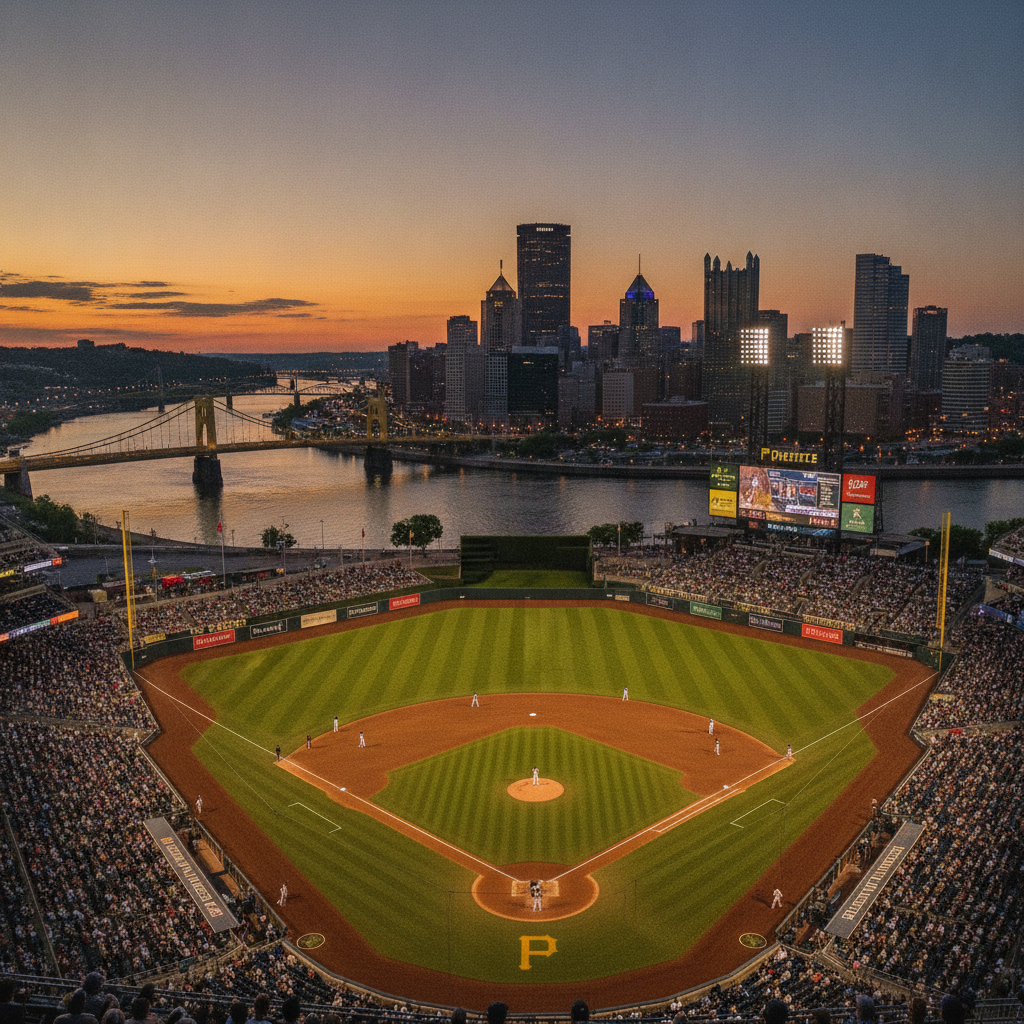
Pittsburgh: Fallingwater in the Forest, Glass Hothouses and the City That Reinvented Itself
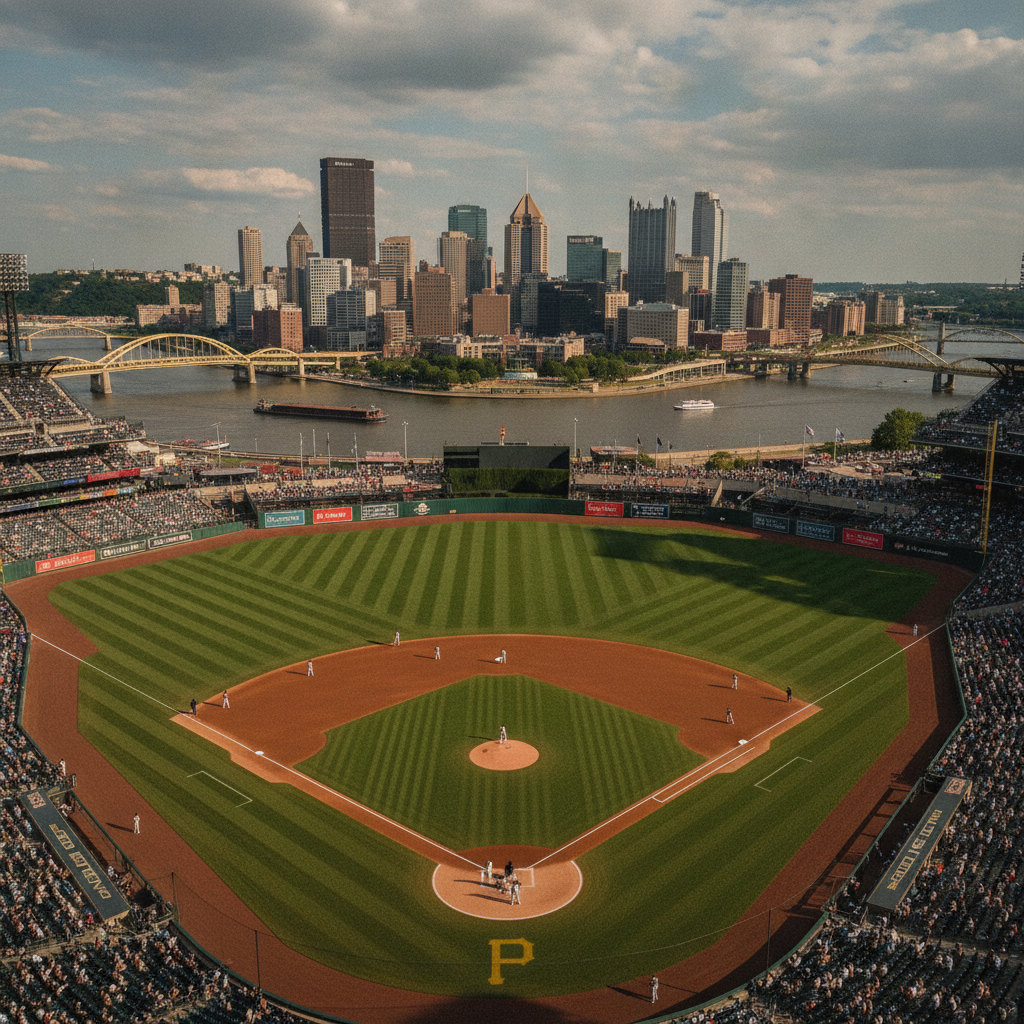
Pittsburgh: Six Super Bowls, Diplodocus Given to Kings and Fries Inside the Sandwich
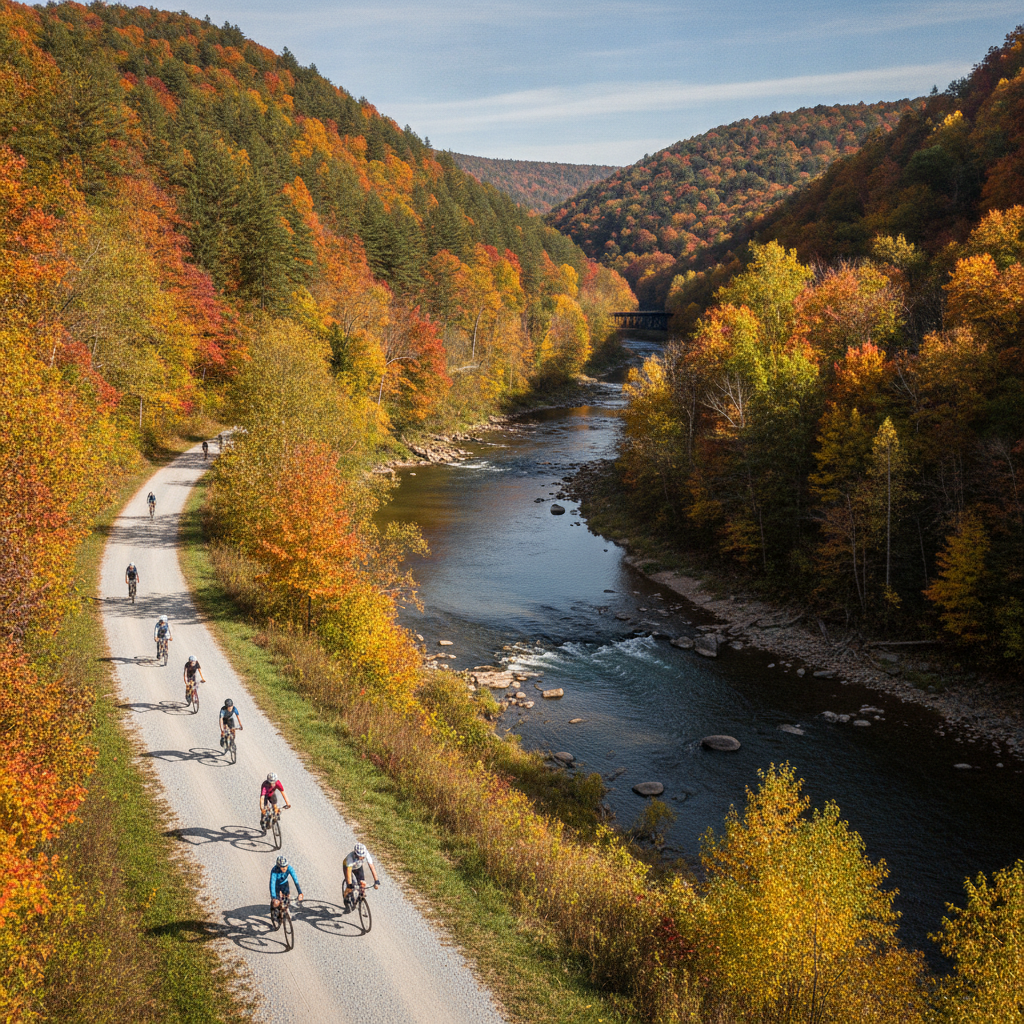
Pittsburgh: 446 Bridges, August Wilson Pulitzers and 335 Miles Car-Free to Washington DC