Phuket's Hidden Depth: Tin Miners' Shophouses, Body-Piercing Vegetarian Festival & Ko Phi Phi's Overcrowding Crisis
Beyond the beach—Phuket's Hokkien tin-mining families who arrived in the 17th century, built Sino-Portuguese mansions from cassiterite wealth, and still dominate the island's commercial life, the Nine Emperor Gods Vegetarian Festival where spirit mediums pierce their cheeks with steel swords while in trance (no equivalent in mainland China), Ko Phi Phi's Maya Bay receiving 5,000 visitors per day before closure and rehabilitation, the Russian tourism wave that put Cyrillic menus in Patong (then collapsed in 2022), elephant sanctuary ethics in a space-constrained island context, and the Phang Nga Bay boat trip economy's unequal distribution between tour operators and bay communities.
- 1
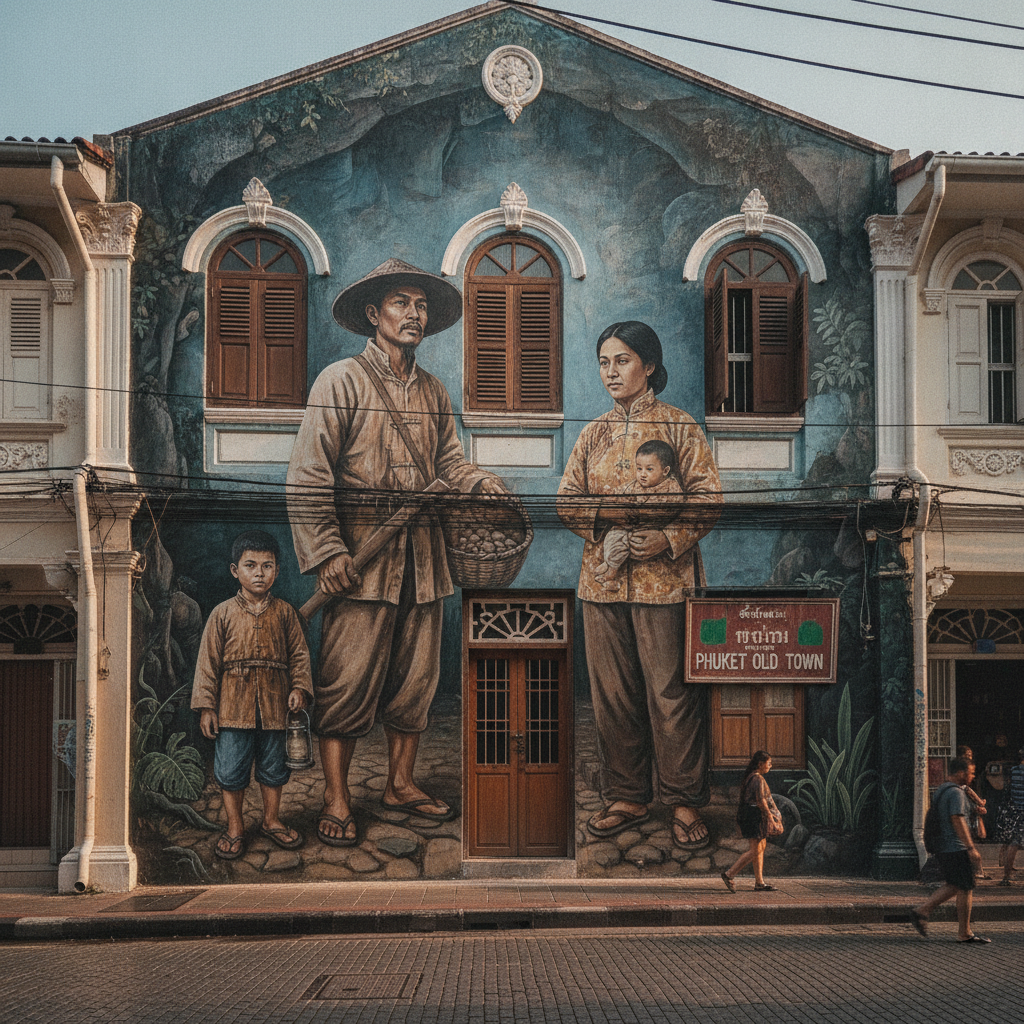
Phuket's Tin Mining History – The Industry That Built the Island
Phuket's modern history is inseparable from tin—the metal that drove the island's economic development from the 16th century until the collapse of global tin prices in 1985. Tin ore (cassiterite) was found in Phuket's granite bedrock and alluvial deposits in vast quantities; the Portuguese noted the tin trade when they reached the Malay Peninsula in the early 16th century. The mining operation was built primarily on the labour of Chinese (principally Hokkien) immigrants who arrived in waves from the 17th century onward, eventually becoming the economic and social elite of the island—the Phuket Chinese community today remains one of the most influential in southern Thailand. The technology evolved from hand-digging to hydraulic gravel pumps (introduced by European mining companies in the late 19th century) to dredges (floating tin dredges operating in the estuaries and coastal shallows—some dredge ponds are still visible in the Thalang and Kathu areas). When the world tin price collapsed in 1985, Phuket's economy had already diversified significantly into tourism, but the mining families' wealth and the Sino-Portuguese architectural legacy remained.
- 2
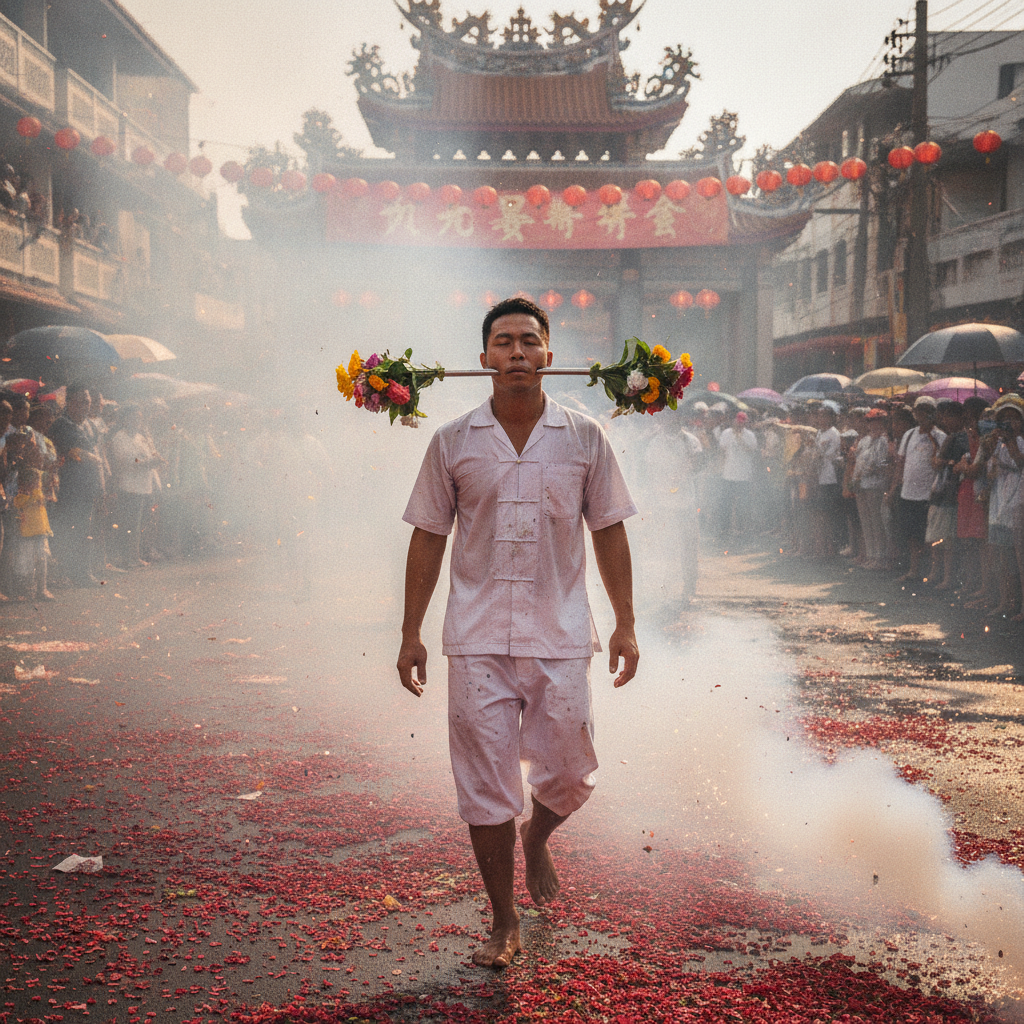
The Vegetarian Festival – Nine Emperor Gods & Body Piercing
Phuket's Chinese Vegetarian Festival (Tesagan Gin Je)—held annually for nine days during the ninth lunar month (September–October, exact dates varying)—is one of Southeast Asia's most extraordinary religious spectacles and the most important event in Phuket Town's Chinese community calendar. The festival honours the Nine Emperor Gods (the stars of the Ursa Major constellation in Chinese cosmology); devotees abstain from meat, alcohol, and sexual activity for purification. The public rituals—which have no direct precedent in mainland Chinese religious practice but developed locally in Phuket's distinctive Hokkien community—include ma song (spirit mediums who enter trance and pierce their bodies with steel skewers, swords, axes, and other implements without apparent pain or bleeding), fire-walking, and processions of firecracker-shrouded palanquins carrying deity statues. The festival is centred on the Chinese shrines of Phuket Town (Jui Tui Shrine, Bang Niaw Shrine, Put Jaw Shrine) and draws large crowds of Thai and foreign observers alongside the participant community.
- 3
Ko Phi Phi – Paradise Island & Its Overpopulation Crisis
Ko Phi Phi Don—the larger of the two Phi Phi Islands, 40 km southeast of Phuket in the Krabi province waters—became one of Southeast Asia's most iconic beach destinations after the 2000 film The Beach (starring Leonardo DiCaprio, filming location: the adjacent Ko Phi Phi Leh's Maya Bay) exposed it to global attention. The island: two mountain masses connected by a narrow sand isthmus (the 'twin bays' of Ton Sai and Loh Dalam, each facing opposite directions), surrounded by turquoise water and dramatic karst cliffs. By 2019, Maya Bay was receiving 5,000+ visitors per day, severely degrading the coral ecosystem; the Thai government closed it for rehabilitation (June 2018–October 2022), reopening with visitor limits of 300 per hour and motorboat exclusion. Ko Phi Phi Don itself receives 15,000+ day-visitors daily at peak season (December–February), creating waste, crowd, and environmental pressure on an island with no vehicle access, limited freshwater, and a population of 3,000 permanent residents.
- 4
Phuket's Russian Community & Tourism Demographics
Phuket's tourism demographics have shifted dramatically since 2010: Russian visitors—who discovered Phuket in large numbers from the mid-2000s, initially attracted by direct charter flights from Moscow and St Petersburg and the Russian-speaking infrastructure that developed to serve them—became the largest single national group of visitors by the early 2010s, fundamentally changing the social character of the Patong and Kata areas (Russian-language restaurant menus, Cyrillic signage, Russian-owned businesses). The Russian visitor numbers collapsed following the 2022 invasion of Ukraine and the subsequent international flight disruptions; the gap was partially filled by Indian tourists (Phuket is now one of the most popular overseas destinations for Indian travellers, especially from Mumbai and Delhi), Chinese visitors (surging before the pandemic, recovering slowly since), and a sustained base of European (British, German, Scandinavian) and Australian visitors. The shifting demographics reflect Phuket's sensitivity to geopolitical events and the ease with which mass-market beach tourism reallocates itself across global nationality pools.
- 5
Phuket's Elephant Camps & Wildlife Ethical Considerations
Phuket's elephant tourism industry—concentrated in camps in the Thalang and Kathu areas of the island's interior—has been subject to the same ethical evolution as Chiang Mai's, though starting from a lower baseline. The compact geography of Phuket (the island is 50 km long, 21 km wide, with significant areas already developed for tourism) means that elephants are kept in smaller areas with less range than their mainland counterparts; the rides-versus-sanctuary debate plays out in a more space-constrained environment. The shift to 'no-ride' sanctuaries has progressed significantly since 2017: the Elephant Jungle Sanctuary (Phuket branch—opened 2016), Elephant Hills (luxury camp with conservation focus), and several other operators have moved to interaction-only models. The Thai Elephant Conservation Centre (the government-run facility in Lampang, northern Thailand) represents the gold standard of elephant welfare in Thailand; Phuket operations are generally assessed against this benchmark.
- 6
The James Bond Island Boat Trip & the Tourism Economy
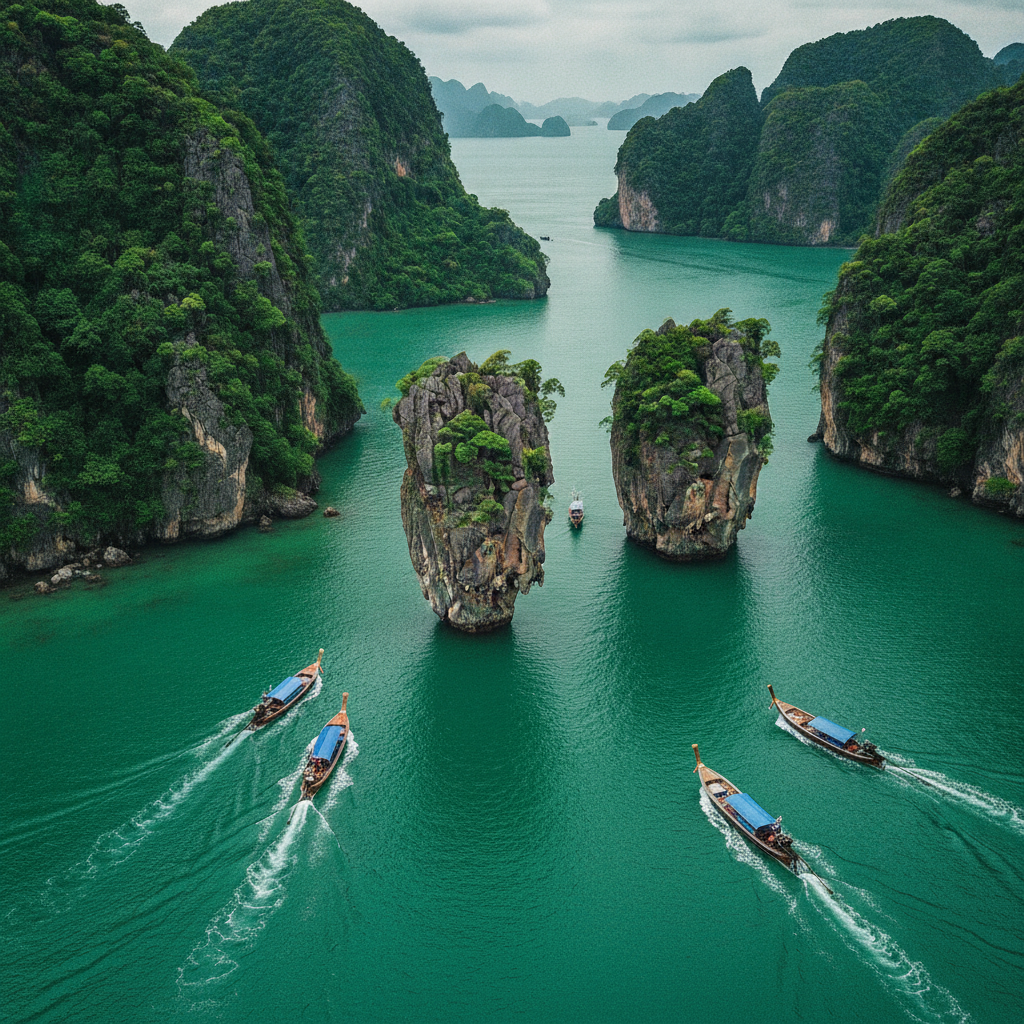
The Phang Nga Bay day trip from Phuket—offered by hundreds of tour operators in every price bracket, from ₹1,200 baht/€33 budget speedboat to ₹6,000 baht/€164 luxury private charter—is the island's most popular day excursion and a useful case study in how mass tourism distributes and degrades natural sites. James Bond Island receives approximately 3,000–4,000 visitors on busy days despite being a small limestone pinnacle with no beach; the surrounding bay's water quality has declined from boat traffic, anchor damage, and waste from tour operators. The economic structure: the boat trip is an anchor product for the Phuket tourism economy (boat operators, guides, souvenir vendors at Ko Panyi, restaurant operators serving the lunch stop), but the revenue flows largely to the private tour operators rather than to the Phang Nga Bay communities most affected by the environmental impact. The sea kayaking operators (John Gray's Sea Canoe—the pioneer, operating since 1989; Sea Canoe Thailand) offer a smaller-scale, lower-impact alternative focused on the hong lagoons.
Walk this route with audio
Stories play automatically as you reach each stop — no tapping needed.
More in Phuket
Phuket's Lesser-Known Faces: Khao Lak's Police Boat Tsunami Memorial, Gibbons in the Last Forest & Sailing the Andaman
Phuket Complete: Phang Nga Bay's James Bond Island, Sino-Portuguese Old Town & the Andaman Sea's Leopard Sharks
Phuket's Identity: The Hokkien Heroines of 1785, Hi-So Surin Beach & the Island That Contains All Contradictions
Phuket's Other Side: Big Buddha Views, Southern Thai Khao Yam & the Amanpuri Resort That Defined Luxury Tourism