Phnom Penh's Depth: The Mekong Flood Pulse That Feeds 11 Million People, 90 Years of French Colonial Architecture & the Cambodian Cinema Archive Burned by the Khmer Rouge
The Tonle Sap's dai fish traps capturing the concentrated fish from a flood pulse that expands the lake from 2,500 to 14,000 km²—a system feeding Cambodians for 2,000 years now threatened by Chinese and Laotian hydropower dams; Raffles Le Royal where Jacqueline Kennedy stayed in 1967 and where the last correspondents sheltered in April 1975 as the Khmer Rouge entered; Rithy Panh's Bophana Center archiving the 300 pre-1975 Cambodian films whose prints were almost entirely destroyed by the regime; the Udong hilltop monastery with 200 monks descending at 05:30 for food offerings from the village; and the 400-metre-wide river at the Phnom Penh confluence with no bridge crossing creating the most dramatic urban river sunset in mainland Southeast Asia.
- 1
Wat Phnom – The Hill Temple That Founded a Capital
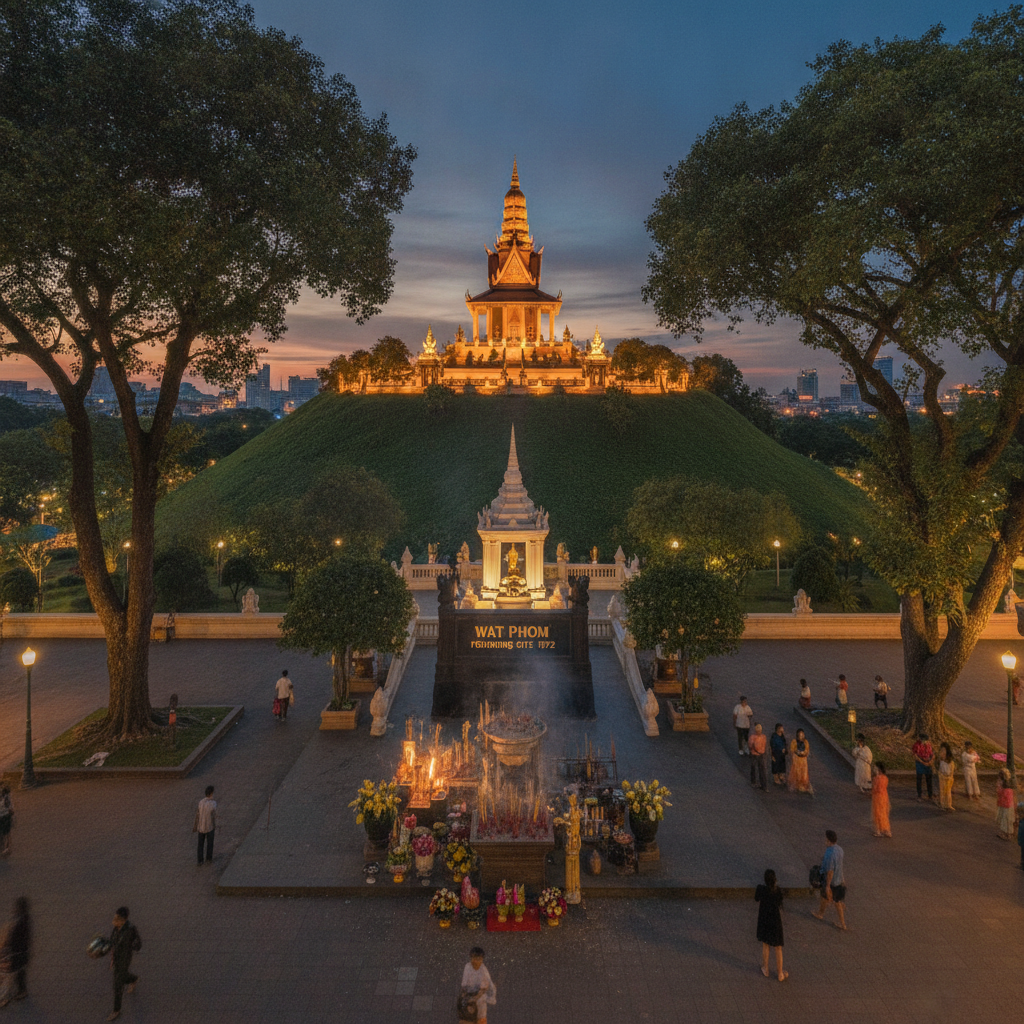
Wat Phnom (the 'Mountain Pagoda'—a 27-metre artificial hill in the north of the city centre; the temple that, according to Cambodian legend, marks the founding of Phnom Penh as a city) is the oldest religious site in Phnom Penh and the nominal reason for the city's existence. The founding legend: in 1372, a wealthy widow named Daun Penh found four bronze statues of the Buddha (and one of Vishnu) washed ashore in a floating tree from the Mekong River; she ordered the hill built to house the statues and a sanctuary constructed on its summit—the community that grew up around the shrine became Phnom Penh ('Hill of Penh'). The current structure: the temple on the summit of the hill (rebuilt multiple times—the current structure dates from 1926) houses a large reclining Buddha and the shrine of Preah Chau (the Chinese guardian deity also worshipped here—reflecting the historical Chinese community of Phnom Penh). The spirit shrine: the shrine to Daun Penh herself (a small structure at the base of the hill's eastern staircase) receives the most active daily offerings of any shrine in the city—flowers, incense, fruit, and small ceramic pigs (the traditional offering to Daun Penh, believed to grant wishes, especially for business success and fertility). The urban park: the hill sits in a small landscaped park (the most central green space in Phnom Penh) that serves as a morning exercise ground, evening promenade, and the natural navigational centre of the city—'north of Wat Phnom' and 'south of Wat Phnom' are the primary orientation markers of the city grid.
- 2
The Mekong & the Cambodian Fishing Tradition
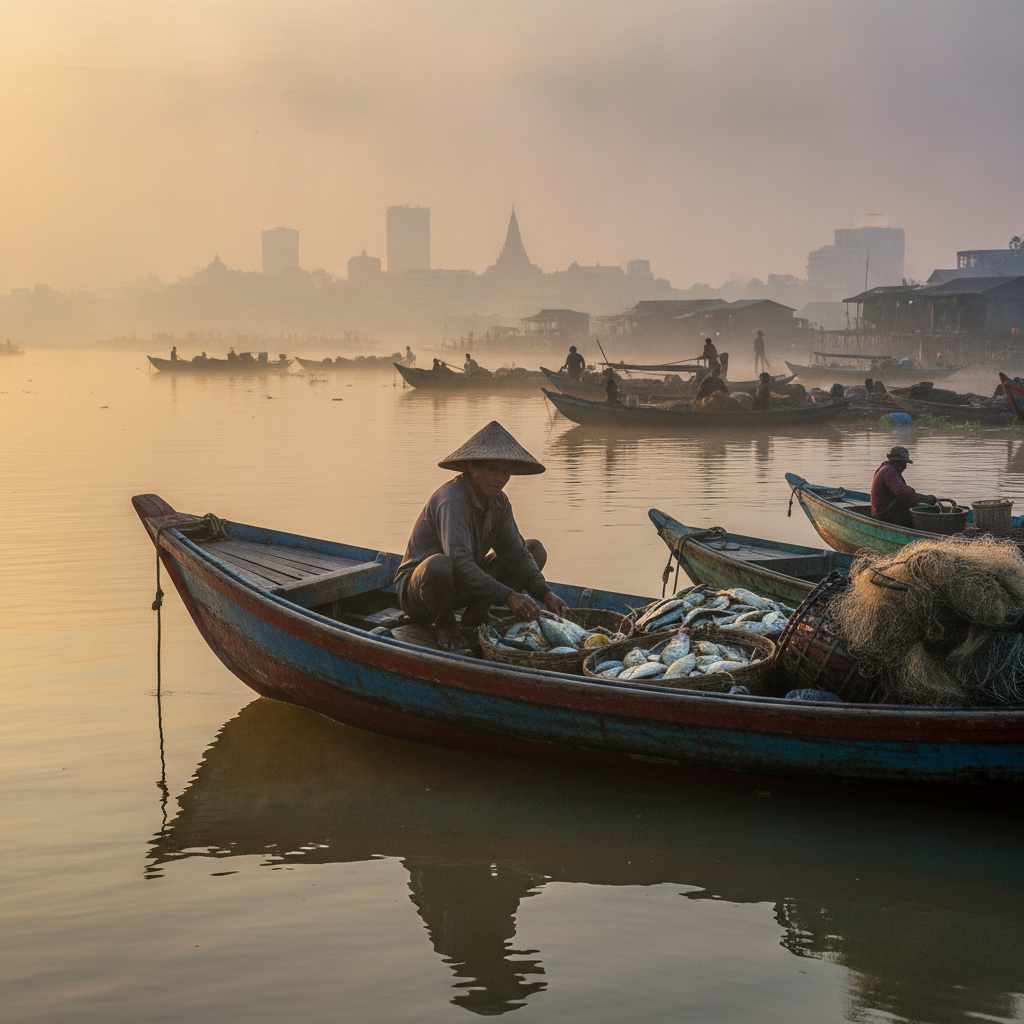
Cambodia's relationship with the Mekong River and the Tonle Sap Lake system—the world's largest inland fishery, producing approximately 500,000 tonnes of wild-caught fish annually (approximately 60% of the animal protein consumed by Cambodians)—is the most fundamental ecological and economic fact of Cambodian life. The fishery: the Tonle Sap Lake (expanding from 2,500 km² in the dry season to 14,000 km² in the flood season) is the most productive inland fishery in the world per unit area: the annual Mekong flood deposits nutrients on the lake's floodplain, the receding water concentrates fish in the shrinking lake, and the traditional dai (large fixed traps in the Tonle Sap River between the lake and Phnom Penh) capture the concentrating fish—a system that has fed the Cambodian population for at least 2,000 years. The fish paste: prahok (fermented fish paste—the most important flavouring ingredient in Cambodian cooking, produced from the glut of small fish captured during the flood season, fermented and salt-preserved in large earthenware jars for use throughout the year; the smell is intense and its absence from a Khmer meal is immediately noticeable to Cambodians)—is made from fish caught in this system. The hydropower threat: the upstream Mekong dams (11 dams planned or built in China, 2 operational in Laos—Xayaburi and Don Sahong—with more under construction) are reducing the Mekong's flood pulse, threatening the lake's productivity and the food security of the 11 million people in the lake's catchment area.
- 3
Phnom Penh's French Colonial Architecture – A Walking Tour
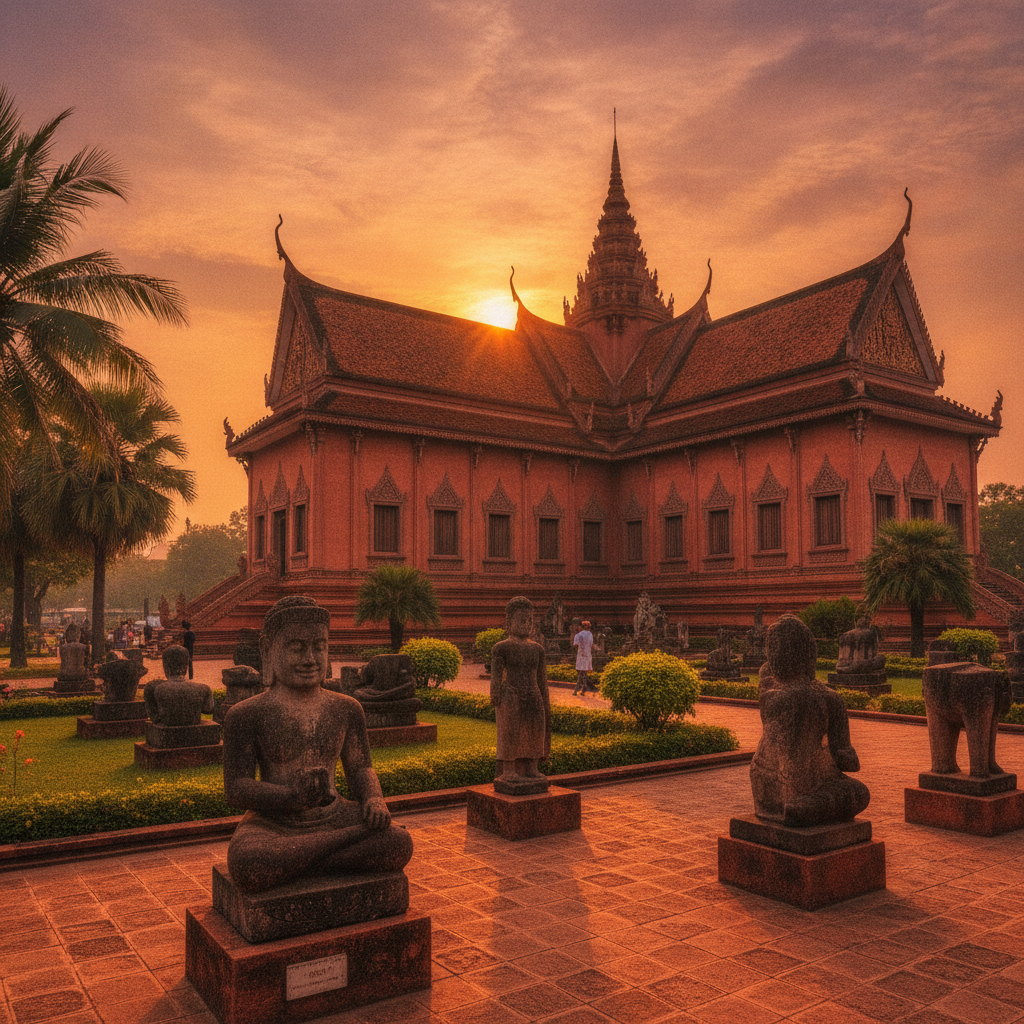
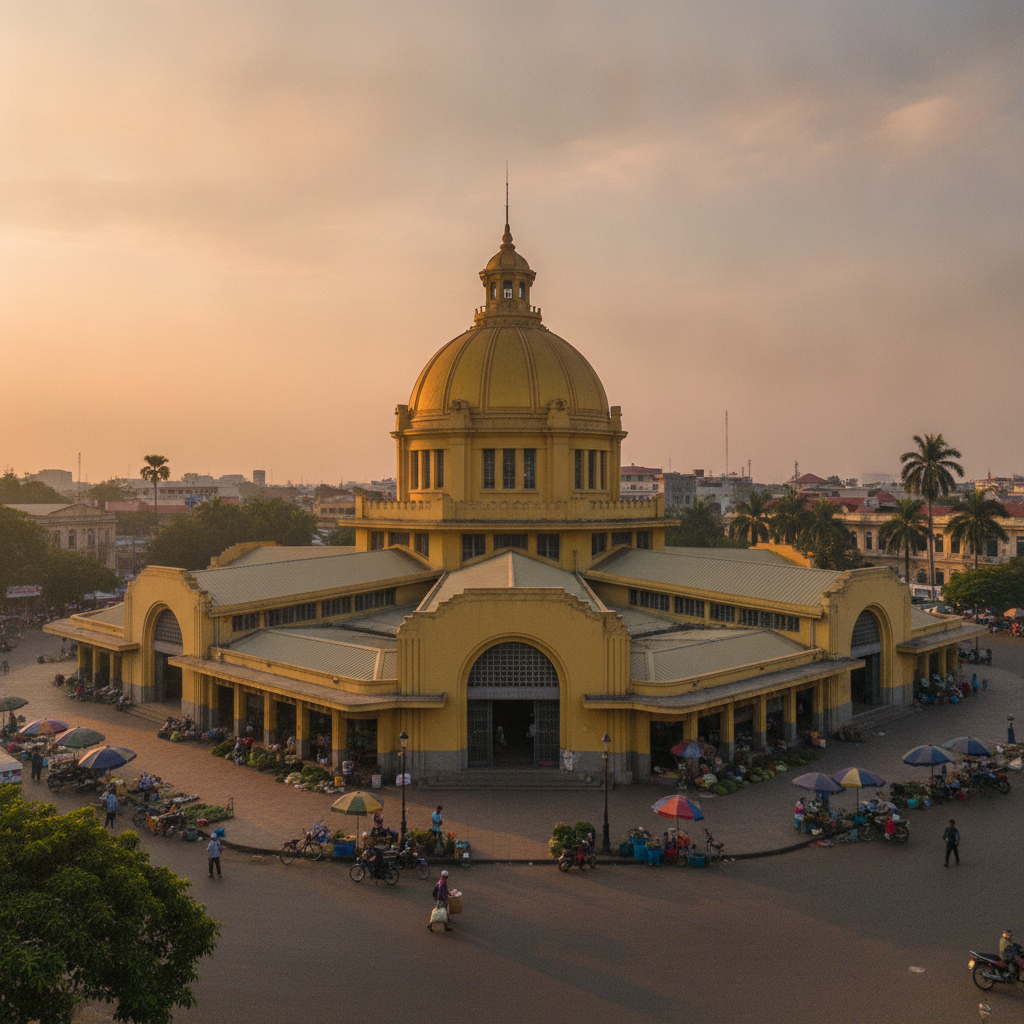
The French colonial architectural legacy of Phnom Penh (1863–1953: 90 years of French Protectorate rule, during which time the Cambodian capital was substantially rebuilt and expanded according to French urban planning principles) is the most intact French colonial urban fabric remaining in mainland Southeast Asia—more coherent and better preserved than the French colonial districts of Ho Chi Minh City or Vientiane. The key buildings: the Central Market (Psar Thmei—1937 Art Deco, the largest Art Deco structure in Southeast Asia); the Post Office (1900s Beaux-Arts, still operating as the Cambodia Post main office); Raffles Hotel Le Royal (1929—the most prestigious hotel in Cambodia, where Jacqueline Kennedy stayed in 1967 and where the last foreign correspondents sheltered during the Khmer Rouge advance in April 1975); the National Museum (1917–1920 Khmer Revival—not purely French but designed under French administration); the French Embassy (1953—the site of the most dramatic event of the 1975 fall of Phnom Penh, when 800 refugees sheltered in the compound until the Khmer Rouge forced them out); the Boulevard Norodom (the main ceremonial boulevard running north-south through the city, modelled on the Paris boulevards).
- 4
The Phnom Penh Art Scene – New Wave Cambodian Creatives
The contemporary art scene of Phnom Penh—one of the most dynamic in mainland Southeast Asia, concentrated in the BKK1, Toul Kork, and riverside districts—reflects the broader cultural recovery of Cambodia and the influx of a young, educated urban population with access to international artistic influences for the first time since the Khmer Rouge. The galleries: the Cambodian Living Arts (CLA) organisation at the Cambodian Living Arts Cultural Village; Meta House (the German-Cambodian cultural centre with film screenings, gallery exhibitions, and live performance); the Bophana Audiovisual Resource Center (established by filmmaker Rithy Panh—a Khmer Rouge survivor and the director of 'The Missing Picture', the Academy Award-nominated documentary—archiving pre-genocide Cambodian film, photography, and music); Java Arts (an independent gallery in the BKK1 district showing contemporary Cambodian painting, photography, and installation art). The new Khmer cinema: a generation of young Cambodian filmmakers (Davy Chou, director of 'Diamond Island'; Neang Kavich, director of 'Night Jar') are producing the first body of internationally recognised Cambodian fiction cinema since the pre-1975 'Golden Age' of Cambodian cinema (1960–1975, when approximately 300 Cambodian films were produced—almost all the prints were destroyed by the Khmer Rouge).
- 5
Day Trip: Udong & the Former Royal Capital
Udong (40 km north of Phnom Penh on National Road 5—accessible by tuk-tuk in approximately 1 hour, or by shared minibus from the Phnom Penh Central Bus Station): the former capital of Cambodia from 1620 to 1866 (when the capital was moved to Phnom Penh under French encouragement), now a hilltop religious and heritage site. The Udong hill: two ridges rising above the surrounding rice plains, connected by stone steps; the southern ridge (Phnom Vihear Leu—'Upper Temple Mountain') carries several large stupas containing the remains of Cambodian kings (the stupa of King Ang Chan, 1525; the stupa of King Norodom, 1904; the Vihear Preah Ath Roes—a sanctuary housing a 9-metre-tall Buddha image); the northern ridge (Phnom Chisors Chivit—'Temple of All Living Things') has the ruins of a 17th-century sanctuary and the views over the Cambodian plain towards the Tonle Sap River. The village below: the Udong market village (at the base of the hill) is one of the most intact examples of a Cambodian market town—the noodle shops, the fruit vendors, the motorcycle repair shops—providing a contrast to the Phnom Penh urban environment that most visitors to Cambodia never see. The monastic community: approximately 200 monks live in the monastery complex on the hill; the morning procession (05:30–06:30, when the monks descend the hill to receive food offerings from the village) is the most atmospheric time to visit.
- 6
The Phnom Penh Sunset & the Night Sky Over the Mekong
The Phnom Penh sunset—viewed from the Sisowath Quay promenade or from one of the riverside rooftop bars—over the Tonle Sap River and the Mekong confluence is the most dramatic urban river sunset in mainland Southeast Asia: the width of the river at the Phnom Penh confluence (the Tonle Sap River is 400 metres wide at its junction with the Mekong), the absence of any bridge crossing at the city centre, and the quality of the light over the Cambodian plain produce a sunset display that is genuinely distinctive. The rooftop sunset culture: the rooftop bars of Phnom Penh (the Quay Hotel rooftop, the Raffles terrace, the Eclipse Sky Bar at the Himawari Hotel—the highest point in central Phnom Penh) begin filling at 17:00; the prime viewing window is 17:30–18:30. The river activity: the sunset coincides with the end of the fishing day—the small wooden fishing boats returning to shore, the water taxis crossing to the opposite bank, and the tourist dinner-cruise boats departing—providing the human foreground that makes the Phnom Penh river sunset a composed photograph rather than simply a sky display. The night market: the Phnom Penh Night Market (Psar Reatrey—along the Sisowath Quay between Streets 108 and 118, operating Friday–Sunday from 17:00–23:00) begins as the sunset ends—clothing, food, and handicrafts stalls under the open sky with the river as backdrop.
Walk this route with audio
Stories play automatically as you reach each stop — no tapping needed.
More in Phnom Penh
Phnom Penh: The Silver Pagoda's 5,329 Floor Tiles, the S-21 Photographs of 17,000 Prisoners & the River That Flows Backwards for 5 Months Every Year
Phnom Penh's Hardest Questions: USD 330M Tribunal for 3 Convictions, the Orphanage Tourism Scam That Involved 70% of Facilities & What the City Asks You Not to Skip
Phnom Penh's Complete Picture: From No Currency in 1975 to USD 7 Billion Garment Exports, Vann Molyvann's Demolished Khmer Bauhaus & the Mekong Speedboat to Vietnam
Phnom Penh's Parallel City: 10,000 People in Floating Houses, the Chinese Investment Wave That Built 40,000 Unsold Condominiums & Why the Genocide Memorials Cannot Be Optional