Phnom Penh's Hardest Questions: USD 330M Tribunal for 3 Convictions, the Orphanage Tourism Scam That Involved 70% of Facilities & What the City Asks You Not to Skip
Orphanage tourism's 70–75% institution involvement rate by 2013—children purchased from poor rural families to attract international donors—and the de-institutionalisation programme that reduced facilities from 407 to 196; the expressway to Siem Reap opened 2023 reducing a 7-hour journey to 5.5 hours and making Angkor Wat's 216-faced Bayon more accessible; Pchum Ben's pre-dawn pagoda visits to feed ancestral spirits versus Bon Om Touk's 2 million people gathered for the boat races; Duch's S-21 commandant life sentence and death in prison 2020 while Pol Pot died in 1998 without ever facing a courtroom; the Cham Muslim silk weavers of Kandal province doing mulberry farming through to finished hol ikat fabric in a single cottage industry; and why visiting Tuol Sleng and Choeung Ek is not optional but the interpretive key to every other experience in the city.
- 1
The Cambodian Children's Charity Sector – NGO Tourism
Phnom Penh has the highest density of international NGOs and charitable organisations per capita of any Asian capital: approximately 3,500 registered NGOs operating in Cambodia (with the majority headquartered in Phnom Penh), addressing healthcare, education, land rights, labour rights, child protection, and cultural preservation. The charity tourism complex: the 'orphanage tourism' phenomenon that dominated Phnom Penh's responsible tourism debates from 2007–2015 (when tourists visited, performed at, and donated to 'orphanages' that were often not genuine orphanages—children were recruited from poor rural families, sometimes paid for by the institution, to provide a compelling attraction for international donors; the practice was estimated to have involved 70–75% of Cambodia's 'orphanages' by 2013). The resolution: the Cambodia government (Ministry of Social Affairs) and UNICEF began a de-institutionalisation programme in 2016, reducing the number of registered residential care facilities from 407 in 2013 to 196 in 2022; the practice of orphanage tourism (direct visitor access to children in institutional care) has been effectively banned. The responsible alternative: organisations such as Cambodian Living Arts, Phare Ponleu Selpak (based in Battambang but with Phnom Penh performances), and Friends International's ChildSafe tourism network provide structured engagement with Cambodian social development without exploiting vulnerable children.
- 2
Siem Reap & Angkor – The Day Trip That Requires a Week
Angkor (the capital of the Khmer Empire from approximately the 9th to the 15th centuries—at its peak, the largest pre-industrial city on Earth, with an estimated population of 750,000–1,000,000 and an urban area of approximately 1,000 km²; the surviving temple complex covers approximately 400 km² and contains over 1,000 individual temple structures) is accessed via Siem Reap—5.5 hours from Phnom Penh by the new expressway (opened 2023, reducing the previous 7-hour journey; bus and private vehicle available) or 1 hour by domestic flight. The Angkor complex: the five most visited temples of the complex—Angkor Wat (the most famous, the largest religious monument on Earth, built by Suryavarman II in the 12th century), Angkor Thom (the walled city with the Bayon temple of 216 stone faces), Ta Prohm (the 'jungle temple' with the strangler fig trees growing through the structure walls), Banteay Srei (the pink sandstone temple 25 km north of the main complex, the finest example of Classical Khmer decorative carving), and Preah Khan (the 12th-century temple whose restoration management has produced the most debated conservation versus non-intervention discussion in Cambodian heritage management). The visitor management: the 3-day Angkor pass (USD 72) is the minimum recommended for meaningful engagement with the complex; the sunrise at Angkor Wat (requiring arrival by 05:00 from Siem Reap—tuk-tuk ride 20 minutes) remains one of the most spectacular travel experiences available in Southeast Asia.
- 3
Khmer New Year & the Cambodian Festival Calendar
The Cambodian festival calendar—structured around the Theravada Buddhist lunar calendar and the agricultural cycle of the monsoon paddy cultivation—produces the most intense festival concentrations of any mainland Southeast Asian country: three major national festivals (Khmer New Year, Pchum Ben, and Bon Om Touk) each involving a three-day national holiday during which the city essentially empties (Phnom Penh residents returning to their home provinces) and the provinces fill with festivals. Khmer New Year (Choul Chhnam Khmer—held in mid-April, 3 days, coinciding with the harvest completion; the most festive celebration): the streets fill with families playing traditional games (bos angkunh—tossing seeds; leak kanseng—circular game with a knotted scarf); the pagodas host traditional music and dance performances; water is thrown (less vigorously than the Thai Songkran but in the same Theravada tradition). Pchum Ben (the Festival of the Dead—15 days concluding on the full moon of Kadeuk, usually October; the period when the spirits of the dead are believed to roam the earth): families visit their home pagoda before dawn each day to offer rice balls to the monks, who distribute them as symbolic food for the deceased ancestors. Bon Om Touk (the Water Festival—November, 3 days, celebrating the Tonle Sap reversal): the largest festival in Cambodia, with 2+ million people gathering in Phnom Penh for the boat races.
- 4
The Khmer Rouge Tribunal – Justice After Genocide
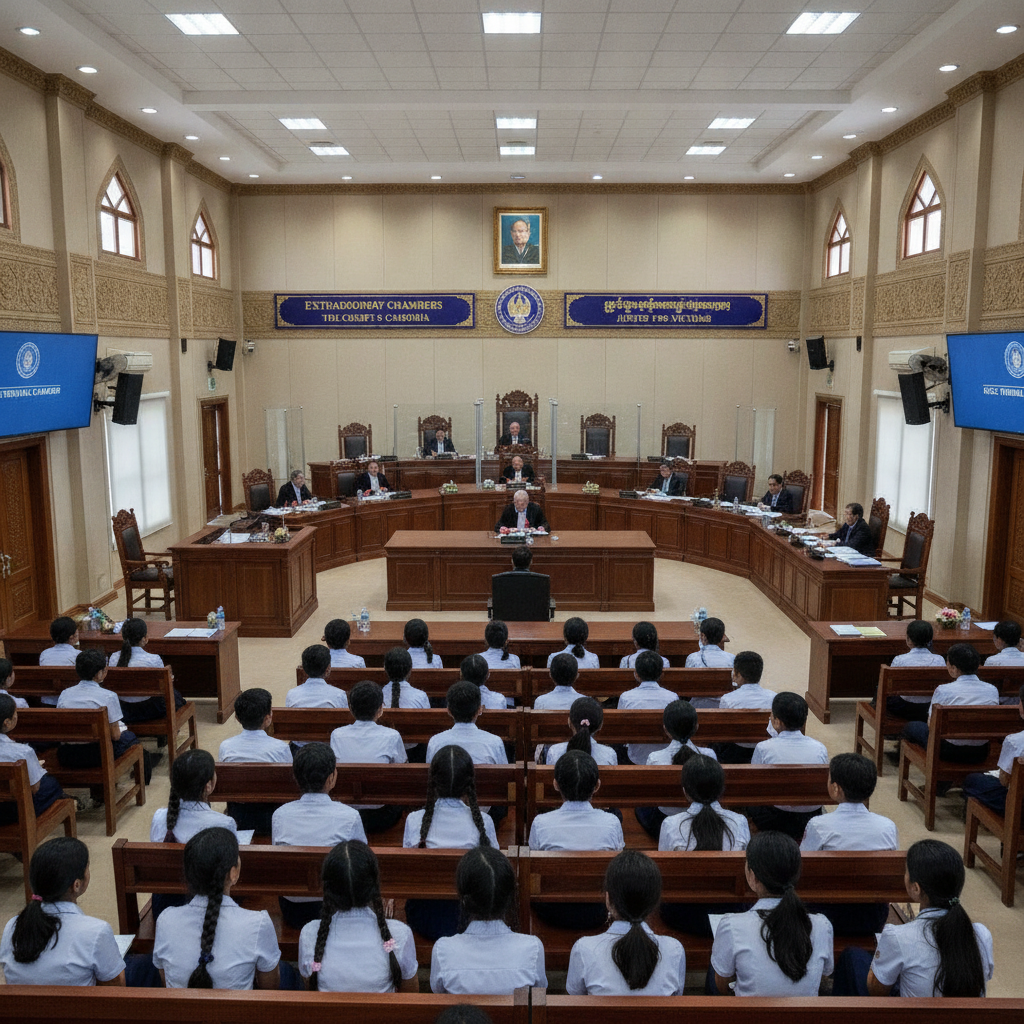
The Extraordinary Chambers in the Courts of Cambodia (ECCC—the UN-backed tribunal established in 2006 to try the surviving senior leaders of the Khmer Rouge regime; commonly called the 'Khmer Rouge Tribunal') is the most significant international war crimes tribunal in Southeast Asian history and one of the most legally complex hybrid courts in the global transitional justice system. The proceedings: the ECCC has processed four defendants through conclusion: Kaing Guek Eav ('Duch'—the commandant of S-21; convicted 2010, sentenced to life imprisonment; died in prison 2020); Nuon Chea ('Brother Number 2'—the regime's chief ideologist; convicted 2014 and 2018, sentenced to life; died 2019); Khieu Samphan (the former head of state; convicted 2018, sentenced to life; appealing); Ieng Sary (died 2013 before verdict) and Ieng Thirith (deemed unfit to stand trial due to dementia, died 2015). The limitations: Pol Pot died in 1998—14 years before the tribunal began; the most responsible individual never faced justice. The cost: the ECCC has cost USD 330 million over 20 years, trying 3 defendants to conclusion—making it the most expensive international tribunal per convicted defendant in history. The observation: the ECCC courtroom in the northwest of Phnom Penh is open to public observers; Cambodian schools organise visits; the gallery observation of a genocide tribunal is one of the most unusual civic experiences available to visitors to any country.
- 5
Cambodian Silk & Textile Traditions
The Cambodian silk weaving tradition—one of the most sophisticated in Southeast Asia, combining the Khmer royal weaving tradition (the court textiles woven for royalty and used in Buddhist ceremonies) with the techniques preserved by the Khmer diaspora in Vietnam, Thailand, and France during the Khmer Rouge period—is experiencing a revival that is simultaneously a cultural recovery project and a livelihood development programme. The traditional hol technique: the Cambodian hol (ikat) weaving—a resist-dyeing technique where the weft threads are tied and dyed before weaving to create the pattern (the same technique as the Indonesian batik ikat and the Japanese kasuri)—produces the most complex Cambodian silk textiles; the royal hol patterns (traditionally restricted to court use) are now produced by the artisan cooperatives. The Phnom Penh silk shopping: the Artisans Angkor shop at the Phnom Penh airport (the most convenient but most expensive); the Russian Market silk stalls (the most varied, but quality ranges from hand-woven authentic hol to machine-made reproduction); the weaving villages south of Phnom Penh along the Mekong (Kandal province—where the Cham Muslim weaving communities produce the silk from mulberry farming through to finished fabric in a vertically integrated cottage industry).
- 6
Leaving Phnom Penh – What the Capital Asks of Its Visitors
The Phnom Penh experience makes specific demands of the visitor that other Southeast Asian capitals do not: the genocide memorials (Tuol Sleng and Choeung Ek) are not optional additions to a city itinerary but the defining context without which Phnom Penh cannot be understood—the city is what it is because of what happened here in 1975–1979, and the visitor who skips the memorials is visiting a city whose history they have chosen not to know. The emotional labour: the Phnom Penh genocide memorial circuit (Tuol Sleng in the morning, Choeung Ek in the afternoon—the standard itinerary) is emotionally exhausting in a way that no other single-day travel experience matches; the survivors' accounts (available at both sites), the children's graves, and the photographs of the prisoners require active emotional engagement and take time to process. The broader question: Phnom Penh asks the visitor to hold two things simultaneously—the weight of the genocide and the resilience of the reconstruction; the energy of the city (young, entrepreneurial, optimistic) and the horror that is within living memory of a significant portion of the population (every Cambodian over 50 has direct personal experience of the Khmer Rouge period). The continuation: the journey most commonly taken from Phnom Penh—north to Siem Reap and Angkor, south to Kampot and Kep, or east to the Mekong provinces—each continues different aspects of what Phnom Penh introduces: the Khmer Empire at its peak, the French colonial coast, the river life of the greater Mekong system.
Walk this route with audio
Stories play automatically as you reach each stop — no tapping needed.
More in Phnom Penh
Phnom Penh: The Silver Pagoda's 5,329 Floor Tiles, the S-21 Photographs of 17,000 Prisoners & the River That Flows Backwards for 5 Months Every Year
Phnom Penh's Complete Picture: From No Currency in 1975 to USD 7 Billion Garment Exports, Vann Molyvann's Demolished Khmer Bauhaus & the Mekong Speedboat to Vietnam
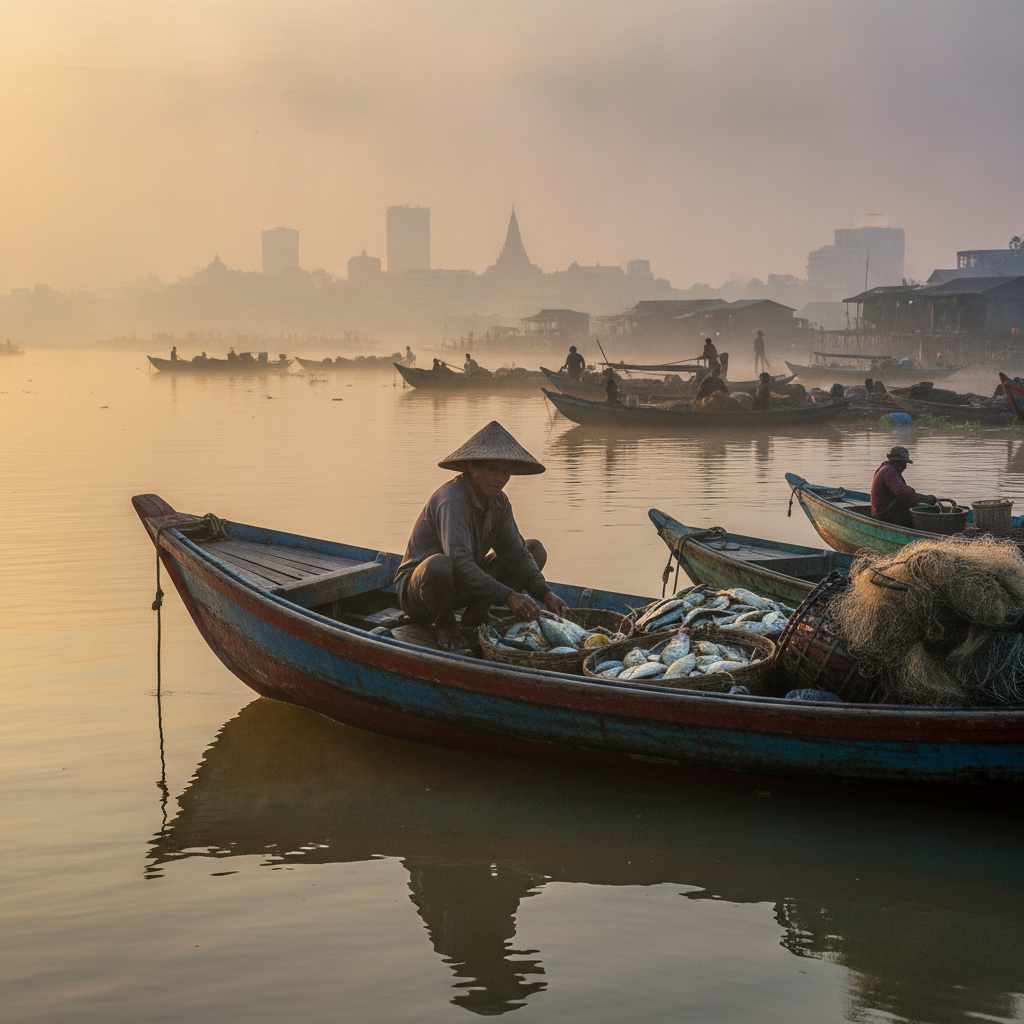
Phnom Penh's Parallel City: 10,000 People in Floating Houses, the Chinese Investment Wave That Built 40,000 Unsold Condominiums & Why the Genocide Memorials Cannot Be Optional
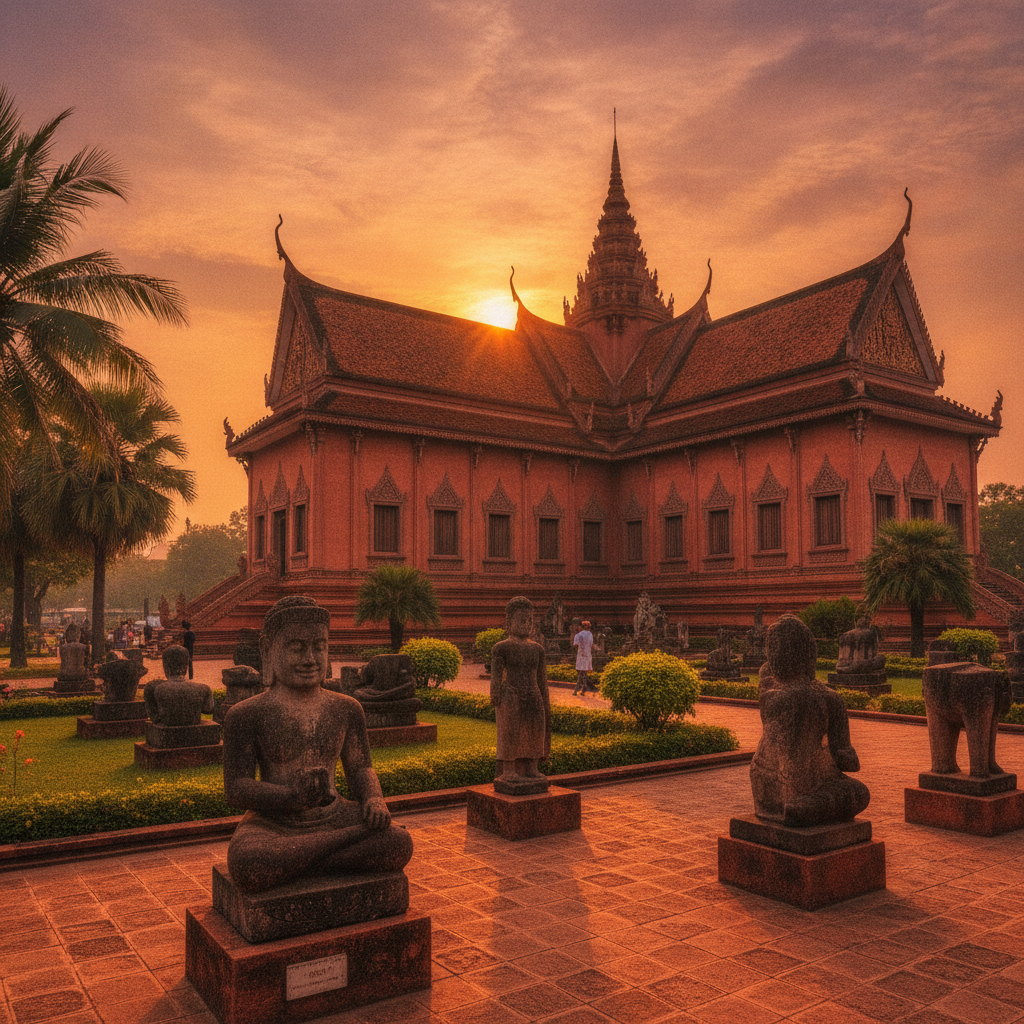
Phnom Penh's Reconstruction: The City Emptied in 1975 and Rebuilt from Zero Since 1979—40 Years of the Most Compressed Urban History in Asia