Arab-Norman Palermo, Palatine Chapel & UNESCO World Heritage Sicily
The 'Arab-Norman Palermo and the Cathedral Churches of Cefalù and Monreale' (UNESCO World Heritage Site since 2015) encompasses the extraordinary monuments of the Norman Kingdom of Sicily (1130-1194) — the medieval kingdom that was the most culturally sophisticated state in Europe, the kingdom that fused the Byzantine, the Arab-Islamic, and the Norman-Latin artistic traditions into the unique 'Arab-Norman' style that is the most extraordinary multicultural artistic synthesis in the history of Western civilization.
- 1
The Palatine Chapel — The World's Most Perfect Medieval Interior
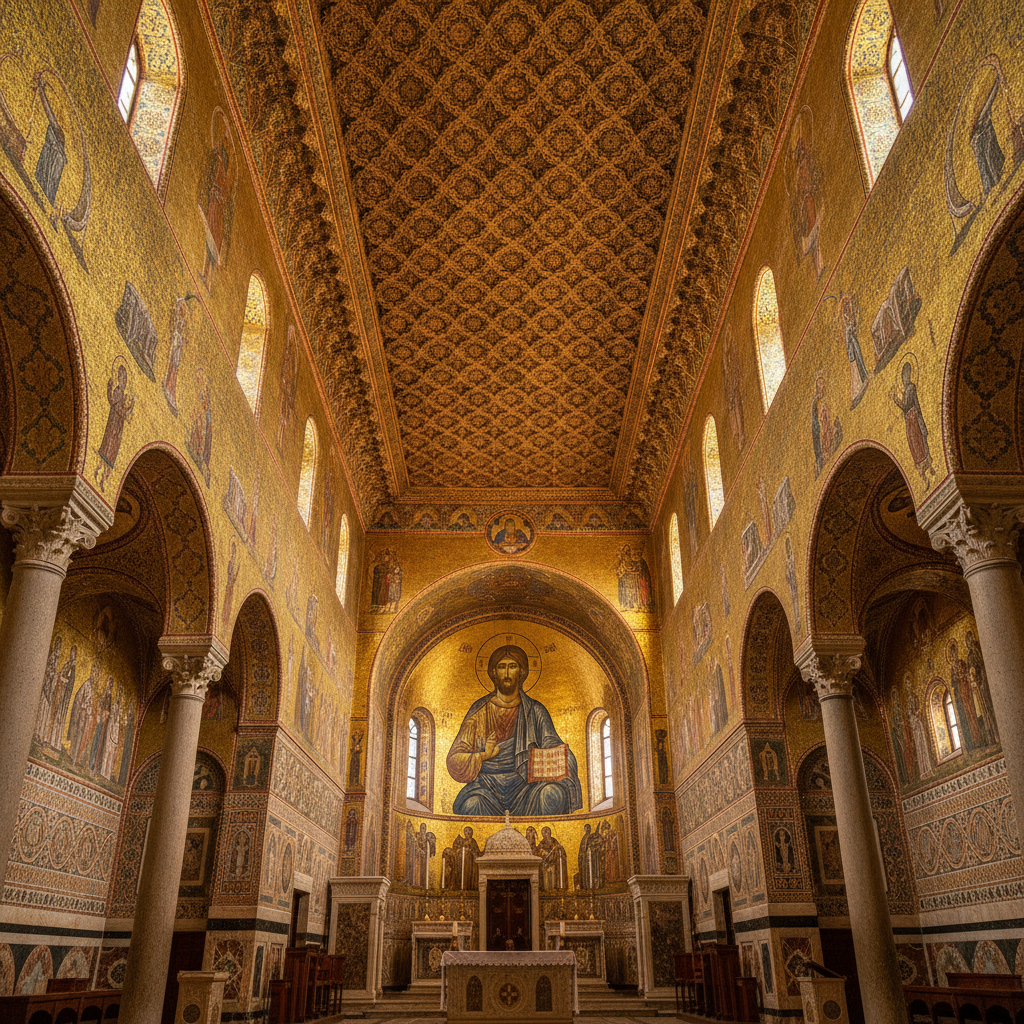
The Cappella Palatina (the 'Palatine Chapel' — the private royal chapel of the Norman Palace in Palermo, the chapel built by the Norman King Roger II of Sicily (1095-1154) in 1132-1140 and decorated with the most extraordinary ensemble of Byzantine mosaics, Islamic geometric woodwork, and Norman architectural elements in the world): the mosaics (the Byzantine gold mosaics of the Palatine Chapel — the mosaics covering approximately 6,340 square metres of surface area (the ceiling, the walls, the arches, and the apses), the most extensive and the best-preserved cycle of medieval Byzantine mosaics in the world outside the Hagia Sophia in Constantinople (now Istanbul)): the programme (the iconographic programme of the Palatine Chapel mosaics — the programme ordered by King Roger II as the theological and political statement of the Norman Kingdom of Sicily: the Pantocrator (the 'Christ All-Powerful' — the image of Christ as the universal ruler of heaven and earth, depicted in the central apse above the high altar) surrounded by the hierarchically ordered representations of the angels, the apostles, the saints, and the scenes from the Old Testament and the New Testament that cover every available wall and vault surface): the muqarnas ceiling (the 'muqarnas' ceiling of the Palatine Chapel nave — the Islamic geometric carved wooden ceiling: the 'muqarnas' (the stalactite ceiling — the carved wooden honeycomb or stalactite structure, the Islamic architectural element at its most elaborate in the Palatine Chapel nave, where the muqarnas ceiling is the most complex and the most finely painted surviving example of Fatimid Islamic art in Europe): the three artistic traditions (the three artistic traditions fused in the Palatine Chapel — the Byzantine mosaic tradition (the floor mosaics and the wall mosaics, the artisans brought from Constantinople by Roger II), the Islamic geometric art tradition (the muqarnas ceiling, the geometric floor patterns, and the pointed arches — the artisans brought from the Arab workshops of Sicily and North Africa), and the Norman architectural tradition (the Romanesque marble columns, the Norman arches, and the Latin liturgical arrangement of the chapel)).
- 2
The Norman Palace & the Arab-Norman Style
The Palazzo dei Normanni (the 'Palace of the Normans' — the royal palace of the Norman kings of Sicily in Palermo, the oldest royal residence in Europe still in use (the palace is now the seat of the Sicilian Regional Parliament)): the palace (the Palazzo dei Normanni — the palace built on the site of the 9th-century Emirate palace of the Arab emirs of Palermo (the 'Qasr' — the Arabic word for 'palace') by the Norman kings Roger I (1031-1101) and Roger II (1095-1154) in the 11th-12th centuries, the palace combining the Norman fortification towers (the 'Torre Pisana' — the tower containing the astronomical observatory of Roger II, the first scientific observatory in Italy) with the Arab-Byzantine decorative interiors (the Palatine Chapel and the royal apartments)): the Arab-Norman style (the 'Arabo-Normanno' architectural style — the unique artistic style developed in the Norman Kingdom of Sicily in the 12th century: the style that is not a simple juxtaposition of the different artistic traditions but a genuine fusion, a new artistic language created from the encounter of the three great civilizations of the medieval Mediterranean (the Arab-Islamic, the Byzantine Greek, and the Norman Latin)): the Norman kings (the Norman kings of Sicily who created the Arab-Norman civilization — the dynasty of the Hauteville family that conquered Sicily from the Arab Emirate of Sicily in 1061-1091 (the conquest led by Roger I 'the Great Count'), ruled as kings from 1130 (when Roger II was crowned the first King of Sicily by the antipope Anacletus II) to 1194 (when the Norman kingdom passed to the Holy Roman Emperor Henry VI of the Hohenstaufen dynasty by marriage).
- 3
Palermo Cathedral & the Norman Royal Tombs
The Cattedrale di Palermo (the 'Palermo Cathedral' — the Cathedral of the Assumption of the Virgin Mary, the cathedral of the Archbishop of Palermo and the most important church in Sicily): the history (the Palermo Cathedral — the cathedral built on the site of the Byzantine basilica that was converted into a mosque during the Arab Emirate of Palermo (831-1072) and then reconverted into a Christian cathedral by the Norman Archbishop Gualtiero Offamilio ('Walter of the Mill') in 1185): the architecture (the Palermo Cathedral — the cathedral built in the 'Arab-Norman' style with the characteristic combination of the pointed arches, the geometric decorative patterns, and the Norman towers: the extraordinary exterior of the cathedral (the 'trafori' — the carved limestone lacework panels covering the apse exterior, the most elaborate example of Norman decorative stone-carving in Sicily)): the Norman royal tombs (the 'Tesoro della Cattedrale' and the 'Tombe Reali' — the treasury and the royal tombs of the Palermo Cathedral: the six royal tombs in the right transept of the cathedral containing the remains of the Norman and Hohenstaufen kings and emperors of Sicily: the tomb of Roger II (the red porphyry sarcophagus of Roger II (1095-1154), the first King of Sicily — the red porphyry being the material reserved for the most powerful rulers of the ancient and medieval world, the same porphyry used for the sarcophagi of the Roman emperors), the tomb of Frederick II (the red porphyry sarcophagus of Frederick II (1194-1250), the Holy Roman Emperor and King of Sicily — the most brilliant ruler of the medieval world, the 'Stupor Mundi' (the 'Wonder of the World'), the sarcophagus placed beside those of his parents Henry VI and Constance I): the Cathedral treasury (the Cathedral treasury — the collection of 27 crowns and diadems of the Norman and Hohenstaufen royalty of Sicily, the most important medieval royal jewellery collection in Italy).
- 4
The Church of San Giovanni degli Eremiti
The Chiesa di San Giovanni degli Eremiti (the 'Church of San Giovanni degli Eremiti' — the 'Church of Saint John of the Hermits' — the 12th-century Norman church in the Arab-Norman style, the church that is the most recognizable symbol of the Arab-Norman Palermo and the most photographed medieval monument in Sicily): the building (the Chiesa di San Giovanni degli Eremiti — the church built 1132-1148 by Roger II on the site of an earlier mosque (the mosque that was itself built on the site of a 6th-century Benedictine monastery): the architecture (the architecture of San Giovanni degli Eremiti — the quintessential expression of the Arab-Norman style: the five red domes ('cupole rosse' — the five bulging, hemispherical red terracotta tile domes rising above the white cubic volumes of the church, the domes that give the church its distinctive silhouette and that recall the domes of the North African mosques of the Fatimid and the Aghlabid periods): the cloister (the 'chiostro' of San Giovanni degli Eremiti — the small Romanesque cloister adjacent to the church, the most perfectly preserved medieval cloister in Palermo: the twin columns (the 24 pairs of slender twin columns in the pointed interlaced arches of the Sicilian-Norman style, the columns supporting the lightweight Sicilian-Arab pointed arches and enclosing the small garden with the citrus trees and the palm trees)): the palm trees (the palm trees visible above the roof of the church and the cloister — the symbol of the Islamic architectural heritage of Palermo, the palm trees that have grown in the Palermo gardens since the Arab period (the Emirs of Palermo planting the palm trees in their palace gardens in the 9th-10th centuries in imitation of the gardens of Baghdad and Cordoba)).
- 5
The Ballarò Market — The Soul of Palermo
The Mercato del Ballarò (the 'Ballarò Market' — the oldest and the largest street market in Palermo, the market in the Albergheria neighbourhood behind the Norman Palace that has operated continuously since the Arab period (the market established by the Arab emirs of Palermo in the 10th century in the Albergheria quarter, the name 'Ballarò' derived from the Arab town of 'Bahlara' in Tunisia from which many of the market traders originally came): the market (the Ballarò market — the outdoor market covering an area of approximately 3,000 square metres of the streets and the alleys of the Albergheria quarter, the market operating from the early morning to the early afternoon every day: the market stalls of the Ballarò (the stalls selling the fish (the Mediterranean fish and shellfish of the Palermo fish tradition — the 'pesce spada' (the swordfish), the 'tonno' (the tuna), the 'sarde' (the sardines), the 'cozze' (the mussels), and the 'vongole' (the clams)), the vegetables (the Sicilian vegetables — the 'melanzane' (the aubergines), the 'pomodori' (the San Marzano and the Pachino tomatoes), the 'carciofi' (the artichokes), and the 'broccoli siciliani' (the Sicilian broccoli)), the spices (the North African spices and the dried herbs — the cumin, the coriander, the saffron, and the dried chilli pepper that reflect the Arab culinary heritage of Palermo), and the street food: the Palermo street food of the Ballarò (the street food sold from the stalls and the counters of the Ballarò market: the 'pani ca meusa' (the 'bread with spleen' — the most distinctive Palermo street food: the soft sesame roll ('mafalde') filled with the thinly sliced, boiled and then briefly fried bovine spleen ('milza') and lungs ('polmone'), dressed with the fresh ricotta ('maritata' — the 'married' version) or without the ricotta ('schettu' — the 'single' version) and squeezed with the lemon), the 'sfincione' (the 'sfincione palermitano' — the thick-based Palermo pizza topped with the onion, the anchovies, the tomato, and the 'caciocavallo' cheese), and the 'arancine' (the 'arancine di riso' — the Sicilian fried rice balls ('arancino' in eastern Sicily, 'arancina' in Palermo) filled with the ragù meat sauce, the peas, and the mozzarella, coated in the breadcrumbs, and fried in the olive oil).
- 6
Monreale Cathedral — The Golden Paradise
The Cattedrale di Monreale (the 'Monreale Cathedral' — the cathedral of the town of Monreale, 8 km southwest of Palermo, the most magnificent Norman cathedral in Sicily and the most complete and the best-preserved cycle of Byzantine mosaics in the world): the history (the Monreale Cathedral — the cathedral built by the Norman King William II of Sicily ('William the Good', 1153-1189) in 1174-1182: the royal commission (the cathedral commissioned by William II as the greatest royal foundation of the Norman Kingdom of Sicily, the cathedral designed to surpass in magnificence all the other Arab-Norman buildings of Palermo (including the Palatine Chapel and the Cathedral of Palermo) and to serve as the dynastic mausoleum of the Norman kings): the mosaics (the Byzantine mosaics of Monreale Cathedral — the most complete surviving cycle of medieval Byzantine mosaics in the world: the mosaics covering approximately 6,340 square metres (the same area as the Palatine Chapel) but in a much larger building, creating the most immersive and the most overwhelming mosaic environment of the medieval world: the programme (the iconographic programme of the Monreale mosaics — the complete theological programme of the Old Testament (the Genesis cycle in the nave), the New Testament (the Life of Christ in the transepts and the crossing), and the Lives of the Saints (the side aisles and the apses), all against the golden background of the Byzantine mosaic tradition): the apse (the central apse of Monreale Cathedral — the most dramatic element of the mosaic programme: the gigantic Pantocrator (the 'Christ All-Powerful') occupying the entire surface of the central apse conch (the semicircular vault above the high altar), the Pantocrator of Monreale being the largest and the most imposing Byzantine mosaic representation of the Pantocrator in existence (the figure of Christ approximately 7 metres in height).
Walk this route with audio
Stories play automatically as you reach each stop — no tapping needed.
More in palermo
La Kalsa — The Arab Quarter and Palermo's Most Historic Neighbourhood
Palermo Street Food, Capo Market & the Sicilian Gastronomic Tradition
Monte Pellegrino, Santa Rosalia & the Patron Saint of Palermo
Cefalù — Norman Cathedral, Beach & the Perfect Sicilian Town
Quattro Canti, Baroque Palermo & the Spanish Viceroyalty Legacy