Ottawa: The Prime Minister Who Talked to His Dead Dog, 3 Million Dutch Tulips Planted as Thanks for Liberation and the Tech Company Collapse That Built a Startup Scene
Cross to Gatineau to see the most visited museum in Canada built by a Blackfoot architect in curves that deliberately contrast the angular Gothic of Parliament Hill across the river, find in the War Museum the Nobel Peace Prize work of the foreign minister who invented UN peacekeeping during Suez and the vehicle from the Rwandan genocide in the same building, hike to a former prime ministers estate where he collected bombed English Parliament stones as garden follies and held seances with his dead terrier, understand that 3 million tulips bloom in Ottawa each May because Canada housed the Dutch royal family during wartime exile and a hospital was declared Dutch territory for one birth, eat at a restaurant scene shaped by 125 embassies and French cheese crossing the bridge from Quebec, and read the story of Nortel employing 95,000 people before collapsing and scattering engineers who eventually built Shopify.
- 1
Canadian Museum of History
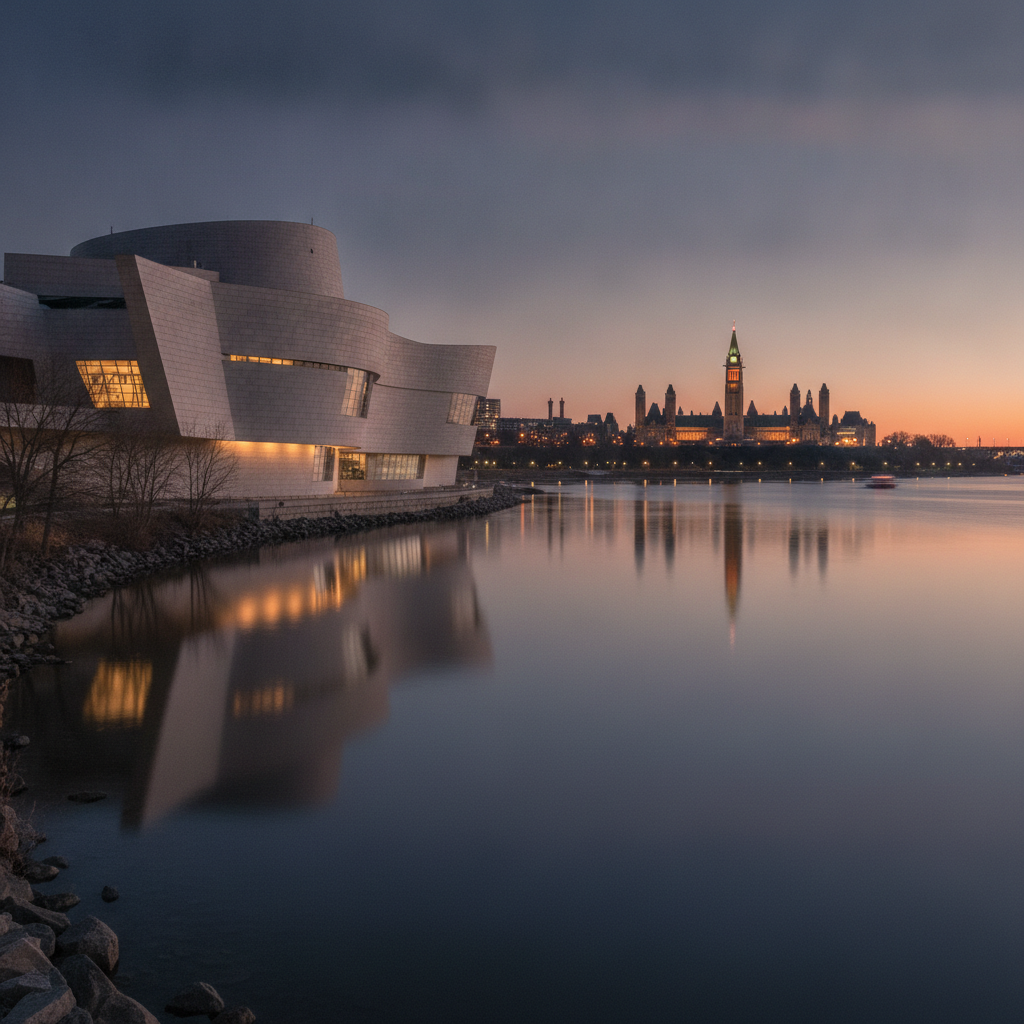
The Canadian Museum of History in Gatineau, directly across the Ottawa River from Parliament Hill, is the most visited museum in Canada with approximately 1.2 million visitors annually, housed in a building completed in 1989 and designed by Douglas Cardinal, a Blackfoot architect from Alberta whose fluid, curvilinear forms inspired by natural landforms stand in deliberate contrast to the angular Neo-Gothic of Parliament Hill visible across the river. The museum holds the Grand Hall, the largest indoor display of totem poles in the world, a 112-metre long hall simulating a Pacific coastal village with six house facades and standing poles from British Columbia First Nations. The Canadian History Hall traces 20,000 years of human history in Canada from the first peoples through to contemporary times. The museum also houses the Canadian Postal Museum and the Canadian Childrens Museum. The building itself, with its exposed curves of warm Indiana limestone, is considered one of the finest examples of organic architecture in North America and is frequently cited as among the most beautiful buildings in Canada.
- 2
War Museum and Peace Keeping Heritage
The Canadian War Museum, opened in 2005 in a purpose-built building designed by Raymond Moriyama in LeBreton Flats west of Parliament Hill, is the national museum dedicated to the history of Canadian military experience, with collections including 600 pieces of artillery, the only surviving German Tiger I tank from North Africa, and the bullet-damaged military vehicle in which Lieutenant General Romeo Dallaire served during the Rwandan genocide. The building design is embedded in a grass-covered hill, with a crack in the roof wall of the Regeneration Hall aligned to illuminate the tomb of the unknown soldier on Remembrance Day morning, November 11. Canada invented the modern concept of peacekeeping through its foreign minister Lester Pearson, who proposed the United Nations Emergency Force during the 1956 Suez Crisis and won the Nobel Peace Prize in 1957, and the museum honours this peacekeeping tradition alongside the combat history. Canada has participated in virtually every United Nations peacekeeping mission since 1956. The Peacekeeping Monument on Sussex Drive near the museum features bronze figures of Canadian soldiers in peacekeeping operations.
- 3
Gatineau Park Four Seasons
Gatineau Park, a 361-square-kilometre wilderness conservation area in the Gatineau Hills of Quebec administered by the National Capital Commission, begins just 15 kilometres from Parliament Hill and provides a remarkable urban wilderness adjacency that gives Ottawa residents access to boreal forest, 50 lakes, ancient Precambrian Canadian Shield geology, and dramatic escarpments within a 20-minute drive of the capital. The Champlain Lookout at 350 metres above the valley floor provides the most celebrated viewpoint in the Ottawa-Gatineau region, looking south over the Ottawa Valley and the capital. The Mackenzie King Estate within the park, the former weekend retreat of Prime Minister William Lyon Mackenzie King who governed Canada for 21 years between 1921 and 1948, contains the ruins of European buildings King collected and had reassembled on his property as romantic garden follies, including stones from the British Houses of Parliament damaged during World War II bombing and a section of the old Ottawa post office. King also held seances at the estate to communicate with his deceased mother and his dead Irish terrier, a fact now considered one of the more remarkable eccentricities in Canadian political history.
- 4
Ottawa Tulip Festival and Commemorations
The Canadian Tulip Festival held in Ottawa each May, the largest tulip festival in the world with over 3 million blooms displayed in city parks and along the Rideau Canal, originated from a gift of 100,000 tulip bulbs from Princess Juliana of the Netherlands to Canada in gratitude for the Canadian liberation of the Netherlands in 1944 and 1945, and for Ottawa hosting the Dutch royal family during their wartime exile, including the birth of Princess Margriet at the Ottawa Civic Hospital in 1943. The Canadian government declared the hospital temporarily Dutch territory for the birth, ensuring Princess Margriet Dutch nationality. The Netherlands continues to send 20,000 bulbs annually to Ottawa as a continuing expression of gratitude. Dows Lake in Ottawas Central Experimental Farm area is the primary display location with over 100 varieties. The Remembrance Day ceremony at the National War Memorial on November 11, where the Governor General, Prime Minister, and veterans gather at the Tomb of the Unknown Soldier, is the national commemoration of Canadians killed in war and is televised across the country.
- 5
Ottawa Cuisine and Dining Scene
Ottawa has a more sophisticated restaurant scene than its reputation as a government town would suggest, driven by the presence of a large diplomatic community with embassies from over 125 countries on Sussex Drive and in Rockcliffe Park, a large university student population, and the government class that entertains internationally at public expense. The Elgin Street corridor is the primary restaurant strip for after-work dining by government workers. The ByWard Market area holds the highest density of restaurants, patios, and bars. The Glebe neighborhood south of Lansdowne Park is the most coherent residential restaurant district with the highest concentration of independent restaurants outside downtown. Ottawa has a strong craft brewery scene with breweries including Beau-Rivage and Tooth and Nail. The farmers market at Lansdowne Park, the Brewer Park market, and the ByWard Market itself provide access to Ontario and Quebec produce. The proximity to Quebec means that French-Canadian food traditions, cheese, foie gras, and cider cross the bridge easily, giving Ottawa access to the full continental culinary range within a city that is otherwise resolutely Anglo-Canadian in tone.
- 6
Ottawa Technology and Innovation Sector
Ottawa has developed one of the most significant technology sectors in Canada since the 1980s, anchored initially by Northern Telecom, Nortel Networks, which employed 95,000 people globally at its peak in 2000 before its catastrophic collapse in 2009 in one of the largest corporate bankruptcies in Canadian history. The collapse of Nortel dispersed thousands of highly skilled engineers and technical workers who founded or joined smaller companies, creating a resilient technology ecosystem in Ottawa that now includes Shopify, founded in Ottawa in 2006 and one of the most valuable companies in Canadian history, Mitel Networks, and hundreds of smaller software, cybersecurity, and photonics companies. The University of Ottawa and Carleton University produce significant numbers of technology graduates annually. The Ottawa tech corridor, concentrated in the Kanata suburb west of the city, houses over 1,700 technology companies employing over 75,000 people. Shopify, now one of the largest e-commerce platforms in the world by merchant volume, was founded in Ottawa by Tobias Lutke who moved to Ottawa from Germany and began by building an online snowboard shop that became the platform on which the company was built.
Walk this route with audio
Stories play automatically as you reach each stop — no tapping needed.
More in Ottawa
Ottawa: The Constitution That Took 115 Years to Bring Home From Britain, the Playing Card Money Used When New France Ran Out of Coins and the Neighborhood Cleared in the 1960s That Is Still Empty
Ottawa: 130000 Federal Employees Who Never Lose Their Jobs in a Recession, the Sacred Falls That Were Industrialized for 150 Years and 1 Billion Year Old Rock Visible From Parliament
Ottawa: Second Coldest Capital City in the World Where 15000 People Commute on Ice, the Confederation Documents in Fireproof Vaults and the Lookout Where You Can See New York State
Ottawa: The Library Saved by a Clerk Who Closed One Door, an Unresolved Land Claim on the Ground Under Parliament and a Farm Doing Agricultural Research Since 1886 Inside the City
Ottawa: The Skating Rink That Is Also a UNESCO World Heritage Site, the Marshmallow Incident That Extinguished the Eternal Flame and the Most Photographed Spider in Canada