Ottawa: 130000 Federal Employees Who Never Lose Their Jobs in a Recession, the Sacred Falls That Were Industrialized for 150 Years and 1 Billion Year Old Rock Visible From Parliament
Join 200,000 people on Parliament Hill for Canada Day where the fireworks at 10pm are the most watched TV event in Canada and new citizens take their oaths in a public ceremony, understand that Ottawa economy is built on 130,000 federal jobs that make the city recession-proof in ways that oil-dependent Calgary or manufacturing Hamilton are not, learn that the Chaudiere Falls inside the Ottawa city limits were sacred to the Algonquin for thousands of years before being industrialized and are still an active power generation site 150 years later, walk Bank Street in the Glebe past independent shops in a neighborhood that produces a disproportionate share of national journalists and activists, look north from Parliament Hill to Canadian Shield granite over 1 billion years old and south to limestone deposited under a tropical sea 450 million years ago, and find a whitewater outfitter to run the same river the voyageurs used as the highway west when paddling from Montreal to the Rockies.
- 1
Canada Day on Parliament Hill
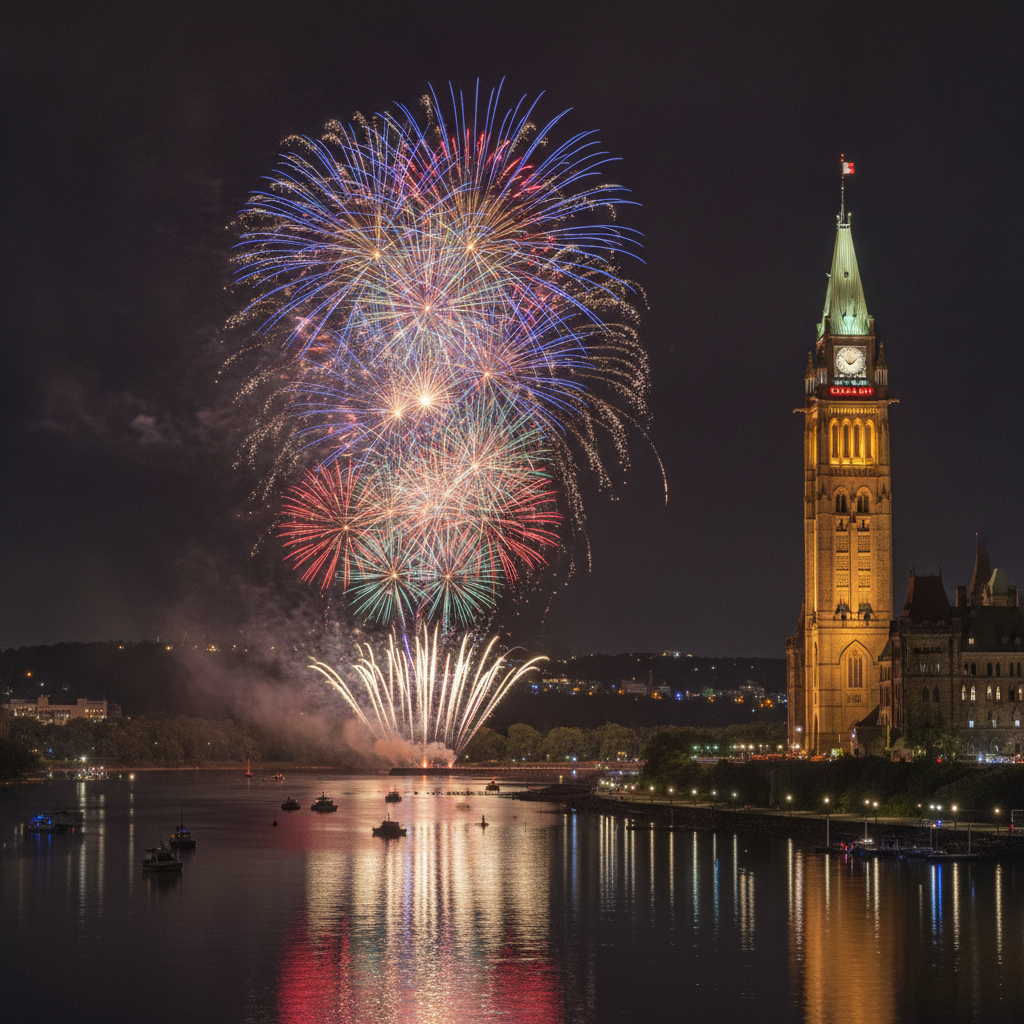
Canada Day, July 1, the national holiday marking Confederation on July 1, 1867, is celebrated most intensely in Ottawa where the Parliament Hill grounds become the site of the largest outdoor public celebration in Canada, drawing 100,000 to 200,000 people to Parliament Hill and the surrounding area for concerts, fireworks, military ceremonies, and the Royal Canadian Mounted Police musical ride performance. The Governor General presides over the Citizenship Ceremony on Canada Day, where hundreds of new Canadians take the Oath of Citizenship in a ceremony that is simultaneously public and deeply personal for participants. The RCMP Musical Ride, a precision drill performed by 32 horses and riders in the red serge uniform of the RCMP, is one of the oldest performance traditions in Canada, dating to 1876. The fireworks display over Parliament Hill at 10pm, broadcast nationally by CBC, is the most watched single event on Canadian television. Ottawa hotels are booked months in advance for Canada Day. The celebration has grown from a modest centennial celebration in 1967 to the national institution it is today, with Quebec City, Montreal, and Toronto hosting parallel celebrations but Ottawa remaining the recognized national center.
- 2
Ottawa River Ecology and Ottawa Outaouais Watershed
The Ottawa River, the second-largest river in Ontario and Quebec at 1,271 kilometres, flowing from the Laurentian Mountains to the St. Lawrence east of Montreal, was for centuries the primary canoe route into the North American interior and formed the boundary between Ontario and Quebec along the Ottawa-Gatineau urban area. The river carries the pink hue characteristic of the Canadian Shield granite it drains in some conditions. The Chaudiere Falls, a dramatic set of rapids and falls at the Ottawa River within the urban area, were for millennia a sacred site of the Algonquin people used for ceremonies and offerings, before being harnessed for industrial milling and hydroelectric generation in the 19th century and remaining an industrial site for over 150 years. The Algonquin people have requested restoration of the Chaudiere Falls site as a cultural heritage location. The Ottawa River has significant recreational use including whitewater kayaking at the Remic Rapids within the city limits and flatwater paddling along the NCC river pathways. Several species of river otter, great blue heron, osprey, bald eagle, and the occasional black bear are visible along the Ottawa River within the city.
- 3
Glebe Neighborhood and Lansdowne Park
The Glebe, the residential neighborhood south of the Queensway between Bank Street and the Rideau River, is the most socially cohesive urban neighborhood in Ottawa, characterized by Victorian and Edwardian housing stock, independent shops on Bank Street, the Lansdowne Park redevelopment that replaced an aging stadium with a mixed-use urban district including TD Place stadium, an urban market, and residential towers, and a strong community organization tradition. The Lansdowne development, completed in 2014, is considered one of the more successful stadium-anchored urban intensification projects in Canada, though it generated significant community controversy over the private development model and the loss of greenspace. The Glebe Farmers Market at Lansdowne is the primary source of local produce for Glebe residents. The Fifth Avenue Court and the Bank Street commercial strip south of Lansdowne have independent bookshops, cafes, cheese shops, and home furnishing stores serving the Glebe professional demographic. Dow-Dupplin House, one of the oldest surviving residential buildings in Ottawa dating to 1832, is in the Glebe. The neighborhood produces a disproportionate share of the activists, journalists, and public intellectuals who shape Ottawa public discourse.
- 4
Ottawa Economy and Public Service
Ottawa is the most economically stable large city in Canada because its economy is dominated by the federal public service, which employs approximately 130,000 people in the National Capital Region, representing the single largest employer bloc in any Canadian metropolitan area. The stability of federal employment through recessions has insulated Ottawa from the economic cycles that affect resource-dependent or manufacturing cities like Calgary or Hamilton. The average household income in Ottawa is among the highest in Canada partly because of public service salaries and partly because of the technology sector concentrated in Kanata. The reliance on government employment creates specific cultural characteristics: political cycles replace economic cycles as the driver of anxiety, Ottawa professionals follow parliamentary procedure and federal budget releases with the intensity that financial professionals in Toronto follow stock prices, and the permanent public service culture of relative security coexists with the political class of elected officials and their staff who arrive and depart with election results. The presence of 125 embassies creates a diplomatic class that lives well in Ottawa and contributes to a restaurant and cultural scene beyond what the city size would otherwise support.
- 5
Ottawa Natural History and Geology
The Ottawa region sits at the geological junction of the ancient Precambrian Canadian Shield of the Gatineau Hills, some of the oldest exposed rock on earth at over 1 billion years old, and the Paleozoic limestone plain of the Ottawa Valley deposited under shallow tropical seas 440 to 480 million years ago when the region sat near the equator. The contrast between these two geological formations, visible from Parliament Hill by looking north to the pink granite Gatineau Hills and south to the flat limestone Ottawa plain, explains much of the regional geography and the historical settlement pattern along the contact zone between forest and farmland. Fossils in Ottawa Valley limestone include corals, crinoids, and brachiopods from the Ordovician period tropical sea. The Carnegie Museum of Natural History in Pittsburgh confirmed the scientific significance of an Ordovician fossil site at Morrison Quarry south of Ottawa in the 1990s. The Ottawa Valley was covered by the Champlain Sea, a post-glacial marine incursion that filled the depressed terrain after the weight of the ice sheets retreated 12,000 years ago, depositing the clay soils that underlie much of the Ottawa urban area and that create challenging engineering conditions for construction.
- 6
Ottawa Canoeing and Indigenous Routes
Canoeing on the Ottawa River and its tributaries was the primary mode of long-distance transportation in the Ottawa Valley and the entire Canadian Shield interior from pre-contact Indigenous times through the French fur trade era and into the early 20th century, with voyageur canoe brigades of 25 to 35 men paddling enormous Montreal canoes loaded with trade goods and returning with beaver pelts over routes totaling thousands of kilometres. The National Capital Commission maintains put-in access points along the Ottawa River and the Rideau River for recreational canoeists, and several outfitters rent canoes and kayaks at the ByWard Market area and along the Ottawa River. The Algonquin Park canoe route system, 250 kilometres north of Ottawa in the largest provincial park in Ontario, is accessible as a multi-day paddling destination from the capital. The Ottawa River Whitewater rafting industry, operating rapids sections in the Pontiac County 100 kilometres west of Ottawa, is one of the largest commercial whitewater operations in Canada. The voyageur route from Montreal to Fort William, retraced periodically by heritage paddling groups using birchbark and fiberglass reproductions of historical canoe designs, passes through Ottawa as its first major stopping point west of Montreal.
Walk this route with audio
Stories play automatically as you reach each stop — no tapping needed.
More in Ottawa
Ottawa: The Constitution That Took 115 Years to Bring Home From Britain, the Playing Card Money Used When New France Ran Out of Coins and the Neighborhood Cleared in the 1960s That Is Still Empty
Ottawa: Second Coldest Capital City in the World Where 15000 People Commute on Ice, the Confederation Documents in Fireproof Vaults and the Lookout Where You Can See New York State
Ottawa: The Library Saved by a Clerk Who Closed One Door, an Unresolved Land Claim on the Ground Under Parliament and a Farm Doing Agricultural Research Since 1886 Inside the City
Ottawa: The Skating Rink That Is Also a UNESCO World Heritage Site, the Marshmallow Incident That Extinguished the Eternal Flame and the Most Photographed Spider in Canada
Ottawa: The Nobel Prize That Invented Peacekeeping, a Capital Built on Unceded Algonquin Land That Has Been in Legal Negotiation for 40 Years and the Only Bilingual National Theatre in the World