Nha Trang's Southern Arc: The Ngoạn Mục Pass to Đà Lạt's French Hill Station, the Cham Priest's 07:00 Puja at Pô Klông Garai & the Vietnamese Coastal Desert You Didn't Know Existed
The Vinpearl cable car's water-colour transition from murky green harbour to blue bay while Hon Mun's coral is visible through the gondola floor—3.3 km at 15 metres above sea; the Ngoạn Mục Pass gaining 1,000 metres in 12 km from the South China Sea to the 1,500-metre Lang Biang Plateau where Đà Lạt's French villas and Crazy House surrealist guesthouse coexist; Po Nagar's syncretism where Cham Hindus and Vietnamese worshippers of the same goddess share the same active temple; the 1978–1979 anti-Chinese campaign reducing Nha Trang's Hoa community from 15,000 to 4,000; Ninh Thuận's red iron-oxide sand dunes in Vietnam's driest climate (less than 700mm annual rainfall); and the Phan Thiết fish sauce market at 200 km from Ho Chi Minh City as the most important single food stop on the coastal road south.
- 1
Hon Tre Island & the Vinpearl Cable Car Experience
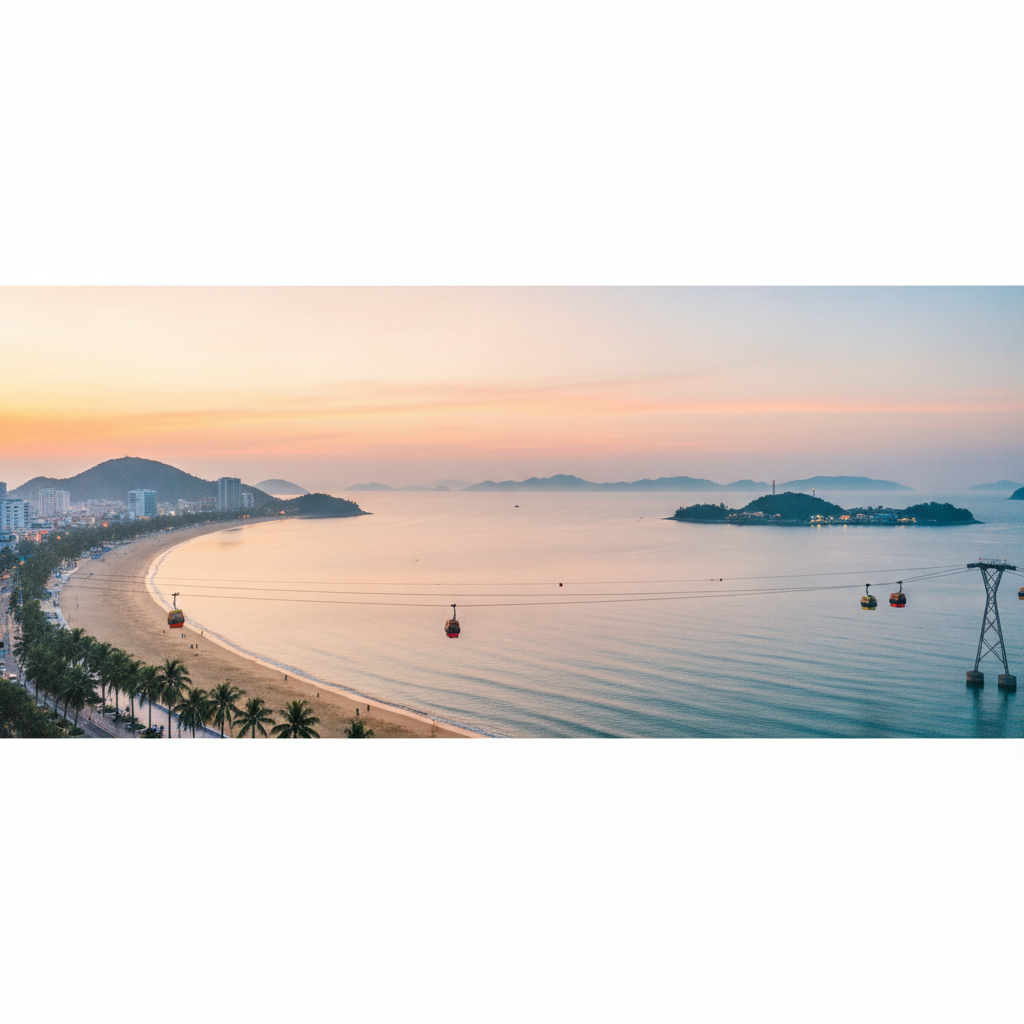
The Vinpearl Nha Trang cable car (the gondola crossing from Cầu Đá pier to Hòn Tre Island—3.3 km long; the cable car runs at approximately 15 metres above the sea surface for most of its length, with the highest point reaching 50 metres as the cable crosses the deep shipping channel; the views of the Nha Trang Bay, the outer islands, and the Khánh Hòa coast are unobstructed): the most popular single tourist activity in Nha Trang and the most unusual sea-crossing method in Vietnam. The crossing: the 15-minute gondola ride crosses the Nha Trang Bay shipping lane and the several outer reef systems; the water colour transitions from the murky green of the harbour (influenced by the Cái River outflow) to the clearer blue of the bay at midpoint; the Hon Mun Island coral reef is visible through the gondola floor windows on the right side of the crossing. The Vinpearl resort: the resort complex on Hòn Tre Island (accessible only by cable car or by the resort's own ferry service) is the most self-contained tourism environment in Vietnam—the 4.5 km² island has been developed to provide every holiday need (hotels from budget to luxury, restaurants (Vietnamese, Korean, Japanese, Italian), the water park (the largest water park in south-central Vietnam), the theme park (roller coasters, carousels), the golf course, the nature trail to the island's undeveloped north coast). The nature trail: the 4-km walking trail from the resort to the island's north coast (through secondary tropical forest, passing a small freshwater spring) is the least visited section of the Vinpearl resort and the only section that gives a sense of the island's natural landscape before development.
- 2
The Nha Trang Long Weekend Circuit – Dalat & the Southern Highlands
The Southern Highland connection from Nha Trang: the 140-km road from Nha Trang to Đà Lạt (the colonial-era French hill station at 1,500 metres elevation in the Lang Biang Plateau—the most popular weekend domestic destination from Nha Trang; accessible in 3.5–4 hours by bus or motorbike via the Ngoạn Mục Pass (also known as the Bellevue Pass—the most dramatic road pass in the southern Vietnam highland system, ascending 1,000 metres in 12 km, with views over the Ninh Thuận coastal plain to the South China Sea)). Đà Lạt: the most European-looking city in Vietnam—the French administration built an entire colonial hill station (hotels, villas, a racetrack, a summer palace, and a European-style market hall) at 1,500 metres altitude between 1897 and 1940; the population of approximately 500,000 now (including the university student population and the agricultural workforce); the strawberry cultivation, the hydroponic vegetable farming (Đà Lạt supplies 60% of Vietnam's greenhouse-grown vegetables), and the flower cultivation (Vietnamese wedding flowers—predominantly from Đà Lạt); the Crazy House (the Hàng Nga Guesthouse—a surrealist architectural guest house designed by Vietnamese architect Đặng Việt Nga, daughter of former General Secretary Trường Chinh; a UNESCO award-winning architectural experiment that is simultaneously a boutique hotel, a sculpture, and a tourist attraction). The circuit: the Nha Trang–Đà Lạt weekend circuit (Nha Trang Friday afternoon bus → Đà Lạt 2 nights → return Sunday afternoon) is the most popular 3-day trip from any Vietnamese coastal city.
- 3
The Po Nagar Cham Temple Complex – Deep Dive into Cham Civilisation
The Po Nagar Cham Towers (full name: Tháp Bà Po Nagar—the Towers of the Goddess Mother; the Hindu temple complex dedicated to the Goddess Uma (Bhagavati/Yan Po Nagar—the 'Mother of the Country' in Cham tradition), who is worshipped both by the Cham Hindu communities as a mother goddess and by the Vietnamese as Thiên Y Ana (a Vietnamese folk deity absorbed from the Cham tradition by the process of religious syncretism following the Vietnamese absorption of Cham territory in the 15th century)): the most actively used Cham religious site in Vietnam—the distinction from Mỹ Sơn being that Po Nagar is a living place of worship, not a ruined archaeological site. The festivals: the Tháp Bà Ponagar Festival (the largest Cham religious festival in Vietnam, held on the 23rd day of the 3rd lunar month—late April/early May; the festival attracts Cham pilgrims from across the south-central coastal region and Vietnamese worshippers of Thiên Y Ana from the surrounding provinces; the ritual programme includes animal sacrifice (the traditional Cham ritual—a buffalo or a goat), the Apsara dance performance (the ritual dance of the Cham goddesses—distinct from the Cambodian Apsara tradition but related), and the ceremonial offering of flowers, incense, and the Cham textile (the thổ cẩm brocade woven specifically for the festival by the Cham weaving cooperatives of Ninh Thuận province). The tower architecture: the main tower (Tháp Bắc—North Tower; 23 metres high, built approximately 817 CE under King Satyavarman) is the best-preserved example of late Cham tower architecture in Vietnam; the carved stone panels on the exterior (demons, deities, and lotus medallions) are the finest decorative carving remaining from the Cham tradition after the destruction of Mỹ Sơn.
- 4
Nha Trang's Chinese Quarter & the Diasporic Community
The Chinese community of Nha Trang—part of the broader Vietnamese Hoa (overseas Chinese) community, descended from the Hokkien and Cantonese traders who settled in Vietnamese port cities from the 17th century onward—has maintained a visible cultural presence in the city through its temples (the Minh Hương Temple, the most important Chinese religious site in Nha Trang), its cemetery (the Bình Tây Chinese cemetery—the oldest continuously used burial site in the city), and its commercial networks (the Chinese trading families who controlled the wholesale trade in dried goods, fish sauce raw materials, and construction materials in the pre-1975 period). The Chinese temple circuit: the Nha Trang Chinese temple circuit (the Minh Hương Hội Quán—the Hokkien community temple on Phước Tiến Street; the Bà Thiên Hậu temple—the Sea Goddess temple, particularly important in a fishing port community; the Quan Công temple—the Chinese war god venerated by the merchant community) is the most complete surviving Chinese diasporic religious landscape in south-central Vietnam, comparable in scale to the Chinese temple heritage of Hội An but much less visited. The post-1975 displacement: the 1978–1979 anti-Chinese campaign in Vietnam (the government's expropriation of Chinese business assets and the harassment of Hoa communities that drove approximately 250,000 Hoa from Vietnam as the 'boat people'—the largest single refugee crisis in Southeast Asian history until the Rohingya crisis of 2017) significantly reduced the Chinese community in Nha Trang, from approximately 15,000 in 1975 to approximately 4,000 in 1985.
- 5
The Ninh Thuận Province Day Trip – Cham Culture & Desert Landscape
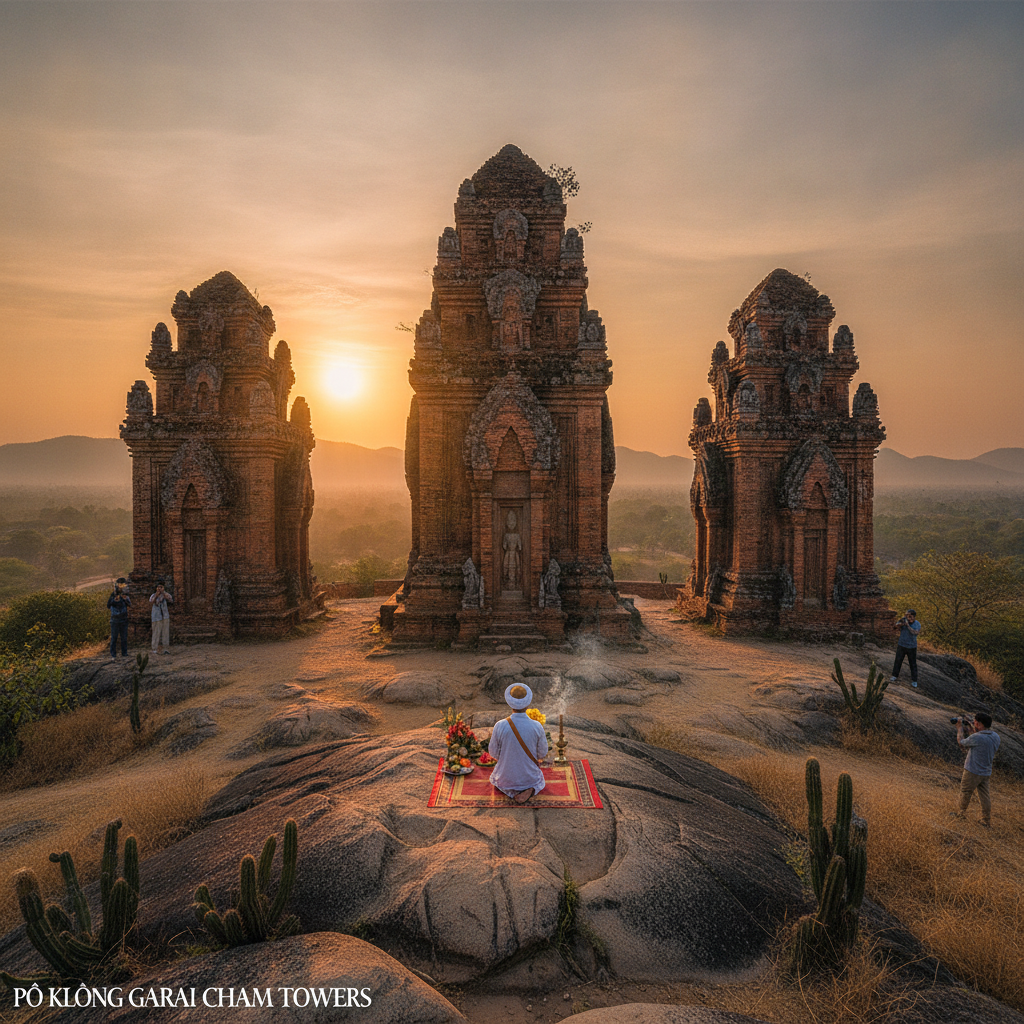
Ninh Thuận province (80 km south of Nha Trang by National Road 1—accessible by bus in 1.5 hours or by motorbike in 2 hours; the driest province in Vietnam, receiving less than 700 mm of rainfall annually—the same desert conditions that characterise northwest India and parts of sub-Saharan Africa, in sharp contrast to the tropical climate of Nha Trang) is the most culturally distinct province accessible as a day trip from Nha Trang: the last region of Vietnam with an intact Cham civilian community (approximately 70,000 Cham people living in 28 Cham villages, representing the largest surviving Cham community in Vietnam). The Pô Klông Garai Cham Towers (the 14th-century Cham temple complex on a granite hill 6 km north of the Ninh Thuận provincial capital Phan Rang—the best-preserved Cham tower complex remaining in active use in Vietnam; the three towers (the main tower, the entrance gate tower, and the fire tower) are maintained by the local Cham Hindu priest community): the daily religious rituals (the priest performing the morning puja at 07:00—the most authentic active Cham ritual visible to outside visitors in Vietnam). The desert landscape: the sand dunes of Mũi Dinh (35 km south of Phan Rang—accessible by motorbike on the coastal road; the most extensive coastal sand dune system in Vietnam; the red sand dunes (from the iron oxide content of the granitic parent rock) set against the South China Sea, with the driest climate in Vietnam creating a surreal coastal desert environment).
- 6
Leaving Nha Trang – South to Ho Chi Minh City & the Vietnamese Coast
The departure from Nha Trang south along the Vietnamese coast—either by the Reunification Express train (12–14 hours to Ho Chi Minh City via the spectacular coastal sections through Bình Thuận and Long An provinces) or by the National Road 1 (the main north-south highway, 440 km, 8–9 hours by bus)—is the most scenic long-distance journey in southern Vietnam, passing through a series of coastal and highland landscapes that represent the full diversity of the Vietnamese south. The train south: the Nha Trang–Ho Chi Minh City section of the Reunification Express (the most popular segment for travellers—the overnight service (SE7 or SE9—departing Nha Trang 20:00–22:00, arriving Saigon 05:00–07:00) allows maximum sleeping time while missing the dark sections; the day service (SE5 or SE7—departing Nha Trang 06:00–09:00) passes through the Mũi Né area (the windsurfing and kitesurfing capital of southern Vietnam—the beach town of Mũi Né, 15 km east of Phan Thiết at 200 km from Ho Chi Minh City) in daylight. The Phan Thiết food stop: the Phan Thiết fish sauce market (the city 200 km from Ho Chi Minh City that disputes with Phú Quốc for the title of finest fish sauce origin in Vietnam—the barung fish sauce produced here from the local anchovy catch is the primary ingredient in the nuoc cham dipping sauce used at every Vietnamese meal): the most important single food industry stop on the Nha Trang–Ho Chi Minh City route.
Walk this route with audio
Stories play automatically as you reach each stop — no tapping needed.
More in Nha Trang
Nha Trang: The 817 CE Cham Towers Still Used for Hindu Pilgrimage, the Floating Wine Circle That Has Damaged Vietnam's Only Marine Reserve & the Soviet Navy's 23-Year Cam Ranh Bay Base That Created the Russian Tourist Market
Nha Trang's Complete Picture: Whale Sharks at 5 Metres Depth in April, the Plague Bacillus Discoverer Who Retired Here in 1895 & the Resort Island With 8 Hotels Employing 5,000 People
Nha Trang's Hidden Depth: The Plague Bacillus Discoverer Who Built Vietnam's Radio System, the Longest Continuous Coral Reef Data Record in Southeast Asia & the Pink Salt Ponds 160km South
Nha Trang's Honest Assessment: The Original French Resort Since 1923 That Now Loses Beach Visitors to Phú Quốc, Squid Caught 3 Minutes Ago Tasting Different From Frozen & Sa Huỳnh Jar Burials Connecting to the Philippines