Nha Trang's Honest Assessment: The Original French Resort Since 1923 That Now Loses Beach Visitors to Phú Quốc, Squid Caught 3 Minutes Ago Tasting Different From Frozen & Sa Huỳnh Jar Burials Connecting to the Philippines
The Grand Hotel (now Yasaka)—the first international hotel in Vietnam outside of Saigon, Hanoi, and Huế, built in the 1930s when Nha Trang was the summer resort for Saigon's French colonial administration; the honest beach comparison where Phú Quốc wins on water clarity and sunsets while Nha Trang wins on diving, nightlife, and accessibility; the night squid tour's freshly grilled catch having a texture and sweetness that 20 minutes in a freezer permanently destroys; the Sa Huỳnh jar burial tradition's glass beads found in archaeological sites from the Philippines to India as Maritime Southeast Asia's most distributed pre-historic trade item; the local motorbike circuit north along the coast through salt flats and shrimp farms to Bãi Dài before the Cam Ranh Airport City development erases the landscape; and the Raglai đàn đá stone xylophone dated to 3000 BCE as the oldest musical instrument in Southeast Asia.
- 1
Nha Trang's Street Art & Creative Scene
The Nha Trang creative scene—smaller than Đà Nẵng's or Ho Chi Minh City's but growing in response to the city's expanding international tourism—is concentrated in the streets between the beach promenade and the Đầm Market (the Yersin Street and Hoàng Hoa Thám Street area) and in the artist studios and gallery spaces that have opened in the former French colonial residential buildings of the central district. The street art: the Nha Trang street art project (a civic commission from the city government in 2020, following Đà Nẵng's successful street art district on Nguyễn Văn Linh Street—approximately 40 murals painted on the walls of the Yersin and Quang Trung Street residential blocks by Vietnamese and international street artists). The underwater photography: the underwater photography community in Nha Trang (the city's dive industry and the clear-water dive sites at Mun Island produce the most diverse underwater photography subject matter of any Vietnamese coastal city) organises annual underwater photography competitions at the Khánh Hòa Oceanography Museum. The local music: the Nha Trang live music scene (the Blue Moon Bar on Trần Phú Boulevard—live Vietnamese rock and cover bands from 21:00 nightly; the Sailing Club's Saturday live international band nights) reflects the international character of the city's nightlife market.
- 2
Nha Trang Versus Other Vietnamese Beaches – The Honest Comparison
The honest comparison of Nha Trang against the other major Vietnamese beach destinations—Phú Quốc (the island destination 250 km south in the Gulf of Thailand), Đà Nẵng (the city beach 440 km north), and Mũi Né (the kitesurfing town 200 km south)—illuminates the specific qualities that Nha Trang provides and the specific qualities it lacks. Against Phú Quốc: Phú Quốc has cleaner water (the Gulf of Thailand's clearer water versus the South China Sea turbidity at Nha Trang), less crowded beaches (Phú Quốc has 150 km of coastline versus Nha Trang's 6-km central beach), and better sunset beaches (the west coast of Phú Quốc faces west); Nha Trang has better diving infrastructure, more nightlife, more city activity, and is more accessible (direct flights versus the requirement for a Phú Quốc flight or the ferry from Rạch Giá or Hà Tiên). Against Đà Nẵng: Đà Nẵng has the better modern city infrastructure, the more dynamic food scene, the more dramatic hinterland day trips (Huế, Hội An, the Marble Mountains, the Hải Vân Pass); Nha Trang has the better diving, the more developed nightlife, and the mudbath experience. Against Mũi Né: Mũi Né has the better kitesurfing conditions and the sand dunes; Nha Trang has the better diving, the longer beach, more accommodation options, and the city infrastructure. The verdict: Nha Trang is the best single destination in Vietnam for a visitor who wants the combination of beach, nightlife, diving, and city culture—but has lower appeal than the alternatives for visitors prioritising island tranquillity, heritage culture, or adventure sports.
- 3
The Nha Trang Night Squid Fishing Experience
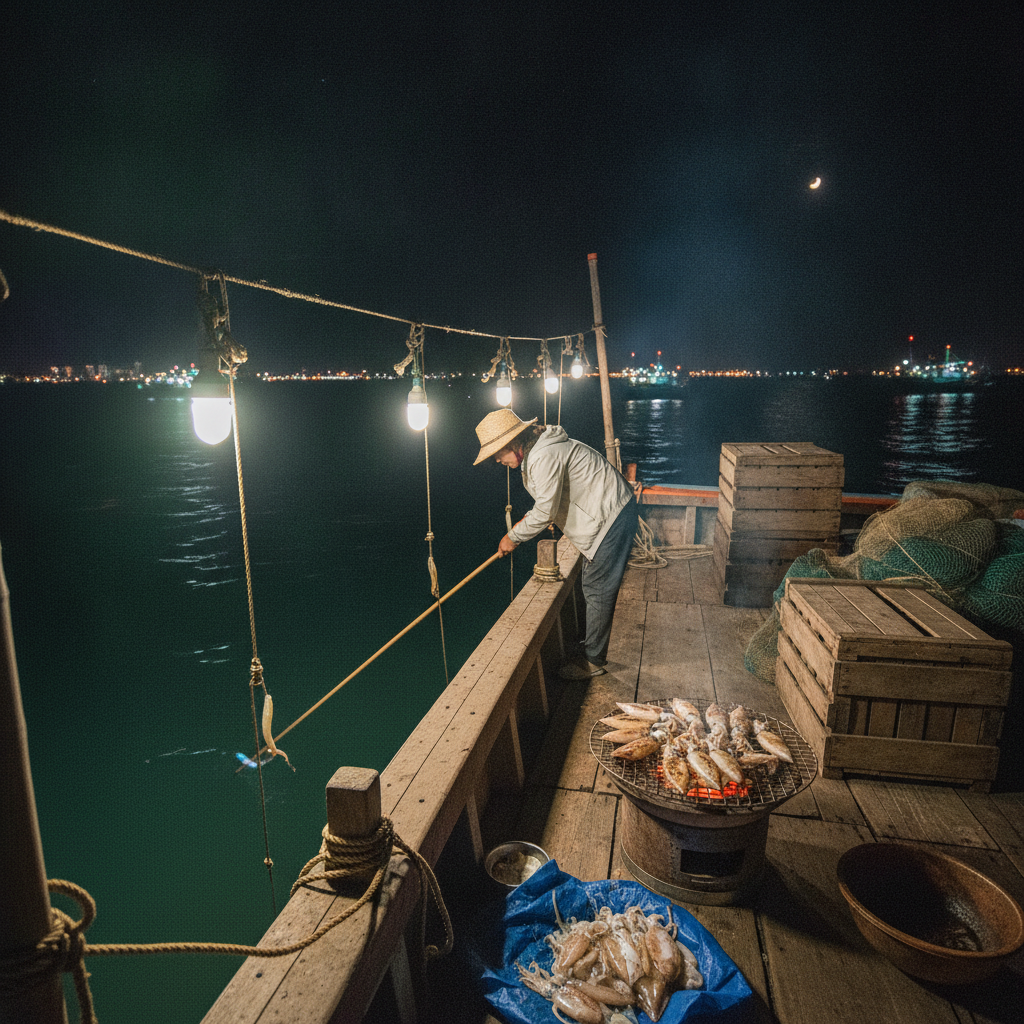
The night squid fishing tour from Nha Trang (the most unusual night activity available from any Vietnamese beach city—departing from Cầu Đá pier at 19:30, sailing 5 km offshore to the squid fishing grounds, fishing until 23:00, returning by 00:30; approximately USD 25–35 per person including equipment and beer): the experience of participating in the same squid fishing that produces the dried squid sold at every Vietnamese street food stall. The technique: the traditional Vietnamese night squid fishing uses a bamboo-handled fishing rod with a jig (a lure with multiple hooks designed to imitate small fish) and a bright LED light suspended over the side of the boat; the light attracts zooplankton to the surface, which attracts the squid; the jig is lowered to 5–10 metres and jerked rhythmically to simulate a fleeing prey item; the squid attacks the jig and is snagged. The success rate: an average participant on the Nha Trang night squid tour catches 3–8 squid per night (the range reflecting the skill of the technique; the guides help beginners with the jerk rhythm); the guides typically catch 20–40 squid in the same period. The eating: the caught squid are grilled immediately on the boat's charcoal hibachi and eaten with salt and lime—the freshest possible squid eating experience; squid caught 3 minutes ago and grilled has a texture and sweetness significantly different from the frozen squid served in the majority of seafood restaurants.
- 4
Nha Trang's Vietnamese Heritage – From the Pre-Cham Period
The Pre-Cham and early Vietnamese history of the Khánh Hòa area—less studied and less presented to visitors than the Cham heritage that dominates the Nha Trang historical narrative—includes the Sa Huỳnh culture (the archaeological culture that occupied the south-central Vietnamese coast from approximately 1000 BCE to 200 CE—contemporary with the late Bronze Age and early Iron Age in Vietnam; the Sa Huỳnh people produced the distinctive jar burial tradition (burying the deceased in large ceramic jars—a burial practice that spread across Maritime Southeast Asia from Taiwan to the Philippines and Borneo, representing the most widely distributed pre-historic burial tradition in the region)). The Sa Huỳnh archaeology: the Khánh Hòa Museum (in Nha Trang—Trần Phú Boulevard) has the most significant display of Sa Huỳnh cultural material in the province, including the jar burial vessels, the iron tools (the Sa Huỳnh iron-smelting tradition was one of the earliest in Southeast Asia), and the ornamental glass beads (the Sa Huỳnh glass bead industry—producing eye beads, carnelian pendants, and the distinctive biconical glass beads now found in archaeological sites from the Philippines to India—was the most significant pre-historic trade item in the maritime Southeast Asian network). The Khánh Hòa indigenous heritage: the Raglai (the indigenous Austronesian community of the Khánh Hòa highlands—approximately 90,000 people; the closest linguistic relatives of the Cham; maintaining traditional music (the đàn đá stone xylophone—the oldest musical instrument in Southeast Asia, with examples dated to 3000 BCE) and forest agriculture practices in the mountains above Nha Trang).
- 5
Nha Trang's Coconut Palm Beach & the Local's Circuit
The local Nha Trang experience—the beaches, markets, and activities that the 450,000 residents of Khánh Hòa province's capital use, distinct from the tourist circuit—provides a qualitatively different engagement with the city. The Bãi Nọc beach (the local beach 4 km south of the central beach strip—no hotels, no beach chairs, no vendors; the city's residents swim here on Sunday mornings, arriving by motorbike at 06:00 and leaving by 09:00 before the heat builds; the beach is flanked by the coconut palms that give it its local name 'Coconut Beach'). The Lê Lợi street market: the 500-metre street market on Lê Lợi Street (1 km from the beach promenade—the Tuesday and Friday morning market where Nha Trang residents buy vegetables, fresh fish from the overnight boats, and the locally distinctive Khánh Hòa specialties including the fresh longan, the sa-ke breadfruit, and the Khánh Hòa salted duck egg). The local motorbike: the most authentic Nha Trang experience for independent travellers is renting a semi-automatic motorbike (USD 5–8/day—widely available on the backpacker streets) and following the coastal road north from the central beach to the Bãi Dài beach area (30 km), passing through the fishing villages, the salt flats, the shrimp farms, and the coconut groves that constitute the actual economic landscape of the Khánh Hòa coast.
- 6
Nha Trang's Place in Vietnamese Tourism – The Original Beach Destination
Nha Trang's place in Vietnamese tourism history—as the original and longest-established beach resort in Vietnam, developed from the 1920s onward under the French administration (as the summer retreat from Saigon and as a resort for the French colonial administration), continuing through the 1950s–1970s South Vietnamese resort era, and expanding rapidly from the 1990s onward as the primary destination for the post-renovation international tourism market—gives it a historical context that newer destinations like Đà Nẵng or Phú Quốc lack. The founding: the French developed the Nha Trang seafront as a resort area from approximately 1923 (the same year the Khánh Hòa Oceanography Museum was established); the Grand Hotel (now the Yasaka Hotel—the most historically significant hotel building in the city, dating from the 1930s) was the first international hotel in Vietnam outside of Saigon, Hanoi, and Huế. The South Vietnamese era: during the 1954–1975 period of the Republic of Vietnam, Nha Trang was the primary domestic beach resort for the Saigon professional class (the generals, the businessmen, and the foreign advisors who could afford the train or the private plane from Saigon used Nha Trang as the standard weekend and holiday resort destination). The post-1986 opening: the 1986 Đổi Mới economic reforms opened Vietnam to international tourism; the first significant international arrivals to Nha Trang were from the Soviet bloc (the Soviet military connection from the Cam Ranh Bay base—the Aeroflot flights that established the Russian market). The current position: Nha Trang remains Vietnam's most historically established beach destination—the benchmark against which all subsequent Vietnamese beach resort development is measured.
Walk this route with audio
Stories play automatically as you reach each stop — no tapping needed.
More in Nha Trang
Nha Trang: The 817 CE Cham Towers Still Used for Hindu Pilgrimage, the Floating Wine Circle That Has Damaged Vietnam's Only Marine Reserve & the Soviet Navy's 23-Year Cam Ranh Bay Base That Created the Russian Tourist Market
Nha Trang's Complete Picture: Whale Sharks at 5 Metres Depth in April, the Plague Bacillus Discoverer Who Retired Here in 1895 & the Resort Island With 8 Hotels Employing 5,000 People
Nha Trang's Hidden Depth: The Plague Bacillus Discoverer Who Built Vietnam's Radio System, the Longest Continuous Coral Reef Data Record in Southeast Asia & the Pink Salt Ponds 160km South

Nha Trang's Southern Arc: The Ngoạn Mục Pass to Đà Lạt's French Hill Station, the Cham Priest's 07:00 Puja at Pô Klông Garai & the Vietnamese Coastal Desert You Didn't Know Existed