Lower Manhattan: Icons, Wall Street & the Brooklyn Bridge
Lower Manhattan is where New York began—and where its mythology runs deepest. This walk moves from Battery Park (where the first Dutch settlers landed in 1624 and where you catch the ferry to the Statue of Liberty) north through the financial district's canyon of skyscrapers to the Brooklyn Bridge, then crosses to DUMBO for the most famous view of the Manhattan skyline in existence. It covers 400 years of American history in about 3 miles: from the colonial fort to the Federal Hall where Washington was inaugurated, to the world's most famous suspension bridge, completed in 1883.
- 1
Battery Park & the Statue of Liberty Ferry
Battery Park, at the southern tip of Manhattan, is where New York's history begins: a Dutch trading post (Fort Amsterdam) was established here in 1624, and the park sits on landfill that was gradually extended into the harbor over 300 years. Today it is a breezy waterfront park with views across New York Harbor to the Statue of Liberty (Île de la Liberté—a gift from France, completed 1886) and Ellis Island (the immigration processing station through which 12 million immigrants passed between 1892 and 1954). The Staten Island Ferry (free) leaves from the Whitehall Ferry Terminal, a 5-minute walk east, and gives an unbeatable close-up view of the statue at no cost. The paid ferry (Statue Cruises) actually lands at the island. Castle Clinton, in the park, is a circular fortress built in 1811 that was originally 200 feet from shore—now it's in the middle of the park—and served as an entertainment venue, an immigration processing station, and an aquarium before becoming a national monument.
- 2
Wall Street & Charging Bull — The World's Financial Heart
Wall Street takes its name from the wooden defensive wall built by Dutch colonists in 1653 along the northern boundary of New Amsterdam (the wall ran along what is now Wall Street). The street is less than a mile long, but its name is synonymous worldwide with American capitalism. Key stops: Federal Hall National Memorial (the site where George Washington was inaugurated as the first President of the United States on 30 April 1789—the current Greek Revival building dates from 1842 and stands on the spot where the original Federal Hall stood); the New York Stock Exchange (opened 1903, the building's six Corinthian columns and triangular pediment are a national monument—trading is no longer visible from outside); and the Charging Bull sculpture (by Arturo Di Modica, installed without permission on Broad Street on 15 December 1989 as a symbol of Wall Street 'bullishness'—now at Bowling Green, always surrounded by tourists photographing each other gripping the bull's horns).
- 3
Stone Street — Manhattan's Oldest Paved Street
Stone Street, just south of Wall Street, is the oldest paved street in Manhattan (paved 1658 by Dutch colonists using cobblestones brought as ballast in trading ships). Today it is a narrow pedestrian alley lined with restored 19th-century commercial buildings, closed to traffic, and filled during the day and evening with outdoor dining tables from the restaurants that line it. It is one of the few streets in Lower Manhattan that retains the scale and atmosphere of pre-skyscraper New York. Nearby Fraunces Tavern (54 Pearl Street) is a restored Georgian tavern where George Washington gave his farewell address to the officers of the Continental Army in December 1783—the building dates from 1719 and is the oldest surviving building in Manhattan.
- 4
Brooklyn Bridge — Engineering Wonder of the 19th Century
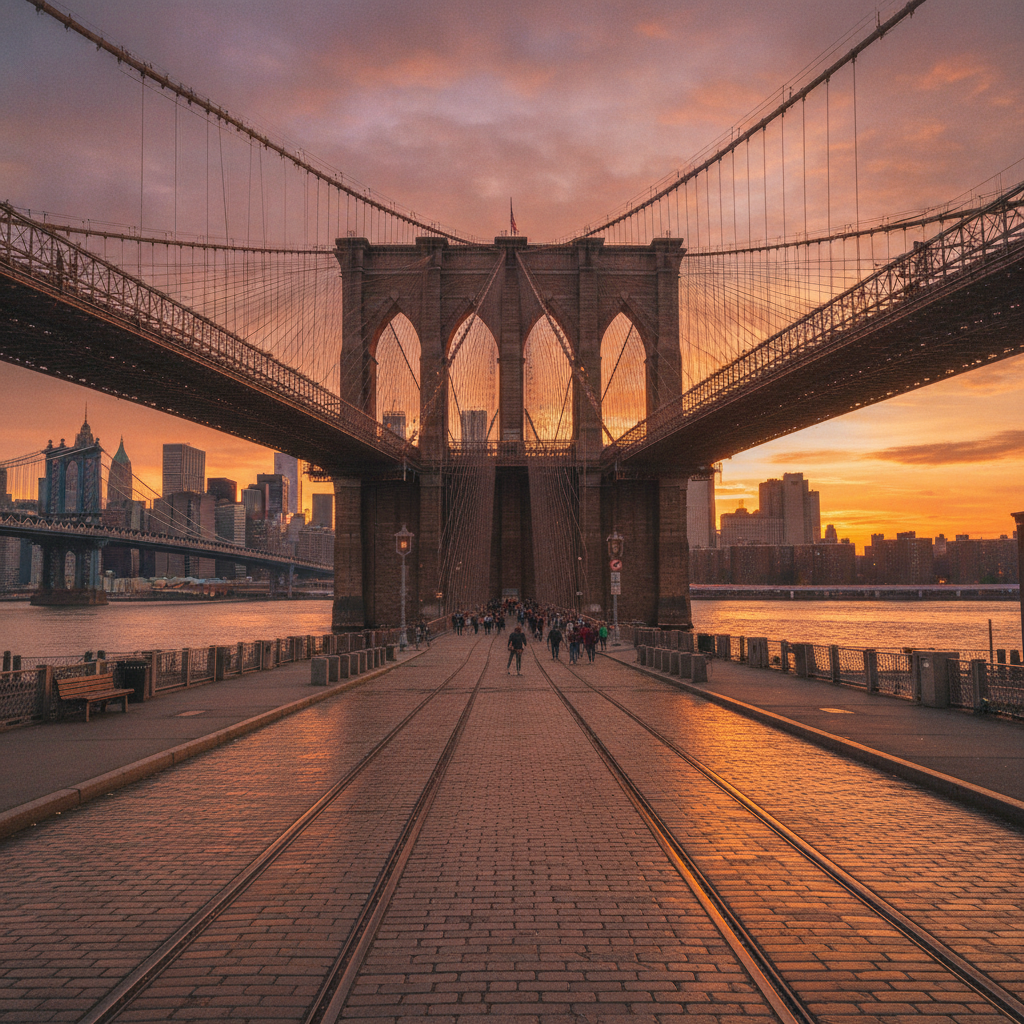
The Brooklyn Bridge—opened 14 May 1883 after 14 years of construction, designed by John Roebling (who died during construction from a foot injury) and completed by his son Washington Roebling (who directed the remainder of the work from a window in Brooklyn Heights after being disabled by decompression sickness)—was the longest suspension bridge in the world at the time of its opening and remains one of the most beautiful bridges ever built. The pedestrian and cycling walkway runs above the traffic lanes between the two massive Gothic stone towers (each 276 feet tall). The walkway is 1.1 miles long. On a clear day the views upriver to Midtown and the Empire State Building, and downriver to the harbor and Statue of Liberty, are extraordinary. Walk to the Manhattan side tower first and pause there before continuing to Brooklyn.
- 5
DUMBO — The Most Photographed View in New York
DUMBO (Down Under the Manhattan Bridge Overpass) is a neighborhood of 19th-century brick warehouses on the Brooklyn waterfront that was converted into artists' studios and lofts in the 1970s and 1980s, and then gentrified into galleries, restaurants and luxury apartments from the 2000s onward. The view from the corner of Washington Street and Water Street—with the Manhattan Bridge framing the Empire State Building in the gap between its two towers—is one of the most photographed spots in New York. Brooklyn Bridge Park (opened 2010) extends along the waterfront south of the bridge: Pier 1 has lawns, a carousel (Jane's Carousel, a 1922 Mangels carousel in a Jean Nouvel glass pavilion), and views directly back to the Lower Manhattan skyline. The park is excellent for picnics.
- 6
Brooklyn Heights Promenade — The Classic Manhattan Panorama
The Brooklyn Heights Promenade, a pedestrian walkway cantilevered over the Brooklyn-Queens Expressway, offers the most complete panoramic view of Lower Manhattan available from ground level: the entire skyline from the Brooklyn Bridge to the Financial District towers, the harbor, Governors Island, and the Statue of Liberty in the distance. The Promenade runs for about a third of a mile along the edge of Brooklyn Heights—one of New York's first landmarked historic districts—and the brownstone-lined streets behind it (particularly Willow Street, Cranberry Street, and Pineapple Street) are among the most beautifully preserved 19th-century residential streets in America. End here at sunset if possible: the light on the Manhattan skyline from this angle is extraordinary.
Walk this route with audio
Stories play automatically as you reach each stop — no tapping needed.
More in new-york
Central Park & Museum Mile: Art, Nature & the Heart of Manhattan
Brooklyn: Food Markets, Art & the Best Views of Manhattan
Greenwich Village & SoHo: Bohemian Heart of Downtown Manhattan
Midtown Icons: Grand Central, Rockefeller Center & Times Square
Lower East Side & Chinatown: The Immigrant City