The World's Oldest Wooden Building, 30,000 Cherry Trees on a Sacred Mountain & the Noodle Tradition That Japan Claims to Have Invented
The Omizutori ceremony's 1,262-year continuous record without interruption and the midnight water-drawing that announces spring in Nara; Hōryū-ji's 1,315-year-old pagoda with its Silk Road Entasis columns and the twice-annual unwrapping of the Kuse Kannon; the blind monk Ganjin's six-crossing journey from China to found Tōshōdai-ji and the first realistic portrait in Japan; Yoshino's four-zone cherry blossom staggered over 3–4 weeks; Miwa's claim to be the oldest sōmen noodle tradition in Japan and Yoshino-kuzu as the country's finest arrowroot starch; and the January Wakakusa mountain-burning event visible with deer silhouettes against the fire.
- 1
The Omizutori Water-Drawing Ceremony
The Shuni-e (Omizutori—'Water Drawing') ceremony at Nigatsudō (Second Month Hall—the secondary hall of Tōdai-ji complex on the hillside above the main Daibutsuden, accessible by a stone path through the forest): the 1,262-year continuous ceremony (held annually in March since 752 CE without a single interruption—the longest continuously performed ritual in Japan) involves 11 priests in a two-week programme of austerities, prayers, and the drawing of sacred water from the Wakasa Well at midnight on 12–13 March. The fire ritual (the most photographed element of the Omizutori ceremony): the large pine torches (12 torches measuring 6–8 metres in length, carried by monks) are ignited from the Nigatsudō hall's fire during the evening ceremony on 1–14 March; the sparks from the torches shower the crowd below the hall's wooden balcony—contact with the sparks is considered to ward off illness for the coming year. The water drawing: the monk procession at midnight on 12–13 March descends to the Wakasa Well (the well said to receive water flowing underground from Wakasa Province in Fukui Prefecture—a legend established in 752 CE and maintained as ceremonial truth): the drawing of the sacred water from the well and its offering to the Buddha constitutes the ceremony's central act. The Shuni-e and the Japanese calendar: the end of Omizutori on 14 March is traditionally the announcement that spring has arrived in Nara—the ceremony's conclusion is followed within days by the first plum blossom in the Tōdai-ji garden.
- 2
Hōryū-ji – The World's Oldest Wooden Buildings
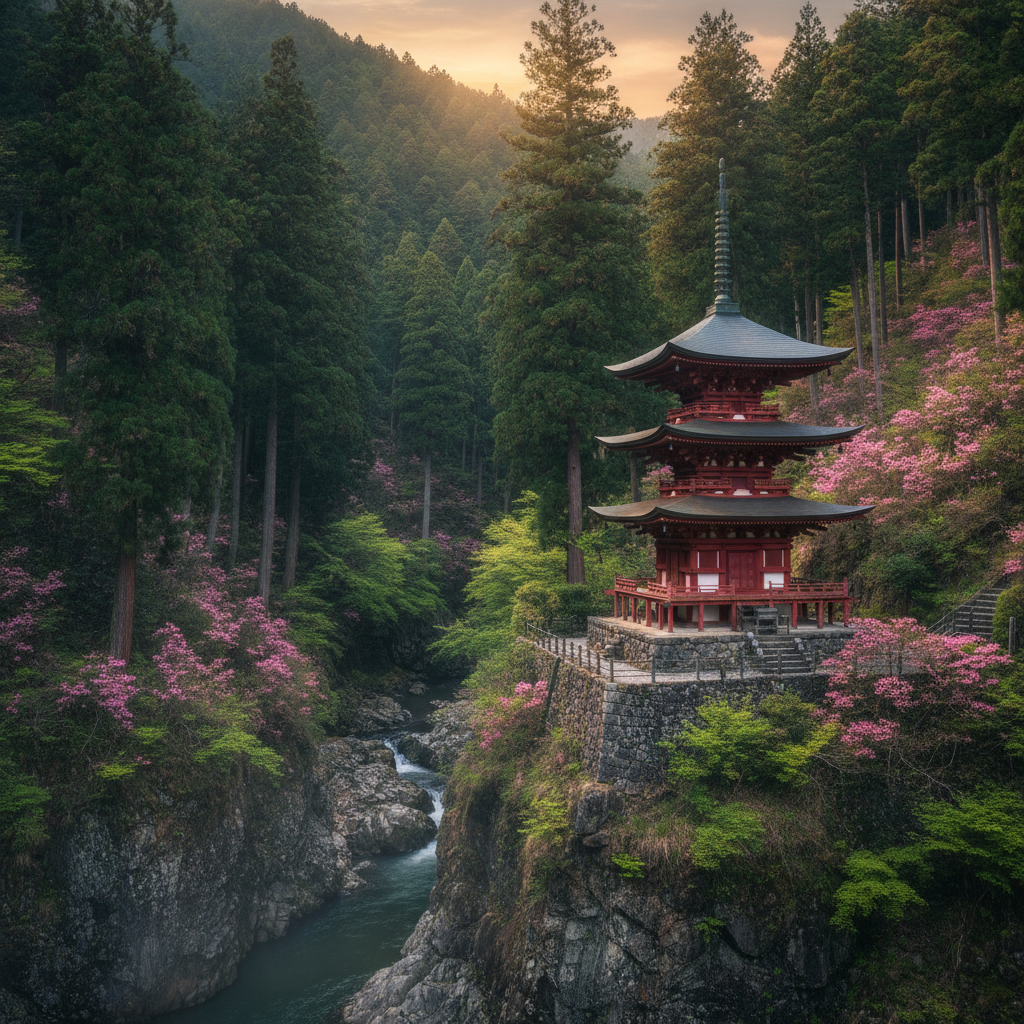
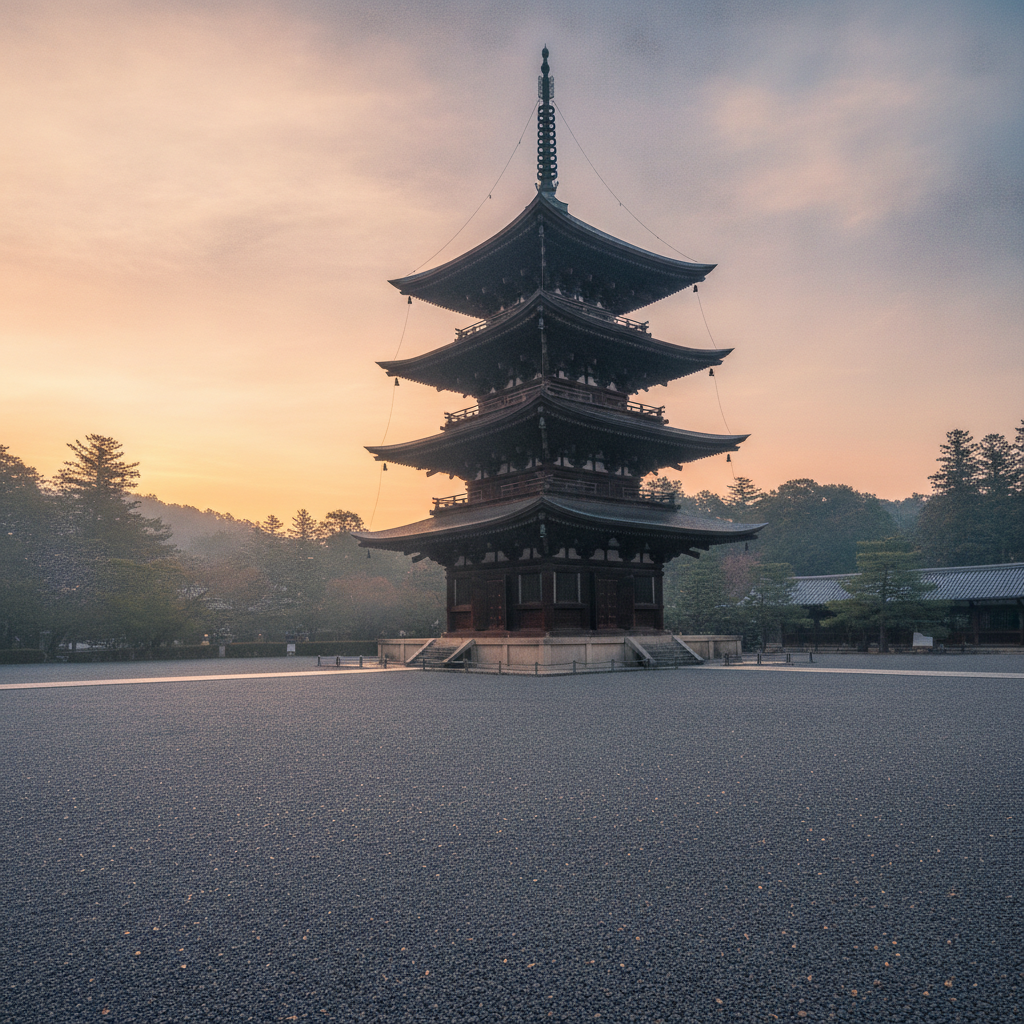
Hōryū-ji (the temple complex 10 km southwest of Nara city center—accessible by JR Yamatoji Line from JR Nara Station to Hōryūji Station, 11 minutes, ¥210; plus a 20-minute walk or 5-minute bus): the 5-story pagoda (建立 607 CE—or more precisely, rebuilt after a fire in 670 CE and reconstructed in 711 CE; the current structure is the world's oldest surviving wooden building at 1,315 years old, with the wooden pillars of the Entasis design (slightly convex taper in the column, borrowed from Greek temple architecture via the Silk Road—the westernmost influence visible in the earliest Japanese Buddhist architecture). The Kondō (the Golden Hall—adjacent to the pagoda, dating from the same 8th-century reconstruction; the interior contains 7 significant Buddhist statues including the Shaka Triad by Tori Busshi (623 CE)—the oldest signed and dated sculpture in Japan): the Tori Busshi sculptures are the earliest Japanese adaptation of Chinese Northern Wei Buddhist sculpture and the foundation of the subsequent Japanese Buddhist sculptural tradition. The Yumedono (the Hall of Dreams—the octagonal hall in Hōryū-ji's East Precinct, built in 739 CE over the site of Prince Shōtoku's meditation hall; the hall houses the Kuse Kannon statue—wrapped in white cloth and shown to the public only twice annually (April and November): the unwrapping of a 1,400-year-old sculpture to public view is one of the most ritually charged events in Japanese art history).
- 3
Yakushi-ji & Tōshōdai-ji – The Nishino-kyō Temple Circuit
The Nishino-kyō district (the temple district 2 km west of Nara city center, accessible by Kintetsu Kashihara Line from Kintetsu Nara to Nishikyogoku Station): two temples within 1 km of each other that constitute the most architecturally significant Buddhist heritage in Japan outside Hōryū-ji. Yakushi-ji (the temple built in 680 CE for Emperor Temmu's prayer for his wife's recovery—the original dedication is one of the earliest documented examples of devotional Buddhist temple construction in Japan; the East Pagoda: the only original 8th-century building surviving at Yakushi-ji, its alternating large-roof-small-roof rhythm giving a visual appearance of 6 stories while actually being 3, the most sophisticated rhythmic exercise in Japanese wooden architecture): the West Pagoda is a 1980 reconstruction. Tōshōdai-ji (the temple founded in 759 CE by the blind Chinese monk Ganjin (Jianzhen)—Ganjin had attempted five sea crossings from China to Japan over 11 years to bring the proper Buddhist ordination ceremony to Japan, losing his sight in the process; arrived in Japan in 754 CE at age 67; founded Tōshōdai-ji at 68; died at 76 having never seen Japan with his eyes): the Kondō at Tōshōdai-ji is the largest surviving Nara-period (710–794 CE) building in Japan and the most architecturally pure example of Tang Chinese Buddhist architecture in the country. The Ganjin dry-lacquer portrait sculpture (755 CE—the oldest portrait sculpture in Japan, depicting Ganjin in his blindness with closed eyes): considered Japan's first realistic portrait.
- 4
Yoshino – Cherry Blossoms at Altitude
Yoshino (45 minutes south of Nara by Kintetsu Yoshino Line from Kintetsu Nara; the mountain town at 365 metres elevation where approximately 30,000 Yoshino cherry trees cover the mountain slopes in concentric bands of blossom): Japan's most famous cherry blossom viewing location and one of the oldest—the pilgrimage associations with the Kinpusen-ji Temple on the mountain (the temple that served as the headquarters of Shugendo, the syncretic mountain ascetic practice) have made Yoshino a sacred site for 1,300 years before it became a tourist destination. The four cherry zones (the Yoshino mountain is divided into four viewing elevations: Shimo Senbon (lower), Naka Senbon (middle), Kami Senbon (upper), and Oku Senbon (innermost)—each zone blooms approximately 1 week after the one below it, extending the total blossom viewing period to approximately 3–4 weeks in April. The optimal strategy (taking the cable car (2 minutes; ¥450) to the Naka Senbon level and walking up through the zones, returning by cable car from the highest practical point): the Oku Senbon area requires a 4 km round-trip walk and is the quietest zone. The Zao Gongen (the principal deity of Kinpusen-ji—a fusion figure combining Shaka, Kannon, and Maitreya in a single form; the 7-metre blue figure is shown to the public for three specific weeks annually in spring, summer, and autumn; the spring unveiling coincides with cherry blossom season, drawing the largest crowds): the Yoshino Mountain management advises against visiting on weekends during peak blossom—a crowd of 100,000 on a Saturday is typical.
- 5
Nara's Food – Kakinoha-zushi & Miwa Sōmen
Nara's culinary traditions are less internationally known than those of Kyoto or Osaka but are among the most historically documented in Japan—the Nara period (710–794 CE) is when the first written Japanese food records appear, and several of those documented foods are still produced and eaten in Nara today. Kakinoha-zushi (the persimmon-leaf pressed sushi—the Yoshino cedar persimmon leaves are used to wrap portions of mackerel or salmon pressed onto vinegared rice; the leaf's natural antimicrobial properties were historically important for preservation in Nara's mountain communities; the leaf imparts a subtle persimmon tannin flavour to the rice over the overnight pressing period): the benchmark kakinoha-zushi producers are the Tanaka and Kakinohazushi Hiraso shops in the Naramachi district. Miwa sōmen (the thin white wheat noodle produced in Miwa Town, south of Nara, where the Ōmiwa Shrine's ritual significance has been associated with white noodle production since the 10th century; Miwa sōmen is considered the oldest noodle tradition in Japan and the origin point of the Japanese thin noodle food culture): served cold in summer with a dipping tsuyu sauce, or in warm broth in winter. Kuzu starch (the arrowroot starch produced from the kuzu vine roots in Yoshino's mountains—Yoshino-kuzu is considered the highest quality kuzu starch in Japan; used in kudzu-kiri (the transparent kuzu starch noodle served in a wooden vessel with kuromitsu syrup) and in the wagashi confectionery of Nara's traditional sweets shops). The sake of Miwa (the Sake Brewery Road in Sakurai City, Nara—the mountain water of the Yoshino watershed producing the 3 sake breweries that maintain the oldest sake production methods in Japan).
- 6
Nara Off-Season & Hidden Sites
The Nara itinerary beyond Tōdai-ji and Kasuga Taisha—the lesser-visited sites that repay the additional time. Isui-en Garden (the 17th and 19th-century garden in two sections east of Kōfuku-ji, borrowing the mountains behind Tōdai-ji as a shakkei (borrowed landscape) backdrop—the most refined garden in Nara and one of the finest Meiji-era gardens in Japan; ¥1,200 entrance): the garden's borrowed view of the Nandai-mon gate and Wakakusa Hill beyond the eastern wall is only available from a specific stone path in the eastern section. Shin-Yakushi-ji Temple (the 747 CE temple on the southeastern edge of Nara Park, housing the 12 clay Guardian Generals (Jūni Shinshō)—each 1.5-metre figure protecting the Yakushi Buddha at the center; 9 of the 12 are original 8th-century clay sculptures, constituting the most complete set of Nara-period clay guardian figures in Japan): less visited than Tōdai-ji but arguably more affecting in its human scale. Nara National Museum (the Nara Buddhist sculpture reference collection—the 2 buildings on the park's western edge housing the most comprehensive collection of Japanese Buddhist art in Japan outside the Tokyo National Museum; the autumn exhibition (October–November) rotates the collection to show the major works that are normally in storage). The Wakakusa Yamayaki (the 'Mountain Burning' on the fourth Saturday of January—the annual burning of the dry winter grass on Wakakusa Hill overlooking Nara Park; the fire is lit at 18:15 after a fireworks display; the burning hillside with the deer silhouettes in the foreground is the most dramatic night event in Nara): accommodation for this event requires booking 6+ months in advance.
Walk this route with audio
Stories play automatically as you reach each stop — no tapping needed.
More in Nara
The Bronze Buddha Cast in 749 CE, the Pillar Hole That Fits His Nostril & the Forest That Has Not Been Cut Since 841 CE
Heijō-kyō's 100,000-Person Capital, the Passive Climate Control Log Cabin With 9,000 Silk Road Objects & Japan's First Mountain God With No Hall
The Cherry Tree Planted as a Prayer That Started 30,000 Trees, the Roller Coaster With Vines Growing Through It & What the Great Buddha's Spiral Curls Look Like From Directly Below
The 20,000 Lantern August Festival, Bruno Taut's 'Highest Expression of the Human Soul' & the Morning Ceremony Before the Great Buddha