Monterrey Water Crisis, Urban Heat and the Environmental Cost of Industrial Growth in the Semi-Arid Nuevo Leon Valley Where Summer Temperatures Hit 45 Celsius and the Metropolitan Area Ran Out of Tap Water in 2022
In the summer of 2022 Monterrey, a metropolitan area of 5.3 million people and the industrial capital of Mexico, ran out of tap water for significant portions of the population for weeks at a time as the reservoirs of the Cerro Prieto and El Cuchillo dams dropped to critical levels after three consecutive years of below-average rainfall in the Sierra Madre Oriental catchment area, exposing the fundamental water vulnerability of a large industrial city built in a semi-arid valley where the annual rainfall averages only 600 millimetres and the industrial and residential water demand has grown faster than the infrastructure to supply it. The 2022 Monterrey water crisis was not a surprise to hydrologists who had documented the combination of population growth, industrial water demand, agricultural irrigation withdrawal, and climate change-driven precipitation reduction that was making the Nuevo Leon water system increasingly fragile, but the political and corporate leadership of the city had consistently prioritized industrial growth over water security investment, leading to the crisis that left middle-class colonias and working-class neighborhoods alike hauling water in trucks while the corporate office parks in San Pedro Garza Garcia maintained supply through priority allocation. The temperature records of Monterrey in recent decades document a sustained warming trend in which the extreme heat events that were previously occasional are becoming routine, with temperatures above 40 Celsius occurring on an increasing number of days per year and the urban heat island effect of the vast concrete and asphalt surface of the metropolitan area adding several degrees to the official temperature measurements.
- 1
Monterrey Water Crisis of 2022
The Monterrey water crisis of 2022, in which the tap water supply failed for weeks and in some areas months for significant portions of a metropolitan area of 5.3 million people, was the most severe urban water failure in modern Mexican history and a warning to the growing cities of the Mexican north about the consequences of building industrial economies in semi-arid regions without proportionate investment in water infrastructure and conservation. The El Cuchillo reservoir, the primary water supply for the Monterrey metropolitan area located on the San Juan River 100 kilometres east of the city, dropped to 2 percent of capacity in the summer of 2022 after three consecutive years of below-average rainfall in the Sierra Madre Oriental watershed. The Cerro Prieto reservoir, the secondary supply, was simultaneously at 20 percent. The state government of Nuevo Leon implemented emergency water rationing by neighborhood, with some areas receiving piped supply only 4 hours per day and others relying entirely on water trucks. The industrial plants, whose water consumption was significant, were not subjected to the same restrictions as residential users, generating protests from neighborhoods that were rationed while beer and steel plants maintained supply. The crisis exposed the dual failure of water infrastructure investment, which had not kept pace with metropolitan population growth from 1 million in 1960 to 5 million in 2020, and water governance, which had no mechanism to allocate reduced supply equitably between residential, industrial, and agricultural users.
- 2
Heat Island Effect and Urban Climate
The urban heat island effect in Monterrey, where the dense concentration of concrete, asphalt, industrial infrastructure, and heat-generating machinery across the 7,000-square-kilometre metropolitan area raises the surface and air temperature by 3 to 5 Celsius above the surrounding semi-desert landscape, compounds the underlying climate warming trend to produce summer conditions in the city center that are significantly more extreme than the official weather station measurements taken at the airport or in park settings. The August 2020 heat event, when Monterrey recorded temperatures above 45 Celsius in the hottest neighborhoods of the eastern industrial municipalities, caused multiple heat-related deaths among outdoor workers, construction laborers, and elderly residents without air conditioning in the working-class colonias that have the least tree cover and the highest proportion of heat-absorbing dark surfaces. The cooling degree days required to maintain comfortable indoor temperatures in Monterrey, calculated as the cumulative daily excess above 18 Celsius, are among the highest in the Mexican north, making air conditioning a necessity rather than a luxury for the majority of the year and creating an electricity demand peak in summer that strains the national grid. The green infrastructure deficit of Monterrey, where the tree canopy cover in the eastern working-class municipalities averages less than 5 percent of land area compared to 15 to 20 percent in the wealthy San Pedro Garza Garcia municipality, creates a stark within-city inequality in heat exposure that maps precisely onto the income inequality documented in municipal revenue statistics.
- 3
Santa Catarina River and Flood History
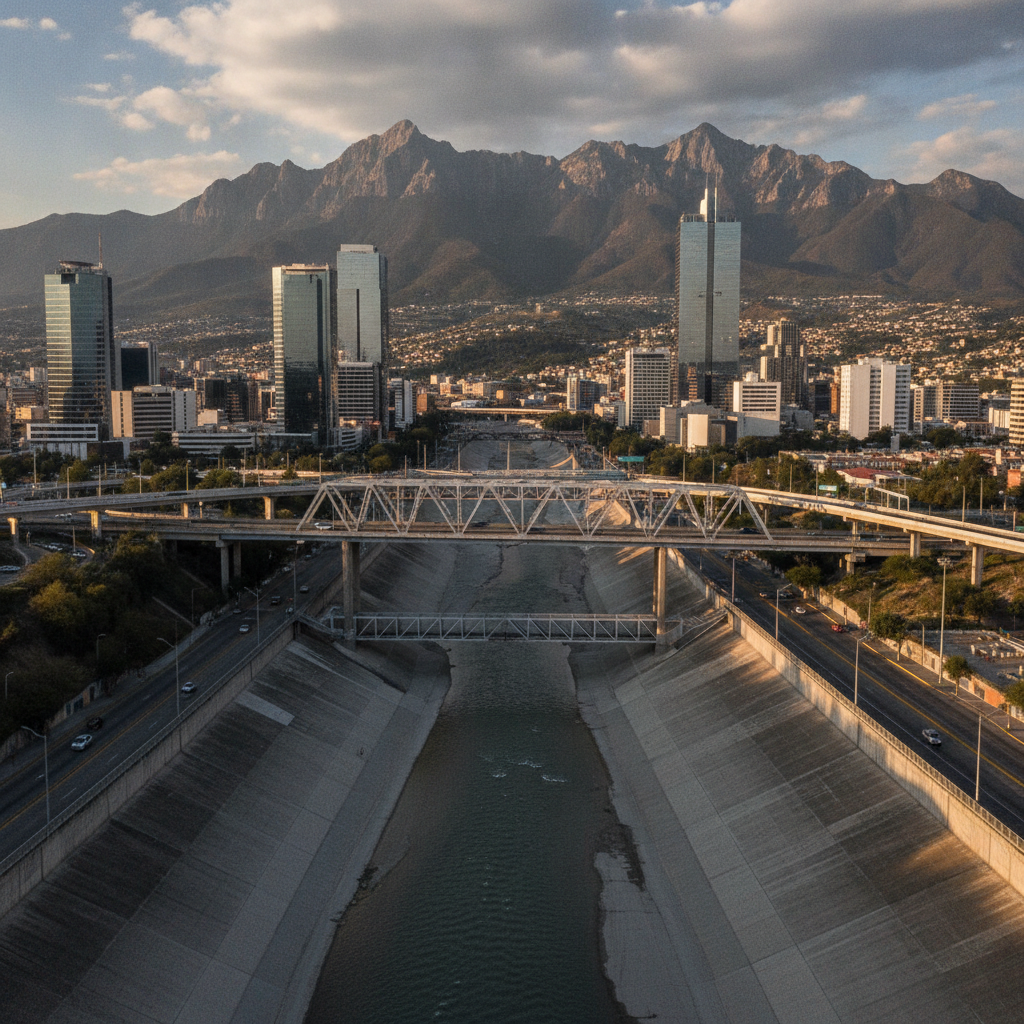
The Santa Catarina River, which flows from the Sierra Madre Oriental through the center of the Monterrey valley in a concrete-channeled course 40 kilometres long, has been channeled, dammed, and managed since the early 20th century in response to the catastrophic floods that recur when Sierra Madre storms dump rainfall faster than the valley drainage system can handle, with the most destructive events killing hundreds and causing billions of pesos in damage. The 1988 flood, caused by Hurricane Gilbert making landfall in Tamaulipas and tracking inland across Nuevo Leon, killed approximately 200 people in Monterrey and caused damage that required years to repair, with the river channel overtopping its concrete banks and flooding the industrial and residential areas of the valley floor. The channeling of the Santa Catarina into a concrete course 6 kilometres through the urban center, completed in the 1970s, enabled the development of the riverbank areas as parks and cycling infrastructure but eliminated the natural riparian ecosystem and the river's capacity to absorb flood flows through floodplain spreading. The Parque Lineal Santa Catarina, a linear park system along the channeled river, provides cycling paths and recreational areas that are the primary green linear infrastructure of the city center. The flooding risk remains significant: the 2010 storms associated with Hurricane Alex deposited over 400 millimetres of rainfall on the Sierra Madre in 48 hours, flooding the Santa Catarina channel again and destroying infrastructure in the western municipalities.
- 4
Monterrey Industrial Pollution and Environmental Legacy
The environmental cost of Monterrey's industrial development, concentrated in the municipalities of Monterrey, Guadalupe, San Nicolas de los Garza, and Apodaca where the steel mills, foundries, glass plants, chemical factories, and maquiladora assembly plants are located, includes decades of air pollution from industrial emissions, soil contamination from industrial waste disposal, and water quality degradation from industrial effluent discharge into the Santa Catarina and Pesqueria rivers. The Fundidora de Fierro y Acero, the steel plant that operated from 1900 to 1986, left a brownfield contamination legacy at the Parque Fundidora site that required significant remediation before the industrial heritage park could be developed, and the contamination plume from its operations reached the adjacent residential areas that had grown up around the plant during its operating life. The air quality monitoring network established by the Nuevo Leon state environmental agency documents episodes of particulate matter and ozone pollution that exceed federal standards on dozens of days per year in the eastern industrial municipalities. The industrial corridor along the Carretera Nacional south of Monterrey and the Apodaca industrial park north of the city generate the highest measured pollution concentrations in the metropolitan area. The transition of the Monterrey economy from heavy industrial production toward high-technology manufacturing and services, which began in the 1990s, has reduced pollution per unit of economic output but has not eliminated it as the manufacturing base expanded to serve the USMCA export market.
- 5
Water Reuse and Conservation Infrastructure
The response to the 2022 water crisis has accelerated investment in water reuse and conservation infrastructure that the Nuevo Leon state government and the Monterrey metropolitan authority had been planning but not implementing at sufficient speed before the crisis forced prioritization. The Planta de Tratamiento de Aguas Residuales Norte, the northern wastewater treatment plant that processes Monterrey municipal wastewater for agricultural and industrial reuse, was expanded after 2022 with capacity to return treated water to the irrigation system of the San Juan River agricultural zone, reducing the agricultural claims on reservoir storage. The desalination of brackish groundwater from the aquifers beneath the Monterrey valley, which had been considered too expensive to implement at scale, was reconsidered after 2022 as part of the supply diversification strategy. The residential water conservation program implemented during the crisis, which required the installation of water meters and low-flow plumbing fixtures in new construction, continued after the crisis eased as a permanent building code requirement. The reforestation program in the Sierra Madre Oriental watershed, designed to improve rainfall infiltration and reduce runoff by restoring native pine and oak forest in degraded areas, was expanded with funding from the state government and corporate sponsors. The 2022 crisis changed the political discourse around water in Monterrey in ways that previous dry years had not, making water security a permanent agenda item in the metropolitan planning conversation.
- 6
Monterrey Environmental Activism and Green Future
The environmental activism of Monterrey, historically suppressed by the economic and political dominance of the industrial families who created the pollution and the state government that prioritized industrial growth, grew significantly after the 2022 water crisis, with citizen groups organizing around water security, tree planting, air quality monitoring, and the protection of the natural areas surrounding the city. The Bosque Urbano Monterrey initiative, a civic tree-planting program that has planted over 500,000 trees in the metropolitan area since 2015 with corporate and government funding, represents the most visible green infrastructure investment in the city. The community groups monitoring air quality in the eastern industrial municipalities using low-cost portable sensors, a citizen science approach developed because the official monitoring network was insufficient for neighborhood-scale measurement, produced data that documented health impacts in communities adjacent to the largest industrial facilities. The green building movement in the Monterrey construction industry, driven partly by the corporate sustainability commitments of the large companies headquartered in the city, has produced several buildings with LEED certification and water reuse systems in the San Pedro Garza Garcia commercial district. The tension between the environmental costs of the manufacturing economy that generates the wealth of Monterrey and the quality of life implications of that manufacturing activity for the majority of residents who live in the industrial municipalities is the defining environmental politics of the city for the foreseeable future.
Walk this route with audio
Stories play automatically as you reach each stop — no tapping needed.
More in Monterrey
Monterrey Colonial History and Nuevo Leon Founding: The Crypto-Jewish Settlers of Luis de Carvajal the Younger, the Failed First Settlements and the 1596 Establishment That Finally Survived

Monterrey Food Culture: Cabrito Roasted Kid Goat, Carne Asada the Northern Mexican Grill Tradition, Pan de Polvo Cookies and the Machaca Dried Beef That Defines the Northern Mexican Ranching Table
Monterrey Mountains and Nature: Grutas de Garcia Limestone Caves, Cola de Caballo Waterfall, Chipinque Ecological Park and the Sierra Madre Canyon System That Makes This the Most Dramatically Situated Industrial City in Mexico
Monterrey Sport and Stadium Culture: Tigres and Rayados Football Rivalry, the PPG Paints Arena Boxing Tradition and the Regiomontano Sports Identity That Turns Two Football Clubs Into a Proxy for Class Division

Monterrey Music Identity: Norteño and Grupero Accordion Music from the Nuevo Leon Border Corridor That Became the Soundtrack of the Mexican Diaspora and the Cultural Background of 35 Million Mexican Americans