Zócalo, Templo Mayor & the Historic Centre — Aztec and Colonial Mexico City
The historic centre of Mexico City occupies the site of Tenochtitlan, the Aztec capital founded in 1325 on an island in Lake Texcoco — the most layered urban history in the Americas, where the ruins of the Aztec empire lie beneath the grandest colonial baroque architecture in the New World, all organized around the Zócalo, one of the world's largest public plazas.
- 1
The Zócalo — Heart of the Americas' Most Layered City
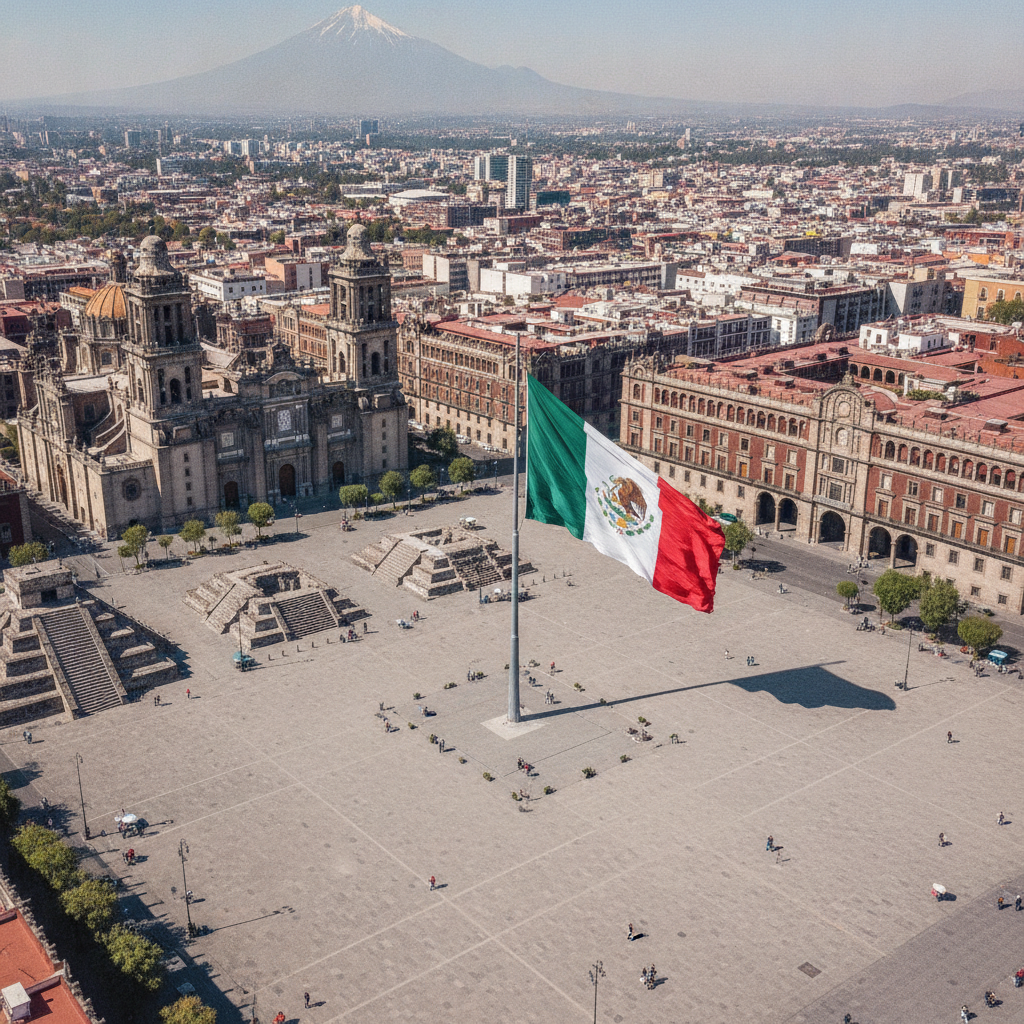
The Zócalo (Plaza de la Constitución, officially — 57,600 square metres, approximately 240 metres per side, the second-largest public plaza in the world after Tiananmen Square in Beijing): the Zócalo has been the civic, religious, and commercial centre of Mexico City for 700 years — from the central plaza of Tenochtitlan (where the great Aztec temple complex stood at the centre of the island capital) to the main plaza of the Spanish colonial capital of New Spain (one of the wealthiest and most populous cities in the world in the 17th and 18th centuries) to the symbolic heart of independent Mexico; the plaza is flanked on the north by the Metropolitan Cathedral (the largest cathedral in the Americas, built between 1573 and 1813, a layered synthesis of Renaissance, Baroque, and Neoclassical styles on foundations that include stones from the Aztec Templo Mayor), on the east by the Palacio Nacional (the National Palace, built on the site of the palace of Moctezuma II, expanded and rebuilt numerous times, containing the Diego Rivera murals of Mexican history commissioned in 1929), and on the north and west by the Portal de Mercaderes and Portal de Evangelistas colonnaded commercial buildings.
- 2
Templo Mayor — The Great Aztec Temple at the Centre of the World
Templo Mayor (Seminario 8, Centro Histórico — the main temple of the Aztec capital Tenochtitlan, accidently rediscovered in 1978 when electrical workers digging a cable trench encountered the massive stone disk of the Moon Goddess Coyolxauhqui (3.25 metres in diameter), leading to an archaeological excavation that has continued ever since, uncovering one of the most significant Pre-Columbian archaeological sites in the Americas): the Templo Mayor was the political and religious centre of the Aztec Empire (Mexica Empire) — a stepped pyramid approximately 60 metres high and 100 metres per side at its largest extent, built and expanded in seven construction phases between approximately 1325 and 1521, dedicated to two deities (Huitzilopochtli, god of the sun and war, and Tlaloc, god of rain and agriculture) whose shrines stood at the top of the two staircases; the temple was demolished by the Spanish in 1521 and its stones used in the construction of the Metropolitan Cathedral; the Templo Mayor Museum (designed by Pedro Ramírez Vázquez, opened 1987) displays the 8,000+ artifacts recovered from the excavations.
- 3
Palacio Nacional — Diego Rivera's Epic Vision of Mexican History
The Palacio Nacional (National Palace, east side of the Zócalo — the seat of the federal executive in Mexico, built on the site of the palace of the Aztec Emperor Moctezuma II (expanded by Hernán Cortés as his residence after the Conquest) and serving as the seat of government of New Spain and subsequently of independent Mexico since 1521): the Palacio Nacional is most celebrated for the extraordinary cycle of murals painted by Diego Rivera on the walls of the main staircase and the first floor galleries between 1929 and 1951 — the most important public art commission in Mexican history and one of the defining works of 20th-century political art; the main staircase mural 'Epic of the Mexican People in Their Struggle for Freedom and Independence' (1929-1935) presents the full sweep of Mexican history from the pre-Hispanic period through the Aztec Empire, the Spanish Conquest, the colonial period, the Mexican War of Independence, the Reform War, the French Intervention and the Revolution to the present, in an extraordinary synthesis of historical narrative, social critique, and aesthetic power that influenced public art worldwide.
- 4
Metropolitan Cathedral — 250 Years of Colonial Baroque Architecture
The Metropolitan Cathedral of the Assumption of the Most Blessed Virgin Mary into Heaven (Catedral Metropolitana de la Asunción de la Santísima Virgen María a los cielos — north side of the Zócalo, begun 1573, consecrated 1656, completed 1813): the largest cathedral in the Americas (it covers an area of 109 metres by 59 metres with twin towers reaching 67 metres) represents the longest building campaign in the New World and the most layered and complex example of colonial religious architecture in existence; the exterior ranges from Renaissance (the lower sections) through Baroque (the 17th-century main portal) to Neoclassical (the upper sections and towers designed by Manuel Tolsá, completed 1813); the interior contains multiple chapels (the Capilla de los Reyes at the far end with its spectacular golden Churrigueresque retablo is the finest individual piece of colonial interior decoration in Mexico), 14 altars of varying periods, and elaborate choir stalls; the cathedral has sunk approximately 2 metres into the soft former lake bed on which it was built and was extensively reinforced in the 1990s-2000s to correct its 0.98-degree list.
- 5
Palacio de Bellas Artes — Art Nouveau, Art Deco & Mexican Muralism
The Palacio de Bellas Artes (Palace of Fine Arts, Avenida Juárez at Eje Central Lázaro Cárdenas, Centro Histórico — begun 1904 under the regime of Porfirio Díaz, architect Adamo Boari, interrupted by the Mexican Revolution and completed 1934 under Architect Federico Mariscal): the Palacio is the most extraordinary example of architectural hybridism in Mexico — the exterior is Italian Art Nouveau in white Carrara marble with a spectacular dome of Tiffany glass (the largest Tiffany glass dome in the world, with 7,400 square metres of Tiffany glass tiles); the interior is pure Art Deco in onyx, marble, and glass, with the central foyer featuring a spectacular Tiffany mosaic curtain depicting the volcanoes Popocatépetl and Iztaccíhuatl (made of 10,000 pieces of Tiffany glass, weighing 22 tons); the theatre hosts the Ballet Folklórico de México; the museum on the upper floors contains murals by Diego Rivera ('Man at the Crossroads', 1934), José Clemente Orozco, David Alfaro Siqueiros, and Rufino Tamayo.
- 6
Alameda Central & Avenida Madero — Colonial Walking Route
Avenida Madero (the pedestrian street running west from the Zócalo to the Alameda Central park, one of the most historically dense urban streets in the Americas — approximately 700 metres long and closed to vehicles): Avenida Madero passes the Torre Latinoamericana (the 1956 skyscraper that was the tallest building in Latin America at its completion, 182 metres, now offering a 360-degree observation deck from the 44th floor), the Casa de los Azulejos ('House of Tiles', the 18th-century mansion entirely faced in blue and white Talavera tiles from Puebla, now a Sanborns restaurant and department store), and the Palacio de Iturbide (the 18th-century baroque palace where Agustín de Iturbide, the first emperor of independent Mexico, held court in 1821-1823); the Alameda Central (the park established in 1592 as the first public park in the Americas) at the western end of Avenida Madero contains the Hemiciclo a Juárez monument and borders the Palacio de Bellas Artes.
Walk this route with audio
Stories play automatically as you reach each stop — no tapping needed.
More in mexico-city
Teotihuacan — The Pyramids of the Sun and Moon
Frida Kahlo, Diego Rivera, Coyoacán & Xochimilco
National Museum of Anthropology & Chapultepec Castle
Mexican Food Culture — Tacos, Tamales, Mole & the Market Tradition
Lucha Libre — Arena México & the Art of Mexican Wrestling