Medellin Urban Transformation: Architecture, Innovation, and the World Design Capital
Medellin was named World Design Capital in 2023, recognizing the city's sustained use of architecture, urban design, and public space investment as instruments of social transformation over the preceding two decades. The transformation began in earnest with the Metrocable installations in 2004 and accelerated through a series of bold public projects including the España Library, the Parque Explora science park, the Jardín Botánico expansion, and the series of Unidades de Vida Articulada community centers. The urban acupuncture strategy, which concentrated high-quality public investment in the most excluded neighborhoods to change the social dynamics of those spaces, became an internationally studied model. The contemporary Medellin architecture scene includes both these landmark public projects and a growing private sector of innovative residential and commercial buildings.
- 1
The España Library: Architecture as Social Statement
The España Library, designed by architect Giancarlo Mazzanti and opened in 2007 in the hillside neighborhood of Santo Domingo Savio in the northeastern comunas, was the most celebrated individual building of the Medellin urban transformation era and the structure that attracted the most international architectural attention. The building, consisting of three black angular rock-like volumes housing library facilities, a community center, exhibition space, and internet access rooms, was placed deliberately on a steep hillside in one of the most historically dangerous and excluded neighborhoods of the city, making a statement that world-class architecture and public investment belonged in the comunas as much as in the valley floor. The España Library won multiple international architecture awards and was featured in major publications worldwide, contributing significantly to Medellin's emerging reputation for innovative urban design. The original building was demolished in 2018 after structural problems related to the slope were discovered; a replacement library project was announced and debated for years, with the site remaining a symbol of both the successes and the ongoing challenges of the urban transformation program. The lesson of España is now studied internationally both for its impact and for the infrastructure maintenance challenges of ambitious public architecture in high-density urban terrain.
- 2
Parque Explora and the Science City Investment
The Parque Explora, a large interactive science museum opened in 2007 adjacent to the Jardín Botánico in the University district of northern Medellin, represents another dimension of the city's public investment in education and public space. The complex includes four large buildings with interactive exhibits covering natural science, technology, physics, and human biology, an aquarium housing one of the largest freshwater fish collections in South America, a planetarium, and outdoor public plazas. The design by the same Giancarlo Mazzanti firm that produced the España Library uses a modular red box system that allows flexible interior arrangements and has become an architectural reference for the period. The park is heavily used by school groups from across the metropolitan area and by families from all socioeconomic levels, fulfilling its explicit design brief of making quality science education accessible to the entire population rather than just those with access to private schools and museums. The surrounding University district, which includes the flagship campuses of the Universidad de Antioquia and the Universidad Nacional, forms an educational and cultural cluster that anchors the northern section of the valley.
- 3
Comuna 13: From Most Dangerous to Global Street Art Destination
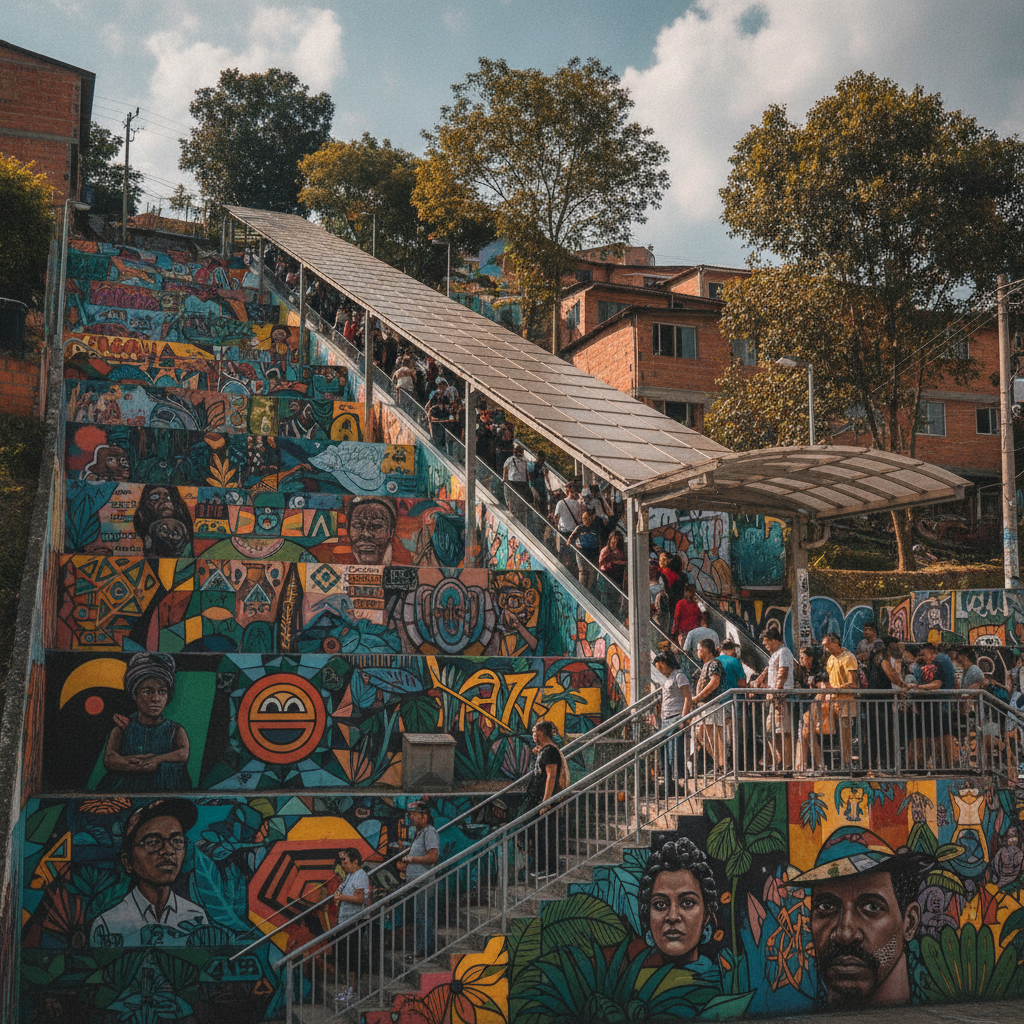
The Comuna 13, San Javier neighborhood on the western slope of the Aburra Valley, was for most of the period from the late 1980s to the early 2000s considered the most dangerous neighborhood in Medellin, controlled by a combination of guerrilla groups, paramilitary forces, and drug gangs who fought repeated urban military operations for territorial control. The 2002 military Operation Orion displaced the guerrilla groups through a controversial military assault that remains contested in its methods and its human rights record. The subsequent installation of the electric outdoor escalator system in 2011, which connected the steep hillside streets to the valley below, transformed the neighborhood's accessibility and signaled public investment. From approximately 2012 onward, a community of local artists began painting large murals throughout the neighborhood's streets and stairways, creating a street art landscape that has become one of the most visited attractions in Medellin. The murals range from community memorials for violence victims to abstract art to political statements to tourism-oriented work; the neighborhood now hosts guided walking tours daily and has become an international symbol of community-led regeneration through art, though debate continues about whether the tourism has displaced longtime residents and whether the artistic narrative has oversimplified a complex history.
- 4
Laureles and Envigado: Local Medellin Beyond the Tourist Circuit
The neighborhood of Laureles, west of El Poblado across the Medellin River, offers a more local and residential version of Medellin that attracts visitors looking to live alongside Paisas rather than primarily with international tourists. The Avenida El Poblado restaurant and bar street in Laureles concentrates a lively local nightlife and dining scene oriented toward Colombian university students and professionals rather than international visitors. The Estadio neighborhood adjacent to Laureles, centered on the Atanasio Girardot sports complex that hosts Atletico Nacional and Independiente Medellin football matches, is the heart of Medellin's football culture; attending a local derby between the two clubs is among the most intense sporting experiences in South America. The municipality of Envigado to the south, though administratively separate from Medellin, forms part of the continuous urban fabric and is known as the birthplace and home base of Pablo Escobar for most of his adult life; the Escobar family hacienda and several sites associated with the cartel era are located here. Envigado also has a thriving artisan craft tradition and several respected Colombian chefs have opened restaurants here in recent years.
- 5
Medellin Innovation Hub: Ruta N and the Tech Ecosystem
Ruta N, the innovation and technology district established by the Medellin municipal government in the northern Universidad sector in 2011, is a deliberate effort to transform the city's economic base from textiles and manufacturing toward knowledge economy sectors including software development, biotechnology, and creative industries. The district provides subsidized office space, coworking facilities, and business support services to technology startups and established companies, and has attracted offices of multinational technology firms including Google, Hewlett-Packard, and several telecommunications companies. The broader Medellin innovation ecosystem has developed around Ruta N to include multiple accelerators, venture capital funds, and a startup community that positions Medellin as a technology hub within the Latin American ecosystem alongside Sao Paulo, Buenos Aires, and Bogota. The city's university concentration, with multiple engineering and business programs producing graduates, provides the human capital that technology companies require. The digital nomad community that has grown in Medellin from the mid-2010s onward, drawn by the combination of good internet infrastructure, low cost of living, year-round spring climate, and the transformation narrative, has reinforced the technology and creative sector by creating demand for coworking spaces, networking events, and the international community infrastructure that attracts further remote workers.
- 6
Jardín Botánico and Green Space in the Urban Valley
The Jardín Botánico Joaquín Antonio Uribe, located in the northern Universidad district adjacent to Parque Explora, is a 14-hectare botanical garden that serves simultaneously as a plant conservation and research institution and as one of the most used public green spaces in the city. The garden contains over 4,500 plant species representing Colombian flora from multiple ecosystem types, and the Orquideorama, a large latticed wooden canopy structure by the Plan B Arquitectos firm opened in 2006, provides a spectacular covered outdoor space for exhibitions, concerts, and events that has become one of the most iconic pieces of contemporary architecture in Medellin. The garden is free to enter and is heavily used by families, students, and professionals from across the city on weekends and weekdays alike, fulfilling a public park function in a city where flat open green space is limited by the narrow valley topography. The broader parks system of Medellin includes the linear parks along the Metro Line A and the various neighborhood parks, and the city has invested in the expansion of green corridors called corredores verdes along major streets, replacing paving with trees and planting to reduce the urban heat island effect. The surrounding Cerro Nutibara and Cerro El Volador hills within the urban area provide accessible natural walking environments.
Walk this route with audio
Stories play automatically as you reach each stop — no tapping needed.
More in Medellin
Medellin History: From Colonial Foundation to Industrial Capital and Cartel Violence
Medellin Day Trips: Guatape, Coffee Region, Jerico, and the Antioqueño Countryside
Medellin Practical Guide: Neighborhoods, Safety, Transport, and Colombia Travel Connections
Medellin Birdwatching: Colombia as the Most Bird-Rich Country and the Antioquia Avifauna
Medellin: The City of Eternal Spring, Urban Transformation, and the Flower Festival