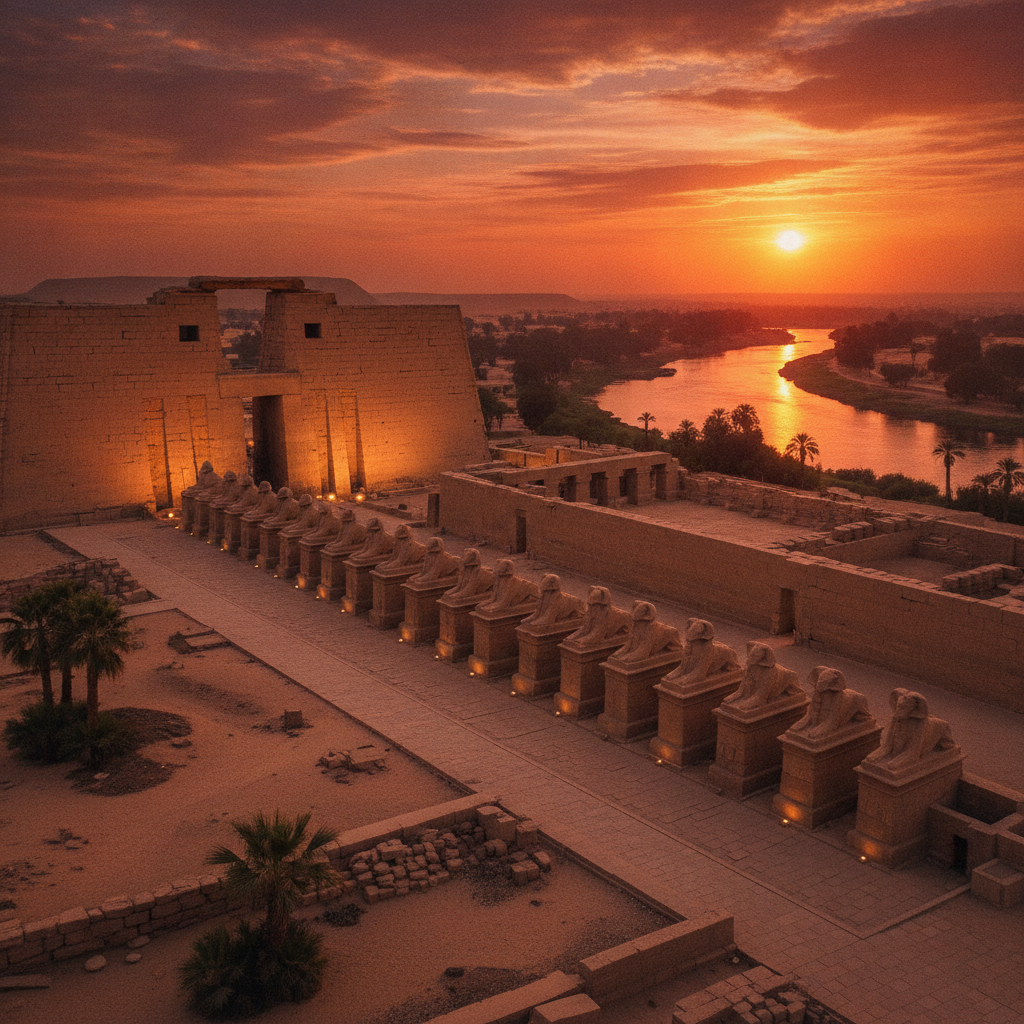
Luxor Through History: Thebes From World Capital to Roman Province
The complete history of ancient Thebes (Luxor): the rise of Thebes as the New Kingdom capital; Thutmose III (Napoleon of Egypt) and 17 military campaigns; Ramesses II, the Battle of Kadesh, and Abu Simbel; the Bronze Age Collapse and the Sea Peoples battle at Medinet Habu; Ptolemaic and Roman Thebes through Cleopatra and Caesar; and the modern European rediscovery from Napoleon through Champollion to Howard Carter.
- 1
The Rise of Thebes - From Provincial Town to World Capital
Ancient Thebes (Waset in ancient Egyptian) rose from a minor provincial town to the capital of the Egyptian New Kingdom (approximately 1550-1070 BCE) and for several centuries the largest and most powerful city in the world. The Eleventh Dynasty princes of Thebes reunified Egypt after the First Intermediate Period under Mentuhotep II (approximately 2055 BCE): Thebes became the capital of the Middle Kingdom briefly and then the permanent capital of the New Kingdom from approximately 1550 BCE when the 18th Dynasty expelled the Hyksos from Lower Egypt. The wealth (the New Kingdom pharaohs controlled the gold mines of Nubia: Nubian gold funded the extraordinary building programs at Karnak and Luxor: at its peak approximately 1400-1200 BCE Thebes had a population of approximately 40,000-80,000: Homer described Thebes as the hundred-gated city with wealth beyond compare). The decline (the Third Intermediate Period: the high priests of Amun at Thebes effectively controlled Upper Egypt: the Assyrian king Ashurbanipal sacked Thebes in 663 BCE: this was the effective end of Thebes as a great capital city though the temples continued to function).
- 2
Thutmose III - The Napoleon of Egypt and 17 Military Campaigns
Thutmose III (ruled approximately 1479-1425 BCE with the first 21 years co-ruled with Hatshepsut): the Napoleon of Egypt, who led 17 military campaigns in Canaan and Syria and established Egyptian power at its greatest geographical extent. The Battle of Megiddo (approximately 1457 BCE): the first battle in recorded history described with detailed tactical information: Thutmose III chose the most direct but most dangerous mountain pass approach to Megiddo against his generals advice: the surprise worked and the Canaanite coalition was routed: Megiddo was then besieged for 7 months before surrendering. He extended Egyptian control over Canaan and reached the Euphrates River: his campaign annals are carved on the walls of the Festival Hall at Karnak. He built the Festival Hall of Thutmose III at Karnak (the unusual tent-pole columns (imitating the tent poles of his campaign headquarters)). Thutmose III was also a remarkable botanist: the Botanical Room at Karnak shows the exotic plants he collected on his campaigns in Syria-Palestine: one of the earliest scientific botanical illustrations. He also erected 7 obelisks in Karnak: of the original 7, pairs now stand in Rome, Istanbul (one from the pair at Constantinople), London (Cleopatra Needle, Victoria Embankment), and New York (Central Park).
- 3
Ramesses II - The Great Builder and the Battle of Kadesh
Ramesses II (ruled approximately 1279-1213 BCE: approximately 66 years: one of the longest reigns in Egyptian history): the most prolific builder in Egyptian history and the pharaoh who left his name on more monuments than any other Egyptian king. The building program (Ramesses II completed and usurped the Karnak Hypostyle Hall (adding his name over those of his father Seti I and grandfather Ramesses I on many columns): he built the Ramesseum (his mortuary temple on the West Bank at Luxor): he built Abu Simbel (the rock-cut temple 270 km south of Aswan with four 20-meter colossal seated statues of himself on the facade): he added to virtually every temple in Egypt). The Battle of Kadesh (approximately 1274 BCE: fought against the Hittite king Muwatalli II in Syria near the city of Kadesh: one of the largest chariot battles in history (approximately 5,000-6,000 chariots on each side): the battle was tactically indecisive but Ramesses II claimed a great victory and had the account carved on the walls of Karnak, Abu Simbel, and five other temples: the Egyptian-Hittite Treaty of Kadesh (approximately 1259 BCE) was the first surviving peace treaty in history: a copy is now displayed at the United Nations headquarters in New York as a symbol of international diplomacy). The Ozymandias colossus (the fallen colossal statue of Ramesses II at the Ramesseum (original weight approximately 1,000 tons) inspired Percy Bysshe Shelley poem Ozymandias (1818)).
- 4
The Sea Peoples and the Bronze Age Collapse - The End of the New Kingdom
The Bronze Age Collapse (approximately 1200-1150 BCE): the most catastrophic civilizational collapse in ancient history, when the eastern Mediterranean Bronze Age civilization (including the Hittite Empire, the Mycenaean Greek palaces, the Ugarit trading city, and much of Canaan) was destroyed within approximately 50 years, and Egypt survived but was permanently weakened. The Sea Peoples (the Sea Peoples: the coalition of migrating peoples from the Aegean and Anatolian regions who swept through the eastern Mediterranean destroying cities and kingdoms: the Peleset (likely the later Philistines), Tjeker, Shekelesh, Denyen, and Weshesh: the Hittite Empire collapsed under the Sea Peoples pressure approximately 1180 BCE: Ugarit was burned approximately 1185 BCE and never rebuilt: the Mycenaean palace civilization collapsed approximately 1180-1150 BCE). The Egyptian defense (Ramesses III (ruled 1186-1155 BCE) defeated the Sea Peoples in a combined land-sea battle on the Nile delta coast approximately 1175 BCE: the great Medinet Habu temple at Luxor has the most detailed surviving ancient account of the Sea Peoples battles: the reliefs show the sea battle with Egyptian archers firing from the shore into the Sea Peoples ships). The aftermath (Egypt survived but was permanently weakened: the 20th Dynasty pharaohs (Ramesses IV-XI) ruled an increasingly impoverished state: the high priests of Amun at Thebes effectively controlled Upper Egypt as a separate realm: the New Kingdom ended approximately 1070 BCE).
- 5
Ptolemaic and Roman Thebes - Alexander, Cleopatra, and the Roman Province
Ptolemaic Thebes (332-30 BCE): the Greek Macedonian pharaohs who adopted Egyptian royal titles and continued building at Karnak and Luxor. The Ptolemies maintained legitimacy with Egyptian priests and population by presenting themselves as Egyptian pharaohs: they built in the ancient Egyptian style (the finest Ptolemaic temples are at Edfu, Dendera, and Philae, all accessible from Luxor). Cleopatra VII (51-30 BCE): the last Ptolemaic ruler and the first to learn the Egyptian language: her political alliances with Julius Caesar and Mark Antony: the Battle of Actium (31 BCE) and defeat by Octavian (Augustus): Egypt became a Roman province. Roman Thebes (the Roman army had a camp (Castra) within the Luxor Temple precinct: the inner sanctuary was converted to a Roman imperial cult room with painted figures of Roman emperors in military dress): the grain (Egypt was the most important Roman province: approximately 20-30% of Rome grain supply came from the Nile Valley: the annual grain fleet from Alexandria to Ostia was the most critical supply line in the ancient world). The rise of Christianity (the Theban region was one of the earliest centers of Christian monasticism: Saint Pachomius (approximately 292-348 CE) established cenobitic (communal) monasticism at Tabennisi south of Luxor: the monastic rules of Pachomius influenced the entire subsequent monastic tradition).
- 6
The Modern Rediscovery of Luxor - From Napoleon to Champollion to Howard Carter
The European rediscovery of ancient Luxor: the Napoleonic expedition (1798), the decipherment of hieroglyphics by Champollion (1822), and the discovery of Tutankhamun by Howard Carter (1922). The Napoleonic expedition (the French Egyptian Expedition of 1798-1801 included 167 scientists alongside the military: the Description de l'Egypte (23 volumes, 1809-1829) was the first systematic scientific survey of Egyptian monuments and launched Egyptomania across Europe). The Rosetta Stone (discovered at Rosetta in 1799 by French soldiers: a decree of 196 BCE in hieroglyphics, Demotic, and Greek: taken by Britain after the 1801 surrender: now in the British Museum). Champollion (Jean-Francois Champollion: his letter to Monsieur Dacier on September 27, 1822 announced the decipherment of hieroglyphics: the ancient Coptic language (last form of ancient Egyptian) provided the phonetic values: 3,500 years of Egyptian history became readable within a generation). Giovanni Belzoni (the 1.97-meter Italian circus strongman who excavated for the British consul: discovered the Tomb of Seti I (KV17) in 1817: removed the Young Memnon (Ramesses II) head from the Ramesseum for the British Museum (1821): opened Abu Simbel for the first time in the modern era). Howard Carter (discovered KV62 on November 4, 1922: spent 10 years (1922-1932) cataloguing the approximately 5,000 objects in the intact tomb of Tutankhamun).
Walk this route with audio
Stories play automatically as you reach each stop — no tapping needed.
More in Luxor
Luxor: Akhenaten, Nefertiti, Tutankhamun, and the Amarna Revolution

Luxor by River: The Nile Cruise to Aswan, the Dahabiyya Sailing Experience, the Temple of Edfu, and the Kom Ombo Temple
Luxor: The Nile Flood, Egyptian Afterlife, Coptic Christianity, and the Nile Cruise Guide
Luxor: Karnak, Luxor Temple, Valley of the Kings, and the World Greatest Open-Air Museum

Luxor Local Life: The East Bank Souq, the Alabaster Workshops, the Papyrus Art, and the Most Practically Lived-In Ancient City
