Leaving Luang Prabang: The Slow Boat Arrival That Changes You, Bolaven Plateau Coffee & the City After 21:00
The final Luang Prabang—Bolaven Plateau's Liberica coffee (a different species, woody and unusual, served with condensed milk in the Lao-French-Chinese café culture), the film festival in December screening contemporary Southeast Asian cinema in open-air old town venues in a country with fewer than 20 feature films in its entire history, why the French, Australian and US cultural missions all invest disproportionately in a city of 56,000 (soft power and a uniquely resonant platform), the city's tendency to change visitors in ways its component parts don't fully explain (the pace, the scale, the monks at 05:30, the fireflies after 21:00), the slow boat arrival's copper Mekong after two days on the river as the memory that defines Southeast Asia for those who made it, and what mindful tourism in Luang Prabang actually means in practice.
- 1
The Lao Coffee Culture – Bolaven Plateau & Siphon Bars
Lao coffee—grown primarily in the Bolaven Plateau of Champasak province in southern Laos (at 1,000–1,350 metres altitude, a volcanic tableland with ideal conditions for arabica and the rare Liberica variety)—is among the most complex and underappreciated coffees in Southeast Asia. The historical context: the French introduced coffee cultivation to the Bolaven Plateau in the 1920s; the plantations survived the civil war and subsequent hardship and are now producing award-winning specialty coffee for international markets. The primary varieties: Typica arabica (the original plantation variety, mild, fruity), Catimor (disease-resistant hybrid, higher volume), and the rare Liberica/Excelsa (a different coffee species entirely—larger beans, woody, unusual flavour profile not found elsewhere in significant commercial quantities). In Luang Prabang: the café scene is concentrated in the old town, with Joma (the Lao chain with regional dominance), L'Etranger Books and Tea (beloved bookshop-café with film screenings), and the Bolaven coffee stalls that offer filter coffee in the traditional Lao style (strong drip coffee in a cloth filter, served with condensed milk and sometimes with tea simultaneously—the Lao 'coffee-tea' combination that reflects the French and Chinese influences on southern Lao food culture).
- 2
Luang Prabang's School System & Education in Laos
Laos' education system—among the least resourced in Southeast Asia despite significant international NGO investment since the 1990s—reflects the country's development challenges: teacher shortages (particularly in rural and ethnic minority areas), inadequate infrastructure, and the historical disruption of the civil war and Khmer Rouge-adjacent political upheaval. In Luang Prabang, the temple schools (attached to the 33 wats) have historically provided primary education for boys from rural families; the public school system serves the broader population with variable quality. The university: the National University of Laos (in Vientiane) is the country's primary higher education institution; Luang Prabang has vocational colleges and a small hospitality school. The English language challenge: English proficiency in Laos is significantly lower than in Vietnam, Thailand, or Cambodia, partly because the colonial legacy was French rather than British or American, and partly because tourism (the primary English-language exposure route) is smaller and more recent. The Big Brother Mouse programme's Lao-language children's books represent an attempt to address literacy rates through the language that rural children actually speak at home.
- 3
The Luang Prabang Film Festival & Cultural Diplomacy
The Luang Prabang Film Festival (LPFF)—established 2010, held annually in December, screening films from Southeast Asian countries—has become, despite its small scale, one of the more thoughtful cultural diplomacy events in the region: a programme of contemporary Southeast Asian cinema (ASEAN member states plus China, Japan, and South Korea in the extended programme) screened in open-air venues in the old town, with filmmakers in attendance for Q&A. The festival's significance: it provides the only regular public film screening infrastructure in a country with almost no cinema industry of its own (Laos has produced fewer than 20 feature films in its entire history) and creates a framework for Lao filmmakers and audiences to engage with regional contemporary cinema. The broader cultural diplomatic context: Luang Prabang receives a disproportionate international cultural investment relative to its size (the French, Australian, and US cultural missions all have active programmes; the Lao-French Alliance Française is the largest in mainland Southeast Asia) because the city's cultural significance and international profile make it a uniquely effective platform for soft-power projection.
- 4
Leaving Luang Prabang – The City That Changes You
Luang Prabang is one of the few cities in the world consistently described by independent travellers—in different decades, from different backgrounds, with different expectations—as having changed them. The mechanism is not fully explicable by its component parts (the temples are numerous but not uniquely beautiful; the food is good but not transformative; the Mekong sunsets are lovely but not unprecedented): it is something about the pace and the scale and the quality of light and the monks at dawn and the silence after 21:00 when the restaurants close and the fireflies come out above the Nam Khan. The city is small enough that its patterns impose themselves: you wake early because the monks walk at 05:30, you eat when the markets are fresh, you are in bed by the time the river mist rises. The changes after 1995 have been significant—the property displacement, the Chinese railway's effect on tourist demographics, the Night Market's standardisation—and some long-term visitors describe the city as diminished from what it was. But the bones are still there: the temples maintained by monks who wake at 04:00, the Mekong flowing as it has for millions of years, the light on the French villas in the late afternoon.
- 5
The Slow Boat Arrives – Entering Luang Prabang from the River
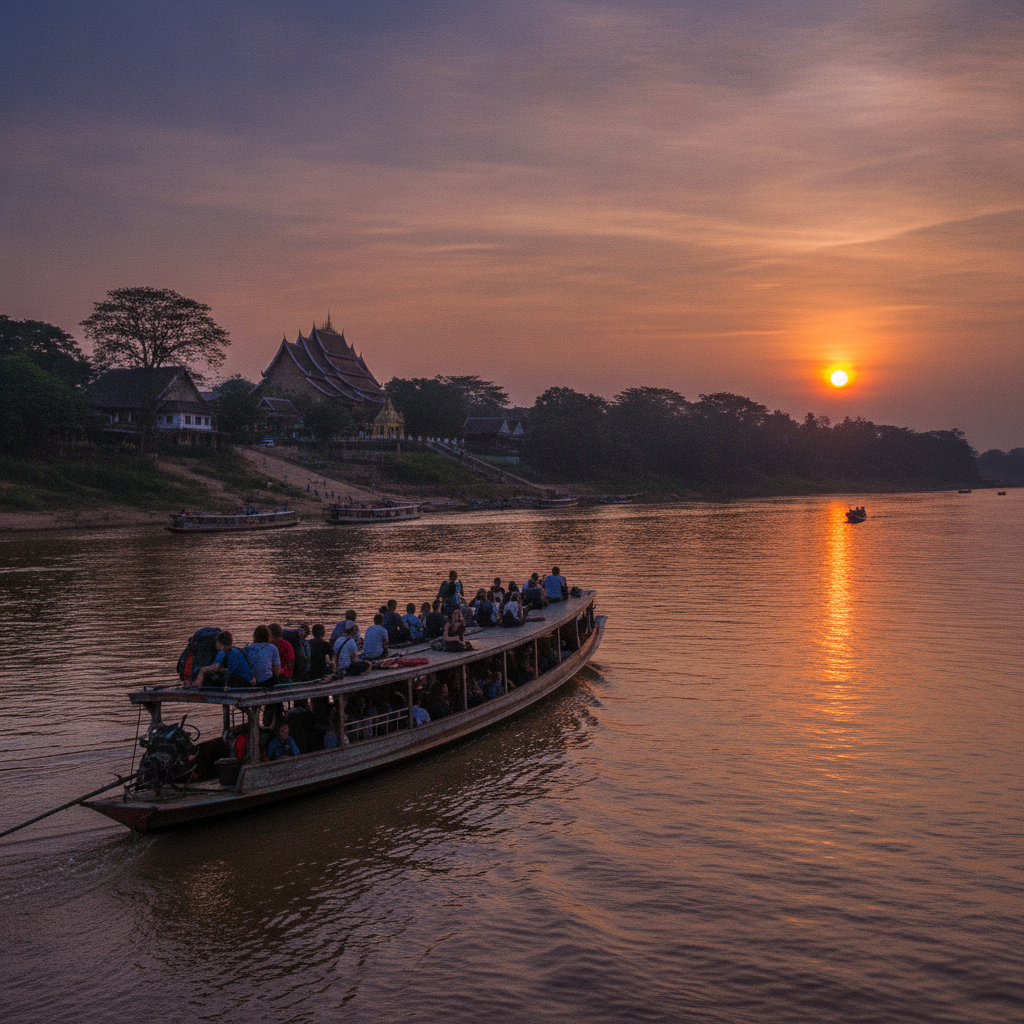
The experience of arriving in Luang Prabang by slow boat from Huay Xai—after two days on the river, sleeping at Pakbeng in a simple guesthouse, waking for the third time to the sound of water and jungle—is considered by many travellers to be among the finest arrivals in travel. The sequence: the boat passes the last few limestone gorges before the valley opens, rice paddies appear on the banks, the first temple gable becomes visible above the treeline, and the boat docks at the Luang Prabang landing below the hill where the city meets the river. The contrast with arriving by flight: the airport is 4 km from the old town and the experience is identical to any provincial airport landing. The contrast with arriving by train from Vientiane: efficient, comfortable, 2 hours, a railway station 10 minutes from the old town. All three arrivals lead to the same city; only one of them—the river—delivers you there having been changed by the journey itself. The slow boat from Thailand to Laos is, for many travellers who have done it, the memory that defines what Southeast Asia was to them.
- 6
Practical Luang Prabang – Getting There, Currency & Staying Mindfully
Luang Prabang International Airport (LPQ)—4 km from the old town—receives flights from Bangkok (1.5 hours, Bangkok Airways near-monopoly, higher prices than Thai market average), Chiang Mai (1 hour, Bangkok Airways), Hanoi (1 hour), Siem Reap (1.5 hours), and Vientiane (40 minutes). Overland: from Thailand via Huay Xai (bus from Chiang Rai to the border, then slow boat 2 days or speedboat 6 hours—the speedboat is loud, cramped, and dangerous); from Vientiane by train (2 hours on the Chinese railway, the most practical option for travellers arriving overland from southern Laos or Thailand's northeast). Currency: the Lao Kip (LAK)—approximately 22,000 kip/€1 (June 2026)—is the official currency, but USD and Thai Baht are widely accepted in tourist businesses; USD is preferred for larger transactions. Money exchange: the Lao Development Bank or private exchange booths in the old town offer competitive rates; hotel rates are typically disadvantageous. Mindful tourism: sit at distance for tak bat (no flash, no approaching monks), hire local tuk-tuk drivers rather than hotel transport, eat at locally owned Lao restaurants rather than international establishments, and buy crafts from Ock Pop Tok and Artisans Angkor-equivalent cooperatives rather than stalls selling mass-produced goods.
Walk this route with audio
Stories play automatically as you reach each stop — no tapping needed.
More in Luang Prabang
Luang Prabang's Foundation: Lan Xang's Million Elephants, Lao Laap with Sticky Rice & River Boats to Buddha Caves
Luang Prabang Essentials: Monks at Dawn, Wat Xieng Thong's Sweeping Roof & Turquoise Kuang Si Falls
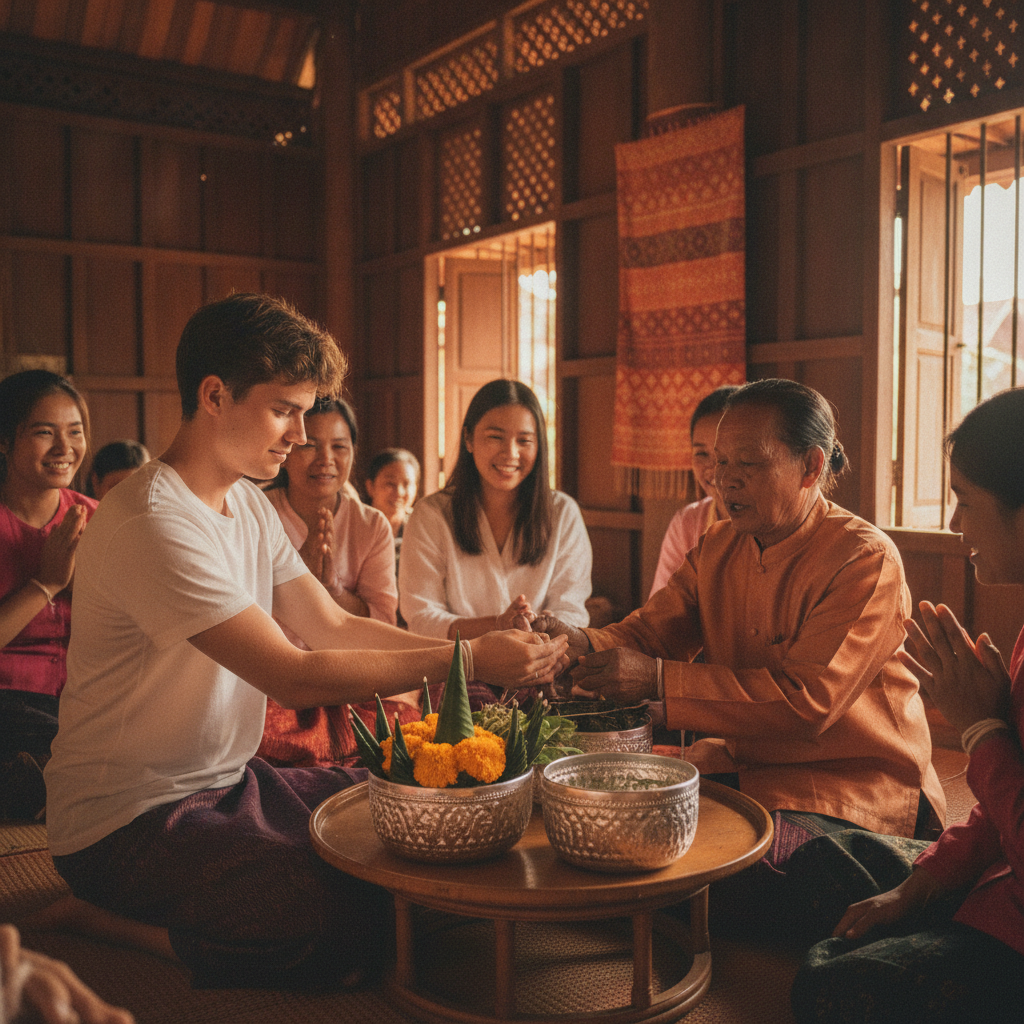
Luang Prabang's Present: China's $6B Railway, the Baci Wrist-Tying Ritual & the UNESCO Heritage Gentrification Trap
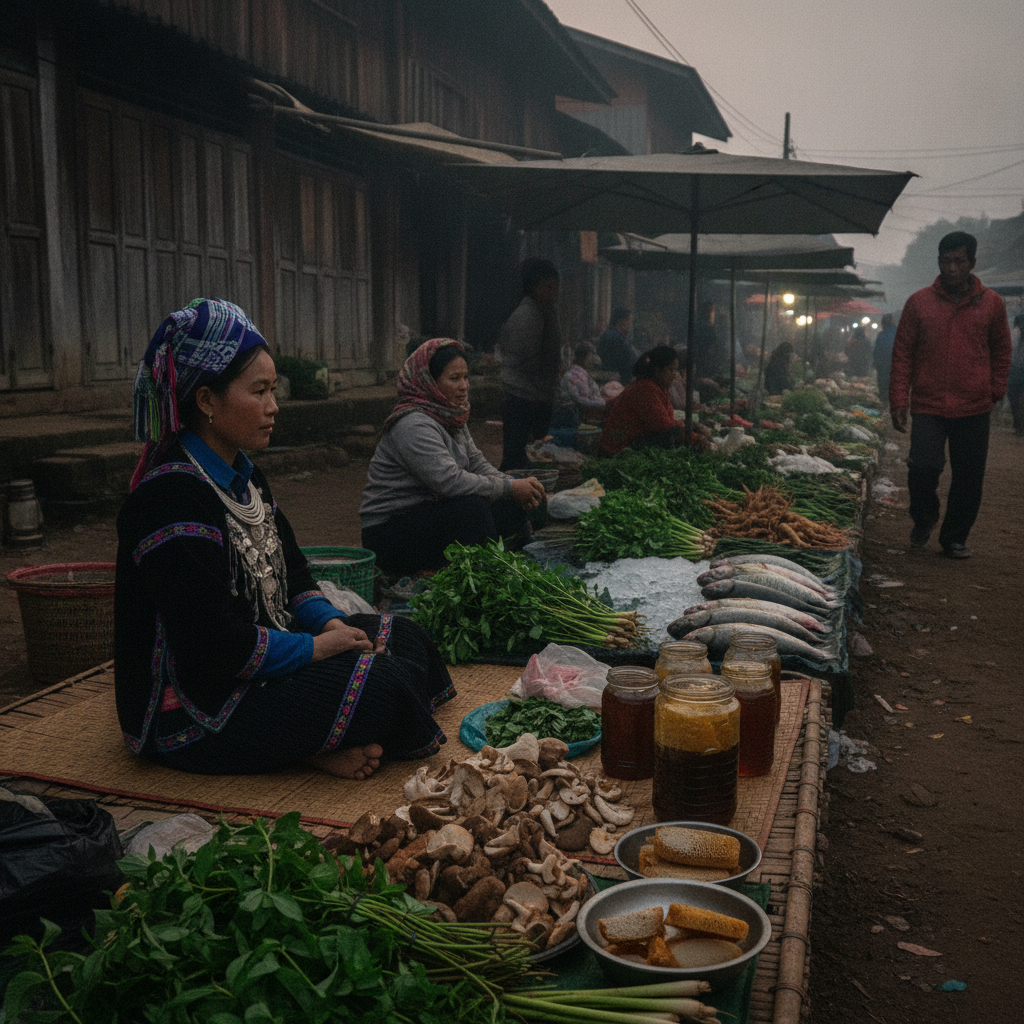
Luang Prabang's Living Layers: Hmong Morning Market, Ock Pop Tok Weavers & the Mekong's 11 Chinese Dams