Pasadena: Huntington Library, Rose Bowl & Old Town
Pasadena — founded 1874, incorporated 1886, the first city in California to reach Los Angeles by rail (1885) and the western terminus of the original Route 66 (1926) — is the most culturally significant suburb in Los Angeles, home to Caltech (the world's top science university by Nobel laureates per capita), the Huntington Library and Gardens, the Rose Bowl, and a concentration of Arts and Crafts architecture unequaled on the West Coast.
- 1
Rose Bowl Stadium (1922) & Tournament of Roses Parade
The Rose Bowl (1001 Rose Bowl Drive, Pasadena, opened October 28, 1922, capacity 92,542) — a National Historic Landmark designed by architect Myron Hunt as a horseshoe-shaped bowl (the open end faces north, toward the San Gabriel Mountains, creating the classic postcard view) in the natural Arroyo Seco canyon — is the most famous college football stadium in the United States: home of the Rose Bowl Game (the oldest bowl game in American football, first played January 1, 1902, as part of the Tournament of Roses festival), consistently ranked the most beautiful stadium in American football. The Rose Bowl has hosted 5 College Football National Championship Games (including Caltech vs. Stanford in 1902, USC vs. Penn State in 1923, and Alabama's legendary 1926 Rose Bowl win), the 1994 FIFA World Cup Final (Brazil vs. Italy, Brazil winning on penalty kicks), the 1999 FIFA Women's World Cup Final (USA vs. China, Brandi Chastain's iconic jersey-removal moment), and Super Bowls XI (1977), XIV (1980), XVII (1983), XXI (1987), and XXVII (1993). The UCLA Bruins football team plays home games here. The adjacent Brookside Park hosts the Doo Dah Parade, the irreverent parody of the Tournament of Roses Parade, every January since 1978.
- 2
Tournament of Roses Parade (January 1, since 1890)
The Tournament of Roses Parade (Colorado Boulevard, Pasadena, January 1 every year since 1890, also known as the Rose Parade or Tournament of Roses) — the most watched annual parade in the United States (TV audience of 35-40 million, with viewing spots along Colorado Boulevard sold out 12+ months in advance) — began as a way to showcase Southern California's mild winter climate to the East Coast (Pasadena promoters sent invitations to friends in the East reading: 'Come to California in winter! While you are buried in snow, we are picking roses!') and now features 100+ elaborate floats (all-floral, no artificial materials permitted), marching bands from across the US and internationally, and equestrian units. The parade has been canceled only once — January 1, 1942 (canceled due to WWII security concerns after the attack on Pearl Harbor). Colorado Boulevard, the parade route, is lined with 1920s-1940s commercial buildings; the Pasadena Civic Auditorium (1932) is at the heart of the route.
- 3
Huntington Library, Art Museum & Botanical Gardens (1919/1928)
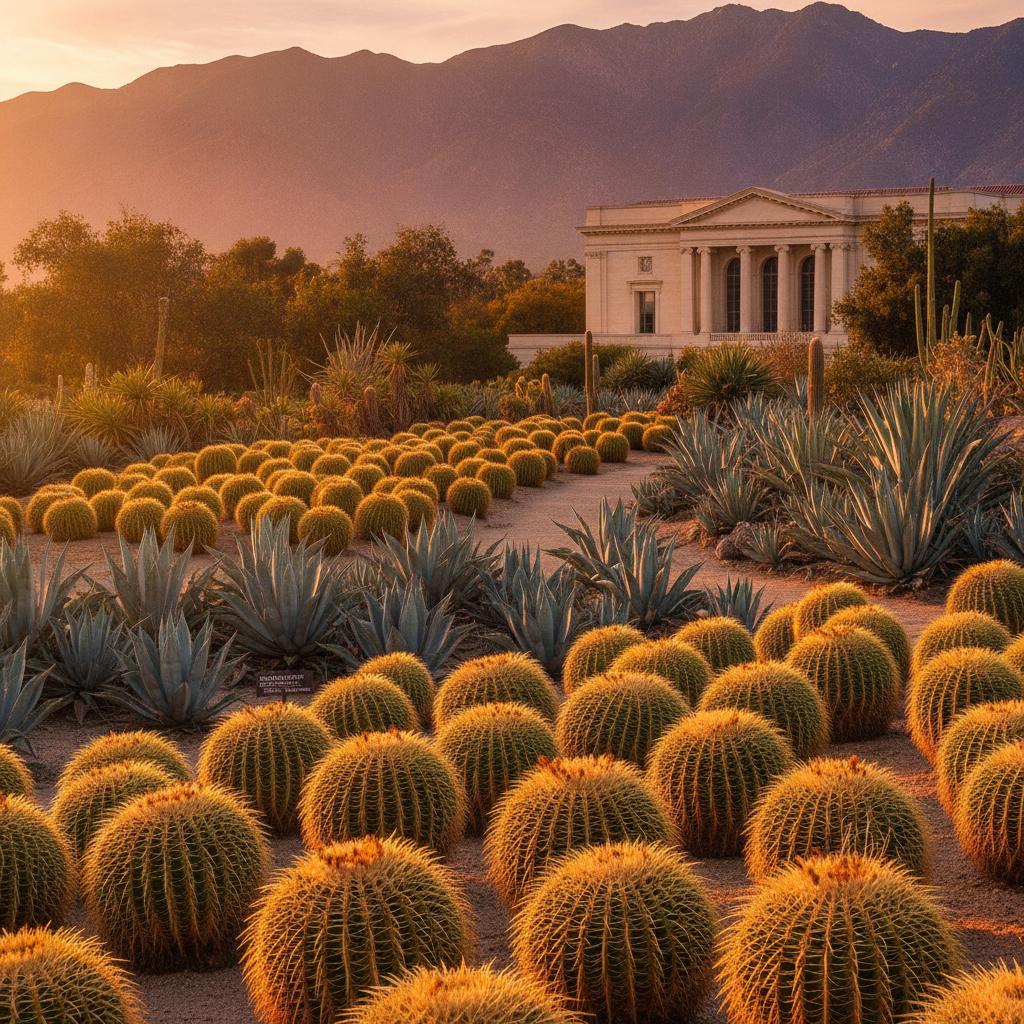
The Huntington Library, Art Museum and Botanical Gardens (1151 Oxford Road, San Marino, adjacent to Pasadena, opened to the public 1928) — created by railroad and real estate magnate Henry E. Huntington (1850-1927) on his 200-acre estate — is one of the great cultural institutions of the world: the library holds 11 million items (manuscripts, rare books, photographs, maps, and ephemera) including Chaucer's Canterbury Tales (c. 1410), a Gutenberg Bible (one of 12 surviving vellum copies), the double folio of John James Audubon's Birds of America (1827-1838), and the earliest complete manuscript of Beowulf (c. 1000 AD). The art collection includes Gainsborough's The Blue Boy (1770) and Lawrence's Pinkie (1794), the iconic pair that Huntington reportedly paid a combined $1 million for in 1921 (then the most expensive pair of paintings ever sold). The botanical gardens (120 acres, 12 themed gardens) include the Desert Garden (the world's largest collection of mature cacti and succulents outside a desert), the Japanese Garden (1912), the Chinese Garden (Liu Fang Yuan, 2008), and the Shakespeare Garden.
- 4
California Institute of Technology (Caltech, 1891)
The California Institute of Technology (Caltech, 1200 East California Boulevard, Pasadena, founded 1891 as Throop Polytechnic Institute, renamed 1920) — one of the world's leading science and engineering universities (3,000 students, 300 faculty, 45 Caltech-affiliated Nobel laureates as of 2024, the highest concentration of Nobel laureates per capita of any institution in the world) — occupies a 124-acre Mediterranean Revival campus in central Pasadena. Caltech's research is disproportionately influential: the university manages the Jet Propulsion Laboratory (JPL, just 2 miles north of campus in the Arroyo Seco), which has designed, built, and operated every NASA planetary science mission since 1958 (Mariner, Voyager, Galileo, Cassini, Mars Science Laboratory/Curiosity, Perseverance). Feynman lectured at Caltech from 1950 to 1988; Murray Gell-Mann, Linus Pauling, William Shockley (inventor of the transistor), and Robert Millikan (who proved the electron's charge) were faculty here. The Seismological Laboratory at Caltech developed the Richter scale (1935).
- 5
Old Town Pasadena & Colorado Boulevard
Old Town Pasadena (Colorado Boulevard between Pasadena Avenue and Marengo Avenue, about 22 blocks) — a 1920s-1930s commercial district that had declined significantly by the 1970s before a major redevelopment beginning in 1977 transformed it into one of the most successful mixed-use districts in California — contains the finest concentration of surviving 1920s-1930s commercial architecture in the LA Basin: brick storefronts, terra cotta ornamentation, Spanish Colonial Revival facades. The transformation of Old Town Pasadena from a largely vacant 1970s ruin to a vibrant commercial district (now hosting 300+ retail businesses, restaurants, and entertainment venues, attracting 2+ million visitors per year) is considered one of the most successful examples of historic preservation-led urban revitalization in California. The Vroman's Bookstore (695 East Colorado, 1894, the oldest and largest independent bookstore in Southern California) is the intellectual anchor of Old Town.
- 6
Arroyo Seco Parkway (1940) & First American Freeway
The Arroyo Seco Parkway (California State Route 110, from Pasadena to downtown Los Angeles via the Arroyo Seco canyon, opened December 30, 1940) — the first freeway in California and the second freeway in the United States (after the Merritt Parkway in Connecticut, 1938) — is a National Historic Landmark (2010): a 6-mile limited-access highway with landscaped medians, gentle curves (designed for 45 mph speeds, in contrast to the later freeways designed for 65+ mph), and parkway-style aesthetics (cloverleaf interchanges, Art Deco bridge overcrossings) that represent the original vision of the freeway as a 'parkway through the city' rather than a utilitarian traffic sewer. The Arroyo Seco Parkway passes through the Arroyo Seco canyon, the natural watercourse that defined the original character of Pasadena and explains its cultural distinctiveness: the canyon was the 'Arroyo Seco culture' zone of the early 20th century, home to the Arts and Crafts movement in California (the Greene & Greene Gamble House, 1908, is nearby).
Walk this route with audio
Stories play automatically as you reach each stop — no tapping needed.
More in losangeles
The Getty Center, Brentwood & Malibu: Art Above Los Angeles
Hollywood Boulevard: Walk of Fame, TCL Chinese Theatre & Dolby Theatre
Downtown LA: Grand Central Market, Bradbury Building & Arts District
Anaheim & Orange County: Disneyland, Knott's Berry Farm & Angel Stadium
LACMA, La Brea Tar Pits & Miracle Mile: Museum Row on Wilshire