Hollywood Boulevard: Walk of Fame, TCL Chinese Theatre & Dolby Theatre
Hollywood Boulevard — the 3.5-mile corridor through the heart of Hollywood that was the center of the American film industry from the 1910s through the 1950s — is simultaneously the most mythologized street in the world (2,700 stars in the sidewalk, the most recognizable architectural landmarks of the film industry, the Oscar ceremony home) and one of the most commercially exploited tourist streets in America, an unsettling mix of genuine cultural history and relentless souvenir hawking.
- 1
Hollywood Walk of Fame (1960-present, 2,700+ stars)
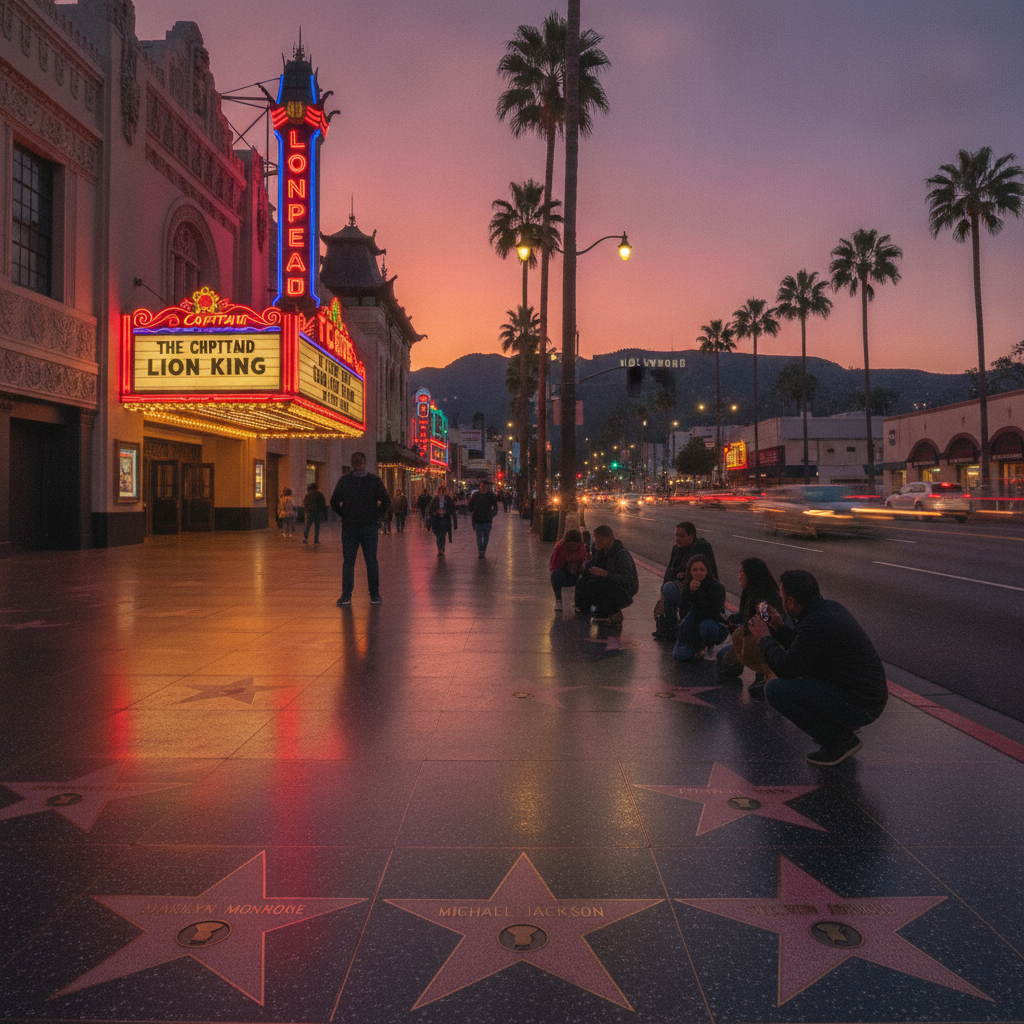
The Hollywood Walk of Fame (Hollywood Boulevard between Gower Street and La Brea Avenue, and Vine Street between Yucca Street and Sunset Boulevard) — created in 1958-1960 by the Hollywood Chamber of Commerce as a tribute to artists and entertainers who have contributed to the entertainment industry, with the first star installed in 1960 for actress Joanne Woodward — now has over 2,700 stars embedded in the pink and charcoal terrazzo sidewalk. Stars are divided into five categories (film, television, radio, recording, and live theatre/performance) and are awarded to artists nominated by fans and vetted by a committee; recipients pay $50,000 (formerly $30,000) toward the installation and maintenance cost. The Walk is maintained by the Hollywood Historic Trust; the most visited stars include Michael Jackson (two stars), Michael Jordan, Marilyn Monroe, Elvis Presley, and — controversially — Donald Trump (2007, often vandalized). The Walk receives approximately 10 million visitors per year, making it the most visited tourist attraction in Los Angeles.
- 2
TCL Chinese Theatre (1927) — 100 Years of Handprints
Grauman's Chinese Theatre (6925 Hollywood Boulevard, now TCL Chinese Theatre IMAX after a 2013 naming rights deal) — opened May 18, 1927 with the premiere of Cecil B. DeMille's King of Kings — is the most famous movie theater in the world: a 1,127-seat picture palace designed by Meyer & Holler in an elaborate Chinese imperial style (red lacquer columns, tiered pagoda roof, massive stone temple dog guardians, jade-green roof tiles) that defined the 'movie palace' aesthetic of 1920s Hollywood. The theater's concrete forecourt contains 200+ sets of celebrity hand and footprints dating from 1927 (beginning with Norma Talmadge, who allegedly stepped in wet cement by accident) through the present, including Marilyn Monroe's handprints, John Wayne's fist prints, R2-D2 and C-3PO's wheel and foot prints, and Jimmy Durante's nose print. The theater is still in active use as a first-run cinema and premiere venue; it received a major renovation in 2013 including a new 3D IMAX auditorium.
- 3
El Capitan Theatre (1926) — Disney's Hollywood Home
El Capitan Theatre (6838 Hollywood Boulevard, opened 1926, restored and reopened by Disney in 1991) — a Spanish Colonial Revival picture palace designed by Morgan, Walls & Clements, the same firm that designed the Bullocks Wilshire department store — was originally a live theater before being converted to a cinema in 1941. The Disney Company acquired and painstakingly restored El Capitan in 1991, restoring it to its original 1926 appearance (painted ceilings, ornate plasterwork, original murals) and using it as the exclusive premiere venue for Disney animated and live-action films: every Disney film since 1991 has had its Los Angeles premiere here, including The Lion King (1994), Toy Story (1995), Finding Nemo (2003), and Frozen (2013). The theater is adjacent to the Disney Studio Store and Disney's Hollywood Hotel (formerly the Hollywood Roosevelt Hotel, scene of the first Academy Awards ceremony in 1929).
- 4
Hollywood Roosevelt Hotel (1927) & First Academy Awards
The Hollywood Roosevelt Hotel (7000 Hollywood Boulevard, opened 1927) — a Spanish Colonial Revival hotel built by a group of investors including Mary Pickford, Douglas Fairbanks, and Louis B. Mayer to serve the growing film industry, and named for Theodore Roosevelt — was the location of the First Academy Awards ceremony on May 16, 1929 (held in the Blossom Room ballroom, lasted 15 minutes, with Emil Jannings winning Best Actor and Janet Gaynor winning Best Actress). The hotel's history is inseparable from Hollywood mythology: Marilyn Monroe lived in Cabana 246 for two years while filming in the early 1950s; Montgomery Clift practiced the bugle in room 928 for three months before filming From Here to Eternity; the pool was designed by David Hockney in 1988. The hotel is still in operation, with the Blossom Room (now a cocktail bar) open to the public.
- 5
Dolby Theatre (2001) — Oscar Ceremony Home
The Dolby Theatre (6801 Hollywood Boulevard, opened November 9, 2001, formerly the Kodak Theatre until 2012, then the Hollywood & Highland Center theatre) — built as the permanent home of the Academy Awards ceremony (held here every year since 2002) inside the Hollywood & Highland Center shopping mall — is a 3,332-seat theater designed by David Rockwell and the Rockwell Group, with a view of the Hollywood Sign visible through the lobby windows. The theater is designed specifically for the Oscars: the stage is one of the largest in the world at 960,000 cubic feet, the orchestra level seats 988, and the theater has more than 220 dressing rooms. The Hollywood & Highland Center (2001, Ehrenkrantz Eckstut & Kuhn Architects, themed on the set design of Intolerance, D.W. Griffith's 1916 epic) contains the Babylon Court, a giant open-air plaza with columns referencing Griffith's film.
- 6
Cahuenga Pass & Universal Studios Approach
Cahuenga Pass — the natural gap in the Santa Monica Mountains that connects the Hollywood Flatlands to the San Fernando Valley — has been the primary pass through the mountains since the Tongva people used it as a trade route, through the Spanish missions (the Camino Real passed through it), to its current role as the route of US-101 (the Hollywood Freeway) and Highland Avenue. The pass was the site of the last battle of the Mexican-American War in California (the Battle of Cahuenga Pass, January 13, 1847, a brief skirmish that ended California's formal resistance to American takeover). The Hollywood Freeway (US-101) through Cahuenga Pass, opened 1940, was the first freeway in Los Angeles and the second in California. Universal Studios Hollywood (100 Universal City Plaza, 1964) — the oldest continuously operating movie studio in the world (Universal Film Manufacturing Company, founded 1912 by Carl Laemmle) — sits just on the other side of the pass, offering the Studio Tour (a working-film-studio tram tour, the anchor attraction since 1964) and a Universal theme park.
Walk this route with audio
Stories play automatically as you reach each stop — no tapping needed.
More in losangeles
The Getty Center, Brentwood & Malibu: Art Above Los Angeles
Downtown LA: Grand Central Market, Bradbury Building & Arts District
Anaheim & Orange County: Disneyland, Knott's Berry Farm & Angel Stadium
LACMA, La Brea Tar Pits & Miracle Mile: Museum Row on Wilshire
Pasadena: Huntington Library, Rose Bowl & Old Town