Griffith Observatory, Hollywood Hills & the Hollywood Sign
The Santa Monica Mountains rise abruptly from the LA basin, and Griffith Park — at 4,310 acres the largest urban park in the United States — occupies their eastern end. This route climbs from Hollywood's Walk of Fame to the Griffith Observatory (the most visited public observatory in the world) and the ridgeline beneath the Hollywood Sign, offering the defining panorama of Los Angeles and access to the hills that have symbolized the city's glamour and aspiration since the silent film era.
- 1
Hollywood Walk of Fame & Hollywood Boulevard
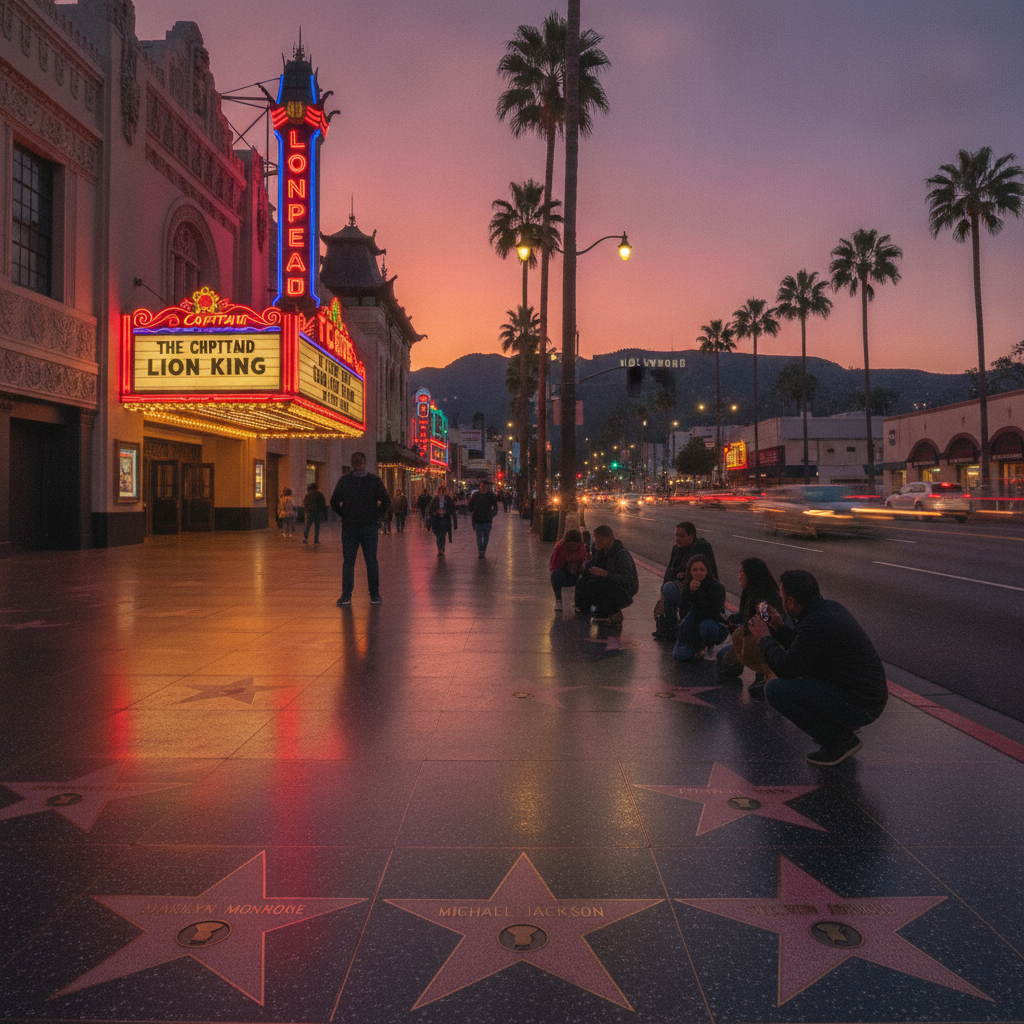
Hollywood Boulevard — the main commercial artery of the Hollywood neighborhood, running east-west from the 101 freeway to La Brea Avenue — contains the Walk of Fame (2,700+ brass-and-terrazzo stars set into the sidewalk since 1958, honoring figures in film, television, music, radio, and live theater), the TCL Chinese Theatre (formerly Grauman's Chinese Theatre, 1927, the most famous movie palace in the world, with 200+ celebrity handprints and footprints in cement in the forecourt, including Marilyn Monroe, James Dean, Harrison Ford, and Julia Roberts), the Egyptian Theatre (1922, the site of the first Hollywood 'premiere', now the American Cinematheque art-film venue), the Hollywood Roosevelt Hotel (1927, site of the first Academy Awards ceremony in 1929, reputedly haunted by Marilyn Monroe and Montgomery Clift), and the Hollywood & Highland complex (2001, the Babylon Court with its massive elephant and gate archway, designed as a homage to the 1916 D.W. Griffith film 'Intolerance'). The Dolby Theatre (formerly Kodak Theatre, 2001) at Hollywood & Highland hosts the Academy Awards ceremony every March.
- 2
Griffith Park & Western Canyon Road
Griffith Park — donated to the city of Los Angeles in 1896 by the Welsh mining magnate Griffith J. Griffith (who later shot and wounded his wife in 1903, serving two years in prison, before donating $700,000 for the observatory and theater) — is the largest urban park in the United States with natural terrain (4,310 acres), containing hiking trails, the Los Angeles Zoo, the Autry Museum of the American West, Travel Town (a train museum), golf courses, and the iconic Griffith Observatory. The park's chaparral-covered hillsides are home to coyotes, deer, and the famous mountain lion known as P-22 (who lived in the park from 2012 until his death in 2022 at approximately 12 years of age, having crossed two major freeways to reach the park and living his entire adult life there — a symbol of urban wildlife co-existence that prompted California's $400 million Wallis Annenberg Wildlife Crossing project over the 101 freeway). Western Canyon Road winds up through the park's western slopes from Los Feliz to the observatory.
- 3
Griffith Observatory (1935)
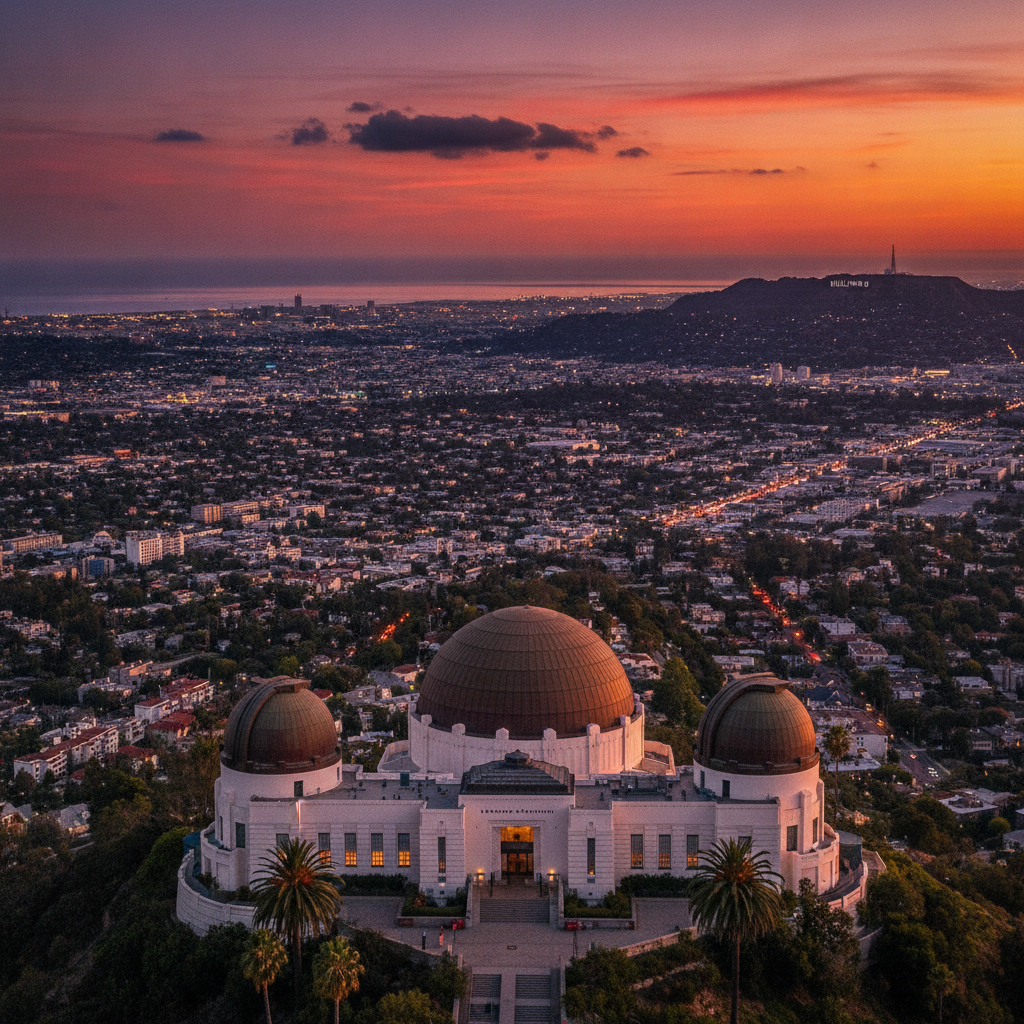
The Griffith Observatory — designed by John C. Austin and Frederick M. Ashley in an Art Deco style influenced by the astronomical observatories of ancient civilizations, built 1933-1935, funded by Griffith J. Griffith's bequest — is the most visited public observatory in the world (approximately 1.5 million visitors per year) and the most recognizable building in Los Angeles. The observatory stands at 1,134 feet on the south face of Mount Hollywood, offering an unobstructed view of the entire Los Angeles basin (from the Pacific Ocean in the west to the San Gabriel Mountains in the east, the downtown skyline to the south, and the Hollywood Hills to the north). The building contains the Samuel Oschin Planetarium (the largest in the western United States), the Zeiss telescope in the main dome (free public viewing on clear nights), the Foucault pendulum, and the Tesla coil exhibits. The observatory appears in 'Rebel Without a Cause' (1955, James Dean's film, shot partially here), 'La La Land' (2016, Ryan Gosling and Emma Stone's opening dance number), and dozens of other films and TV shows. A bronze bust of James Dean stands outside.
- 4
Mount Hollywood Trail & Hollywood Sign Viewpoint
The Mount Hollywood Trail — beginning at the Griffith Observatory, ascending 1.6 miles and 500 feet to the 1,625-foot summit of Mount Hollywood, the highest point accessible by trail in Griffith Park — offers the closest publicly accessible viewpoint to the Hollywood Sign. The Hollywood Sign (originally 'Hollywoodland', 1923, built as an advertisement for a real estate development in the hills, the 'land' removed in 1949 when the sign was adopted by the Hollywood Chamber of Commerce, each letter 45 feet tall and 35 feet wide, visible from much of the Los Angeles basin) is located on the ridgeline of Mount Lee (1,680 feet), 0.7 miles north of the Mount Hollywood summit, and is protected by a security fence and cameras — visitors can approach to within 200 feet via the Brush Canyon Trail from the north. The trail to the Mount Hollywood summit also passes the Dante's View overlook (the most comprehensive view of the LA basin from the north of the park) and the old zoo site (abandoned in 1966 when the new LA Zoo opened).
- 5
Los Feliz & Vermont/Hillhurst Avenue
Los Feliz — the neighborhood at the southern base of Griffith Park, one of the oldest and most continuously inhabited areas of Los Angeles (its name refers to José Feliz, the corporal who commanded Mission San Fernando and was granted the rancho here by the Mexican government in 1843) — is one of the most culturally dense neighborhoods in the city: the intersection of Vermont Avenue and Hillhurst Avenue contains the Vista Theatre (1923, Egyptian Revival, one of the oldest surviving movie theatres in Los Angeles), Skylight Books (one of the city's best independent bookshops), and a concentration of cafes and restaurants that has made Los Feliz the neighborhood of choice for LA's creative and literary community. The surrounding streets contain some of the finest early 20th-century residential architecture in the city: the Hollyhock House (1921, Frank Lloyd Wright's first Los Angeles work, designed for oil heiress Aline Barnsdall, now a UNESCO World Heritage Site), the Ennis House (1924, Frank Lloyd Wright, concrete textile block, the most futuristic of Wright's LA houses, filmed as the alien spacecraft in 'Blade Runner'), and the Lovell Health House (1929, Richard Neutra, one of the first steel-framed residential buildings in the United States).
- 6
Barnsdall Art Park & Hollyhock House (1921)
Barnsdall Art Park — the hilltop park on Olive Hill in East Hollywood donated by oil heiress Aline Barnsdall to the city of Los Angeles in 1927 (after a complex series of disputes with Frank Lloyd Wright over the design and construction of her intended arts colony on the hill) — contains the Hollyhock House (1919-1921, Frank Lloyd Wright, the first of his Los Angeles works, named for Barnsdall's favorite flower whose stylized form appears on every exterior surface, inscribed as a UNESCO World Heritage Site in 2019). The Hollyhock House is one of the founding works of California Modernism and Wright's first exploration of what he called 'California Romanza' (free-form architecture drawing on pre-Columbian Mayan temple forms). The park's hilltop position (330 feet above the surrounding neighborhood) offers a panoramic view of the Hollywood Hills and the downtown skyline that is less visited and more intimate than the Griffith Observatory. The municipal arts gallery (Junior Arts Center and Barnsdall Gallery Theatre) in the park continues Barnsdall's original vision of public art access.
Walk this route with audio
Stories play automatically as you reach each stop — no tapping needed.
More in losangeles
The Getty Center, Brentwood & Malibu: Art Above Los Angeles
Hollywood Boulevard: Walk of Fame, TCL Chinese Theatre & Dolby Theatre
Downtown LA: Grand Central Market, Bradbury Building & Arts District
Anaheim & Orange County: Disneyland, Knott's Berry Farm & Angel Stadium
LACMA, La Brea Tar Pits & Miracle Mile: Museum Row on Wilshire