Greenwich & the Prime Meridian: Time, Ships & the Edge of the World
Greenwich—accessible by riverboat from central London in 40 minutes—is where Greenwich Mean Time was invented, where the line divides East and West, and where Britain's greatest maritime heritage is preserved. The Royal Observatory sits on the hill above a town that was the centre of British naval power for three centuries. This route takes in the Cutty Sark (the world's fastest tea clipper), the Old Royal Naval College (Baroque architecture on the grandest scale), the National Maritime Museum, the Royal Observatory, and the best view of London from any hill in the city.
- 1
Cutty Sark — The World's Last Tea Clipper
The Cutty Sark at Greenwich Pier is the world's sole surviving tea clipper—a class of fast sailing ships that raced to be first to bring the new season's tea from China to London in the 1870s. Built in 1869, the Cutty Sark was the fastest ship in the world during her tea-trade years, making the round trip to China in under 120 days. She later carried wool from Australia. She is now raised on a glass platform so you can walk underneath and see the copper-clad hull from below. Inside: the decks, captain's cabin, cargo hold, and an exhibition on the tea and wool trades. Allow 90 minutes. The ship survived a devastating fire in 2007 and was reopened in 2012.
- 2
Old Royal Naval College — Baroque on the Thames
Immediately east of the Cutty Sark, the Old Royal Naval College is one of the finest Baroque architectural ensembles in Britain—two paired domes and colonnades designed by Christopher Wren (begun 1696) flanking a central vista down to the Thames, deliberately left open so that the Queen's House behind could maintain its river view. The buildings were originally the Royal Hospital for Seamen (a retirement home for naval ratings, founded by William and Mary) and later became the Royal Naval College; they now house the University of Greenwich and Trinity Laban. The Painted Hall—the 'Sistine Chapel of Britain'—is a magnificent dining hall whose ceiling and walls were painted by James Thornhill between 1707 and 1726; free to visit. Nelson's body lay in state here after Trafalgar.
- 3
National Maritime Museum — Britain's Sea Story
The National Maritime Museum at Greenwich is the largest maritime museum in the world, housed in a series of buildings around a glazed courtyard. The collection covers the full sweep of British naval and maritime history: Nelson's uniform jacket (with the bullet hole from Trafalgar), the binnacle from the wreck of the Mary Rose, the logbooks of Captain Cook's voyages, and an extraordinary collection of ships' figureheads, charts, paintings and navigational instruments. The Sammy Ofer Wing (2012) adds three floors of new galleries. Free entry. Allow two hours. The café overlooks the Greenwich Park.
- 4
Royal Observatory & the Prime Meridian
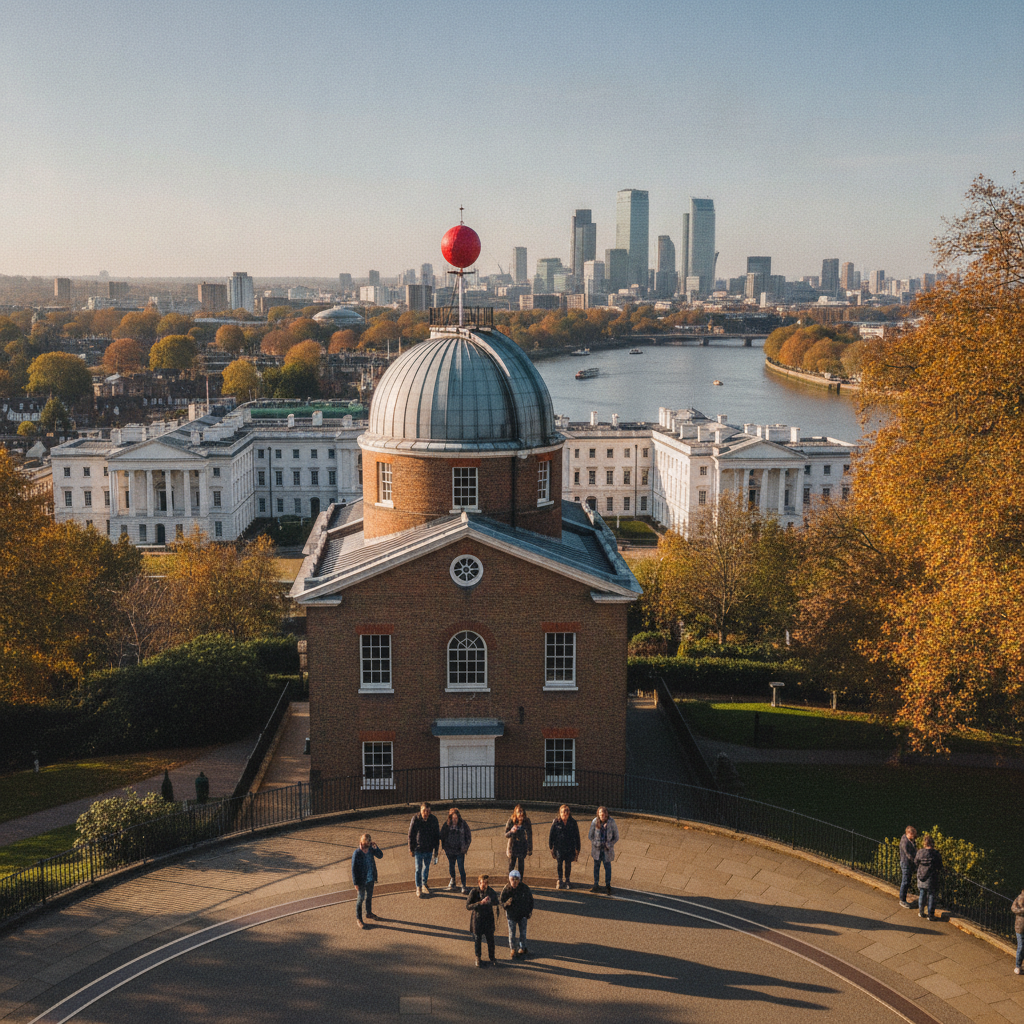
The Royal Observatory stands on the hill above Greenwich Park, built in 1675 by Charles II to improve navigation for British ships. Longitude—the east-west position on Earth—could only be determined by an accurate clock and a reference point: Greenwich was chosen as that reference point in 1884 at the International Meridian Conference. The bronze Meridian Line in the courtyard (Longitude 0°00'00") is the most-photographed tourist spot in Greenwich: stand with one foot in the Eastern Hemisphere, one in the Western. The Observatory contains the original instruments used to establish the prime meridian, the Camera Obscura, and an excellent planetarium (separate ticket). The view from the hill—Wren's Naval College, the Thames, Canary Wharf—is one of the great London panoramas. Free entry to the courtyard; paid entry to the buildings.
- 5
Greenwich Park — Royal Park with the Best Hill in London
Greenwich Park is the oldest of the Royal Parks, enclosed by Henry V in 1433. The park covers 74 hectares on a ridge above the Thames, with the Royal Observatory at the top of the main hill. The view from the observatory terrace down the avenue of chestnut trees to the Naval College, the Queen's House, the Thames and the towers of Canary Wharf is the most classic London skyline panorama—featured on countless postcards. The park has deer enclosures, rose gardens, a café, and a large open meadow popular for picnics. In summer, the Greenwich and Docklands International Festival fills the park with outdoor performances.
- 6
Greenwich Market & Town Centre
End the route in Greenwich town centre, clustered around the covered market. Greenwich Market (open daily) is one of London's best artisan and craft markets—strong on handmade jewellery, vintage clothing, ceramics, and street food. The surrounding streets contain some good independent restaurants and pubs: The Trafalgar Tavern on the waterfront (Victorian, grand, right on the river) and the historic Plume of Feathers nearby are both worth a visit. The Clipper river service from Greenwich Pier back to Embankment Pier (or to the Tate Modern at Bankside) is one of the best ways to see the Thames—45 minutes, crossing under Tower Bridge, with commentary.
Walk this route with audio
Stories play automatically as you reach each stop — no tapping needed.
More in london
The Square Mile: City of London Pub Walk
Literary Bloomsbury & Covent Garden: Books, Philosophers & Street Theatre
East End & Brick Lane: Street Art, Bagels & Bangladeshi Curry
South Bank Arts Trail: Waterloo to Borough Market
Museum District & Hyde Park: Science, Art & the Great Outdoors