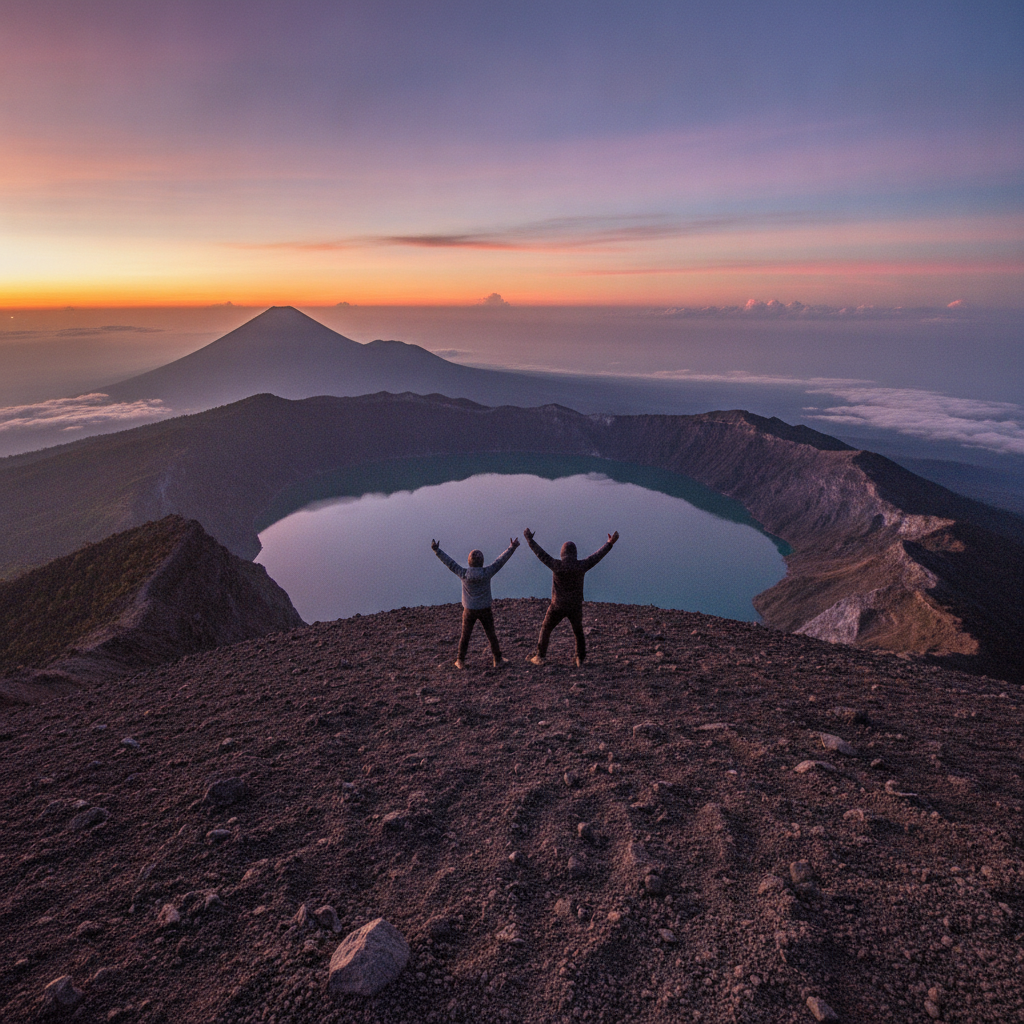
Lombok's Full Picture: Gili Trawangan's Full Moon Parties, Pura Lingsar's Hindu-Wetu Telu Shared Temple & Sumbawa's Mt. Tambora
Gili Trawangan's magic mushroom milkshake history and the Islamic alcohol restriction that is formally unenforced on an island whose economy runs on Bintang beer; Pura Lingsar—the only temple in Indonesia shared by Balinese Hindus and Muslim Wetu Telu practitioners for separate ceremonies at the same complex; sea turtle cleaning stations between Gili Meno and Air at 3–10 metres depth where hawksbills tolerate respectful snorkellers; the Sasak gendang beleq wedding processional ensemble where two enormous drums are carried on shoulder straps through the village stopping at each neighbour's gate; Selong Belanak's shallow-water family bay before the Mandalika road network arrived; and Sumbawa's Mt. Tambora—site of the 1815 eruption that killed 70,000 globally, ejected 160 km³ of ash, and caused 1816's Year Without a Summer.
- 1
Gili Trawangan's Social Scene & Long-Term Resident Culture
Gili Trawangan—the largest and most visited of the Gili Islands, with a permanent population of approximately 1,500 Sasak and Bugis residents plus a significant long-term expatriate community (mostly from Australia, Europe, and North America, operating dive shops, bars, and restaurants)—has developed an international social culture remarkable for its tiny geographic footprint (3 km × 2 km). The party geography: the east coast (the arrival side, with the fast boat pier) hosts the densest concentration of beach bars, restaurants, and dive shops; the west coast (the sunset side) is quieter and more residential; the interior (which visitors rarely see) is where the Sasak community lives, with mosques, small warungs, and rice fields. The no-alcohol paradox: Gili Trawangan is part of the Lombok regency, which is formally subject to Islamic regulations restricting alcohol—but in practice, alcohol is sold freely throughout the island for tourist consumption (a pragmatic accommodation between the Islamic administrative framework and the tourism economy that has been unresolved for decades). The full moon parties: monthly full-moon parties on Gili Trawangan are among the most reliably attended party nights in Southeast Asia—backpackers from across the region time their Lombok visit to coincide, creating temporary beach parties of 2,000+ people. The Magic Mushroom question: magic mushroom milkshakes were openly sold on Gili Trawangan until approximately 2010, when enforcement tightened; their availability remains variable and their use is illegal under Indonesian law.
- 2
Lombok's Hindu Temples – The Balinese Legacy
The Balinese Hindu legacy in Lombok—the architectural and religious heritage of the 150-year Karangasem dynasty that ruled western Lombok from Mataram—is visible in a series of temples and water palaces in and around the provincial capital, as well as in the living Balinese Hindu communities in the villages of west Lombok. Pura Meru (in Mataram—the largest Hindu temple in Lombok, built in 1720 by Anak Agung Made Karangasem to unify the diverse Hindu communities of Lombok under a single ritual centre): the three-tiered meru towers represent the three gods of the Hindu Trimurti—Brahma (11 tiers), Vishnu (9 tiers), Shiva (7 tiers); the temple is the most important ceremonial site for Lombok's approximately 150,000 Balinese Hindus. The Mayura Water Palace (Taman Mayura—built 1744 by Anak Agung Made Karangasem): a large ornamental lake with a floating bale (pavilion) connected to the shore by a causeway—originally a royal meeting hall and court of justice; the site of a 1894 massacre in which Dutch colonial troops killed 300 Balinese guards during the conquest of western Lombok. Pura Batu Bolong (on the Senggigi coast): the most photogenic temple in Lombok—a small Balinese temple built on a naturally perforated volcanic rock jutting into the sea, with sunset views across the Lombok Strait to Bali's volcanoes. Pura Lingsar (8 km east of Mataram): the only Balinese temple in Indonesia shared by Hindus and Muslim Wetu Telu practitioners for their respective ceremonies.
- 3
Snorkelling Lombok – Reefs, Turtles & the Wallace Line Underwater
The marine environment of Lombok and its surrounding islands—lying at the intersection of the Indian and Pacific Oceans on the Wallace Line (the biogeographic boundary separating Asian and Australian marine faunal communities)—is among the most biodiverse in Indonesia, with the Gili Islands Marine Protected Area, the Sekotong Gulf's small islands, and the Tanjung Ringgit cape offering accessible snorkelling for non-divers. The Gili Island turtle sites: the turtle cleaning stations between Gili Meno and Gili Air (where green sea turtles and hawksbill turtles rest while cleaner wrasse remove parasites from their shells) are the most reliably productive sea turtle snorkelling in Southeast Asia—encounters at water depths of 3–10 metres with turtles that have learned to tolerate respectful snorkellers. The Sekotong Gulf (southwest Lombok): a series of small islands (Gili Nanggu, Gili Sudak, Gili Tangkong) with fringing coral reefs, significantly less visited than the Gili Trawangan-Meno-Air trio—accessible from the Lembar port area by local boat (Rp 150,000–250,000 roundtrip). The Wallace Line underwater: the marine version of the biogeographic boundary—fish species typical of the Indo-Pacific (clownfish, parrotfish, butterflyfish) are present on both sides, but the density and species composition shifts noticeably between the Bali Strait and the Lombok Strait. The snorkelling season: year-round, but visibility is best May–October (dry season, minimal river runoff, lower plankton load).
- 4
Lombok Music & the Gamelan Sasak Tradition
The Sasak musical tradition—distinct from but related to the Balinese gamelan tradition—encompasses several distinct instrumental and vocal forms that reflect the Sasak people's synthesis of pre-Hindu animist, Hindu, and Islamic musical cultures. The gamelan Sasak (not actually called gamelan by the Sasak—referred to as the 'gendang beleq'—the 'large drum'): a processional ensemble of two large barrel drums (gendang beleq—carried on shoulder straps and played while walking), a pair of small drums (gendang lanang and gendang wadon—male and female drums), a set of bronze gongs, and a pair of cymbals (ceng-ceng)—used to accompany traditional ceremonies, particularly the Nyongkolan (the wedding procession that carries the groom's party to the bride's house through the village, stopping to perform at each neighbour's gate). The Islamic musical tradition: the Barzanji (a recitation of the Prophet Muhammad's biography in Arabic, performed at maulid (the Prophet's birthday) and circumcision ceremonies—with the Lombok version of the Barzanji performed in a distinctive call-and-response style with the audience) and the Rudat (an Islamic martial arts display combining Arabic-influenced music with acrobatic combat demonstrations). The contemporary music scene: Mataram has a small but active live music scene—the Artini Café and several venues near the Mataram University host local bands, and the Lombok music community has produced several nationally known artists in the genre of pop Sasak (Sasak-language pop music).
- 5
Lombok for Families – Beaches, Activities & Practical Planning
Lombok's combination of calm, shallow beaches (particularly on the west coast and at Selong Belanak on the south coast), accessible snorkelling, and relatively uncrowded conditions makes it one of the better family destinations in Indonesia—though the lack of urban infrastructure (few international schools, no paediatric hospitals outside Mataram, limited child-friendly restaurant options) means it works best as a short holiday destination rather than an extended family base. The best family beaches: Selong Belanak (the most family-friendly beach in Lombok—a sweeping bay with shallow, calm water, no significant wave break, a small beach community of warungs, and a few surf schools that offer beginner lessons for children from age 6); Gili Meno (the quietest Gili island, with calm water, turtle sightings within swimming depth of the shore, and significantly less nightlife than Trawangan—the best Gili option for families). The Rinjani question for families: Rinjani is appropriate for children over 12 who are experienced trekkers for the crater rim (2 days up and back); the waterfall trails at Senaru (Sindang Gila) are appropriate for younger children and take 30–40 minutes. The practical planning: the airport (LOP) is the easiest entry point; Kuta Lombok has a reasonable selection of villa accommodation with swimming pools that are more practical for families than the compact hotel rooms of the Gili Islands.
- 6
Beyond Lombok – The Eastern Islands & the Sumbawa Connection
Lombok's geographical position—midway between Bali to the west and the eastern Indonesian archipelago to the east—makes it the natural staging point for travel to islands that most Indonesia visitors never reach. Sumbawa (immediately east of Lombok, connected by a 2-hour fast ferry from Lombok's Labuhan Kayangan port): a largely Muslim island with an extraordinary surfing coastline (Supersuck and Lakey Peak at Hu'u are among the most internationally known surfing destinations in Indonesia), traditional Sumbawan horse culture (Sumbawa horses—a small but strong breed, used for both agriculture and the Sumbawan equestrian festivals), and the Mt. Tambora volcano (2,850 metres—the site of the largest volcanic eruption in recorded history, the April 1815 eruption that ejected 160 km³ of ash and caused the 'Year Without a Summer' in 1816, with global crop failures and famine estimated to have killed 70,000 people globally). Flores (2 hours by air from Lombok, or 3 days overland/ferry via Sumbawa): the elongated island of East Nusa Tenggara with Komodo National Park (Komodo dragons), Kelimutu's three differently-coloured crater lakes, and the Spider Web rice terraces of Ruteng. The overland option: the trans-Nusa Tenggara route from Lombok through Sumbawa, Flores, and the ferry chain to Timor and the Indonesian-East Timor border is one of the great overland journeys of Southeast Asia—rarely undertaken, always rewarding.
Walk this route with audio
Stories play automatically as you reach each stop — no tapping needed.
More in Lombok
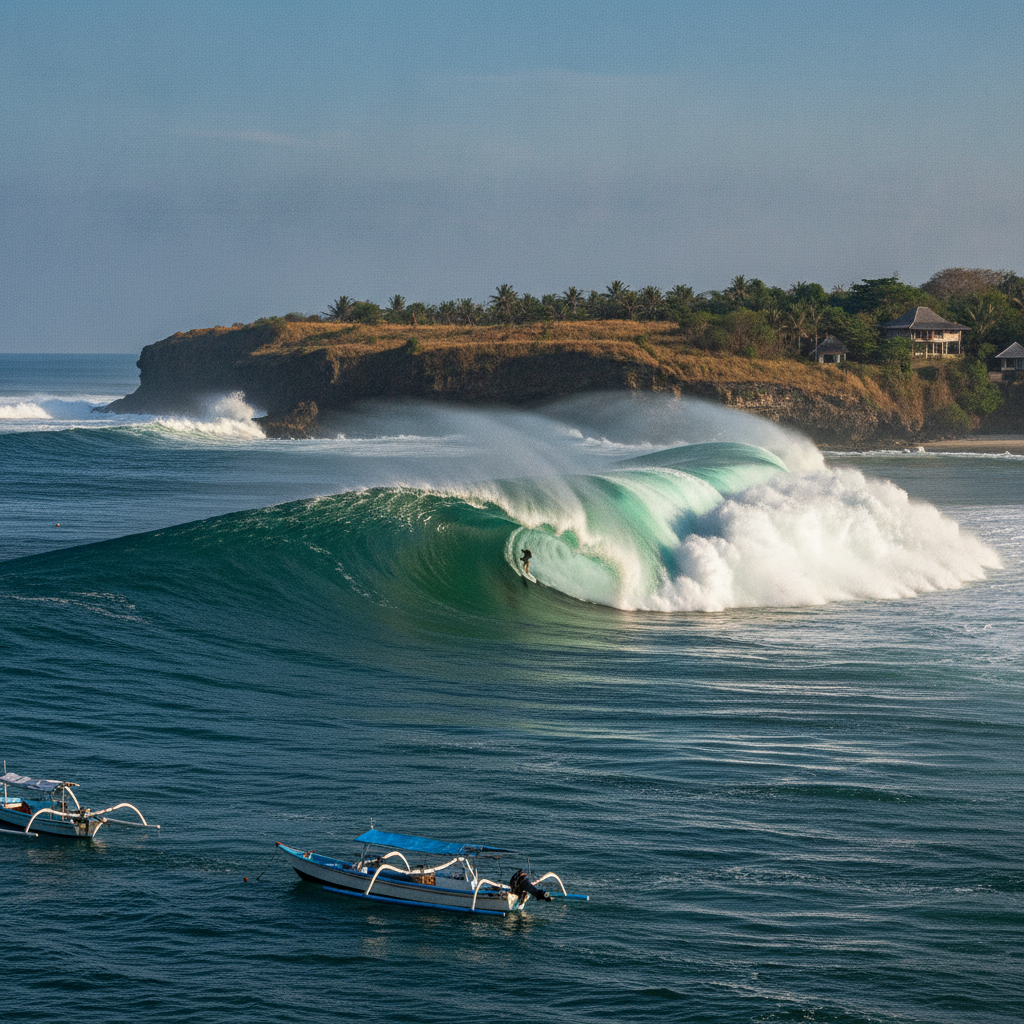
Lombok's Deeper Cuts: Segara Anak's Twin Pilgrimage Traditions, Desert Point's World-Record Barrel & Ayam Taliwang's Sasak Chilli Heat
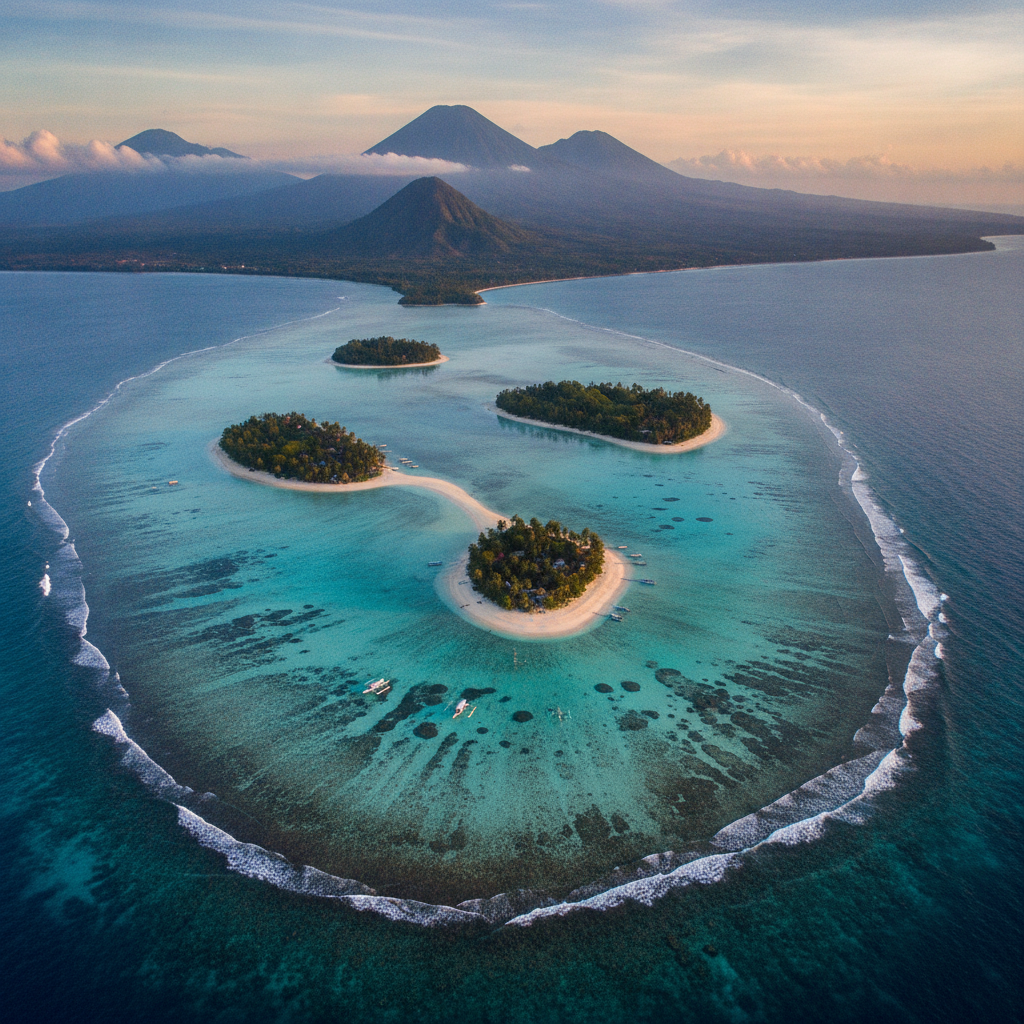
Lombok's Contested Future: The 2018 M7.0 Earthquake, Gili Eco Trust's Turtle Recovery & Mandalika's MotoGP Circuit Displacing Sasak Farmers
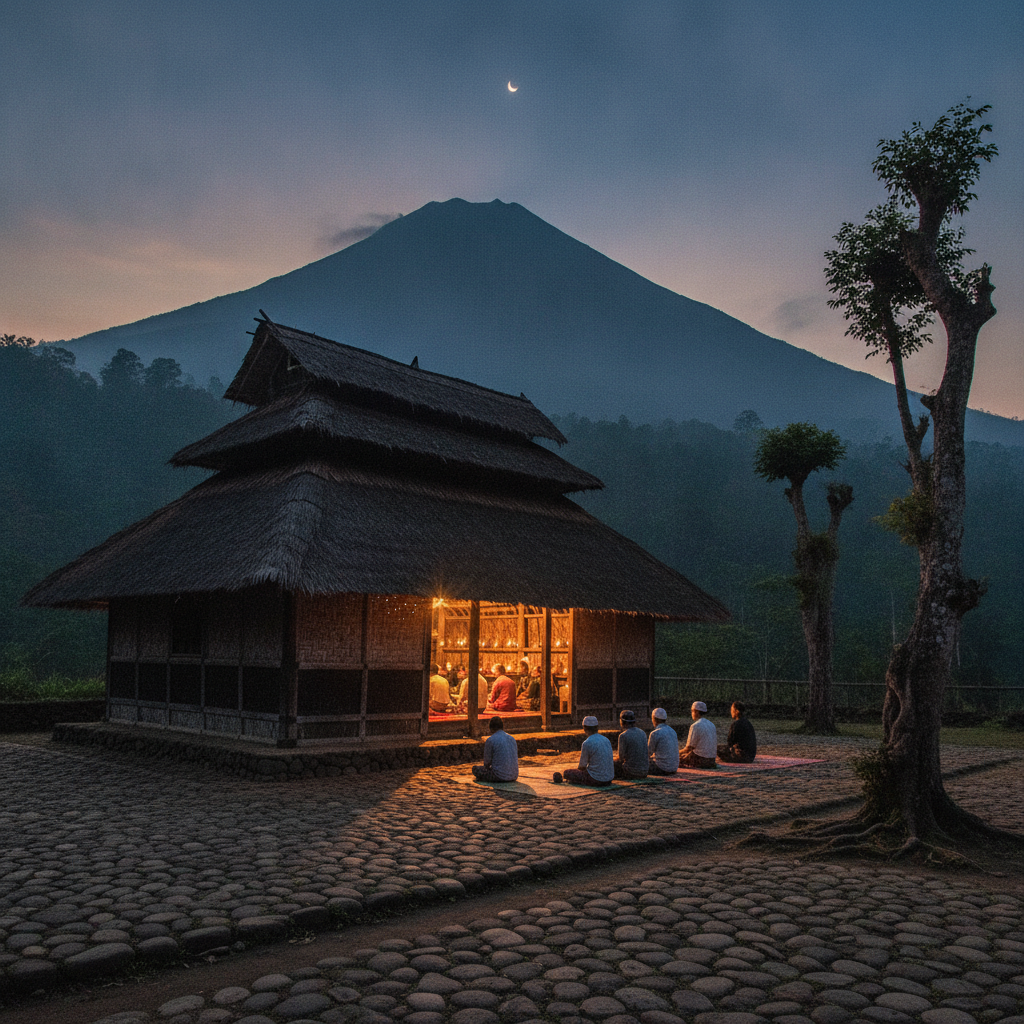
Lombok's Soul: Wetu Telu's Three-Daily-Prayer Islam, the Rinjani Scops Owl (New Species 2013) & the Sumbawa Tambora Connection
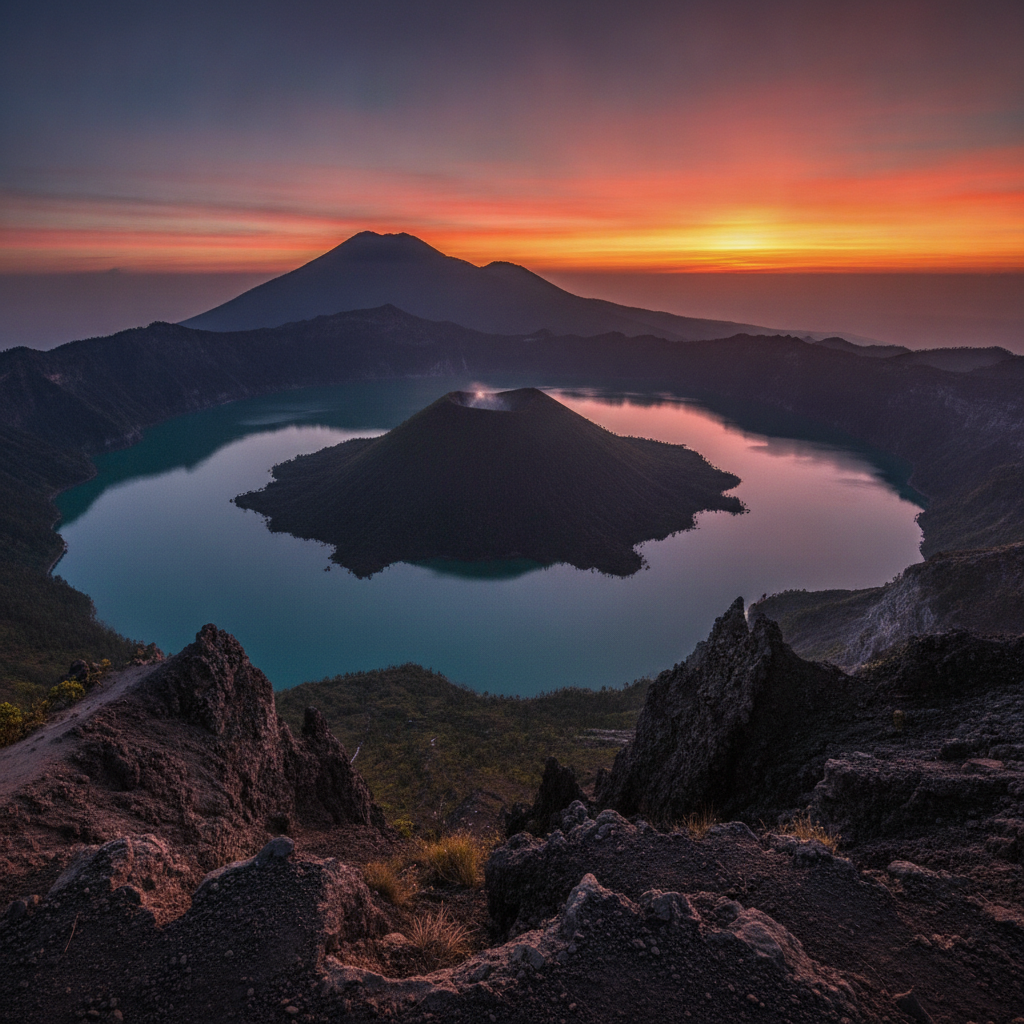
Lombok: Rinjani's 3,726m Crater Lake Trek, Gili Trawangan's No-Motor-Vehicle Coral Reefs & the Sasak Wetu Telu Syncretic Islam