Lombok's Contested Future: The 2018 M7.0 Earthquake, Gili Eco Trust's Turtle Recovery & Mandalika's MotoGP Circuit Displacing Sasak Farmers
The M7.0 earthquake of August 2018 that killed 555 people and taught the paradox that traditional bamboo Sasak houses survived better than the concrete-block houses built through government modernisation programmes; the Karangasem Balinese dynasty that ruled western Lombok 1740–1894 and left a permanent Hindu minority with Pura Meru's three-tower temple in the capital; Ekas Bay's seaweed farming cooperatives where Foraminifera red coral organisms colour Tangsi Beach pink; Lombok tobacco's Virginia and Oriental varieties exported to kretek clove cigarette factories; the Gili Eco Trust's reef monitoring after the 40% shallow coral damage from 2018 seismic disturbance plus 2015–16 El Niño bleaching; and 250 Sasak families displaced from Mandalika shoreline for the MotoGP circuit that drew 80,000+ spectators to the Indonesian Grand Prix when it returned in 2022.
- 1
The 2018 Lombok Earthquake – Recovery & Rebuilding
The 2018 Lombok earthquake sequence—beginning with a M6.4 earthquake on 29 July 2018, followed by the main M7.0 shock on 5 August 2018, and two subsequent M6.2 aftershocks on 9 and 19 August—killed 555 people, injured 1,300, displaced 417,000, and destroyed 73,000 houses across the Lombok interior, particularly in the North Lombok regency around Tanjung and the Rinjani foothills. The impact pattern: the earthquake did not significantly damage the Gili Islands (no casualties) or the southern beach areas (minimal damage), but devastated the rural Sasak communities in the north and west of the island—the traditional Sasak houses (built on bamboo platforms with bamboo-and-thatched-roof construction) were generally more resilient than the concrete-block houses built through government rural development programmes (which collapsed frequently). The recovery: the Indonesian government and international NGOs funded rapid temporary shelter construction, and within 18 months most displaced residents had returned to rebuilt houses; the Gili Islands tourism economy recovered fully by 2020. The lessons: the earthquake demonstrated the seismic vulnerability of the entire Lombok-Bali-Sumbawa region (all islands sit on the Banda Arc subduction system); and the paradox that traditional Sasak architecture—often replaced by concrete under 'modernisation' programmes—would have survived better.
- 2
Lombok's Transmigration History & Ethnic Diversity
Lombok's population diversity—beyond the majority Sasak (85%)—reflects both pre-colonial migration patterns and the Indonesian government's transmigration programme (transmigrasi—the large-scale resettlement of people from Java and Bali to less-populated outer islands, conducted from 1905 under the Dutch and expanded dramatically by the Suharto government 1970–2000). The historical Balinese community: the Karangasem dynasty (from east Bali) conquered and ruled western Lombok from approximately 1740 to 1894, when the Dutch expelled the Balinese rulers; the Balinese who had settled in western Lombok during the colonial period remained, creating a permanent Balinese Hindu minority (approximately 15% of west Lombok's population), with their own temples (most notably Pura Meru in Mataram). The transmigration communities: the government resettled approximately 200,000 Javanese and Balinese transmigrants to Lombok between 1970–2000, concentrating them in the transmigration settlements of southwest Lombok (around Sekotong and the Lembar port area) and the Lombok Tengah plain. The Bugis community: Bugis sea traders from South Sulawesi have maintained communities in the Lombok coastal settlements (particularly around Tanjung in north Lombok and Labuhan Lombok in the east) since the 18th century—fishing and inter-island trade.
- 3
Ekas Bay & Southeast Lombok – The Undeveloped Coast
Ekas Bay (Teluk Ekas—a large, almost-enclosed bay on Lombok's southeast coast, 80 km from Kuta and 100 km from Mataram)—is the least developed significant bay in Lombok: seaweed farming cooperatives covering the inner bay (the seaweed aquaculture is one of Lombok's most important agricultural industries—Indonesia is the world's second-largest seaweed producer—the Ekas Bay area produces eucheuma and cottonii varieties for the food and cosmetic industries); a surf break at the bay's eastern point; and the Surga resort (one of a handful of small-scale eco-lodges attempting to establish a sustainable tourism model in the bay before larger development arrives). The Pink Beach (Tangsi Beach—on the southeast coast 75 km from Mataram, north of the Ekas area): one of only seven pink-sand beaches in the world—the pink colour derives from microscopic red coral organisms (Foraminifera) mixed with the white sand, producing a distinct rose tint visible in daylight. The southeast coast accessibility: the roads connecting Kuta Lombok to the southeast coast have been significantly improved since 2019 (part of the Mandalika development road network), reducing travel time and opening the southeast coast to day trips from Kuta. The future: several large resort developments were proposed for Ekas Bay as part of the broader Mandalika tourism development—the coronavirus pandemic delayed most; the post-2022 development trajectory is uncertain.
- 4
Lombok's Agricultural Economy – Rice, Tobacco & Seaweed
Lombok's economy is predominantly agricultural: the island's fertile volcanic soils and reliable rainfall support intensive rice cultivation (2–3 harvests per year on irrigated land in the central plains), tobacco growing (Lombok is one of Indonesia's most important tobacco-producing regions—the Lombok tobacco, particularly the Praya area's Virginia and Oriental varieties, is exported to cigarette manufacturers across Indonesia), and the growing seaweed aquaculture industry. The Lombok tobacco: tobacco has been grown in Lombok since the Dutch colonial period; the Lombok Praya area's tobacco is used in kretek (clove cigarettes)—Indonesia's dominant cigarette type (accounting for 90% of the Indonesian cigarette market, one of the largest in the world). The rice agriculture: the Sasak subak (Lombok's adaptation of the Balinese cooperative irrigation system—distinct from the Balinese original in being organised through the mosque community rather than the temple network) manages the irrigation water of the central plains. The seaweed aquaculture: the Ekas Bay and south Lombok coast seaweed farming employs approximately 50,000 households; the seaweed (processed into carrageenan) is used in food products (dairy alternatives, ice cream, processed meat) and cosmetics worldwide. The Mandalika SEZ (Special Economic Zone): the Indonesian government's investment in south Lombok has included road building, airport expansion, and the MotoGP circuit—intended to shift the economic base from agriculture to tourism services.
- 5
The Gili Islands Marine Conservation & Diving
The marine environment of the Gili Islands—part of the Gili Matra Marine Protected Area (established 1993, one of the first marine protected areas in Indonesia)—supports one of the highest densities of sea turtles in the eastern Indian Ocean, with regular sightings at the cleaning stations adjacent to all three islands. The dive sites: Shark Point (between Gili Air and the Lombok mainland—encounters with blacktip and whitetip reef sharks, occasional wobbegong; depth 12–30 metres); Halik (the east side of Gili Trawangan—a wall dive with sea fans and occasionally pelagic fish); Bounty Wreck (an artificial reef created from a sunken boat, now colonised by lionfish, moray eels, and schooling glassfish—depth 15 metres, suitable for beginners); Turtle Heaven (the most-dived site, adjacent to Gili Meno, where turtle sightings are almost guaranteed year-round). The coral reef status: the Lombok Strait's 2018 earthquake caused significant coral damage through seismic disturbance; combined with the 2015–2016 El Niño bleaching event, approximately 40% of the shallow reef was damaged. Recovery has been partial—the deeper reef (15–30 metres) is largely intact. The conservation organisations: Gili Eco Trust (the primary conservation NGO, running reef monitoring, trash collection, and mooring buoy installation to prevent anchor damage); the no-motorised-boat rule on all three islands reduces the pollution and propeller strike risk to turtles.
- 6
The Mandalika Development & Indonesia's New Bali Ambition
The Mandalika Special Economic Zone (KEK Mandalika—a 1,175-hectare development on Lombok's south coast, adjacent to Kuta)—is Indonesia's most ambitious tourism infrastructure project since Nusa Dua Bali was developed in the 1970s. The anchor project: the Pertamina Mandalika International Street Circuit—a 4.31-km FIA Grade 1 motorsport circuit built on the Mandalika coast in 2021, designed for MotoGP and Formula E, with a grandstand capacity of 150,000. The MotoGP connection: the Indonesian Grand Prix (Pertamina Grand Prix of Indonesia) returned to the FIM MotoGP calendar in 2022 after a 25-year absence from Indonesian motorsport, held at Mandalika in March (in the waning dry season); the event attracted 80,000+ spectators in its first year, making it one of the largest attended events in Indonesian sports history. The development tensions: the Mandalika project required the displacement of approximately 250 Sasak farming and fishing families from the Mandalika shoreline (documented by Amnesty International and the Indonesian legal aid organisation LBH—the land acquisition process involved contested compensation payments and forced relocation); the construction of the circuit used a controversial financing structure involving a state-owned enterprise (ITDC). The broader ambition: the Indonesian government's '10 New Balis' programme targets 10 tourism destinations for Bali-level development—Mandalika/Lombok is the most advanced, followed by Labuan Bajo/Flores (Komodo) and Lake Toba/North Sumatra.
Walk this route with audio
Stories play automatically as you reach each stop — no tapping needed.
More in Lombok
Lombok's Full Picture: Gili Trawangan's Full Moon Parties, Pura Lingsar's Hindu-Wetu Telu Shared Temple & Sumbawa's Mt. Tambora
Lombok's Deeper Cuts: Segara Anak's Twin Pilgrimage Traditions, Desert Point's World-Record Barrel & Ayam Taliwang's Sasak Chilli Heat
Lombok's Soul: Wetu Telu's Three-Daily-Prayer Islam, the Rinjani Scops Owl (New Species 2013) & the Sumbawa Tambora Connection
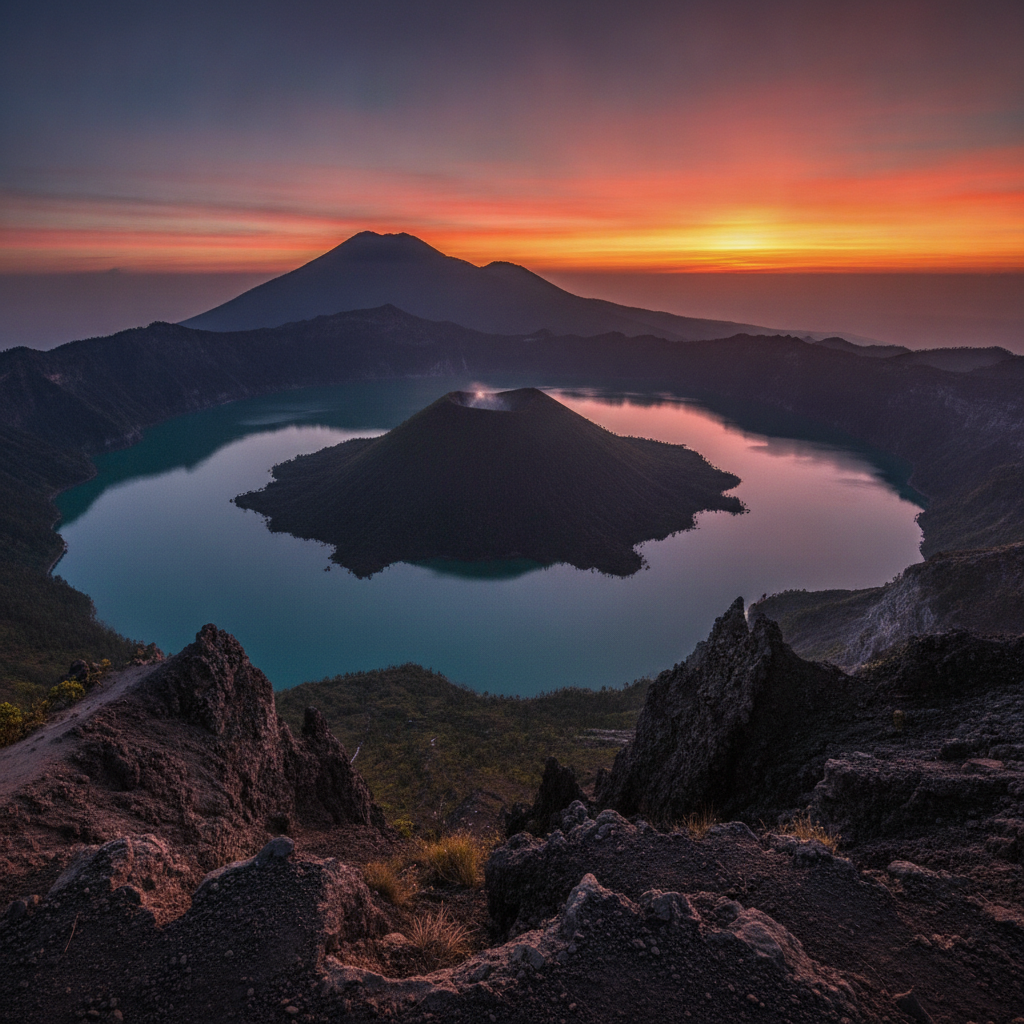
Lombok: Rinjani's 3,726m Crater Lake Trek, Gili Trawangan's No-Motor-Vehicle Coral Reefs & the Sasak Wetu Telu Syncretic Islam