Belém: The Manueline Monuments of the Age of Discoveries
Belém ('Bethlehem' in Portuguese), the riverside district 6 km west of Lisbon's center, is where Vasco da Gama set sail for India in 1497 and where the most spectacular monuments of Portugal's Age of Discoveries were built in his honor and the honor of those who followed. The Jerónimos Monastery and the Tower of Belém — both UNESCO World Heritage Sites since 1983 — are the supreme achievements of the Manueline style, Portugal's unique Late Gothic architectural form characterized by maritime motifs and a ornamental exuberance that has no parallel in European architecture.
- 1
Jerónimos Monastery (Mosteiro dos Jerónimos)
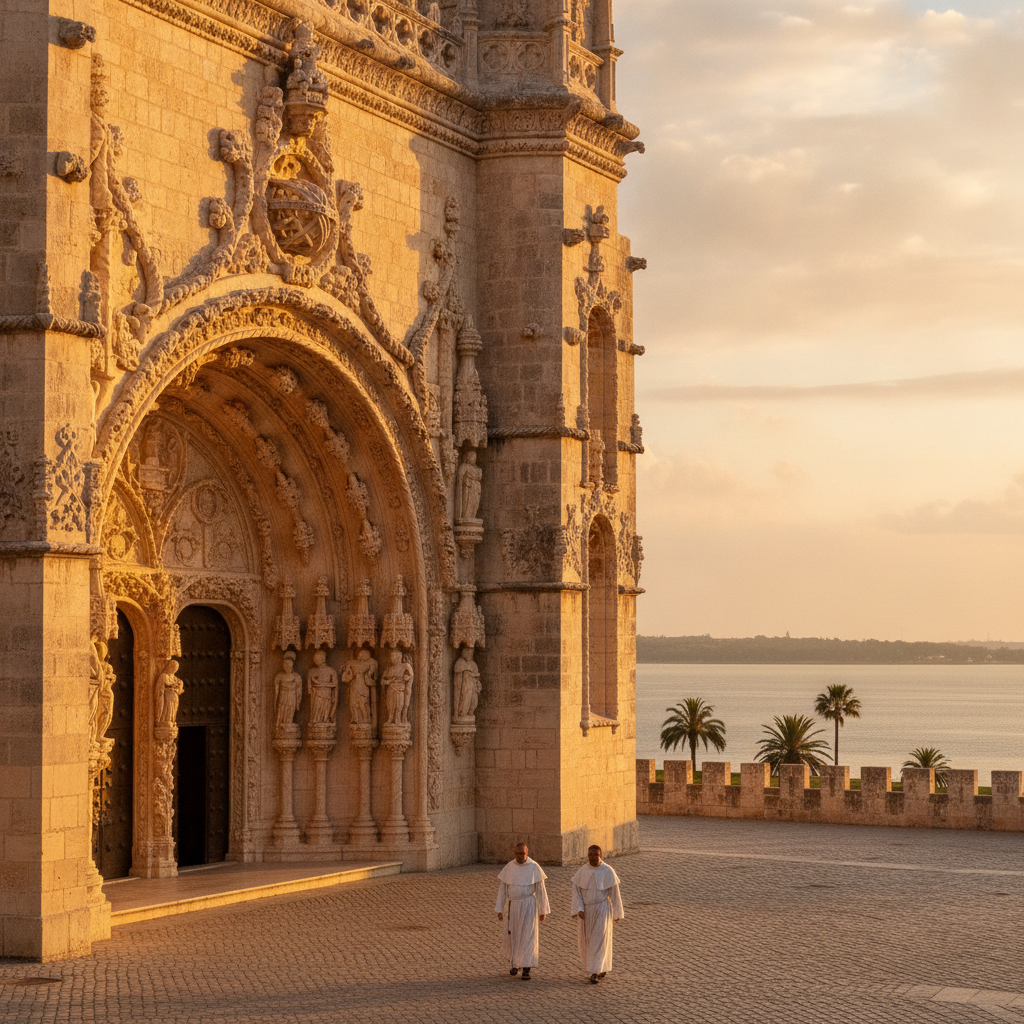
The Jerónimos Monastery, built between 1501 and 1601 on the orders of King Manuel I with revenues from the lucrative spice trade — particularly the pepper monopoly from India — is the greatest surviving monument of the Manueline architectural style and one of the masterpieces of Late Gothic art anywhere in the world. The south portal, the work of João de Castilho and Diogo de Boytac, is a tour de force of sculptural imagination: ropes, coral, armillary spheres, crosses of the Order of Christ, navigational instruments, and exotic vegetation cascade across the doorway in stone with an extravagance that reflects the wealth and confidence of the golden age of Portuguese maritime expansion. Inside, the single nave soars on slender octagonal columns whose surface is covered with carved decoration. The monastery's cloister — two stories of arched galleries surrounding a central garden — is the most elegant interior space in Portugal. In the church transept, the tomb of Vasco da Gama (died 1524) is marked by a sarcophagus carved with navigational instruments; opposite, the tomb of the national poet Luís de Camões (1524-1580), author of Os Lusíadas, the epic poem of Portuguese maritime expansion.
- 2
National Coach Museum (Museu Nacional dos Coches)
The National Coach Museum, in a purpose-built pavilion designed by the Brazilian architect Paulo Mendes da Rocha (completed 2015) adjacent to the former Royal Riding School, houses the world's finest collection of royal carriages — over 70 vehicles from the 17th to 19th centuries, including the most elaborately decorated court coaches in existence. The three coaches created for the Portuguese embassy to Pope Clement XI in Rome in 1716 — known as the 'Oceans' coaches — are the most magnificent examples of Baroque applied art in Portugal, their gilded exterior panels depicting the four oceans, the four seasons, and the allegories of Fame, Glory, and Honor in carved and painted wood with such elaboration that they are essentially mobile sculptures. The original carriage hall (Picadeiro Real, 1726) retains several more historical coaches and the architectural character of the Pombaline stable complex.
- 3
Tower of Belém (Torre de Belém)
The Tower of Belém, built between 1516 and 1521 by Francisco de Arruda on a small island in the Tagus (the river's edge has since shifted so it now appears on the riverbank), was constructed as a ceremonial gateway to Lisbon and as a fortress protecting the mouth of the port. Its form — a square tower rising from a lower bulwark with Manueline decorative elements including watchtowers with Moorish-inspired ribbed domes, stone rhinoceros (the first naturalistic depiction of a rhinoceros in European stone sculpture), ropes, armillary spheres, and crosses of the Order of Christ — makes it the most architecturally coherent surviving Manueline building. The tower is UNESCO-listed together with the Jerónimos Monastery as 'Monastery and Tower of Belém'.
- 4
Monument to the Discoveries (Padrão dos Descobrimentos)
The Monument to the Discoveries, a 52-meter concrete structure in the form of a caravel's prow jutting into the Tagus, was erected in 1960 (originally built in perishable materials for the 1940 World Exhibition) to mark the 500th anniversary of the death of Prince Henry the Navigator. Thirty-three historical figures are carved in stone on both flanks of the prow: Henry leads, followed by Vasco da Gama, Bartolomeu Dias, Fernão de Magalhães (Magellan), Pedro Álvares Cabral (discoverer of Brazil), and other navigators, cartographers, missionaries, and chroniclers of the Age of Discoveries. The monument's rooftop terrace offers panoramic Tagus views. Before it, a large compass rose inlaid in the pavement — a gift from South Africa in 1960 — shows the routes of Portuguese maritime exploration.
- 5
Pastéis de Belém (Original Pastel de Nata)
The Pastéis de Belém pastry shop, at Rua de Belém 84-92 immediately beside the Jerónimos Monastery, has been producing the original pastel de nata (custard tart) since 1837 — when the monastery monks, facing dissolution under the Liberal government, began selling the tarts to survive, using a recipe that remains a closely guarded secret to this day. The shop (which can serve over 20,000 tarts daily in peak season) bakes them in vast industrial quantities in the visible kitchen behind the counter, each tart emerging golden and slightly scorched on top, dusted with powdered sugar and cinnamon, and eaten warm. The pastel de nata is now Portugal's most iconic food export; the Belém original — legally distinguished from imitations by the name 'Pastel de Belém' — is considered definitive.
- 6
Belém Cultural Centre (Centro Cultural de Belém) & Berardo Collection
The Centro Cultural de Belém (CCB), a vast limestone complex on the Tagus waterfront built for Portugal's EU Presidency in 1992 and designed by Vittorio Gregotti and Manuel Salgado, houses the Berardo Collection Museum — one of the most important collections of modern and contemporary art in the Iberian Peninsula. The Berardo Collection, assembled by the Madeiran businessman José Berardo, spans 20th-century art from Cubism through Pop Art to the present, with major works by Pablo Picasso, Andy Warhol, Francis Bacon, Mark Rothko, and Jeff Koons among the 900+ works on permanent display. The CCB also contains a major concert hall, a conference center, and a long terrace promenade facing the Tagus.
Walk this route with audio
Stories play automatically as you reach each stop — no tapping needed.
More in lisbon
Alfama & São Jorge Castle: Lisbon's Moorish Heart
Parque das Nações: Expo '98 and Lisbon's City of the Future
Tram 28, Estrela & Campo de Ourique: Lisbon's Most Scenic Ride
LX Factory, Alcântara & the 25 de Abril Bridge: Industrial Lisbon Reborn
Cascais & Estoril: The Portuguese Riviera by the Sintra Line