Neon Museum, Wedding Chapels & Downtown Las Vegas Arts
Beyond the Strip, Downtown Las Vegas contains the most historically significant and culturally authentic neighbourhood in the city — the original Las Vegas casino district, the world-famous wedding chapels, the Neon Museum, the Mob Museum, and the emerging 18b Arts District form a downtown experience completely distinct from the mega-resort Strip.
- 1
The Neon Museum — Las Vegas's Most Poignant Attraction
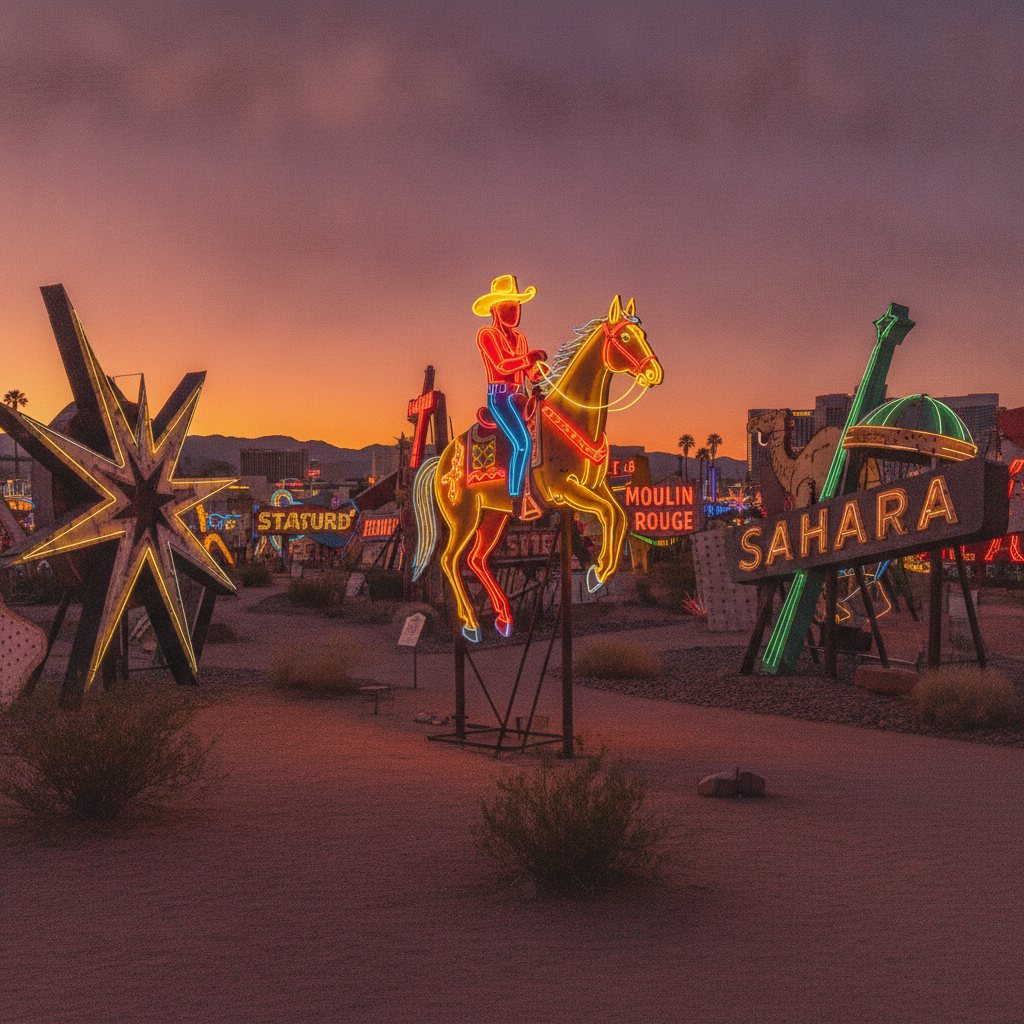
The Neon Museum (770 Las Vegas Boulevard North, Downtown Las Vegas — the open-air museum of more than 200 historic Las Vegas neon signs, the preserved artefacts of the city's mid-century golden age): the Neon Museum (founded 1996 and opened to the public in its current form in 2012) preserves and exhibits the decommissioned neon signs from demolished Las Vegas hotels and casinos — the signs that defined the visual identity of Las Vegas from the 1930s through the 1990s (the era when Las Vegas Boulevard was lined with the independently themed low-rise casino-hotels (the Flamingo (1946), the Desert Inn (1950), the Riviera (1955), the Stardust (1958), the Tropicana (1957), and others) that have since been replaced by the mega-resort complexes of the current Strip): the collection includes: the 'Hacienda Horse and Rider' (1967 — the largest and most iconic sign in the museum), the 'Stardust' starburst sign (from the demolished Stardust Resort & Casino (1958-2007)), the 'Sahara' camel-and-dome sign (from the demolished Sahara Hotel (1952-2012)), the 'Moulin Rouge' sign fragment (from the historic 1955 hotel (the first racially integrated casino in Las Vegas, the 1955 Moulin Rouge Agreement — signed after the Moulin Rouge's overnight success with Black performers and Black patrons showed the casino industry that integration was commercially viable — was the agreement that ended segregation in Las Vegas's casino industry)), and the 'Young Electric Sign Company' (YESCO) collection of vintage Las Vegas signage (YESCO, the Utah-based sign company that created the majority of the famous Las Vegas casino signs from the 1940s through the 1990s, is the primary donor to the Neon Museum collection).
- 2
Las Vegas Wedding Chapels — The World's Most Famous Elopement Destination
Las Vegas wedding chapels (the wedding industry that makes Las Vegas the most popular elopement and spontaneous-wedding destination in the world — approximately 80,000-90,000 weddings are performed in Las Vegas annually (approximately 1,700 per week), making Las Vegas the city with the highest number of weddings per capita of any major city in the United States and one of the highest in the world): Las Vegas weddings (the combination of Nevada's marriage laws (no waiting period, no blood test, a $77 marriage license fee, and the license is valid immediately — the fastest and most permissive marriage laws of any US state) and the proliferation of around-the-clock wedding chapels (approximately 50 licensed wedding chapels in the Las Vegas area)) have produced the most famous and most romanticized elopement culture in the world (the cultural archetype of the Vegas wedding — the spontaneous decision to get married after a night of casino-fueled celebration — has been the subject of hundreds of films, television episodes, and songs): the most famous chapels are: the Little White Wedding Chapel (1301 Las Vegas Boulevard South — the oldest and most famous chapel in Las Vegas, established 1951 and famous for the drive-through 'Tunnel of Love' wedding service (the world's first and most popular drive-through wedding), the chapel where Michael Jordan, Michael Keaton, and Bruce Willis were married), and the Graceland Wedding Chapel (619 Las Vegas Boulevard South — the Elvis-themed chapel famous for the Elvis impersonator officiant, the most photographed wedding experience in Las Vegas).
- 3
The Mob Museum — The National Museum of Organized Crime and Law Enforcement
The Mob Museum (The National Museum of Organized Crime and Law Enforcement — 300 Stewart Avenue, Downtown Las Vegas, in the historic 1933 Federal Building and US Post Office that served as the site of the 1950 Kefauver Committee hearing (the landmark US Senate hearing investigating organized crime that featured the first live televised Congressional hearing in American history, viewed by an estimated 30 million Americans — the hearing that established public awareness of organized crime in the US and directly led to the modern FBI's organized crime investigation programme)): the museum (opened February 2012, funded by the City of Las Vegas) presents the history of organized crime in the United States and the law enforcement response to it, with particular emphasis on Las Vegas (the city most defined by its relationship with the Mafia in the popular imagination): the exhibits include: the St. Valentine's Day Massacre wall segment (the actual section of the brick wall from the SMC Cartage Company garage in Chicago (2122 North Clark Street) where the 7 members of the North Side Gang were machine-gunned by Al Capone's South Side gang on February 14, 1929 — one of the most significant physical artefacts of American organized crime history), the electric chair from Nevada State Prison, the 'Beat the House' gambling exhibition (the interactive demonstration of the mathematics behind casino games), and the speakeasy bar (the working bar in the museum's basement, accessible through the original vault of the Federal Building, serving Prohibition-era cocktails).
- 4
18b Las Vegas Arts District — The Creative Downtown
18b Las Vegas Arts District (the 18-square-block arts and creative district in the area of Las Vegas Boulevard South between Sahara Avenue and Charleston Boulevard — the most creatively diverse and authentic neighbourhood in Las Vegas, and the oldest commercial district in the city (the area was the commercial heart of the original Las Vegas townsite platted in 1905)): the Arts District (named '18b' for the approximately 18 square blocks of its original footprint) has developed since the 1990s as the counter-cultural alternative to the Strip, attracting independent art galleries (the 108 Contemporary (the finest contemporary art gallery in Las Vegas), the Holocene Gallery, and the rotating pop-up galleries), independent restaurants and bars (the most interesting independent restaurant scene in Las Vegas, concentrated in the Arts District area), the First Friday event (the monthly First Friday (the free public arts event held on the first Friday of every month in the 18b Arts District, drawing 10,000-15,000 visitors to the galleries, outdoor stages, food trucks, and street art activities — the longest-running and most popular recurring arts event in Las Vegas)), and the architecture (the mix of 1910s-1940s commercial buildings, 1950s motels converted to artist studios, and new creative spaces that gives the Arts District its human-scale, walkable character in contrast to the mega-resort scale of the Strip).
- 5
The Venetian & Palazzo — Canals Inside a Casino
The Venetian Resort Las Vegas (the Italian Renaissance-themed luxury hotel and casino at 3355 Las Vegas Boulevard South, opened in 1999 by Sheldon Adelson (1933-2021) of Las Vegas Sands Corporation at a cost of $1.5 billion — the largest hotel in the United States by room count when opened (at 7,117 suites, all of the guest rooms at the Venetian are suites rather than standard hotel rooms, a concept that Adelson pioneered)): the Grand Canal Shoppes (the enclosed shopping mall within the Venetian, designed as a reproduction of the streets of Venice, Italy — the most architecturally theatrical retail environment in the world: the painted ceiling (the 'sky ceiling' — a reproduction of the Venetian sky at various times of day, painted on the barrel-vaulted ceiling of the main shopping corridor to simulate being outdoors in Venice), the Grand Canal (the 980-foot (299-metre) reproduction of the Grand Canal running through the centre of the mall, with actual gondolas (the 13 gondolas operated by gondoliers in traditional Venetian costume, who row customers in the gondolas along the canal while singing Italian opera and popular songs — the only gondola ride in the United States outside of Venice-themed attractions) and the St. Mark's Square (the reproduction of the main piazza of Venice at the end of the Grand Canal, used as a performance space for the 'streetmosphere' performers (the actors, musicians, and living statues who perform throughout the day in the shopping areas))).
- 6
Las Vegas Architecture — From Mob Casinos to Megaresorts
Las Vegas's architectural history (the most dramatic and compressed architectural evolution of any city in the world — from a small railroad town (1905) to the largest concentration of themed mega-resort architecture in human history in just 100 years): the principal architectural periods of Las Vegas are: the early casino era (the 1940s-1960s low-rise casino-hotels along the original Las Vegas Strip — the Flamingo (1946, designed by George Vernon Russell), the Sahara (1952), the Riviera (1955), and the Tropicana (1957) established the pattern of the themed hotel-casino with a prominent neon sign, a single main gaming floor, a showroom, and a small pool area); the MiMo era (the Miami Modern / Googie architecture of the late 1950s-1960s that produced the most extravagant resort architecture of the Space Age: the Stardust (1958), the Dunes (1955), and the International Hotel (1969 — the largest hotel in the world at opening, designed by Martin Stern Jr. — the Y-shaped floor plan of the International (now Westgate) that has been imitated in virtually every Las Vegas hotel tower built since); the mega-resort era (the post-1989 era of billion-dollar themed mega-resorts that defines the current Las Vegas Strip: the Mirage (1989, $630 million, Steve Wynn's first mega-resort — the project that established the template for all subsequent Las Vegas mega-resort development), the MGM Grand (1993, the largest hotel in the world at opening), the Bellagio (1998, $1.6 billion), and the CityCenter (2009, $8.5 billion — the largest privately funded construction project in US history).
Walk this route with audio
Stories play automatically as you reach each stop — no tapping needed.
More in las-vegas
Las Vegas Nightclubs, EDM & the World's Greatest DJ Culture
Poker, Blackjack & the Science of Las Vegas Gambling
Sinatra, the Rat Pack & the Golden Age of Las Vegas
Grand Canyon, Valley of Fire & Desert Escapes from Las Vegas
Las Vegas Pool Parties, Spas & the Ultimate Resort Experience