Lake Titicaca Puno Festivals: The Candelaria and Altiplano Folklore
The department of Puno is known throughout Peru as the capital of folklore, a title earned by the extraordinary density of traditional dance, music, and festival traditions concentrated in the altiplano communities around the lake. The Fiesta de la Candelaria each February, honoring the Virgin of Candelaria who is the patron of Puno, draws over 200 dance groups from the entire region to perform in the streets over two weeks in one of the most spectacular cultural events in Latin America. The rich traditions of Aymara and Quechua music including the sikuri pan-pipe ensembles, the lakita and ayarachi styles, and the brass-dominated marching band music represent a living indigenous cultural heritage of extraordinary vitality.
- 1
Fiesta de la Candelaria: The February Folklore Explosion
The Fiesta de la Candelaria, held each February in Puno around the feast day of the Virgin of Candelaria on February 2, is the most important festival in the department and one of the largest traditional festivals in the Americas, drawing an estimated 40,000 costumed dancers and musicians from more than 200 groups performing over two weeks. The festival combines Catholic religious devotion to the Virgin with a competitive dance festival in which groups representing different communities and traditions perform in the street processions and in the stadium competition. The opening procession on the first Saturday features hundreds of groups in full traditional costume in a parade lasting six to eight hours through the main streets. The central week includes the staged competition in the Estadio Enrique Torres Belón where judging panels evaluate costume quality, dance precision, and musical performance. UNESCO designated the Candelaria festival as Intangible Cultural Heritage in 2014.
- 2
The Diablada: Devil Dance of the Andean Festivals
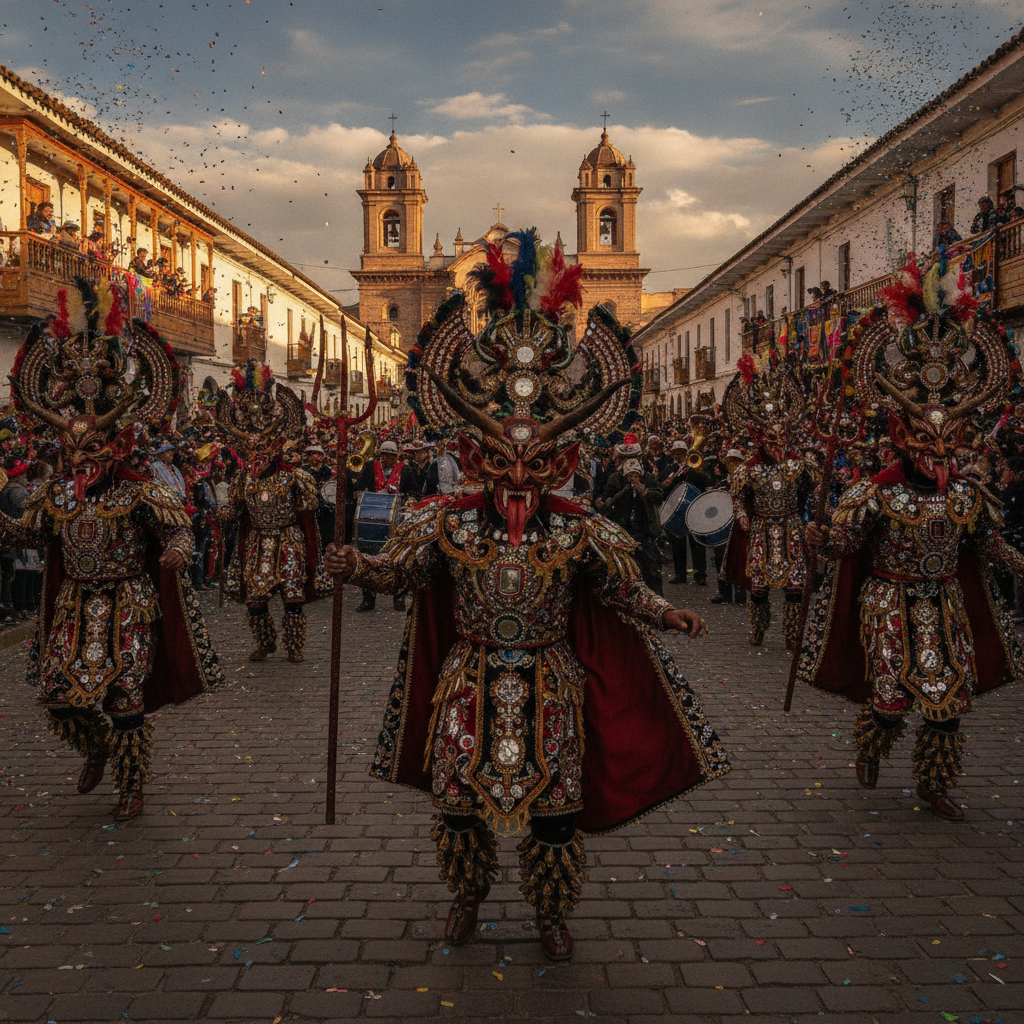
The diablada, the devil dance performed at Candelaria and at the Oruro Carnival, is the most visually spectacular of the altiplano dance forms, with dancers wearing elaborate devil costumes incorporating a large painted mask with multiple horns, serpents, and frogs, a cape of sequined fabric representing the devil attributes, and platform boots with metal spurs. The dance depicts the eternal struggle between good and evil, with the Archangel Michael and his forces defeating the forces of the devil in a narrative sequence derived from colonial religious theater. The masks, each individually crafted by specialist artisans and costing between 500 and 3,000 USD for the finest examples, are the most expensive element of the costume and can take months to complete. Puno has a thriving mask-making industry that supplies both the Candelaria and the Oruro Carnival, and the workshop of a skilled mask-maker is one of the most interesting craft visits in the city.
- 3
Sikuri Music: The Pan-Pipe Ensembles of the Lake
The sikuri tradition, the communal playing of large interlocking pan-pipe ensembles by groups of men from the communities around the lake, is one of the most distinctive and oldest musical traditions of the Andean altiplano. The siku, or pan-pipe, is made from bamboo or reed and is played in pairs: one player holds the arca half of the instrument and the other holds the ira half, and the melody is produced by the two players alternating notes in a system called hocketing that requires precise coordination and collective musical memory. The ensemble can have dozens of players, each with the same instrument at different pitches, creating a rich layered sound that carries across the open altiplano. The sikuri music tradition differs between communities: the ayarachi style from the Paratia region uses large instruments with a deep buzzing tone played at funerals and agricultural ceremonies, while the lakita style from the lake shore communities uses smaller instruments with a brighter tone for festive occasions.
- 4
The Puno Brass Band Tradition: Spanish Colonial Meets Andean Festivity
The brass band tradition that now dominates the sonic character of the Candelaria and other Puno festivals represents one of the most successful colonial-period cultural fusions in the Andes. Spanish missionaries introduced European brass instruments in the 17th century as tools for Catholic ceremonial music; the Aymara and Quechua communities adopted the trumpet, trombone, tuba, and bass drum and transformed them into vehicles for indigenous festive music. The resulting hybrid style, played by bands of 20 to 60 musicians marching in procession, combines the harmonic vocabulary of European military march music with Andean rhythmic patterns, pentatonic melodic choices, and the infectious energy of community celebration. The brass band accompaniment for the diablada and morenada dances has become the defining sound of the Puno festive season. Local brass band composers are celebrated community figures; the most popular Candelaria tunes spread quickly across the altiplano through recordings and YouTube and become the themes of specific festival seasons.
- 5
The Morenada Dance: History Encoded in Costume
The morenada, one of the most popular dances at both the Candelaria and the Oruro Carnival, depicts the enslaved African workers who were brought to the Potosi mines in the colonial period. The dancers wear elaborate costumes including a large rolling-eyed mask representing the faces of enslaved Africans, embroidered jackets studded with mirrors and beading, and the distinctive matraca rattle that makes the heavy rolling sound mimicking the shuffling walk of workers in leg irons. The dance and its imagery encode a specific historical memory of the Atlantic slave trade as experienced in the Andean context, and the performance is simultaneously a commemoration, a parody, and a celebration of survival. The morenada costume has become one of the most elaborate and expensive in the festival circuit, with top-level costumes costing thousands of dollars for the complete ensemble. Women participate prominently in the morenada as borracheras, dancers playing drunk women characters, a relatively recent addition that has become a major visual element of the dance.
- 6
Puno Day: The City Festival of November 5
Puno Day, celebrated on November 5, commemorates the legendary emergence of Manco Capac and Mama Ocllo from the waters of Lake Titicaca and marks the founding of the city of Puno in 1668. The festival features a theatrical reenactment of the emergence of the first Inca couple from the lake, performed in elaborate Inca costume on the shores of the lake near the city center, followed by a parade of dance and music groups through the main streets. The Puno Day celebration is smaller than the Candelaria but has the advantage of occurring in the dry season with better weather conditions; the Candelaria in February falls during the rainy season when afternoon downpours frequently interrupt the outdoor performances. The November date also coincides with the Dia de los Muertos celebrations of late October and early November, when the cemetery in Puno becomes a center of community gathering, food preparation, and overnight vigil that reflects both Catholic All Saints traditions and older Andean ancestor veneration practices.
Walk this route with audio
Stories play automatically as you reach each stop — no tapping needed.
More in Lake Titicaca
Lake Titicaca Practical Guide: Getting There, Island Visits, and Peru-Bolivia Border Crossing
Titicaca Aymara Culture: Language, Textiles, and the Living Tradition
Lake Titicaca Birdwatching: Flamingos, Grebes, and Andean Waterbirds
Lake Titicaca: The Highest Navigable Lake and the Birthplace of the Inca
Lake Titicaca Bolivia: Copacabana, Tiwanaku, and the Bolivian Shore