Titicaca Aymara Culture: Language, Textiles, and the Living Tradition
The Aymara-speaking peoples of the Lake Titicaca basin, who number approximately 2.5 million on both the Peruvian and Bolivian sides of the border, represent one of the largest surviving indigenous language communities in the Americas. The Aymara language predates the Inca conquest of the lake region and survived Spanish colonization by maintaining its role as the daily language of the altiplano communities. The distinct Aymara textile tradition, with its bold geometric designs in vivid colors produced on backstrap and treadle looms, encodes social information about community membership and ceremonial status. The political mobilization of Aymara identity culminated in the election of Evo Morales, the first indigenous head of state in Bolivia, in 2006.
- 1
Aymara Language: The Pre-Inca Language of the Altiplano
Aymara, with approximately 2.5 million speakers in Bolivia, Peru, and smaller communities in Chile and Argentina, is one of the most widely spoken indigenous languages in the Americas after Quechua and Nahuatl. The language predates the Inca expansion into the lake basin around 1450 and survived the Inca imposition of Quechua as the administrative language in the highland communities where it was spoken as a daily tongue. After the Spanish conquest, Aymara survived in the rural altiplano communities where Spanish colonial administration was less intensive than in the cities. Contemporary Aymara is taught in schools in Bolivia following the 2009 constitution that recognized Aymara as one of 36 official languages, and radio stations broadcast in Aymara in both Bolivia and Peru. The language is notable for having a tense system in which past tense is expressed as in front because the past is what can be seen and therefore known, while future tense is expressed as behind because it cannot yet be seen, an inversion of the spatial metaphor used by most of the world languages.
- 2
Aymara Weaving: The Bold Geometric Tradition of the Altiplano
The Aymara textile tradition of the Lake Titicaca basin is characterized by bold geometric designs in intensely contrasting colors, produced on both backstrap and treadle looms using wool from the alpaca, llama, and sheep raised on the altiplano. The geometric vocabulary of Aymara weaving differs from the more curvilinear and figurative traditions of some Quechua-speaking communities and is executed in a technique called complementary warp weaving that produces identical patterns on both faces of the cloth. The most elaborate pieces, the axsu and the urku, are wrap-around garments worn by Aymara women and decorated with continuous bands of geometric pattern whose combinations communicate social status, community affiliation, and ceremonial occasion. The cholita fashion, in which Bolivian Aymara women wear traditional dress including the distinctive bowler hat, full skirt, and woven shawl in contemporary urban contexts, has been celebrated internationally as an expression of contemporary indigenous identity rather than mere cultural survival.
- 3
The Cholita: Aymara Women Identity and the Bowler Hat
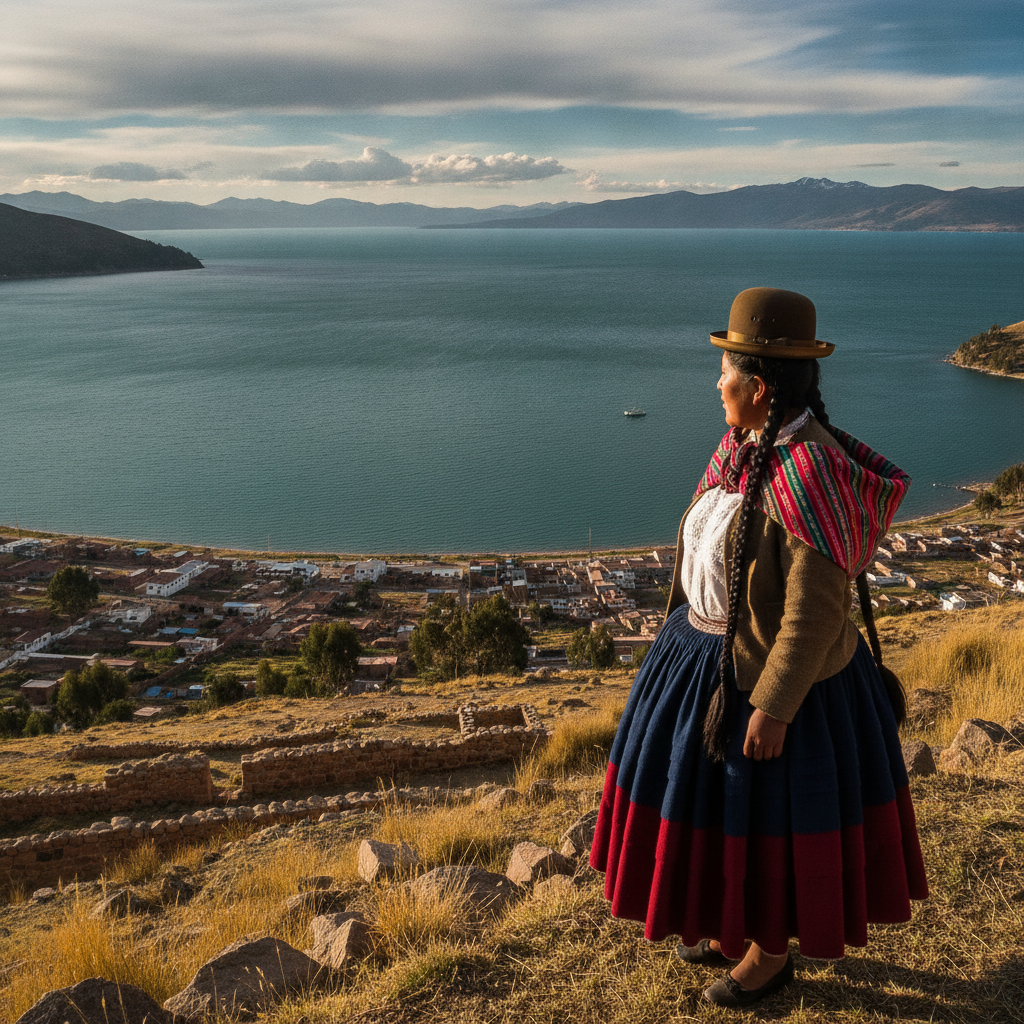
The cholita, the Bolivian Aymara woman in traditional dress, is one of the most recognizable figures in South American iconography: the bowler hat perched on glossy black braids, the embroidered blouse visible beneath a finely woven shawl, the full skirt called pollera spreading widely above embroidered slippers. The bowler hat, introduced to Bolivia by British railway engineers in the early 20th century, was adopted by Aymara women after an initial consignment proved too small for the men it was intended for and was sold to indigenous women instead; within decades it became the defining headgear of Aymara female identity. The cholita carries her baby and goods in a carrying cloth called an aguayo that is also a major vehicle for the geometric weaving tradition. The cholita wrestling events in El Alto above La Paz, in which traditionally dressed Aymara women wrestle in theatrical bouts in the lucha libre style, became an international media phenomenon from the 2000s and simultaneously a genuine community entertainment tradition.
- 4
Evo Morales and the Aymara Political Awakening
The election of Evo Morales as president of Bolivia in December 2005, the first election of a self-identified indigenous person as a Latin American head of state in the post-colonial history of the hemisphere, was the political culmination of decades of Aymara and Quechua social movement organizing in the altiplano and in the coca-growing Chapare region. Morales, an Aymara from the altiplano who became a coca farmers union leader, led the Movement for Socialism to power on a platform of nationalizing natural resources, expanding indigenous rights, and reforming the colonial racial hierarchy that had structured Bolivian society since the 16th century. The 2009 constitution under Morales declared Bolivia a Plurinational State with 36 recognized indigenous nations and languages, transforming the formal political and legal status of indigenous identity in Bolivia. The political tradition of Aymara community governance, the ayllu system of rotating communal authority, provided a cultural foundation for the political mobilization that brought Morales to power.
- 5
Quinoa and the Altiplano Food Revolution
Quinoa, the protein-rich seed crop domesticated on the altiplano margins of Lake Titicaca approximately 3,000 to 5,000 years ago, experienced a dramatic global demand surge from the 2000s onward as international food markets discovered its nutritional properties. The boom in quinoa export, particularly from Bolivia and Peru, initially benefited rural Aymara and Quechua farmers in the altiplano who had maintained quinoa cultivation through centuries of agricultural transition. However, the price surge also caused land conflicts, soil exhaustion from intensified production, and a shift from subsistence food production to cash-crop monoculture in some communities. The traditional Aymara and Quechua food system around Lake Titicaca also includes chuño, freeze-dried potato made by the natural overnight freezing and daytime drying cycle of the altiplano, which has been produced for preservation and trade for at least 3,000 years and represents one of the earliest freeze-dried foods in human history.
- 6
The Carnival of Oruro: Bolivia Greatest Festival Near the Lake
The Carnival of Oruro, held in the mining city 240 kilometers southeast of Lake Titicaca each February, is designated UNESCO Intangible Cultural Heritage and is considered by anthropologists as one of the greatest cultural expressions of Andean civilization in the contemporary world. The festival combines Catholic carnival tradition with the pre-Columbian Andean deity Supay and the Pachamama earth goddess in a sequence of spectacular dance performances involving dozens of groups performing the diablada devil dance and other traditional forms over three days in full elaborate costume. The diablada costume, an articulated devil mask decorated with serpents, condors, and pre-Columbian iconography rising to 60 centimeters above the dancer head, requires months of artisanal construction. The Oruro carnival draws approximately 400,000 visitors and 28,000 costumed performers annually and is the most important cultural event of the Bolivian altiplano region. The proximity to Lake Titicaca makes it a natural extension of a lake and altiplano travel itinerary.
Walk this route with audio
Stories play automatically as you reach each stop — no tapping needed.
More in Lake Titicaca
Lake Titicaca Practical Guide: Getting There, Island Visits, and Peru-Bolivia Border Crossing
Lake Titicaca Puno Festivals: The Candelaria and Altiplano Folklore
Lake Titicaca Birdwatching: Flamingos, Grebes, and Andean Waterbirds

Lake Titicaca: The Highest Navigable Lake and the Birthplace of the Inca
Lake Titicaca Bolivia: Copacabana, Tiwanaku, and the Bolivian Shore