Batu Caves, Thaipusam Festival & Hindu Tamil Culture in Malaysia
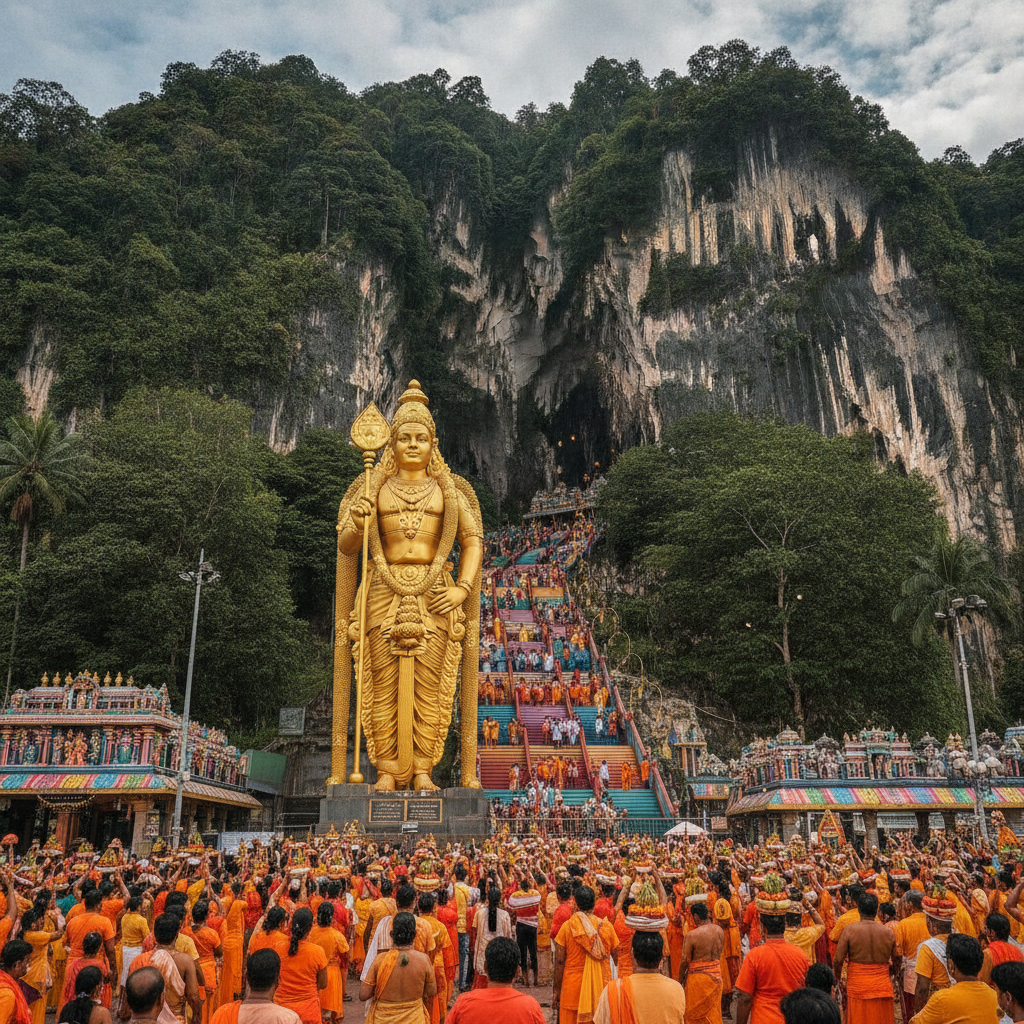
Batu Caves — the limestone hill 13 kilometres north of Kuala Lumpur containing one of the most important Hindu shrines outside India, approached by 272 rainbow-painted steps past the world's tallest statue of Lord Murugan — is the most visited tourist attraction outside of Kuala Lumpur proper and the site of the spectacular Thaipusam festival (the Tamil Hindu festival of devotion celebrated annually in January-February by over a million worshippers).
- 1
Batu Caves — The Most Important Hindu Site in Malaysia
Batu Caves (Gombak, Selangor — 13 kilometres north of Kuala Lumpur city centre, 272 rainbow-painted steps ascending 100 metres to the main Cathedral Cave entrance, with the 42.7-metre gilded statue of Lord Murugan at the base of the steps — the tallest statue of Murugan in the world and the second-tallest statue in Malaysia): the limestone caves at Batu were known to the indigenous Temuan people long before their Hindu significance was established — the shrine was created in 1891 when S. Thambusamy Pillai, an Indian Tamil businessman, installed an image of Lord Murugan (the Hindu god of war and victory, son of Shiva and Parvati, the primary deity of the Tamil Hindu community) in the main cave; the Temple Cave (Cathedral Cave) is approximately 100 metres high and 400 metres deep, lit by natural light from openings in the cave ceiling and housing several Hindu shrines and a resident population of long-tailed macaques; the smaller Dark Cave (accessible only with a trained guide) contains rare cave-adapted species including cave spiders, centipedes, and the rare cave racer snake.
- 2
Thaipusam — The Festival of Devotion and the Kavadi
Thaipusam (the Tamil Hindu festival celebrating the birthday of Lord Murugan and the occasion on which Parvati gave Murugan a vel (divine lance) to defeat the demon Soorapadman — observed on the full moon of the Tamil month Thai (January-February) as a public holiday in Malaysia): the Thaipusam celebration at Batu Caves is the largest Hindu festival outside India, attracting over 1.5 million devotees and observers over the 3-day festival period; the central practice of the festival is the carrying of the kavadi ('burden') — an elaborate framework of metal spikes, peacock feathers, flowers, and fruit carried on the body, often with metal skewers piercing the skin of the back, cheeks, and tongue — as an act of devotion and penance to Lord Murugan; the kavadi bearers process from the Mahamariamman Temple in central KL to Batu Caves (a distance of approximately 15 kilometres) carrying their kavadi, sustained by a trance state induced by fasting, chanting, and the beat of percussion music.
- 3
Sri Mahamariamman Temple — KL's Oldest Hindu Temple
Sri Mahamariamman Temple (Jalan Tun H.S. Lee, Chinatown — the oldest and most important Hindu temple in Kuala Lumpur, founded in 1873 by Tamil immigrants brought to Malaysia as plantation and mining workers): the temple is dedicated to the goddess Mahamariamman (a manifestation of the goddess Parvati worshipped primarily by Tamil Hindus, associated with rain, fertility, and the protection from epidemic disease); the current temple building (extensively renovated 1968) has a 22.9-metre gopuram (entrance tower) in the characteristic South Indian style, decorated with over 228 golden figures of Hindu deities in vivid colours; the temple is the starting point of the Thaipusam procession to Batu Caves and receives thousands of worshippers daily; the surrounding streets of Chinatown provide a vivid visual contrast between the Tamil Hindu temple culture and the Chinese shophouse commercial environment.
- 4
Thean Hou Temple — Six-Tiered Pagoda of the Sea Goddess
Thean Hou Temple (Jalan Syed Putra, Seputeh — the large Taoist temple dedicated to Thean Hou (the Heavenly Mother, a Chinese sea goddess worshipped as a protector of sailors and fishermen by the Hainanese community), built 1989, one of the largest Taoist temples in Southeast Asia, with a 6-level pagoda visible from much of southern Kuala Lumpur): the temple complex covers approximately 1.5 hectares on a hilltop above Jalan Syed Putra, with the main temple hall on the upper level housing shrines to Thean Hou, Guan Yin (the Buddhist goddess of mercy) and Shui Wei Sheng Niang (the goddess of the waterfront); the temple is known for its elaborate New Year celebrations, elaborate lantern displays during the Mid-Autumn Festival, and as a venue for traditional Chinese weddings; the open terrace offers panoramic views over the Kuala Lumpur skyline.
- 5
Gombak River & the Original KL Settlement Site
The Gombak-Klang River Confluence (at the Masjid Jamek mosque, Jalan Tun Perak — the historic site of the original Kuala Lumpur tin-mining settlement established circa 1857, where 87 Chinese miners led by Hiu Siew and sponsored by Rajah Abdullah of Klang landed at the muddy confluence of the Gombak and Klang rivers to work the tin deposits of the Ampang area upstream): the first settlement at the confluence was a rough camp of tin prospectors that grew within a decade into the largest Chinese commercial settlement in the Klang Valley, becoming the capital of the Selangor Sultanate in 1880 and the capital of the Federated Malay States in 1896; the confluence is today overlooked by the Masjid Jamek mosque (the oldest mosque in KL) and accessible via the LRT Masjid Jamek station; the Klang River Heritage Trail provides a walking route along the river banks connecting the key historical sites.
- 6
Kuala Lumpur's Multicultural Religious Landscape
Kuala Lumpur's extraordinary religious diversity (the city contains the headquarters or major places of worship of all the major religions of Asia within a compact area — Islam, Buddhism, Hinduism, Christianity, Taoism, and Sikhism): the Masjid Negara (National Mosque, Jalan Perdana — the principal mosque of Malaysia, completed 1965, capacity 8,000 worshippers, with its distinctive 18-pointed star roof and 73-metre minaret), the Buddhist Maha Vihara Temple (Brickfields, the most important Theravada Buddhist temple in KL), the Sri Mahamariamman Temple (Chinatown, Tamil Hindu), the Gurdwara Sahib Brickfields (the oldest Sikh gurdwara in KL), and St. John's Cathedral (colonial-era Anglican cathedral) are all within a few kilometres of each other — an urban religious landscape that is unique in the world for the density and variety of its major houses of worship.
Walk this route with audio
Stories play automatically as you reach each stop — no tapping needed.
More in kuala-lumpur
Malaysian Food Culture — Nasi Lemak, Hawker Centres & KL's Culinary Melting Pot
Sunway Lagoon, Genting Highlands & KL's Entertainment Escapes
Chinatown, Petaling Street, Merdeka Square & Old Kuala Lumpur
Putrajaya — Malaysia's Planned Federal Capital and Putra Mosque
Petronas Twin Towers, KLCC & Bukit Bintang — KL's Golden Triangle