Kraków Museums & the Royal Road — the Czartoryski Collection, Lady with an Ermine & National Galleries
Kraków's museum circuit (the most concentrated collection of significant museums in Poland outside Warsaw, the National Museum's six branches holding the most important collections of Polish art, the Czartoryski Museum holding the most important collection of European art in Central Europe) is organized along and around the Royal Road running from the Florian Gate south to Wawel Castle.
- 1
The Czartoryski Museum — Leonardo and the Rembrandt
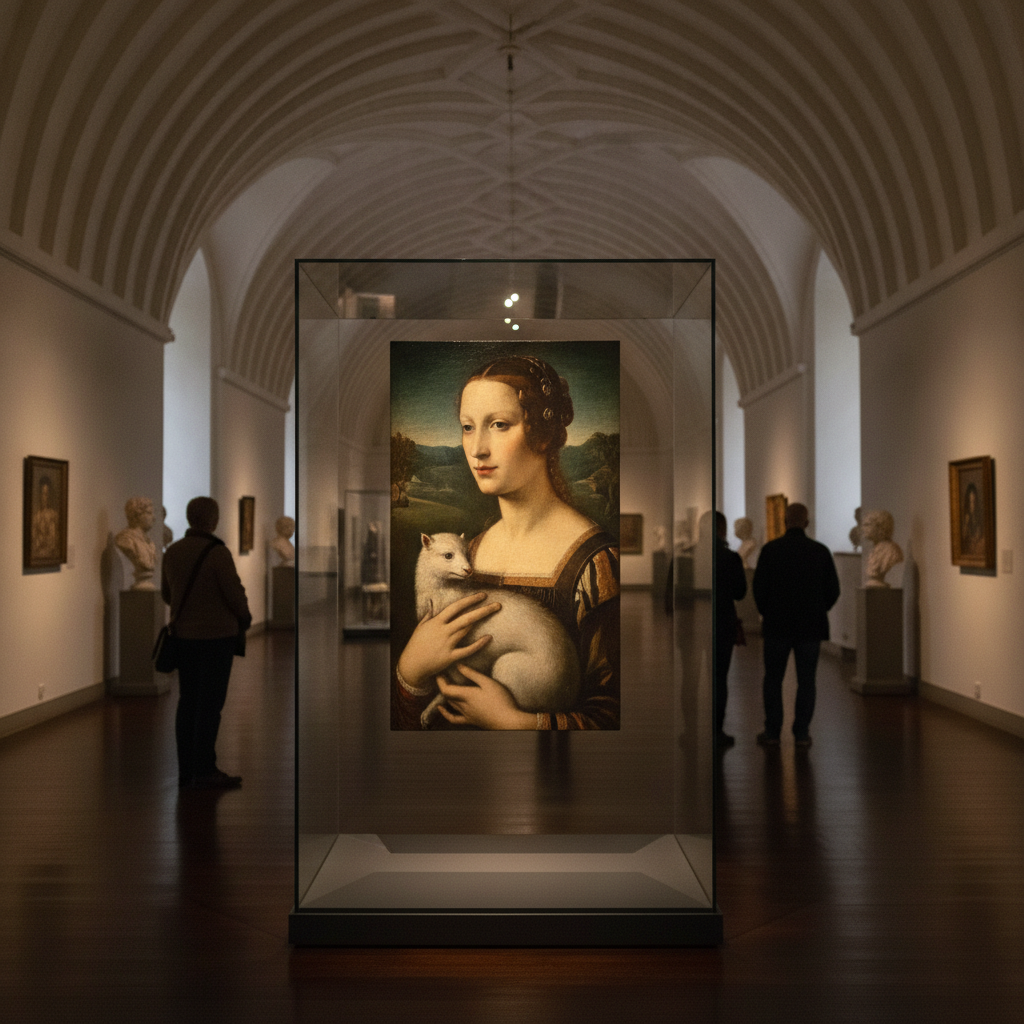
The Czartoryski Museum (Pijarska 15, the museum of the Czartoryski family collection, Poland's oldest and most important aristocratic art collection, assembled by Princess Izabella Czartoryska from 1782, the collection surviving the partitions of Poland, the confiscations, the Nazi occupation — during which the Lady with an Ermine and the Landscape with the Good Samaritan by Rembrandt were stolen by Hans Frank, the Nazi Governor-General of occupied Poland, the Lady with an Ermine stored in Frank's personal collection until the American forces captured him in 1945 — and the communist period, returned to the Czartoryski family in 2016 and then donated by them to the Polish state in the same transaction — €15 adults, Tuesday-Sunday 10am-6pm, the collection in the restored 15th-century Arsenal building). The Lady with an Ermine (Leonardo da Vinci, c. 1489-90, the portrait of Cecilia Gallerani, mistress of Ludovico Sforza of Milan, one of only four authenticated paintings by Leonardo da Vinci on public display in the world, the ermine a symbol of purity and also an emblem of Ludovico Sforza — the ermine facing left as if responding to something outside the picture space, the extraordinary detail of the fur and the sitter's hand demonstrating Leonardo's unique technical achievement) is the single most important painting in Poland.
- 2
The National Museum — the Gallery of 19th-Century Polish Painting
The National Museum in Kraków (the main building on Al. 3 Maja 1, the largest collection of Polish art in the country, €18 adults for the full collection, Tuesday-Sunday 10am-6pm, the permanent galleries covering: the Gallery of Decorative Arts — the Polish applied art from the 10th century to the 20th century, the medieval goldsmithing, the Renaissance armour, the Baroque woodcarving, the Historicist furniture) and the Gallery of 19th-Century Polish Painting (the most visited section, the large-format history paintings of Jan Matejko — the most important Polish painter, whose monumental canvases of Polish history from the 10th to the 17th century defined the visual identity of the Polish nation during the period of partition — the Battle of Grunwald 1410, the Constitution of 3 May 1791, the Stańczyk court jester — the paintings physically enormous and emotionally direct, the storytelling in the Matejko canvases accessible without art-historical knowledge). The Sukiennice Gallery (the Gallery of 19th-Century Polish Painting in the first floor of the Renaissance Cloth Hall on the Main Market Square, €10 adults, Tuesday-Sunday 10am-6pm, the branch of the National Museum the most conveniently located for the old town visit, the Matejko paintings at the same scale as the main building's collection) is the correct art-museum stop for the time-limited visitor.
- 3
The Collegium Maius — the Oldest University Building in Poland
Collegium Maius (Jagiellońska 15, the oldest surviving university building in Poland, the main building of the Jagiellonian University founded in 1364 — the second-oldest university in Central Europe after Charles University in Prague — the current Collegium Maius building dating from the 15th century, the Gothic courtyard with the arcaded loggia, the well in the centre, the academic atmosphere entirely unchanged from the 15th century, €7 adults for the guided tour, Monday-Friday 9am-5pm, Saturday 9am-2pm, the tour including the rector's throne room, the treasury with the globe showing America — the oldest globe in the world to include America, made 1507 — and the collection of astronomical instruments used by Nicolaus Copernicus, who studied at the Jagiellonian University from 1491 to 1495) provides the academic historical counterweight to the royal Wawel. The Jagiellonian University today (the largest university in Poland with 40,000 students, the university campus extending through the southern old town and the Salwator district, the university's presence giving Kraków its characteristic student energy).
- 4
The Wawel Royal Collections — Tapestries and the Lost Sword
The Wawel Royal Castle collections (the distributed museum within the castle buildings, the different collections requiring separate tickets — the State Rooms at €15, the Royal Private Apartments at €15, the Crown Treasury and Armoury at €12, the Oriental Art collection at €8, the Lost Wawel archaeological excavation at €9, the combined ticket at €35, Tuesday-Sunday 9:30am-5pm, the ticket office at the castle gate, the timed-entry system for July-August requiring advance booking at the castle website): the tapestries (the Flemish tapestry collection of 138 pieces commissioned by King Zygmunt II August in Brussels in the 1550s-1560s, the single greatest collection of Brussels tapestries in the world, the large-format biblical and hunting scenes in the Senate Hall and the Hall of Deputies the most spectacular, the collection stored in Canada during World War II to prevent confiscation) and the Szczerbiec (the coronation sword of the Polish kings since 1320, the only surviving regalia of the Polish kingdom, the sword used in the coronation of every Polish king from Władysław Łokietek in 1320 to Stanisław August Poniatowski in 1764 — the blade 13th century, the handle 14th century, the sword displayed in the Crown Treasury).
- 5
The Underground Rynek Museum — Medieval Kraków Below the Square
The Rynek Underground Museum (Rynek Główny 1, below the Main Market Square, the €17 adults museum in the medieval vaults below the square, open Monday 10am-8pm, Tuesday 10am-4pm, Wednesday-Sunday 10am-10pm, the reservation required in season, the exhibition presenting the archaeological excavation of the medieval market square — the foundations of the 12th-century market stalls, the 14th-century well structure, the medieval road surface — through a dramatic combination of in situ archaeology and multimedia displays, the holographic market scenes and the projected map of the medieval town overlaid on the current square plan) is the most technically sophisticated museum in Kraków and the best way to understand the 900-year urban history compressed beneath the visible surface of the square. The specific discoveries (the medieval leather shoes, the bronze coins from multiple centuries, the 12th-century wooden market stalls, the Romanesque foundation walls of the first Cloth Hall) contextualize the current square as the continuation of the same function — the commercial heart of the city — that has operated on this 40,000-square-metre site for 800 years.
- 6
The Stained Glass Museum and Wyspiański
Stanisław Wyspiański (the Kraków artist, playwright, and designer, 1869-1907, the central figure of the Young Poland artistic movement, the Polish equivalent of a Gesamtkunst artist working simultaneously in stained glass design, painting, poster art, theatrical costume, furniture design, and poetry — his plays, particularly Wesele 'The Wedding' 1901, the most important Polish dramatic works of the 20th century) is the correct cultural key to understanding fin-de-siècle Kraków. The Stained Glass Workshop and Museum (Basztowa 7, the atelier where Wyspiański and his collaborator Józef Mehoffer designed and produced the stained glass windows of the Franciscan Church — the Apollo cycle and the God the Father window visible in the Franciscan Church itself at Plac Wszystkich Świętych 5, free entry during church hours, the God the Father window the most famous single work of Polish Art Nouveau, the luminous blue and violet God emerging from the Creation storm one of the most powerful images in European Symbolism) and the Wyspiański Museum (3 Maja 5, the branch of the National Museum dedicated to Wyspiański's decorative art, painting, and stage designs, €8 adults, Tuesday-Sunday 10am-6pm) are the two venues for the Wyspiański encounter.
Walk this route with audio
Stories play automatically as you reach each stop — no tapping needed.
More in krakow
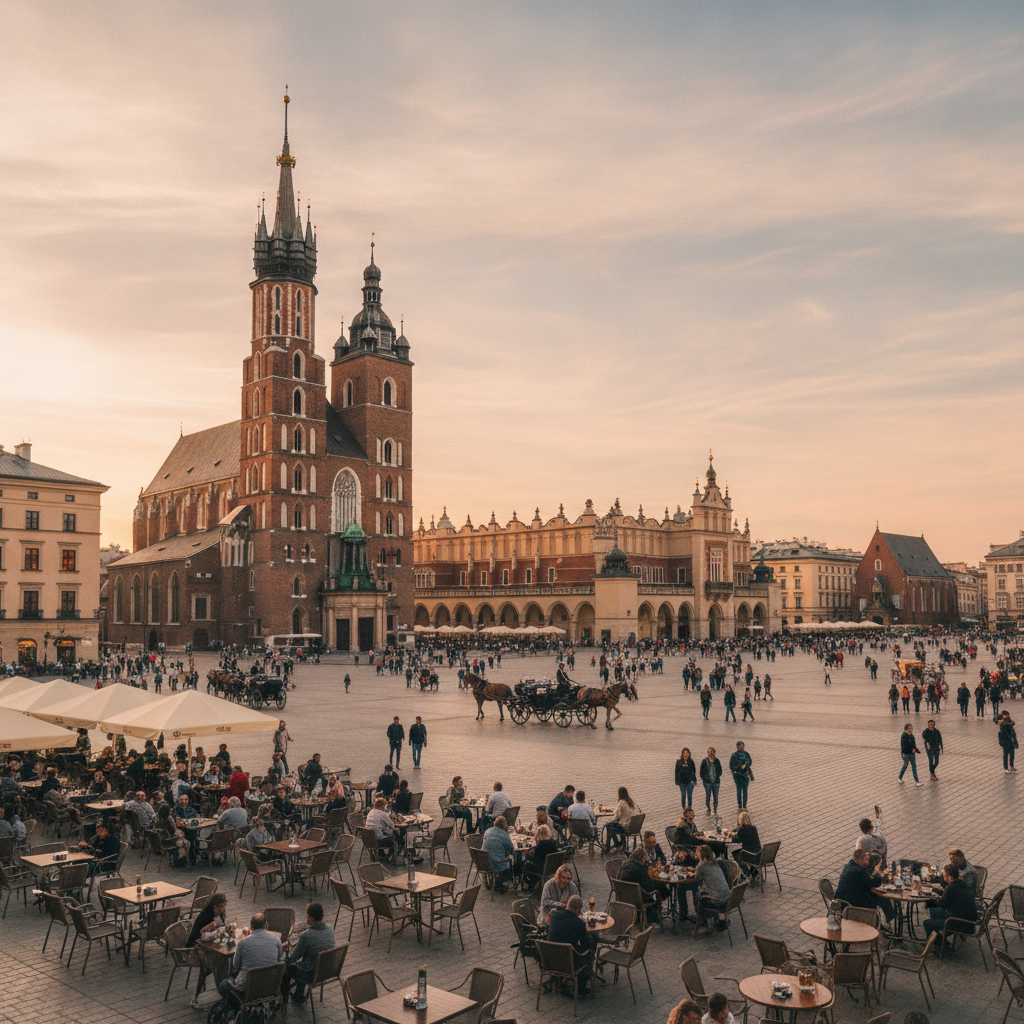
Kraków Old Town — the Main Market Square, St. Mary's Basilica & Wawel Castle
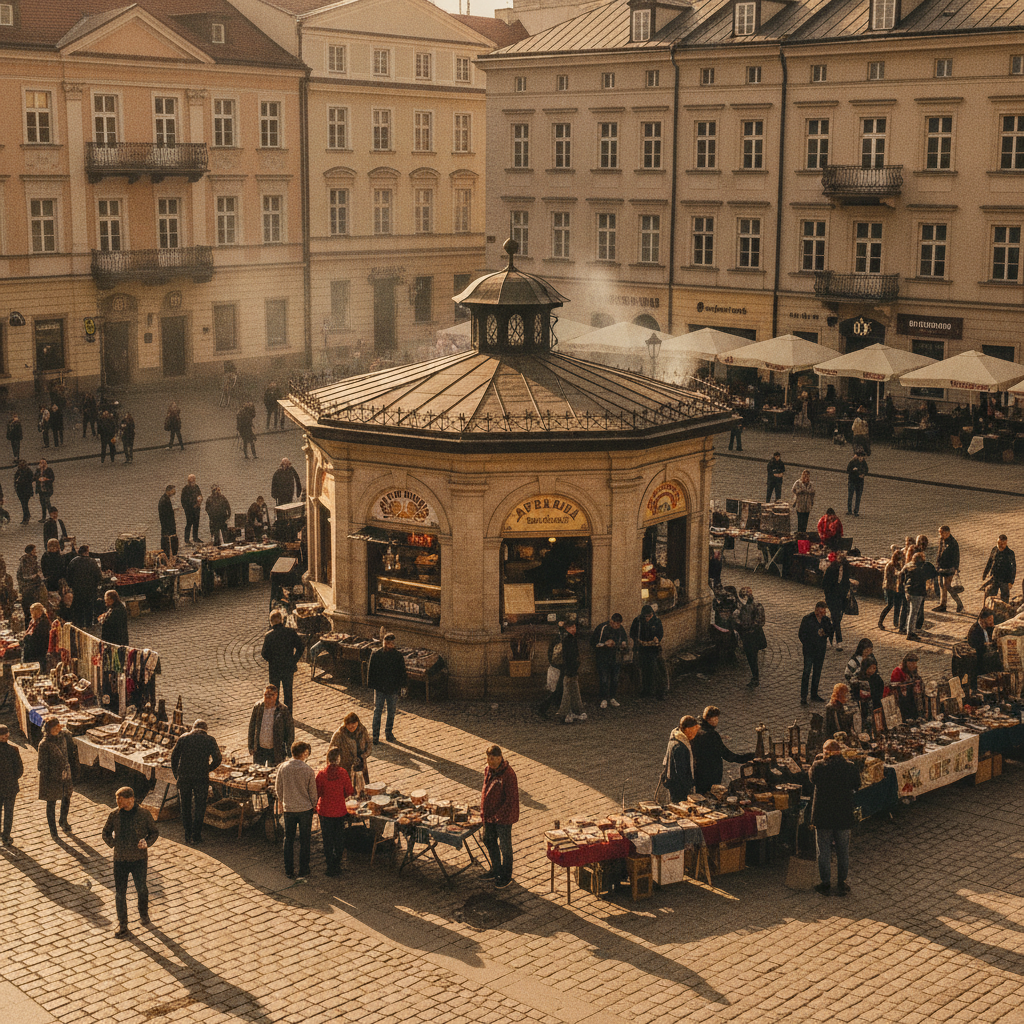
Kazimierz — the Jewish Quarter, Synagogues & the Schindler Factory
Kraków Practical Guide — Seasons, Trams, Nightlife & Getting Around
Kraków Food — Pierogi, Żurek, Zapiekanka & the Polish Restaurant Tradition