Kazimierz — the Jewish Quarter, Synagogues & the Schindler Factory
Kazimierz (the district of Kraków established in 1335 as a separate royal city, incorporated into Kraków in 1791, the Jewish community settled here from 1495 when King Jan Olbracht expelled the Jews from the Kraków old town, the district the centre of Jewish life in southern Poland for 450 years before the Nazi occupation of 1939) is the most important Jewish heritage district in Poland.
- 1
The Old Synagogue and the Jewish Museum
The Old Synagogue (Stara Synagoga, Szeroka 24, the oldest surviving Jewish religious building in Poland, built in the late 15th century in the Gothic style by a Jewish community from Bohemia, rebuilt in the Renaissance style after a 1557 fire by the Italian architect Matteo Gucci, the building used as a stable by the Nazis during the occupation, restored 1956-1959 and converted to the Judaica Division of the Kraków Historical Museum, €11 adults, Tuesday-Sunday 10am-5pm, the collection of Jewish religious objects — Torah scrolls, menorah, Passover seder plates, and the everyday objects of the Kazimierz Jewish community — combined with the photographic archive of the pre-war community) is the essential first stop in Kazimierz. The exhibition (the comprehensive history of the Jewish community in Kraków from the 15th century through the Holocaust, the photographs of the Kazimierz street markets of the 1920s and 30s, the faces and the specific streetscapes legible from the current Kazimierz street network) is the contextual grounding for the subsequent visit to the other synagogues and the Schindler factory.
- 2
The Remuh Synagogue and the Old Cemetery
The Remuh Synagogue (Szeroka 40, the small 16th-century synagogue named after Rabbi Moses Isserles — Remuh, one of the greatest Polish Jewish scholars, the author of the Mapah commentary to the Shulchan Aruch that made the Shulchan Aruch authoritative for Ashkenazi Jews, buried in the adjacent cemetery — the synagogue still in use for regular Shabbat services, the only functioning traditional Orthodox synagogue in Kraków, €5 adults, Sunday-Friday 9am-6pm) and the Remuh Cemetery (the Old Jewish Cemetery of Kazimierz adjacent to the synagogue, established 1533, the tombstones from the 16th-18th centuries in Hebrew and Aramaic, the oldest surviving Jewish cemetery in Poland, the tombstones of Rabbi Isserles and other major Polish Jewish scholars legible to Hebrew readers, the Renaissance tombstones the finest examples of Jewish funerary art in Poland). The 'Wailing Wall' within the cemetery (the wall assembled from tombstone fragments found buried in the cemetery grounds in 1959, the fragments hidden by the Jewish community before the Nazi destruction of the cemetery in 1942 — the Nazis used the tombstones as paving material — the fragments reassembled as a memorial wall, the Hebrew inscriptions clearly visible).
- 3
The Tempel Synagogue and the Progressive Community
The Tempel Synagogue (Miodowa 24, the most ornately decorated synagogue in Kraków, built 1862 in the Moorish Revival style by the progressive — Reform — Jewish community of Kraków, the interior with the painted ceiling, the cast-iron galleries on three sides, the stained glass windows in Moorish geometric patterns, the painted walls with floral and geometric ornament, the most visually elaborate non-Orthodox synagogue in Central Europe, €5 adults, Sunday-Friday 10am-6pm, the synagogue restored 1994-2000 after serving as an equestrian storage facility under the Nazi occupation) represents the prosperous and culturally assimilated Jewish merchant and professional community that existed in Kraków from the mid-19th century. The contrast between the Tempel (the architecturally exuberant expression of Jewish middle-class success in Austro-Hungarian Galicia) and the Remuh (the austere traditional Orthodox shul of the 16th century) encapsulates the range of Jewish religious practice that coexisted in Kazimierz until 1939.
- 4
Plac Nowy — the Heart of Kazimierz
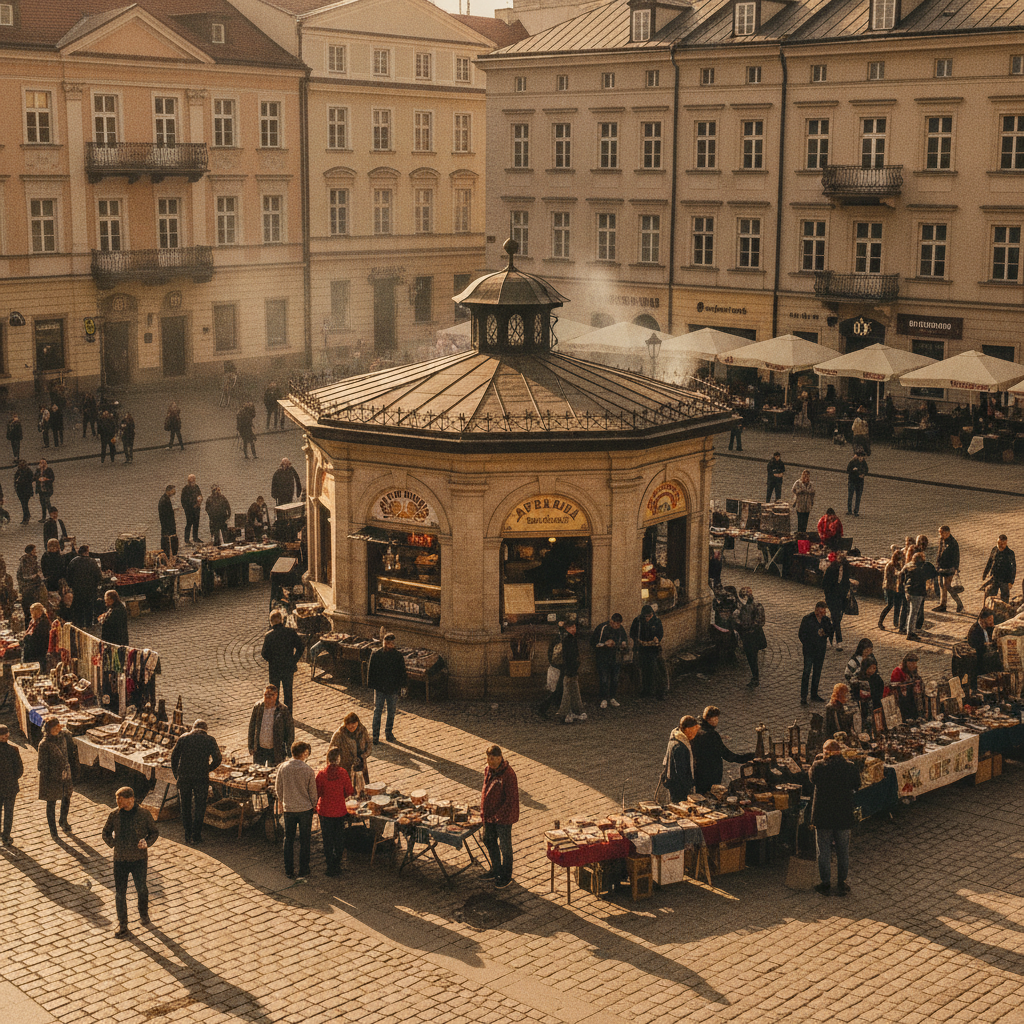
Plac Nowy (the octagonal covered market at the geographic centre of Kazimierz, the former Jewish meat market — the kosher butchers operating here until 1939, the market maintaining its function under the Nazi occupation and the communist period though no longer as a Jewish institution, the rotunda used for the kosher slaughter of poultry and the distribution of meat — now the de facto food and flea market centre of the district, the flea market on Saturday mornings from 6am, the antique dealers, vintage clothing sellers, and small-object vendors occupying the outer ring of the square, the zapiekanka sellers occupying the rotunda from 10am to 2am daily) and the cafe district (the ring of Kazimierz cafe-bars surrounding Plac Nowy — the Alchemia, the Mleczarnia, the Singer cafe with its sewing-machine-top tables — the most atmospheric and historically conscious cafe scene in Kraków, the bars filling from 6pm and operating until 4am, the Kazimierz bar circuit the correct evening alternative to the Main Market Square tourist restaurants) define the contemporary identity of the neighbourhood.
- 5
Schindler's Factory — the Enamel Works Museum
Schindler's Factory (Oskar Schindler's Emalia — Deutsche Emailwarenfabrik, Lipowa 4, the factory where the German industrialist Oskar Schindler employed approximately 1,000 Jewish workers from the Kraków Ghetto and subsequently saved 1,200 Jewish lives during the Holocaust, the factory converted to the Kraków Under Nazi Occupation Museum, €18 adults, Monday 10am-2pm, Tuesday-Sunday 10am-8pm, timed entry tickets required in advance — the most visited museum in Kraków after Wawel Castle, the exhibition covering the Nazi occupation of Kraków from 1939 to 1945 with particular focus on the destruction of the Jewish community and Schindler's rescue activities, the exhibition design recreating the atmosphere of the occupied city through documentary photography, film, and period objects). The original factory buildings (the production hall where the pots and pans were manufactured, the administrative office where Schindler's actual desk is preserved, the enamelware production line partially reconstructed) are integrated into the exhibition. The film connection (Steven Spielberg's Schindler's List, shot partly in Kazimierz and at the Płaszów camp site in 1993, the film responsible for the international recognition of the Schindler story and the Kazimierz Jewish heritage, the filming locations mapped in the museum guide) is acknowledged throughout the exhibition.
- 6
The Kraków Ghetto and Płaszów Camp
The Kraków Ghetto (the area in the Podgórze district on the south side of the Vistula, the ghetto established March 1941, the Jewish population of Kraków confined here, the liquidation of the ghetto in March 1943 with the deportation and mass murder of the residents, the survivors transported to the Płaszów concentration camp — the camp established on the site of two Jewish cemeteries 3km south of the ghetto, the gravestones used as paving, the camp under the command of Amon Göth from 1943-44, the murderous conditions of the camp the subject of Spielberg's film): the Ghetto Heroes Square (Plac Bohaterów Getta, the main square of the former ghetto in Podgórze, the 70 bronze chairs installed 2005 as a memorial to the Jews of Kraków — each chair representing 1,000 murdered victims, the chairs reflecting the fact that the Jews fleeing the ghetto liquidation had time only to take a chair before being shot or deported), the Pharmacy Under the Eagle (the pharmacy of the non-Jewish Tadeusz Pankiewicz who remained voluntarily in the ghetto throughout its existence, the pharmacy now a museum of the ghetto period), and the Płaszów camp site (the open meadow on the hillside, the grass covering the site of the former camp, the stone monument on the hill, accessible by tram from the Ghetto Square in 10 minutes).
Walk this route with audio
Stories play automatically as you reach each stop — no tapping needed.
More in krakow
Kraków Old Town — the Main Market Square, St. Mary's Basilica & Wawel Castle
Kraków Museums & the Royal Road — the Czartoryski Collection, Lady with an Ermine & National Galleries
Kraków Practical Guide — Seasons, Trams, Nightlife & Getting Around
Kraków Food — Pierogi, Żurek, Zapiekanka & the Polish Restaurant Tradition