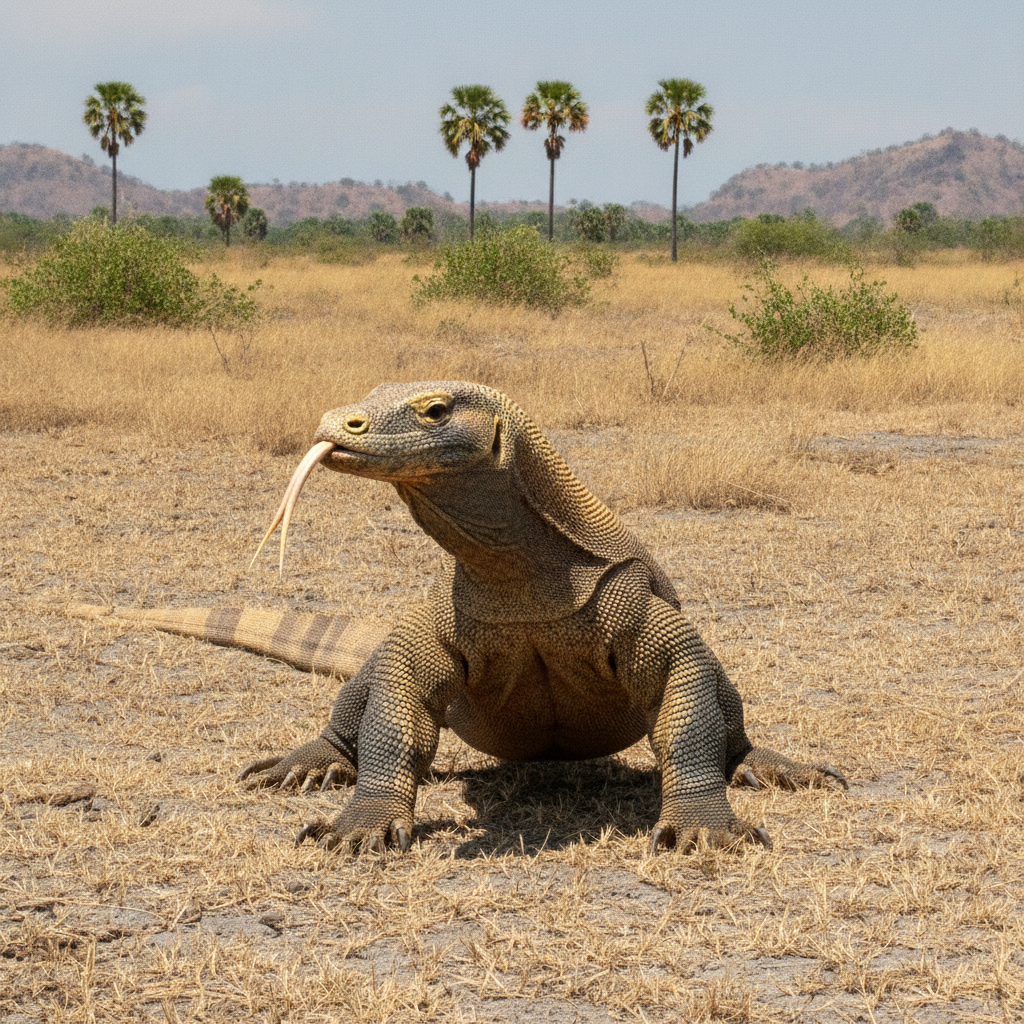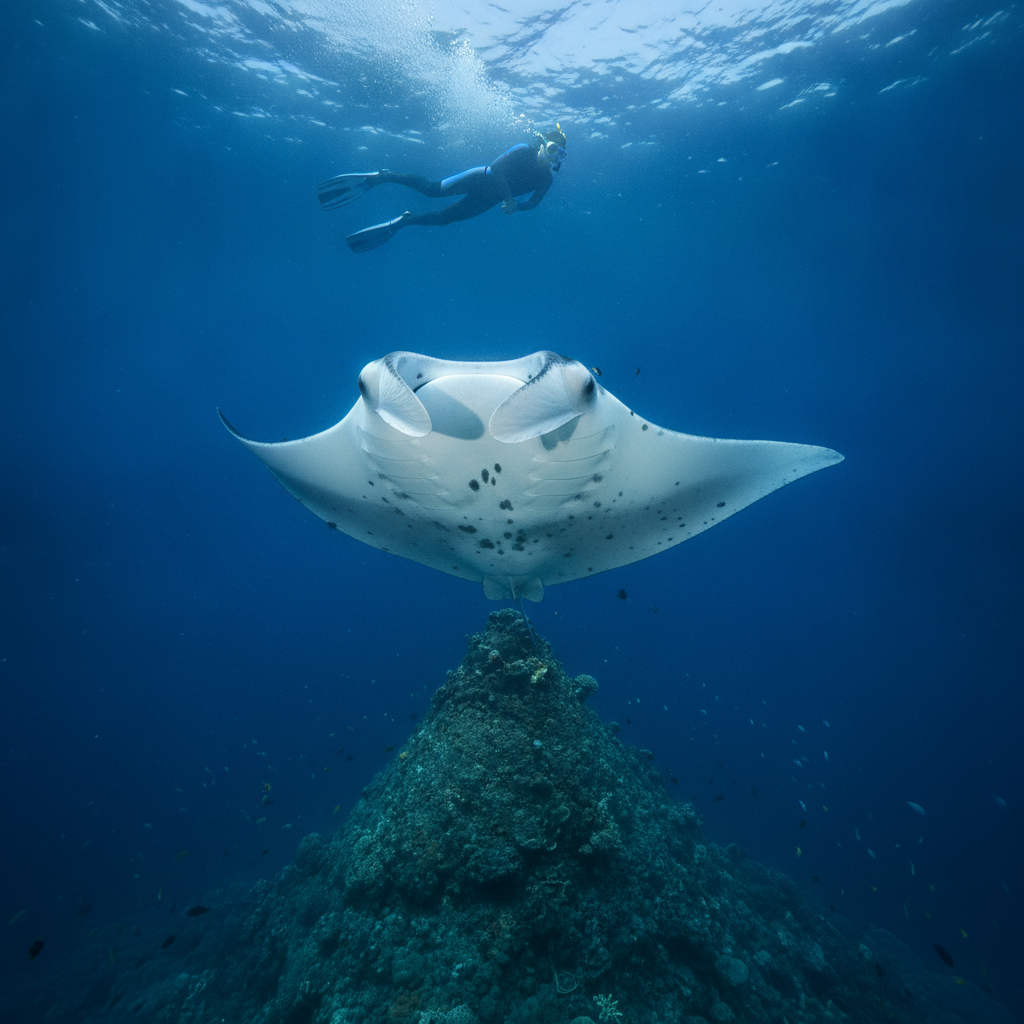
Komodo's Pelagic World: Orca Hunting Whale Shark Juveniles in the Sape Strait, 500,000 Flying Foxes at Kalong & the Road to Sumba's Pasola
December–March whale shark aggregations in the Flores Sea when upwellings peak—genuinely unplanned encounters unlike Oslob's fee-fed sharks; orca sightings in the Sape Strait pursuing whale shark juveniles through the 1,300-metre channel; the three-night phinisi liveaboard's Day 1 Rinca dragon trek, Day 1 sunset Kalong flying fox exodus, Day 2 Pink Beach, Day 3 Batu Bolong pinnacle's fish-dense current and Manta Point's cleaning station, Day 4 return; the habituation problem at Rinca compound where kitchen smells have conditioned dragons to congregate near tourists; the Komodo dragon's evolutionary ancestry in Australian Varanus priscus (7 metres, extinct) making the Wallace Line transition biologically literal; and Sumba's 70-tonne burial stones moved by hand and the Pasola cavalry battle as the most spectacular ceremony in Indonesia.
- 1
Whale Sharks & Pelagic Encounters Around Komodo
The waters around Komodo National Park—particularly the northern approaches and the Flores Sea north of the park boundary—are part of the migration route of the whale shark (Rhincodon typus—the world's largest fish, reaching up to 12 metres in length), making occasional encounters possible for lucky snorkellers and divers. The whale shark ecology: whale sharks filter-feed on plankton, small fish, and fish eggs; they aggregate in locations where upwellings bring nutrients to the surface—the conditions created by the Komodo/Flores Sea nutrient dynamics periodically create these aggregations. The encounter question: unlike Cenderawasih Bay in West Papua (the most reliable whale shark encounter site in Indonesia, where sharks are conditioned to approach fishing platforms) or Oslob in Cebu (where sharks are fed—an ethically controversial practice), Komodo whale shark encounters are genuinely unpredictable; when they occur (typically December–March when the ocean temperature differential is highest), they are particularly special precisely because they are unplanned. The other pelagic species: the Komodo area produces regular sightings of orca (killer whales—occasionally seen in the Sape Strait pursuing whale shark juveniles), sperm whales (in the deep water north of Komodo island), and blue whales (very rarely—the Flores Sea is on the migration route). The dolphin pods: spinners, bottlenose, and Risso's dolphins are regular companions of liveaboard boats in the Komodo area—bow-riding at boat speed is a daily occurrence.
- 2
Labuan Bajo's Food Scene & Flores Cuisine
Labuan Bajo's restaurant scene—transformed since 2019 from a handful of basic warungs serving nasi goreng to a diverse landscape of seafood restaurants, international cafés, and rooftop bars—reflects the tourism development investment and the influx of visitors with more diverse food expectations. The Flores culinary tradition: Flores cuisine is distinct from Javanese and Balinese—the Manggarai people's traditional food is based on rice (the staple), corn (the alternative staple in areas where rice doesn't grow well), cassava, and the protein from the sea (dried fish, fresh fish, shellfish) supplemented by buffalo meat at ceremonies. The specific Flores dishes: nasi jaha (sticky rice cooked in bamboo over fire—a ceremony food also sold at markets), gecok (a Manggarai dish of buffalo meat or organ meat cooked with spices and coconut milk—the Flores equivalent of rendang), wue (a sour soup of fermented bamboo shoots with fish or pork—specific to the Manggarai highlands). The Labuan Bajo restaurants: Bamboo Garden (the long-established garden restaurant serving both Indonesian and international food, with reliable internet and the town's most consistent cold drinks); the waterfront restaurants along the new promenade (seafood grilled to order—the freshest fish from the daily catch, prices inflated by the tourist location); Bajo Bakery (specialty coffee and Western breakfast—the 'digital nomad hub' of Labuan Bajo).
- 3
The Komodo Liveaboard Experience – A Day-by-Day Account
The 3-night/4-day liveaboard circuit—the most popular format for experiencing the full range of Komodo National Park—follows a generally consistent itinerary that can be adjusted based on tidal conditions and weather. Day 1 (afternoon departure from Labuan Bajo): the boat motors southeast to Rinca island, arriving for the afternoon dragon trek (2–3 hours at Loh Buaya ranger station); then north to Kalong Island for the sunset flying fox departure (approximately 17:30–18:30—500,000 large flying foxes departing in a stream lasting 45 minutes). Day 2 (Komodo island): morning arrival at Loh Liang for the medium or long dragon trek; afternoon at Pink Beach for snorkelling and swimming; evening anchored in a sheltered bay. Day 3 (diving focus): all-day diving—the specific sites depend on tidal conditions, but typically include Batu Bolong (the iconic pinnacle dive), Manta Point (for the rays), and a macro site for nudibranchs and pygmy seahorses. Day 4 (return): morning dive or snorkel at a site close to Labuan Bajo (Sebayur Kecil or Pantai Merah are common choices) before the mid-morning return to Labuan Bajo. The weather variables: December–March brings the rainy season to Flores—seas can be rough, particularly in the Flores Sea north of the park; the southern sites (Manta Point, Horseshoe Bay) are more protected in north swell.
- 4
Komodo Dragons & Human Encounters – Safety & Ethics
The relationship between Komodo dragon visitors and the animals they come to see involves a complex set of safety protocols, ethical questions, and the specific history of attacks on humans within the national park. The attack history: three fatal attacks on humans have been documented in the national park since 1974 (the most recent in 2009—a park ranger); non-fatal attacks occur occasionally, most frequently involving tourists who have ignored safety guidelines (approaching too closely, moving erratically, carrying food). The ranger-guided system: all dragon viewing must be conducted with armed park rangers carrying forked sticks—the stick is used to deflect a charging dragon rather than as a weapon (Komodo dragons are protected animals and cannot legally be harmed even in self-defence within the park). The dragon behaviour at the Rinca compound: the congregation of Komodo dragons near the Loh Buaya kitchen has created an artificial habituation situation—these animals have learned to associate the ranger compound with food smells and have reduced their natural wariness of humans; this makes encounters more certain but less naturalistic and potentially more dangerous (habituated animals may approach without the usual warning behaviour). The photography ethics: drone photography of Komodo dragons is officially prohibited without special permits (the sound and movement of drones disturbs the animals); flash photography is discouraged; and attempting to position a dragon for a better photograph (by throwing sticks, making noises) is both unethical and dangerous.
- 5
Eastern Indonesia Context – What Komodo Means in the Archipelago
Komodo National Park's significance extends beyond the specific wildlife attraction of the Komodo dragon: it represents a threshold—the point at which the traveller enters the less-visited eastern half of the Indonesian archipelago, where the cultural, ecological, and geographic diversity of the world's largest island nation becomes most apparent. The eastern Indonesia statistics: the island of New Guinea (the western half of which, Papua, is Indonesian) is the largest tropical island in the world; the province of East Nusa Tenggara (encompassing Flores, Sumba, and Timor) has approximately 5.5 million people across an area larger than Java but with 3% of Java's population density. The biodiversity significance: the Wallace Line (passing through the Lombok Strait, 200 km west of Komodo) and the subsequent Wallacea region (the transitional zone between Asian and Australian faunal regions) includes Komodo in the zone where both Asian and Australian species are present—the Komodo dragon itself has evolutionary roots in Australian monitor lizards (the extinct species Varanus priscus reached 7 metres and is considered an ancestor of the modern Komodo dragon). The Sumba connection: 200 km south of Flores, the island of Sumba (accessible by flight from Labuan Bajo or Ende) offers a completely different cultural experience—megalithic tombs, traditional clan houses, the Pasola cavalry festival, and the finest handwoven ikat textiles in Indonesia—with perhaps 5% of Komodo's tourist traffic.
- 6
Leaving Komodo – Onwards to Sumba, Timor & West Papua
The onward journey from Labuan Bajo—whether east along Flores by road, south to Sumba by air, or further east to Timor and Papua—offers some of the least-travelled and most rewarding travel in Southeast Asia. The Trans-Flores Highway: the road running the full length of Flores (360 km from Labuan Bajo to Larantuka on the eastern tip) passes through Ruteng, Bajawa, Ende, Moni (for Kelimutu), Maumere, and Larantuka—a 3–5 day journey by public bus or private vehicle, encountering the full range of Flores' volcanic, agricultural, and cultural landscapes. The Sumba flight (45 minutes from Labuan Bajo, or 1 hour from Kupang): Sumba is the destination most highly recommended by experienced Indonesia travellers who want to go beyond the standard archipelago circuit—traditional ikat weaving, clan burial tombs (grave stones weighing up to 70 tonnes moved by hand), the Pasola (a ritual cavalry battle in February/March where hundreds of horsemen charge each other with blunted spears in a ceremony related to the sea worm harvest—the most spectacular traditional ceremony in Indonesia), and a fishing and pastoral landscape that remains largely outside the mass tourism economy. West Papua (Raja Ampat—accessible by flight from Sorong, reached from Labuan Bajo via Makassar or Jakarta): the most biodiverse marine environment on Earth, with 75% of all known coral species and 1,600+ fish species in the Bird's Head Seascape—Komodo's extraordinary marine life is surpassed only by Raja Ampat.
Walk this route with audio
Stories play automatically as you reach each stop — no tapping needed.
More in Komodo
Komodo's Conservation Reality: Sea Rangers vs. Blast Fishers, the Sape Strait's 1,300m Cold Upwelling & Ngada Villages' Ngadhu-Bhaga Pairs
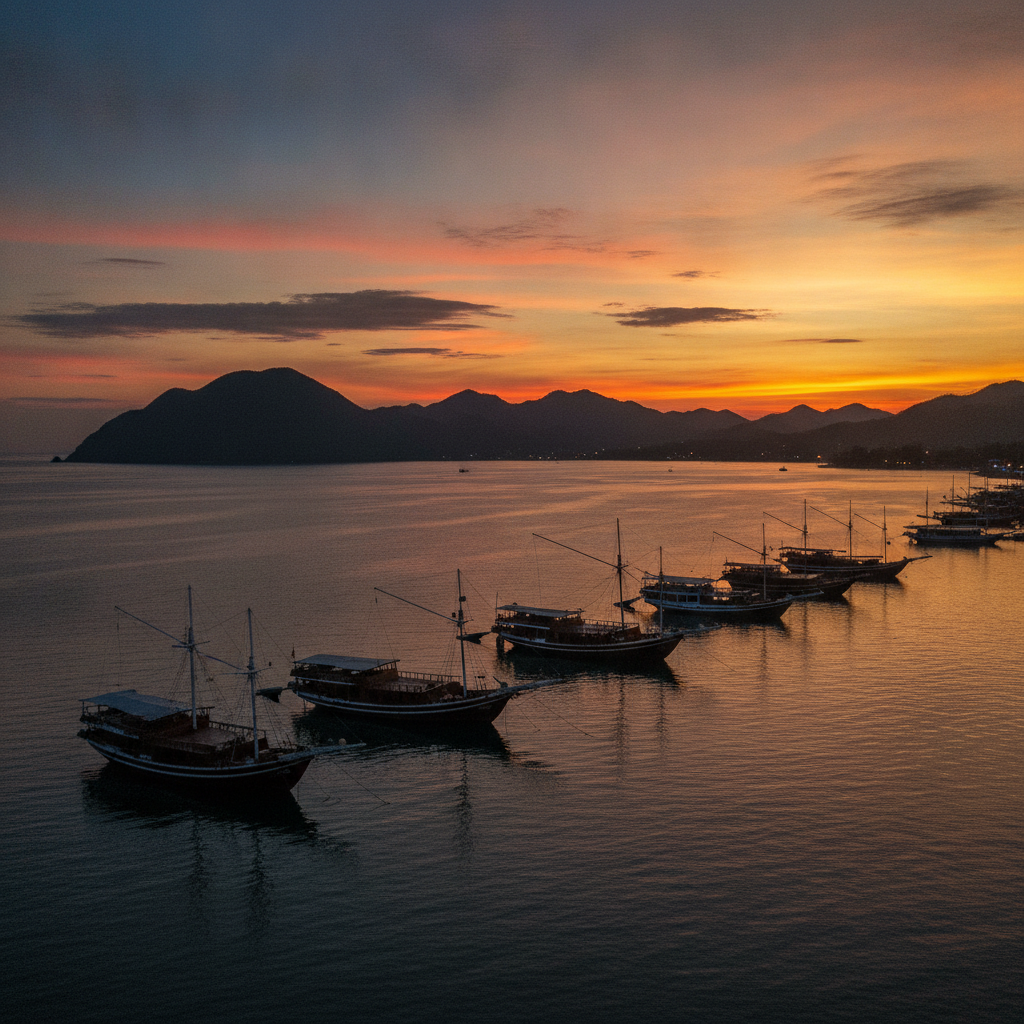
Komodo's Overlooked Depths: Larantuka's 500-Year-Old Portuguese Easter Procession, Yellow-Crested Cockatoo & the IUCN's 2021 Climate Verdict
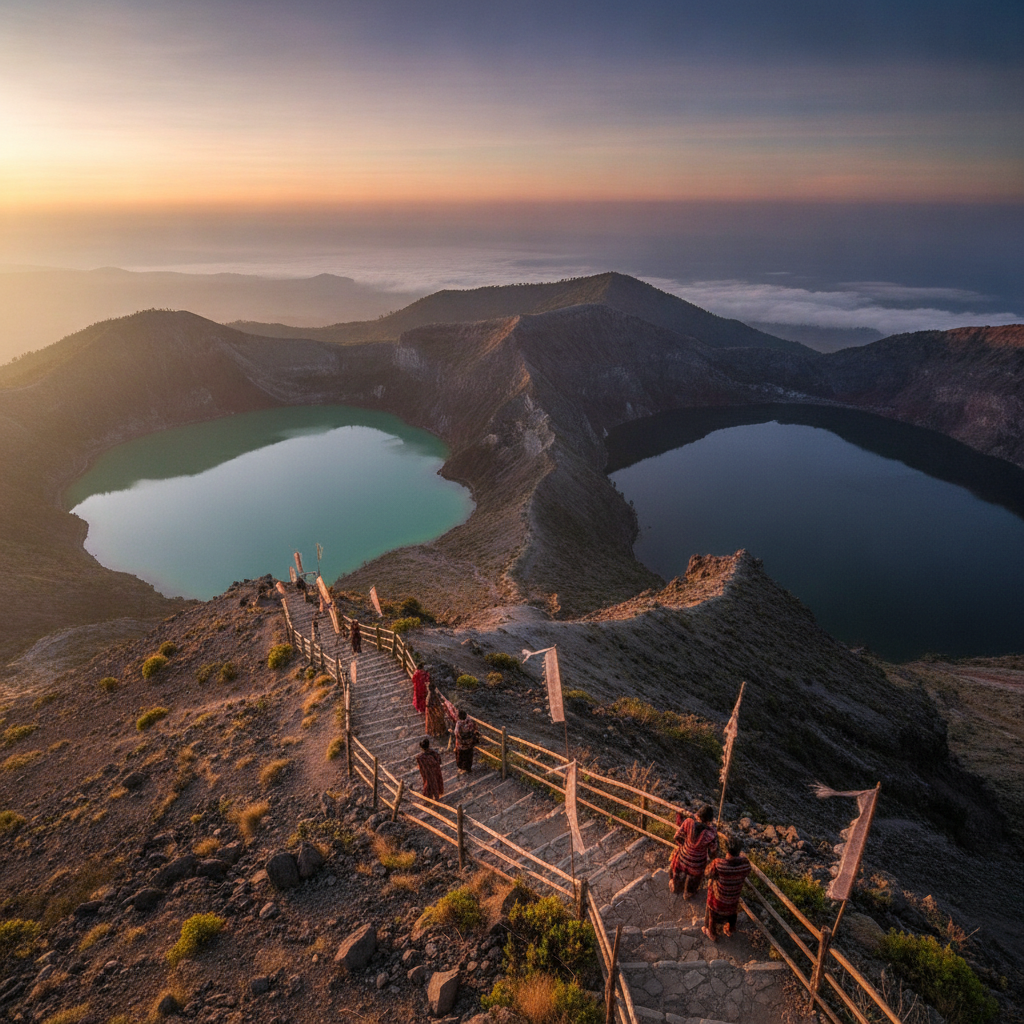
Komodo's Wider World: Kelimutu's Three-Colour Volcanic Soul Lakes, Wae Rebo's Conical 5-Floor Village Houses & Phinisi Liveaboard Bugis Crew
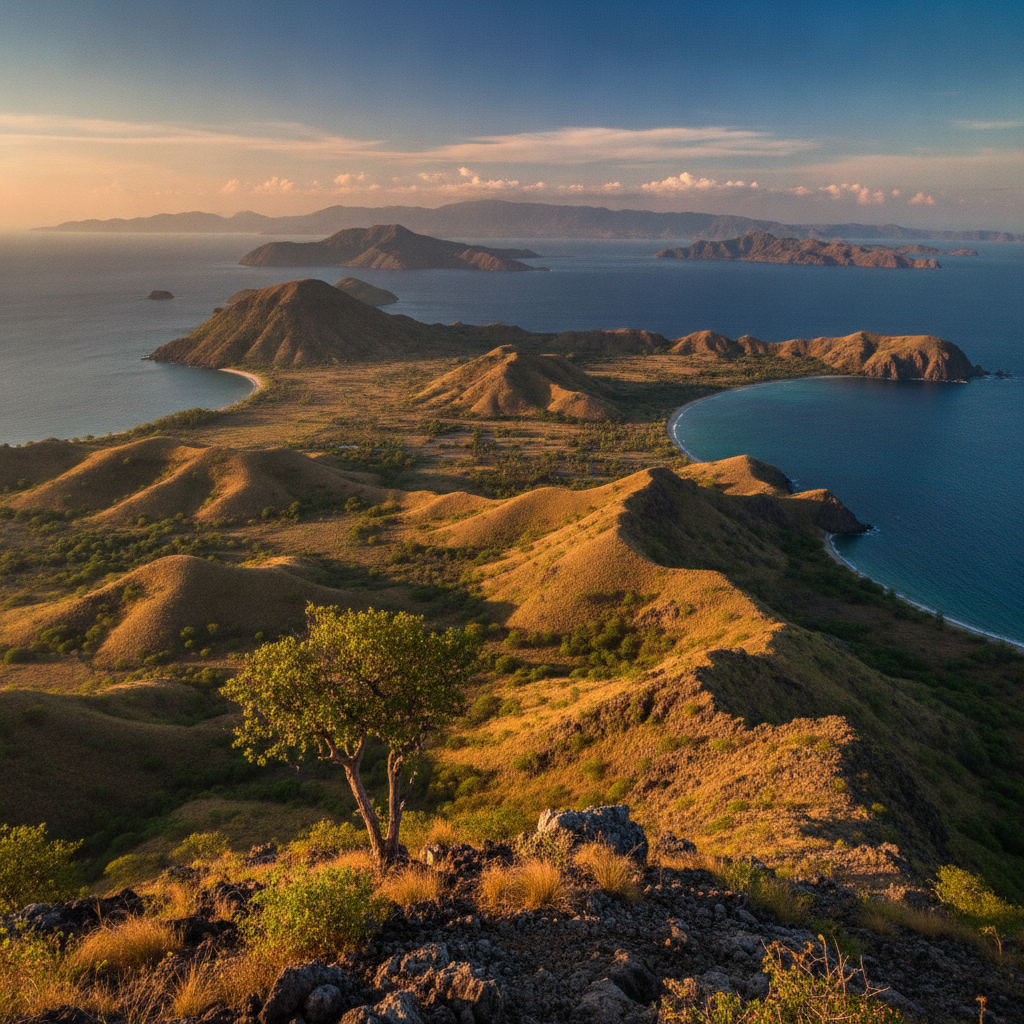
Komodo Complete: The 338m Gunung Ara Summit Panorama, Flores Sea Sperm Whales & the UNESCO 'In Danger' Warning That Stopped the Jurassic Park Resort