Kigali Extended: Women in Parliament, Tech Hub, Pre-Genocide History, and Final Rwanda Legacy
Rwanda in full: women comprising 61% of parliament (the highest proportion in the world); Kigali as the emerging tech hub of East Africa; the pre-colonial Kingdom of Rwanda; the Imigongo art tradition; Rwanda coffee and the specialty coffee revolution; and the final Rwanda legacy assessment.
- 1
Rwanda Women in Parliament - The Country with the World Highest Female Representation
Rwanda has the highest proportion of women in parliament of any country in the world: women hold 61% of the seats in the Rwandan Chamber of Deputies (as of 2023): this exceeds the nearest competitors (Iceland, Bolivia, Cuba) by a significant margin and is the result of deliberate post-genocide policy choices. The constitutional mandate (the 2003 Rwanda Constitution mandates that at least 30% of parliamentary seats must be held by women: the constitution was drafted in the post-genocide period when the RPF government recognized that (a) women were the survivors (the genocide killed disproportionately more men) and (b) the post-genocide reconstruction required the full inclusion of women): the result (the 30% minimum has been significantly exceeded in practice (the 2023 election produced 61% female representation): Rwanda has a culture of political participation by women that goes beyond the constitutional minimum). The context (the post-genocide context: after the genocide approximately 70% of the Rwanda population was female (the genocide killed disproportionately more Tutsi men): women took over the reconstruction of the economy and society in the immediate post-genocide period: this created a culture of female economic and social leadership that translated into political representation): the practical outcomes (the Rwanda gender equality record extends beyond parliament: Rwanda consistently ranks among the top African countries in the World Economic Forum Gender Gap Index: Rwanda has achieved significant gender equality in education (girls and boys have equal access to primary and secondary education): the health outcomes for women in Rwanda have improved significantly (maternal mortality has declined dramatically): the economic participation of women (Rwandan women have high rates of formal employment and business ownership by African standards)). The critics (the critics argue that the high female parliamentary representation is partly cosmetic (the RPF controls who runs for parliament and the parliament has limited real power in Rwanda one-party system): the question of whether representation translates into genuine political power and policy influence for women is contested).
- 2
Kigali as Africa Tech Hub - RwandAir, Innovation City, and the Digital Ambition
Kigali tech hub ambition: the Kigali Innovation City project, RwandAir as a continental airline, the drone delivery program, and Rwanda strategy to become the technology and knowledge economy capital of East Africa. RwandAir (RwandAir: the national airline of Rwanda: founded 2002: the primary airline connecting Rwanda to the world: fleet (Boeing 737 series, Boeing 787 Dreamliner, Q400 turboprop): the route network (RwandAir has expanded aggressively: current routes include London Heathrow (one of the few direct sub-Saharan African airlines to the UK), Brussels, Paris, Dubai, Mumbai, Guangzhou, Cape Town, Lagos, Nairobi, and numerous other African destinations): the Kigali aviation hub ambition (Rwanda wants Kigali to be the primary aviation hub for Central Africa (competing with Nairobi for East/Central African hub status): the Bugesera International Airport (the new international airport under construction approximately 25 km from Kigali: designed to have a capacity of 4-7 million passengers per year in the first phase): the open skies policy (Rwanda has an open skies aviation policy that allows any airline to serve Rwanda without restrictions)). The drone delivery program (the Zipline drone delivery program: Zipline is a US company that designed and operates the world first national drone delivery program in Rwanda: launched 2016: Zipline drones deliver blood products, vaccines, and medical supplies from distribution hubs to remote health facilities throughout Rwanda: the drones fly beyond the line of sight and deliver by parachute drop: the program has been expanded to several additional countries). The Kigali Innovation City (the KIC: a planned 62-hectare technology campus adjacent to the University of Rwanda in Gikondo: the primary anchor institutions (the Carnegie Mellon University Africa campus (CMU-Africa): the only CMU campus outside the United States): the African Institute for Mathematical Sciences (AIMS): the planned development (tech company offices, co-working spaces, startups, and research institutions)).
- 3
The Pre-Colonial Kingdom of Rwanda - Mwami, Cattle, and the Intore Dancers
The pre-colonial Kingdom of Rwanda: the sophisticated centralized state that existed in Rwanda before European colonization, the mwami (king), the cattle wealth system, and the Intore dance tradition. The kingdom (the Kingdom of Rwanda: one of the most sophisticated pre-colonial African kingdoms south of the Sahara: the kingdom existed from approximately the 11th century to the colonial period (the German occupation from 1897 and Belgian from 1916): the mwami (the Rwanda king): the divine king whose power was theoretically absolute: the mwami was surrounded by elaborate court rituals (the ubwiru: the secret royal rituals of the Rwanda court): the drum (the royal drum (the ingabe): the primary symbol of royal power in Rwanda: the drum embodied the spirit of the king and the continuity of the kingdom): the cattle (the cattle were the primary measure of wealth and the center of the Rwanda social hierarchy in the pre-colonial period: the Tutsi traditionally owned cattle and the Hutu traditionally farmed: the social hierarchy was partly based on cattle ownership: a Hutu who acquired enough cattle could become Tutsi by the pre-colonial social convention (the social categories were more fluid before the Belgian racial categorization)). The Intore dance (the Intore dance tradition (the Intore (chosen ones): the traditional elite dancers and warriors of the Rwanda royal court: the Intore warriors were trained in dance, poetry, and martial arts at the royal court: the Intore dance (the male dance (the umushagiriro: performed with headdresses of long white cowhide tassels (the distinctive headdress that swings dramatically with each movement): the spear and shield held by the dancers): the female dance (the umuushagiriro: a gentle swaying dance emphasizing grace and femininity): the Intore dance is performed at the Kigali National Museum in Butare and at tourism events in Kigali).
- 4
Rwanda Coffee and the Specialty Coffee Revolution
Rwanda coffee: how the country that suffered one of the worst genocides of the 20th century rebuilt its economy partly through one of the finest specialty coffees in the world, and the story of the Rwanda coffee revolution. The coffee (Rwandan coffee (Coffea arabica): grown in the volcanic highlands of Rwanda (the altitude (1,500-2,500 meters) and the rich volcanic soil produce beans of exceptional quality): the coffee varieties (the Bourbon variety of arabica (a traditional variety brought to Rwanda by the Belgian missionaries in the early 20th century): the Bourbon variety from Rwanda produces a distinctive flavor profile (bright acidity, medium body, stone fruit and red berry notes, floral aroma)). The genocide and the coffee industry (the coffee industry was devastated by the 1994 genocide: the coffee washing stations (the primary infrastructure for processing coffee cherries into exportable green coffee) were destroyed: the coffee plantation workers were killed or displaced: the post-genocide recovery (the Rwanda government and international development organizations invested in rebuilding the coffee washing station network (the washing station (the station where coffee cherries are pulped, fermented, washed, and dried on raised drying beds): the washing station is the key quality control point for Rwanda specialty coffee): the Maraba Cooperative (the Abahuzamugambi (Those Who Strive Together) Coffee Cooperative of Maraba: the first Rwanda cooperative to produce and export specialty coffee (2002): the Maraba coffee won a Cup of Excellence award in 2004 (a blind international coffee quality competition): the Maraba coffee won by Starbucks at auction: the first time a Rwandan coffee was sold at specialty prices on the international market)). The current industry (Rwanda is now one of the most recognized specialty coffee origins in the world: approximately 400,000 farming families are involved in coffee production: the Rwanda coffee sector (the Cup of Excellence competition (held annually in Rwanda since 2008): the highest-scoring Rwanda coffees sell for USD 20-100 per pound at auction: the Kigali coffee shops (the Kigali specialty coffee scene is one of the most developed in East Africa: Question Coffee (the specialty roaster owned by the Abahuzamugambi Cooperative): Bourbon Coffee: the Coco Hut roastery)).
- 5
Imigongo Art - The Ancient Rwanda Geometric Art Tradition
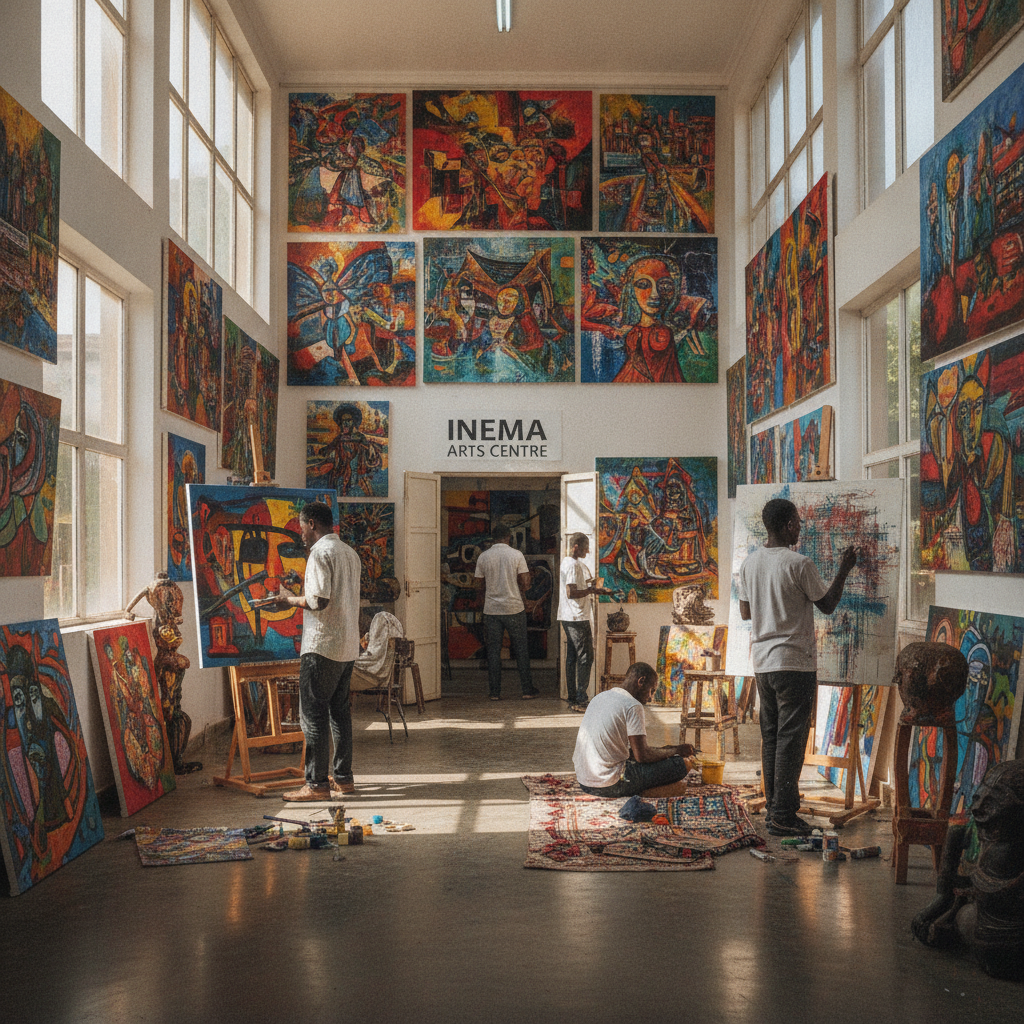
The Imigongo art tradition: the ancient Rwanda geometric art made from cow dung that has survived into modernity as one of the most distinctive African art forms and a significant component of the Rwanda cultural tourism economy. The tradition (Imigongo (pronounced ee-mee-GON-go): the traditional Rwanda geometric wall art: the art is produced by applying cow dung (fresh dung from a healthy cow, mixed with ash or earth for different effects) to a smooth surface and incising geometric patterns into the dung while still wet: the dung is then dried and painted with natural pigments (black from charcoal, white from kaolin clay, red from iron oxide): the patterns (the Imigongo patterns are geometric (spirals, interlocking diamonds, chevrons, spirals within circles): the patterns have symbolic meanings within the Rwanda traditional culture (the spiral pattern represents the interconnectedness of the community)). The origins (Imigongo is believed to have originated in the Kirehe district of eastern Rwanda (the traditional Imigongo-making area): the tradition is said to be approximately 200-300 years old: the court origin (the tradition was associated with the Rwanda royal court (the Mwami court))). The near-extinction and revival (the Imigongo art nearly disappeared during the colonial period and the post-genocide period: the revival (the Kakira Imigongo cooperative in the Kirehe district: the primary cooperative reviving and commercializing the Imigongo art tradition): the commercialization (Imigongo art has become a significant souvenir and export product: sold in Kigali craft markets and exported to Europe and North America: the patterns have been applied to fabric, ceramics, and greeting cards as well as the traditional board format)). The Kigali market (the Caplaki Craft Village in Kigali (the primary craft market of Kigali: approximately 330 vendors: the place to buy Imigongo art, basketry, wooden carvings, and other Rwandan crafts in Kigali)).
- 6
Kigali Final Legacy - The Most Remarkable City in Africa
Kigali final legacy assessment: why Rwanda and its capital are the most remarkable story in contemporary Africa, the limits and lessons of the Rwanda model, and what the visitor takes home from the Land of a Thousand Hills. The remarkable story (Rwanda 30-year transformation (1994-2024): the country moved from the worst genocide in Africa since the Biafra war to one of the fastest-growing economies on the continent: the transformation is real (the statistics are genuine (growth rates, literacy, life expectancy, child mortality, gender equality in parliament) and the physical reality of Kigali (the cleanliness, the order, the functioning infrastructure) is visible to any visitor): the gorillas (the Volcanoes National Park gorilla encounter is genuinely one of the most emotionally profound wildlife experiences on Earth: the combination of the landscape, the forest, the hour with the gorilla family, and the knowledge of what Rwanda has been through gives the experience an unusual depth): the genocide memorial (the Kigali Genocide Memorial is one of the most important historical sites in Africa: visiting it seriously is an obligation for any visitor who wants to understand contemporary Africa)). The limits of the model (the authoritarian governance (the Rwanda development achievement has come with a high price in political freedom: the suppression of political opposition, the restrictions on press freedom, the allegations of extra-judicial violence against dissidents: the question (can the Rwanda model be exported? Is the political control the cause of the development achievement or merely a feature of it?): the inequality (Rwanda growth has reduced poverty but has also increased inequality: the rural Rwandan farmer has seen improvements in basic services but has not shared equally in the growth of Kigali)). The visitor legacy (the visitor who engages seriously with Rwanda (not just the gorillas but the genocide memorial, the gacaca justice system, the Imigongo art, the umuganda community work, the Lake Kivu beauty, and the Kigali cleanliness) leaves with a complex and powerful impression: Rwanda is simultaneously the most hopeful and the most sobering story in contemporary Africa: the hope (what a society can rebuild from even the worst imaginable destruction): the caution (the price of that rebuilding and the fragility of what has been built)).
Walk this route with audio
Stories play automatically as you reach each stop — no tapping needed.
More in Kigali
Kigali: Cleanest City in Africa, Genocide Memorial, Mountain Gorillas, Paul Kagame, and the Rwanda Miracle

Kigali Outdoors: Virunga Volcanoes, Golden Monkey Trekking, and the Rwanda Highland Hikes
Kigali Final: Rwanda Planning Guide, Health Miracle, Goma Border, Photography, and Complete Legacy
Kigali Reconciliation, Gacaca Courts, INEMA Arts, and Lake Kivu