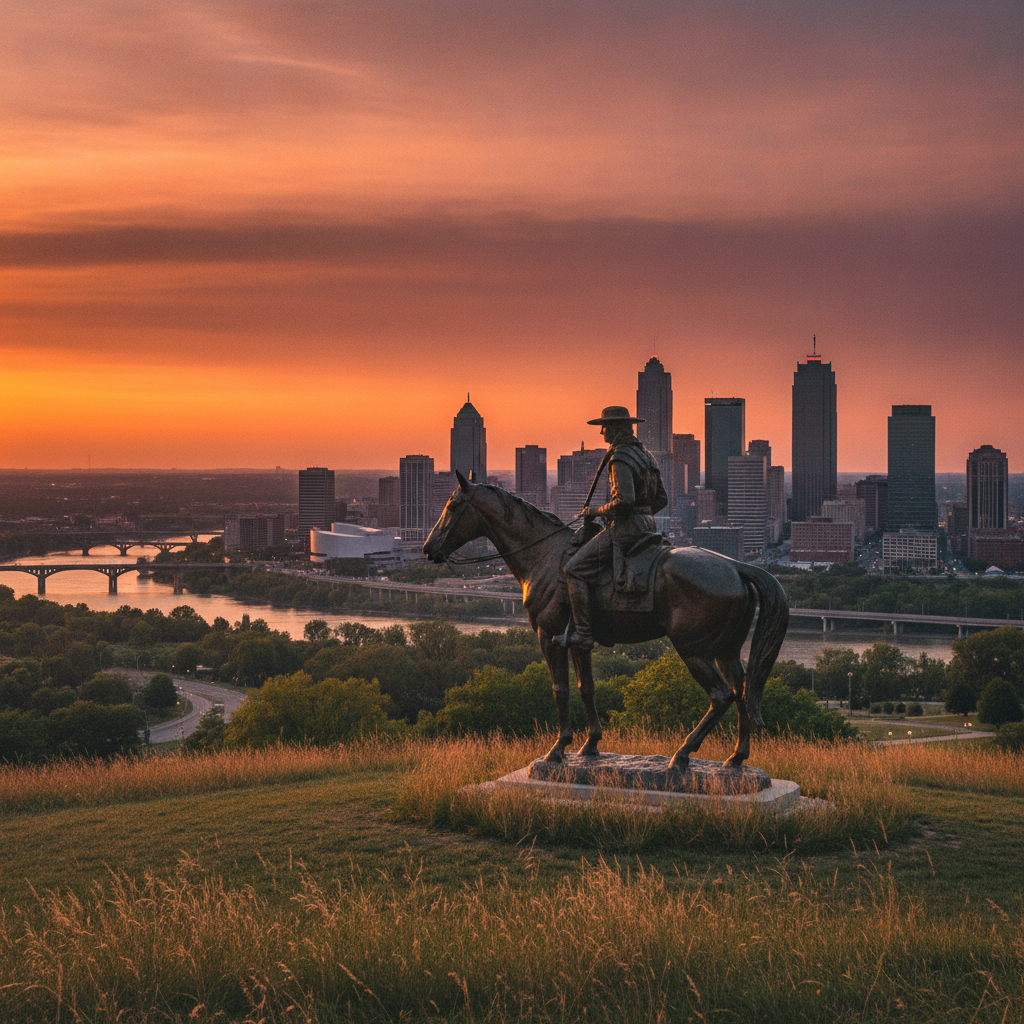
Kansas City R5-R6: Crown Center (85 acres Hallmark Cards HQ 1971 mixed-use precursor, J.C. Hall 1891-1982 arrived 18 two shoeboxes USD 183 savings built USD 4B revenue Hallmark Channel, H&R Block Henry Bloch 1922-2019 20M clients 60 countries donated USD 25M Nelson-Atkins), WWI Memorial (Liberty Memorial 1921-1926 five Allied commanders only time together Pershing Foch Wilson Diaz Jacques, USD 2.5M raised 10 days 83,000 donors fastest civic fundraising 1921, National WWI Museum 2006 75,000 artifacts most comprehensive world, glass floor 9000 poppy seed heads Allied dead Western Front), Royals (1969 expansion, 1985 WS comeback 3-1 Denkinger missed call, George Brett three-decade batting titles .390 1980 closest to .400 since Williams 1941, Pine Tar Incident July 24 1983, Dan Quisenberry poet sidearm), African American culture (Paseo main street Black KC, Thomas Dorsey Father Gospel Music Take My Hand Precious Lord 1932 tragedy-written, Charlie Parker Center music education, Black Archives Mid-America 2033 Vine), Immigrants (Garozzo Italian since 1989, Guadalupe Centers 1919 oldest largest Latino Midwest West Side, Vietnamese pho Independence Ave, Cambodian largest Midwest northeast KC), Practical (hot humid summers 30-35C ice storms winters, Plaza Lighting Ceremony 280,000 lights Thanksgiving 1925 100,000 spectators, KC Renaissance Festival 200,000 Bonner Springs September-October, Hotel Phillips 1931 Art Deco, Crossroads Hotel 2019 Pabst warehouse, free streetcar Main Street).
Kansas City R5-R6: Crown Center (85 acres Hallmark 1971, J.C. Hall arrived 18 two shoeboxes USD 183 built USD 4B Hallmark Channel, H&R Block 1955 Henry Bloch 20M clients 60 countries USD 25M Nelson-Atkins donation), WWI (Liberty Memorial five commanders only time together, USD 2.5M 10 days 83,000 donors, National Museum 2006 75,000 artifacts most comprehensive, glass floor 9000 poppy heads), Royals (1969 expansion, 1985 WS comeback 3-1 Denkinger, Brett three-decade batting titles .390 1980, Pine Tar July 24 1983), African American (Paseo main street, Dorsey Father Gospel Take My Hand Precious Lord 1932 tragedy, Charlie Parker Center, Black Archives 2033 Vine), immigrants (Garozzo Italian 1989, Guadalupe Centers 1919 oldest largest Latino Midwest, Vietnamese pho, Cambodian largest Midwest northeast), practical (30-35C summers, Plaza Lighting 280,000 lights 1925 Thanksgiving 100,000 spectators, Renaissance Festival 200,000 Bonner Springs, Hotel Phillips 1931 Art Deco, Crossroads Hotel Pabst warehouse 2019, free streetcar).
- 1
Crown Center and Hallmark - Kansas City Corporate Culture
Crown Center (at 2405 Grand Boulevard, 2 km south of downtown Kansas City): the 85-acre mixed-use development built by Hallmark Cards Incorporated on the site of the former Union Station railyard, developed starting in 1971 as a self-contained urban neighborhood (with hotels, apartments, offices, restaurants, theaters, and retail — a precursor to the urban mixed-use development model that became standard in American cities in the 1990s-2010s). Hallmark Cards Incorporated (headquarters at 2501 McGee Street, Crown Center, Kansas City): the world's largest manufacturer of greeting cards, founded in 1910 by Joyce C. Hall (born December 29, 1891, David City, Nebraska; died October 29, 1982, Kansas City) who arrived in Kansas City at age 18 with two shoeboxes of postcards and USD 183 in savings, and built a global company with approximately USD 4B in annual revenues, 30,000 employees worldwide, and the Hallmark Channel (the cable television network now known as Great American Media). The Hallmark Visitors Center (at 2501 McGee Street): the free museum documenting the history of Hallmark Cards, with exhibits on the creation of greeting cards, historic card designs, and the life of J.C. Hall. The Hallmark Crown Center Ice Terrace: the outdoor ice skating rink at Crown Center (open November-March, free admission on weekdays) that has become one of the most beloved wintertime destinations in Kansas City. The H&R Block world headquarters (at One H&R Block Way, 1 N Main Street, downtown Kansas City): the global tax preparation company (founded 1955 by Henry W. Bloch — born July 30, 1922, Kansas City; died April 23, 2019 — and his brother Richard A. Bloch — born August 26, 1926; died July 21, 2004 — serving approximately 20 million clients per year in more than 60 countries) whose founders are among the most important philanthropists in Kansas City history (Henry Bloch donated USD 25M to the Nelson-Atkins Museum for the Bloch Building addition).
- 2
Kansas City and World War I - The Liberty Memorial
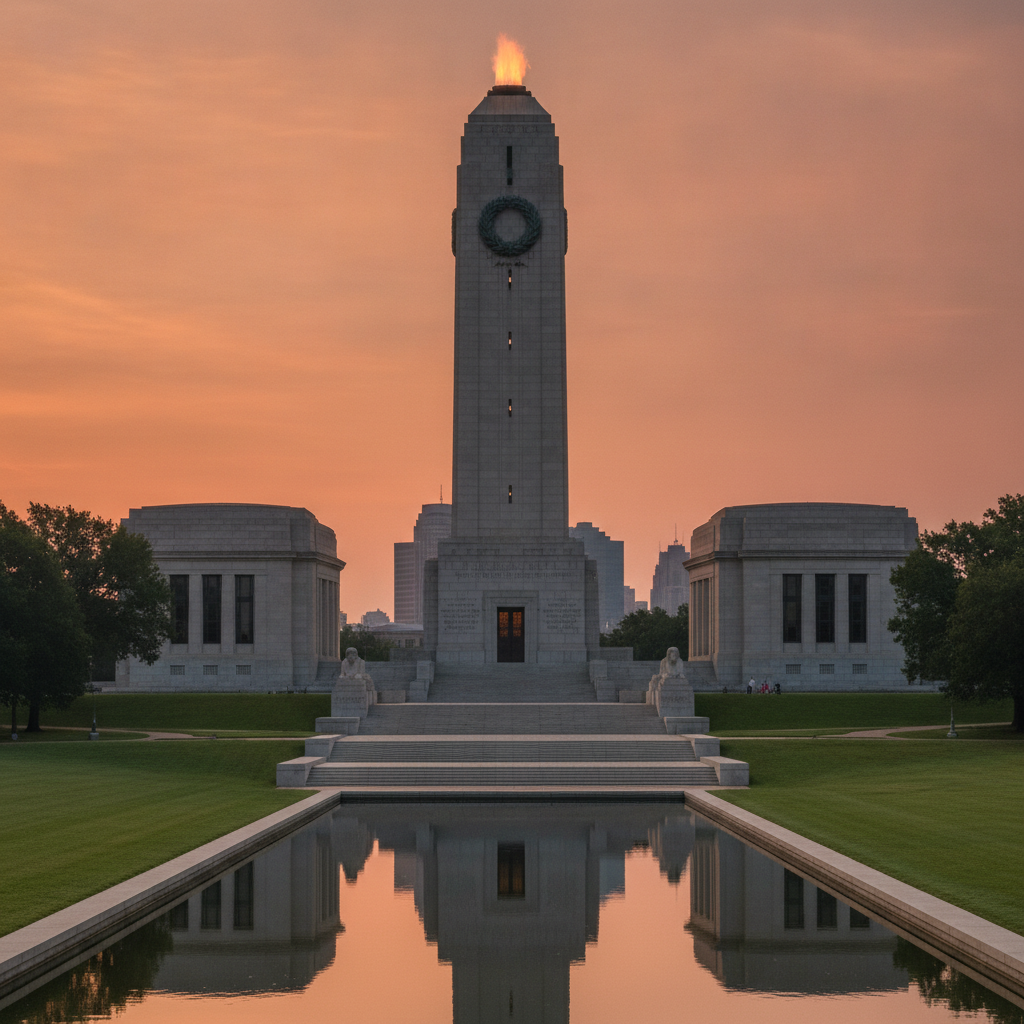
The Liberty Memorial and the National World War I Museum (at 100 W 26th Street, Penn Valley Park, Kansas City): the most important World War I memorial and museum in the United States, built between 1921 and 1926 to honor the dead of the Great War, and the only structure in the United States specifically designated as the national memorial to World War I. The Liberty Memorial dedication: the cornerstone was laid on November 1, 1921, in a ceremony attended by the Allied commanders of WWI — the only time the five Allied commanders were ever gathered together in the same place: General John Pershing (United States), General Ferdinand Foch (France), Field Marshal Sir Henry Wilson (Britain), General Armando Diaz (Italy), and Lieutenant General Baron Jacques (Belgium). Kansas City's special relationship with WWI: the city sent a disproportionately high percentage of its male population to the war (approximately 200,000 from the metropolitan area served) and the Liberty Memorial campaign raised USD 2.5M in 10 days from 83,000 Kansas City donors — at the time the fastest large-scale civic fundraising campaign in American history. The National WWI Museum: the museum (opened November 11, 2006, the 88th anniversary of the Armistice, and redesignated as the National WWI Museum by Congress in 2004) contains approximately 75,000 artifacts — the most comprehensive collection of WWI material in the world — including the glass floor over 9,000 poppy seed heads representing the Allied dead on the Western Front, uniforms and weapons from all major combatants, and personal diaries and letters that humanize the industrial scale of the slaughter. The memorial tower: the 52-m limestone tower (with the Eternal Flame burning at the top) is flanked by two sphinx-like figures (Memory and Future) and offers views of the downtown Kansas City skyline.
- 3
Kansas City Royals - From Expansion to Championship
Kansas City Royals in depth: the franchise founded as an American League expansion team in 1969 (Kansas City had been without a team since the Athletics moved to Oakland after the 1967 season) has won two World Series championships and produced some of the most beloved players in Kansas City sports history. The 1985 World Series: the Royals won the World Series against their in-state rivals the St. Louis Cardinals in 7 games, becoming the first team since the 1985 team to come back from a 3-1 deficit (a comeback that was aided by a controversial umpire call in Game 6 — Don Denkinger's missed call at first base that extended the Royals' game-winning rally — generating controversy still discussed in St. Louis). The Royals dynasty players: George Brett (born May 15, 1953, Glen Dale, West Virginia) is the greatest Royal in franchise history — a three-time batting champion and the only player in history to win batting titles in three different decades (1976 at .333, 1980 at .390, 1990 at .329), hitting .390 in 1980 (the closest any player has come to .400 since Ted Williams hit .406 in 1941), and the central figure in the Pine Tar Incident (July 24, 1983, in which Brett's game-winning home run was disallowed because pine tar on his bat extended more than 18 inches from the knob — causing Brett's famous eruption from the dugout — before the ruling was reversed on appeal and the home run reinstated). Frank White (born September 4, 1950, Greenville, Mississippi): the second baseman who won 8 Gold Gloves and was a key member of both championship teams. Dan Quisenberry (born February 7, 1953; died September 30, 1998): the sidearm reliever who was one of the most dominant closers in baseball in the early 1980s and who became a beloved poet and community figure in Kansas City after his playing career.
- 4
Kansas City's African American Cultural Heritage - Beyond 18th and Vine
Kansas City African American cultural heritage in full context: the Black community of Kansas City built one of the most vibrant African American urban cultures in the Midwest, constrained by segregation into specific neighborhoods (the northeast quadrant of the city, east of Troost, including the 18th and Vine district and the surrounding neighborhoods of Paseo, Blue Hills, and Hyde Park) but producing extraordinary cultural, intellectual, and economic achievements within those constraints. The Paseo (the grand boulevard running north-south on the east side of the city, designed by George Kessler as the central boulevard of the east side): the main street of Black Kansas City, lined with the civic institutions of the African American community — the NAACP, the Urban League, the Black churches, and the fraternal organizations. Thomas Andrew Dorsey (born July 1, 1899, Villa Rica, Georgia; died January 23, 1993, Chicago): the Father of Gospel Music, who played blues piano under the name Georgia Tom before his religious conversion (following the deaths of his wife and infant son) and his composition of Take My Hand Precious Lord (1932, written on the night of his personal tragedy) — the most sung hymn in the African American church tradition and one of the most covered religious songs in history (recorded by Elvis Presley, Aretha Franklin, and Mahalia Jackson, among hundreds of others). Dorsey lived and worked in Kansas City for periods of his career. Charlie Parker Center (at 1600 E 18th Street, the Charlie Parker Memorial Foundation): the nonprofit organization dedicated to preserving the legacy of Kansas City's greatest musical son and providing music education to Kansas City youth. The Black Archives of Mid-America (at 2033 Vine Street, adjacent to the 18th and Vine Heritage District): the research archive dedicated to the history of African Americans in the Midwest.
- 5
Kansas City's Immigrant Communities and Ethnic Neighborhoods
Kansas City's diverse immigrant communities: Kansas City has been shaped by waves of immigration from Europe, Latin America, and Southeast Asia that have created distinctive ethnic neighborhoods and culinary traditions. The Italian-American community of Kansas City: concentrated in the North End (the neighborhood north of downtown) and the suburb of North Kansas City, the Italian-American community established the restaurants, bakeries, and social clubs that have persisted for more than a century. Garozzo's Ristorante (at 526 Harrison Street, downtown Kansas City): the Italian-American restaurant that has been a Kansas City institution since 1989, known for its chicken spiedini and the bocce court in the dining room. The Mexican-American West Side (see above): the historically Mexican neighborhood west of downtown that has maintained its character through generations of immigration and serves as the primary Mexican cultural hub of the city. The Guadalupe Centers (at 1015 Avenida Cesar E Chavez, West Side): the oldest and largest Latino social service organization in the Midwest (founded 1919), providing education, social services, and cultural programming to the Latino community of Kansas City. The Vietnamese and Southeast Asian community of Kansas City: centered in the northeast neighborhoods and along Independence Avenue, the Vietnamese community has established a concentration of pho restaurants, grocery stores, and community institutions. The Cambodian community (one of the largest Cambodian communities in the Midwest, established following the fall of Phnom Penh in 1975 and the subsequent refugee wave): the community centered in northeast Kansas City. The Korean community of Johnson County, Kansas (the suburban county south of Kansas City, Kansas, which has become the center of Korean and other East Asian immigrant settlement in the metropolitan area).
- 6
Kansas City Seasonal Guide and Visitor Tips
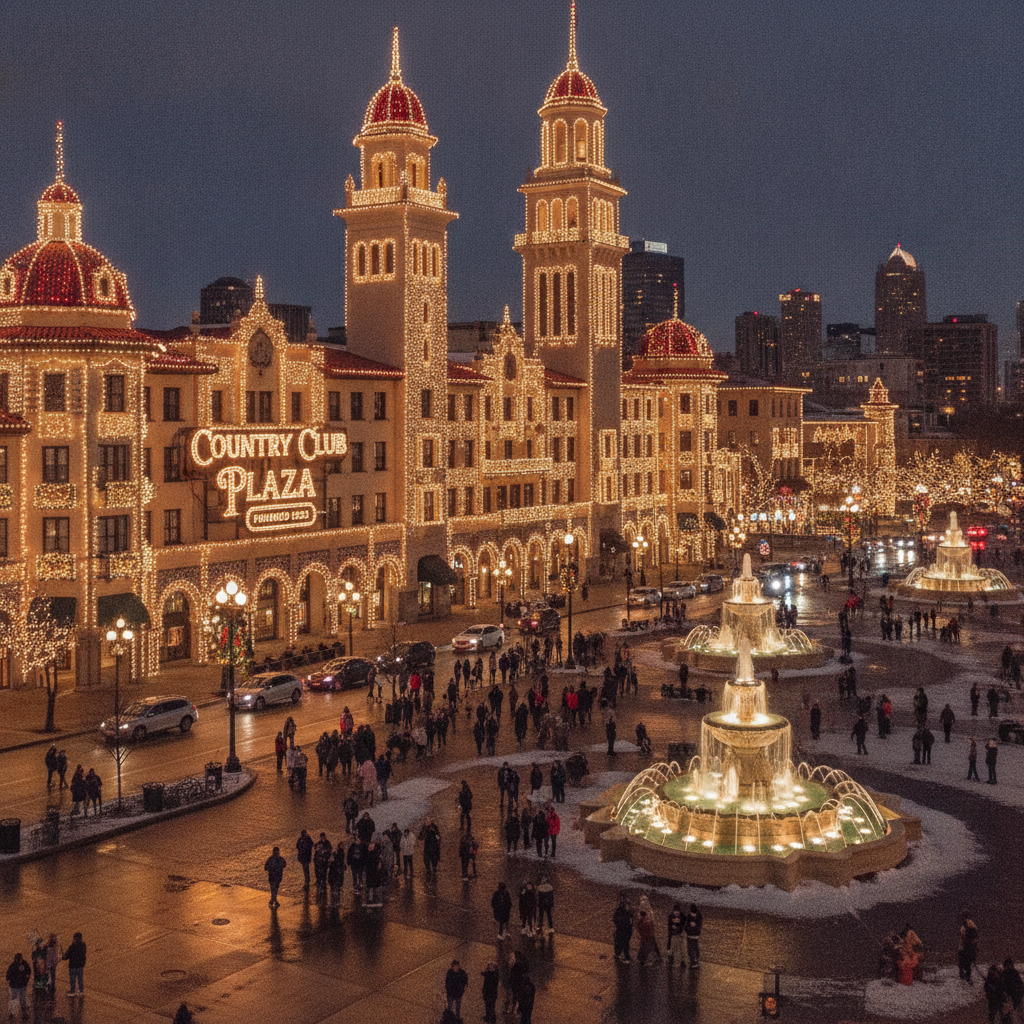
Kansas City seasonal guide and complete visitor information. Climate: Kansas City has a humid continental climate with hot, humid summers (June-August: average highs 30-35 degrees Celsius, with frequent heat indexes above 40 degrees Celsius, and severe thunderstorm season from April through July) and cold winters (December-February: average highs 4-7 degrees Celsius, with occasional ice storms and snowfalls of 5-15 cm). The best seasons: spring (April-May: average highs 18-24 degrees Celsius, blooms in Loose Park rose garden, the Country Club Plaza Lighting Ceremony is in late November) and fall (September-October: average highs 20-26 degrees Celsius, Cardinals baseball playoff season at Kauffman Stadium, fall foliage along the Kessler boulevards). Kansas City festivals: the Kansas City Renaissance Festival (in Bonner Springs, Kansas, 30 km west of downtown, held weekends in September-October): one of the largest Renaissance festivals in the United States, with approximately 200,000 annual attendees. The Plaza Lighting Ceremony (the annual Thanksgiving weekend event in which the Country Club Plaza is illuminated with approximately 280,000 holiday lights, a tradition since 1925): one of the most beloved annual events in Kansas City, drawing approximately 100,000 spectators. Accommodation: the Hotel Phillips (at 106 W 12th Street, downtown, built 1931, Art Deco masterpiece), the Crossroads Hotel (at 2101 Central Street, Crossroads Arts District, opened 2019 in the converted Pabst brewing warehouse), and the InterContinental Kansas City at the Plaza (at 401 Ward Parkway, Country Club Plaza). Getting around: the free KC Streetcar (Main Street), the RideKC bus system, and rideshare are the primary options — a car is recommended for Graceland (wrong city — substitute: a car is recommended for Arrowhead Stadium and day trips beyond the streetcar and bus network).
Walk this route with audio
Stories play automatically as you reach each stop — no tapping needed.
More in kansas-city
Kansas City: World-Class Art, Jazz Heritage and Legendary Smoke
Kansas City: BBQ, jazz, architecture, Negro Leagues, Chiefs, and practical guide
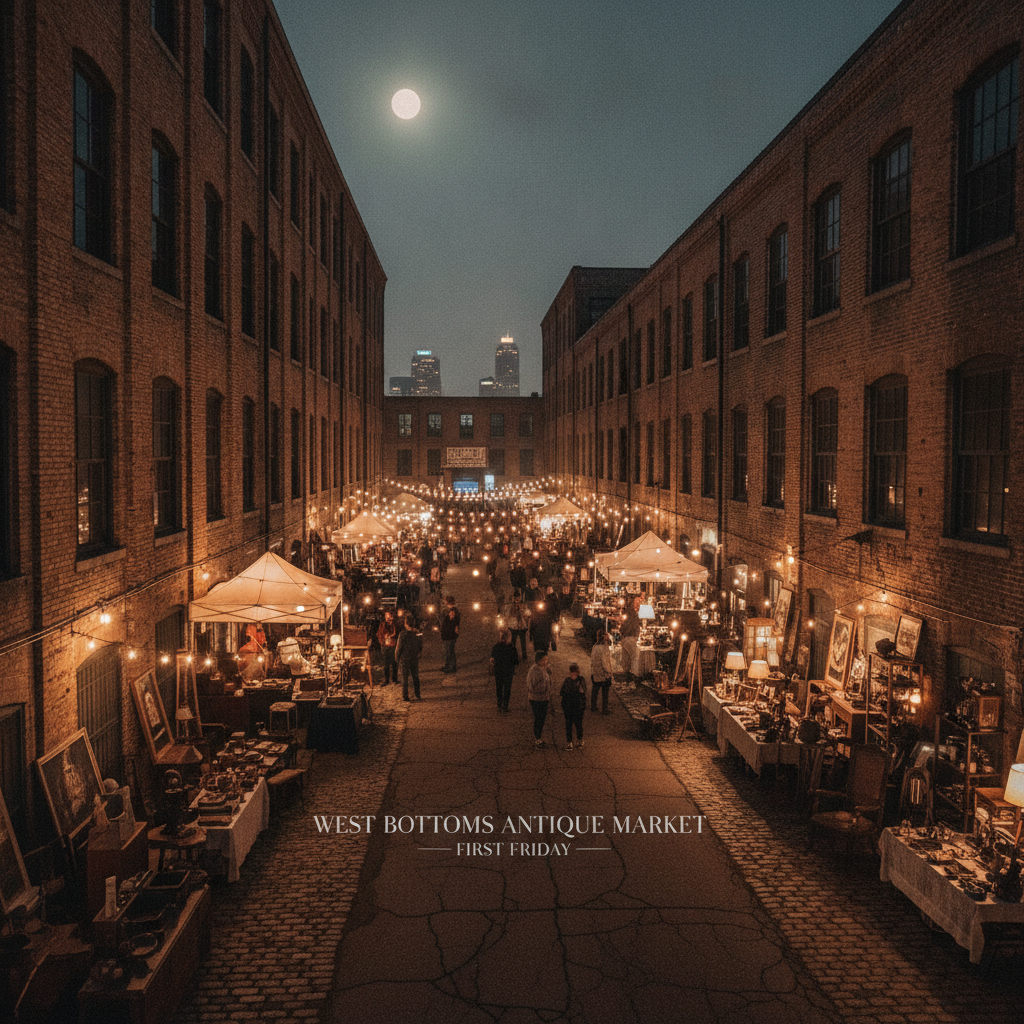
Kansas City R4-R6: West Bottoms (stockyards 400 acres 1917 hotel bank post office, First Weekend antique market largest Midwest monthly, American Royal Livestock largest combined livestock horse show rodeo world, 1993 flood 4m underwater, West Bottoms beef culture direct legacy), Kauffman (Marion Labs USD 5,000 basement 1950 to USD 6.5B 1989, Royals USD 5.25M 1968 now USD 1.8B, Kauffman Foundation USD 3.5B largest entrepreneurship focus US, Sprint founded Abilene 1899 T-Mobile 2020, Cerner 1979 Oracle USD 28.3B 2022), Civil rights (Troost Wall most persistent racial boundary US history, Jenkins v Missouri 1977-2011 longest desegregation case USD 2B 12 years considered failed, Bruce Watkins Cultural Heritage Center, 1968 uprising 6 killed after King assassination), Parks (Swope Park 1769 acres zoo 1700 animals, Loose Park Battle of Westport October 23 1864 29,000 vs 8500 largest Civil War battle west Mississippi, tallgrass prairie less than 4% original remains), tech (Google Fiber 2012 first gigabit residential US USD 300M economic impact, 500+ tech companies AgTech health IT, Hallmark since 1910 largest greeting cards world, H&R Block 1955 brothers Bloch), Identity (KCK vs KCMO separate states governments, 39th Street 3am vs 2am bar migration, Sporting KC Children's Mercy Park 2011, Taylor Swift Travis Kelce 2023 USD 100-200M economic impact).
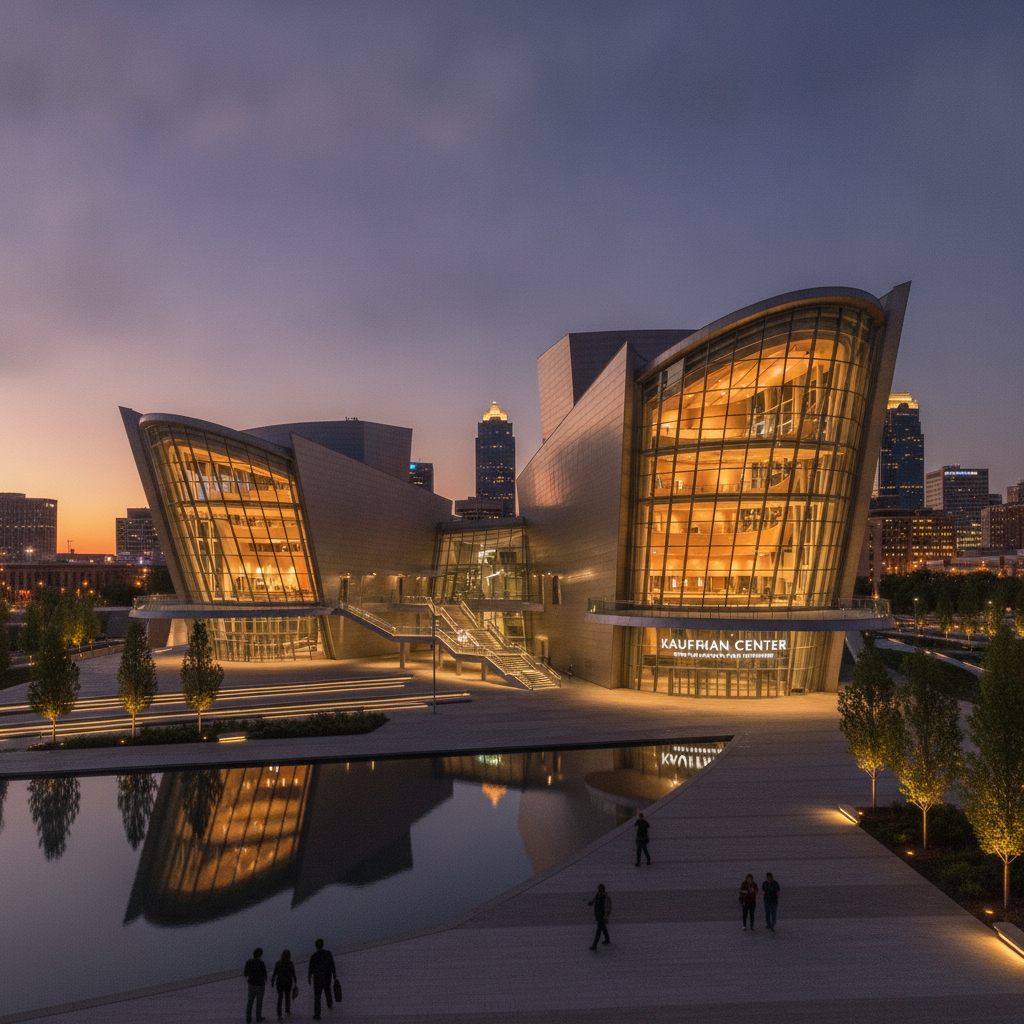
Kansas City R3: Pendergast Machine (ghost voters ballot stuffing police control USD 40M 12-year plan City Hall courthouse, Ready Mixed Concrete Company conflict of interest, Truman Jackson County judge 1922 presiding 1926 attended Pendergast funeral 1945), Truman (Boys if you ever pray pray for me now April 12 1945, Hiroshima August 6 1945 70,000 immediate 120,000 total, Nagasaki August 9 40,000 immediate 80,000 total, desegregated military EO 9981 July 26 1948, recognized Israel May 14 1948 11 minutes first nation, Marshall Plan USD 13B 1948-1952, Korea June 27 1950, Truman Library Independence 1957), Santa Fe Trail (1821 1400km Independence Missouri to Santa Fe, Kearny Army of the West conquered New Mexico August 1846, National Frontier Trails Museum ruts still visible, Westport Landing outfitting point 1830s-1860s Fremont Pathfinder), music (Knuckleheads Saloon country blues Americana, Kauffman Center 2011 Moshe Safdie Helzberg Hall violin shell, Charlie Parker Jazz Festival August Penn Valley, Boulevard Brewing 1989 700,000 barrels Midwest largest specialty), streetcar (3.5km free USD 1.7B development since 2016, extension to Plaza UMKC under construction), food beyond BBQ (West Side Mexican 60% Hispanic authentic, Cafe Sebastienne Kemper Museum Jennifer Maloney, Boulevard Brewing Tank 7 Saison-Brett).
Kansas City: Creative Arts, Champion Chiefs and Pioneer Outfitting Ground