Juneau: Mendenhall Glacier, Alaska Capital City, Gold Rush History, Tongass Rainforest, Whale Watching, and Practical Info
Juneau (population 32,000, the capital of Alaska and the only US state capital with no road connection to the outside world -- accessible only by sea or air) sits in a dramatic fjord on the Inside Passage of Southeast Alaska, surrounded by the Tongass National Forest (the world's largest temperate rainforest at 68,375 square km, larger than Washington state), the Chilkat Mountains, and the Juneau Icefield (3,800 square km, feeding 38 glaciers including the Mendenhall Glacier 13 km from downtown). Founded in 1880 after a gold discovery guided by the Tlingit chief Kowee, Juneau became the territorial and then state capital of Alaska (1906/1959), and today receives 1.3+ million cruise passengers per year (43 times its permanent population) while maintaining a government-town character of 32,000 year-round residents who work in government, fishing, tourism, and the university. The city's defining natural feature is the Mendenhall Glacier (the most visited glacier in the US, retreating 3 km since the visitor center was built in 1958) and the spectacular marine wildlife of Stephens Passage (500-600 humpback whales summering within 85 km, orca, Steller sea lions, harbor seals).
- 1
Mendenhall Glacier - The Glacier You Can Drive To
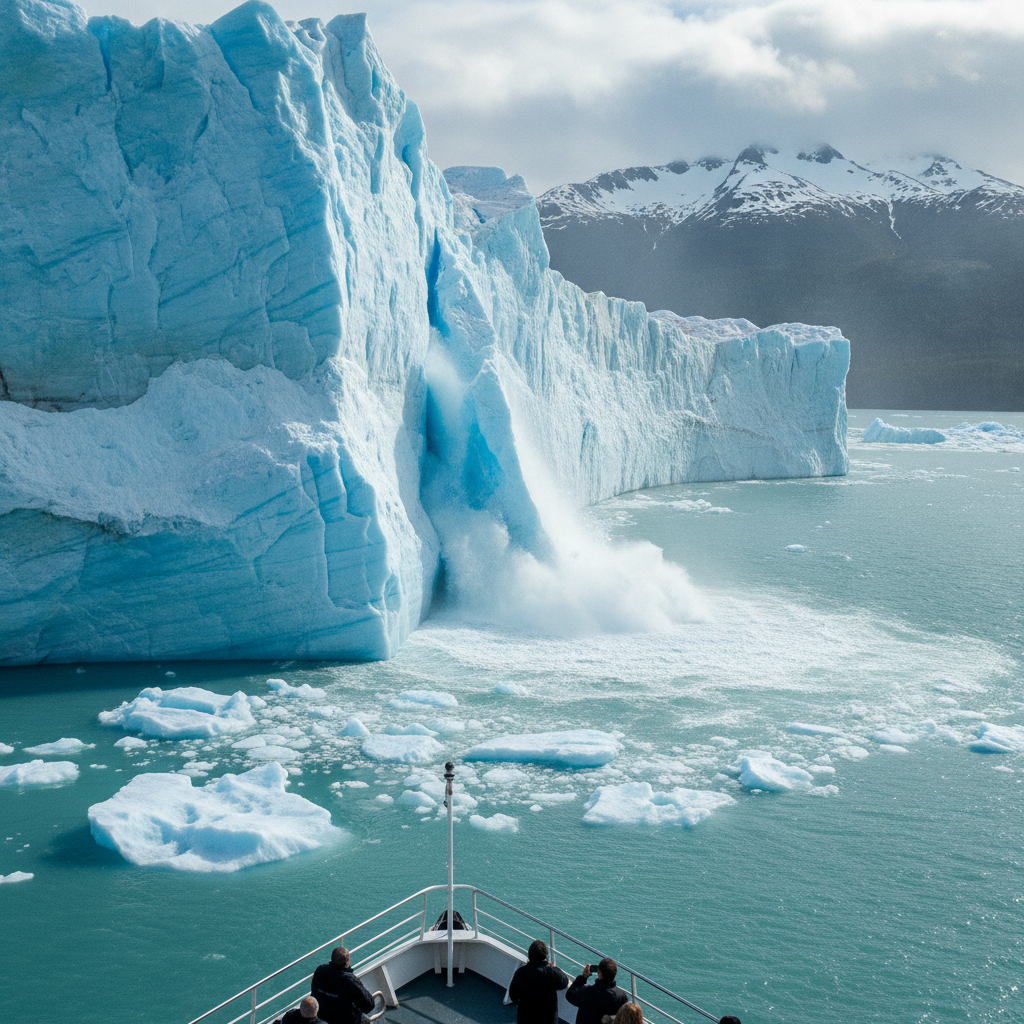
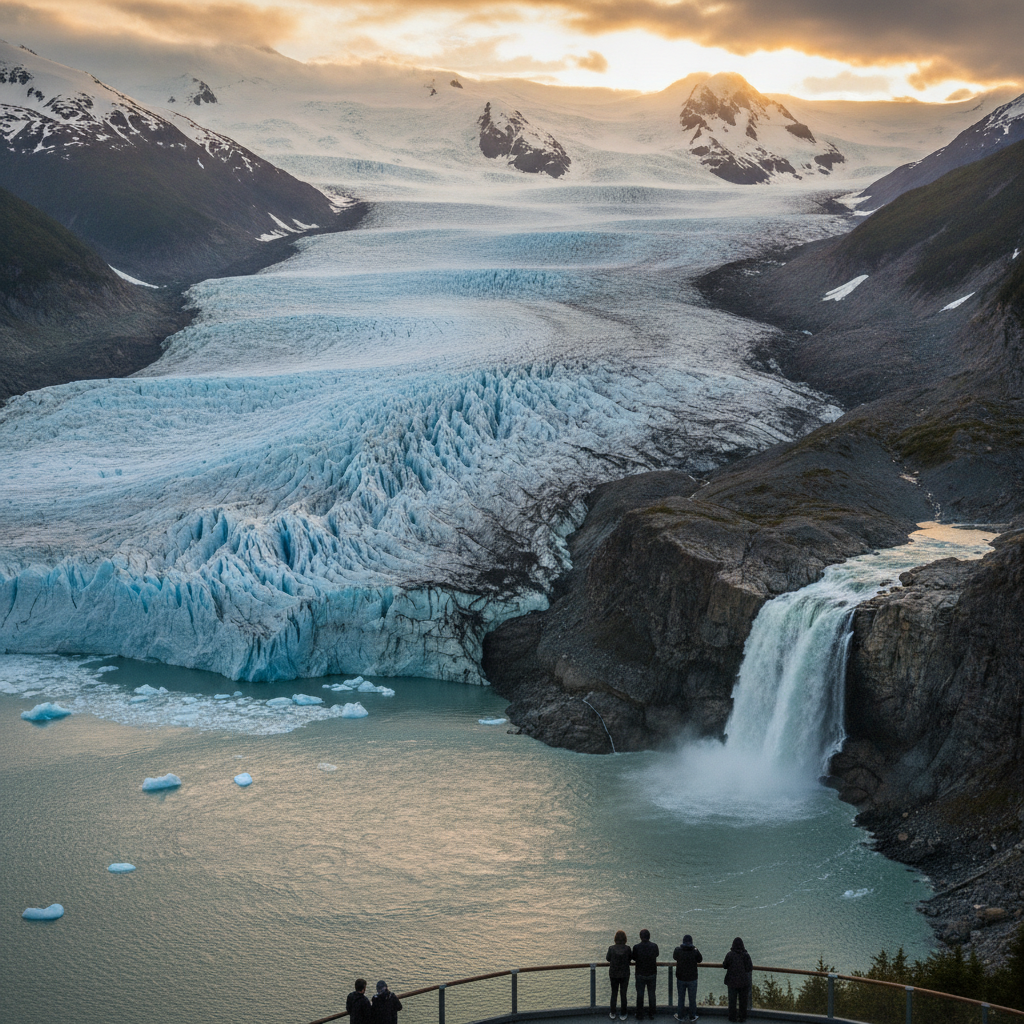
Mendenhall Glacier (at 6000 Glacier Highway, Juneau, AK, 13 km from downtown Juneau, the visitor center at the Mendenhall Glacier Recreation Area managed by the Tongass National Forest): the most visited glacier in the United States and one of the most accessible glaciers in the world, a 20-km-long glacier flowing from the Juneau Icefield (a 3,800-square-km icefield straddling the Alaska-British Columbia border, feeding 38 glaciers) to the Mendenhall Lake (a proglacial lake formed entirely since 1930, as the glacier has retreated to reveal the lake bed). The glacier retreat: Mendenhall Glacier has retreated approximately 3 km since 1958 (when the visitor center was built) and over 4 km since 1900 -- visitors arriving today see the glacier 3 km further from the visitor center than visitors in 1958 saw it, and the Nugget Falls waterfall (now visible on the far side of the lake) was hidden behind ice until the glacier retreated to reveal it in approximately 2003. The glacier ice caves: accessed by kayak across Mendenhall Lake and then a scramble up the glacier face with crampons and ice axes, the Mendenhall ice caves (the caverns formed by meltwater rivers running under and through the glacier ice) have become a major attraction, with guided tours available from multiple operators for approximately USD 225-400 per person. The West Glacier Trail (5.5 km round-trip from the West Glacier Trailhead at the end of Mendenhall Loop Road): the most dramatic free hike at Mendenhall, climbing the hillside above the glacier for views looking down the glacier tongue toward the lake and the city of Juneau.
- 2
Juneau as Alaska State Capital - Governance at the End of the Road
Juneau as the only US state capital inaccessible by road: Juneau is the only state capital in the United States (and one of very few in the world) with no road connection to the rest of its state or nation -- the city is surrounded by the Tongass National Forest, the Chilkat Mountains, and the Inside Passage, accessible only by sea (the Alaska Marine Highway ferry) or air (Juneau International Airport). The Juneau airport fog problem: the Juneau International Airport (at 1873 Shell Simmons Drive, Juneau) is notorious for weather delays -- the airport sits in a fjord between the Coast Mountains and Lynn Canal, making it susceptible to fog, low clouds, and the williwaw (the sudden violent gust of wind that descends from mountain passes) that can close the airport for hours or days. The capital move controversy: the relocation of the Alaska state capital from Juneau to a more central and accessible location has been debated and voted on multiple times -- in 1974 Alaska voters approved in principle moving the capital, in 1982 voters chose a site near Willow (120 km north of Anchorage), but in 1982 they also voted against funding the move (the estimated cost was USD 2.8B), effectively ending the relocation debate. The Alaska State Capitol (at 120 4th Street, Juneau, built 1931, the neoclassical building housing the Alaska Legislature and the Governor's office): the most important government building in Alaska, modeled on the Greek Revival style of many state capitols but considerably smaller (it was originally built as a federal building before Alaska became a state in 1959 and was repurposed as the state capitol at statehood). The Alaska Governor's mansion (at 716 Calhoun Avenue, Juneau, built 1912 in the colonial revival style): the official residence of the Governor of Alaska.
- 3
Gold Rush Juneau - The Discovery That Founded a City
The founding of Juneau: Juneau is the only US state capital founded as a result of a gold rush, established after prospectors Joe Juneau (born February 17, 1833, Quebec, Canada; died January 23, 1899, Dawson City, Yukon) and Richard Harris (born 1833, Pennsylvania; died February 16, 1907, Seattle) discovered gold at Gold Creek on October 4, 1880 -- guided to the site by the Tlingit chief Kowee of the Auk Tlingit, who showed the prospectors the gold-bearing quartz veins. The Treadwell Mine (the gold mine established in 1882 on Douglas Island, across Gastineau Channel from Juneau): the largest hard rock gold mine in the world from 1882 to 1917, with four connected shafts, 960 stamps (the crushing machinery that pulverized the ore), and producing USD 75M in gold at historical prices (approximately USD 3B at current prices) before the mine flooded catastrophically on April 22, 1917 when the sea broke through the mine walls, flooding all four shafts and collapsing 4 acres of surface -- the 300 miners on shift escaped to the surface, but the mine was permanently lost. The Alaska-Juneau Mine (the mine at 2 Basin Road, Juneau, operating 1893-1944, producing USD 80M in gold): the most productive hard-rock gold mine in Alaska history, with the mine buildings (including the processing mill at the base of Mount Juneau) still standing as historic ruins above the downtown area. The Last Chance Mining Museum (at 1001 Basin Road, Juneau, in the preserved buildings of the Alaska-Juneau Mine compressor plant): the museum documenting the gold mining heritage with original mining equipment including the largest compressor in the world at the time of its installation (1898).
- 4
The Tongass National Forest and the Temperate Rainforest
The Tongass National Forest (the 68,375-square-km national forest covering most of southeast Alaska, the largest national forest in the United States -- more than 5 times larger than any other national forest, larger than the states of Washington or South Carolina): the world's largest temperate rainforest, receiving 200-400 cm of annual precipitation (depending on location) and supporting the most productive old-growth temperate rainforest ecosystem on earth, with Sitka spruce (Picea sitchensis, reaching 90 m tall), western hemlock (Tsuga heterophylla), and red cedar (Thuja plicata) forming the canopy of the old-growth stands that have been at the center of the most contentious timber and conservation debate in US history. The Tongass old-growth timber controversy: the Tongass has been logged commercially since the 1950s (with the Ketchikan Pulp Company and the Alaska Pulp Corporation operating large-scale clear-cut operations subsidized by the U.S. Forest Service, which built 27,000 km of roads and sold timber below cost for decades), generating one of the most prolonged environmental battles in US Forest Service history. The Biden administration reinstated the Clinton-era Roadless Rule for the Tongass in 2023, protecting 1.3 million acres of old-growth from future logging. The Glacier Gardens Rainforest Adventure (at 7600 Glacier Highway, Juneau, 10 km from downtown): the unique rainforest garden where trees have been planted upside down (with the root balls skyward) in a grove of living and dead Sitka spruce, creating gravity-defying floral sculptures in the temperate rainforest environment. The Tongass National Forest trail network near Juneau: the Perseverance Trail (4 km, historic miners trail to the Silverbow Basin), the Mount Roberts Trail (7.5 km, 1,000 m elevation to the alpine tundra above Juneau, also accessible by the Mount Roberts Tramway), and the Point Bridget State Park coastal trail.
- 5
Whale Watching and the Marine Life of the Inside Passage
The marine life of the Inside Passage near Juneau: the glacially carved fjords, kelp forests, and salmon-rich waters of the Stephens Passage and Lynn Canal immediately surrounding Juneau support extraordinary concentrations of marine wildlife that can be observed year-round from whale watching boats, kayaks, and the Alaska Marine Highway ferry. The humpback whale (Megaptera novaeangliae): the most commonly observed large whale in the Juneau area, with approximately 500-600 individual humpback whales summering in the waters between Juneau and Frederick Sound (85 km south of Juneau) -- individually identified by the unique black-and-white pattern of the flukes. The bubble net feeding: the most dramatic wildlife behavior in Alaskan waters -- groups of 5-15 humpback whales cooperatively feeding by releasing air bubbles underwater in a spiral pattern that concentrates herring into a ball at the surface, then rushing upward through the bait ball with mouths open. The humpback whale song: humpback whales on the winter breeding grounds in Hawaii sing the most complex songs of any non-human animal, with songs lasting 20+ minutes and evolving culturally across the Pacific population over years. The orca (killer whale, Orcinus orca): the apex predator of Alaskan waters, with two ecotypes present in the Juneau area -- the transient (Bigg's) orca (mammal-eating pods that range widely, occasionally seen in Stephens Passage hunting sea lions and harbor seals) and the resident orca (fish-eating pods that follow the salmon runs). Steller sea lions (Eumetopias jubatus): the largest sea lion species in the world (males up to 1,100 kg), with the largest Steller sea lion rookeries in Alaska located on the outer coast of the Tongass, approximately 200 km west of Juneau. Harbor seals (Phoca vitulina): the most commonly seen marine mammal in the Juneau area, hauling out on the ice floes that calve from LeConte Glacier, the southernmost tidewater glacier in North America (125 km south of Juneau).
- 6
Juneau Practical Guide - Getting There, Exploring, and What Not to Miss
Getting to Juneau: Juneau International Airport (at 1873 Shell Simmons Drive, Juneau, IATA code JNU): the commercial airport with non-stop service from Seattle (Alaska Airlines, 2 hours, USD 150-350), Anchorage (Alaska Airlines, 1.5 hours, USD 120-280), and several other Alaska cities. Weather delays are frequent -- the Juneau airport is closed approximately 30-45 days per year due to fog, low clouds, or wind. The Alaska Marine Highway: the weekly ferry connection from Bellingham, Washington (the port 90 km north of Seattle) to Juneau, passing through Ketchikan, Wrangell, and Petersburg in the Inside Passage, with cabins and a solarium deck for budget-oriented travelers (the 38-hour journey from Bellingham to Ketchikan, then another 8 hours to Juneau). The cruise ship traffic: Juneau is the most-visited cruise ship port in Alaska, with approximately 600-700 cruise ship calls per year and 1.3+ million cruise passengers disembarking in Juneau annually (2023 record) -- the equivalent of 43 times the permanent population of Juneau (32,000). The cruise ship impact on downtown: downtown Juneau's S. Franklin Street transforms dramatically on cruise ship days (typically 3-5 ships per day May through September) from a government town into a tourist corridor of jewelry stores, T-shirt shops, and tour operators, with 8,000-12,000 new visitors arriving within 2 hours of each other. The Mount Roberts Tramway (at 490 South Franklin Street, Juneau, departing from the cruise ship dock area, rising 550 m to the Mount Roberts Tramway Station at 1,090 m elevation in 6 minutes): the most convenient way to access the alpine tundra above Juneau, with panoramic views of the Gastineau Channel, Douglas Island, and the Juneau Icefield on clear days. Restaurant highlights: Tracy's King Crab Shack (at 432 South Franklin Street, the outdoor crab shack on the cruise ship corridor), Hangar on the Wharf (at 2 Marine Way, the restaurant in the historic aircraft hangar at the waterfront).
Walk this route with audio
Stories play automatically as you reach each stop — no tapping needed.
More in juneau
Juneau: Douglas Island, Cruise Ship Economy, Neighborhoods, Skagway Gold Rush, Chilkat Bald Eagles, and Tongass Wildlife
Juneau: Arts and Culture, Tongass Conservation, State Museum, Rain Culture, Tracy Arm Fjord, and the Future of the Capital