Juneau: Douglas Island, Cruise Ship Economy, Neighborhoods, Skagway Gold Rush, Chilkat Bald Eagles, and Tongass Wildlife
Juneau: Douglas Island (residential island Douglas Bridge Gastineau Channel 35km saltwater channel mudflats shorebird habitat, Treadwell Mine ruins 1882-1917 largest hard rock gold mine world collapsed glory hole overgrown spruce alder accessible historic trail, Sandy Beach 12-14C July popular dry suits wetsuits), cruise ship economy (1.3M passengers 32,000 residents 41:1 ratio most cruise-dependent major US city, 3-5 ships peak day 8,000-15,000 passengers 4-hour window 4 city blocks S. Franklin, USD 270M direct spending, cruise companies no Alaska income tax no flag-of-convenience US tax, 2022 ballot 12,000/day limit Saturday restrictions, Diamonds International Tanzanite chain vs locally-owned whale watching USD 30M), neighborhoods (City Borough Juneau 8,494 sqkm largest US city larger Rhode Island and Delaware combined, historic downtown Juneau-Douglas City Museum gold nuggets Alaska State Museum 395 Whittier Tlingit Russian, Mendenhall Valley 13km north UA Southeast 3,000 students Costco Fred Meyer, Mendenhall Wetlands 2,800 acres 140+ species, Auke Bay 18km north seaplane ferry terminal whale-watching harbor), Skagway (1,100 winter 30+ ships summer 145km north, Klondike Gold Rush NHP 1976 most preserved gold rush town US, Portland docked Seattle July 17 1897 68 miners 2 tonnes gold 100,000 stampede, White Pass Yukon Route Railroad July 29 1900 873m summit 35km 35,000 tons black powder steam locomotives most scenic mountain railway North America, Soapy Smith born 1860 died July 8 1898 gunfight Frank Reid con man controlled Skagway 1897-1898), Chilkat eagles (Haines 2,600 130km north ferry Eagle Capital World, Chilkat Bald Eagle Preserve 1982 19,500 acres groundwater keeps river ice-free November-December, 3,000-4,000 eagles 5km stretch largest single concentration world, national bird designated June 20 1782, Alaska population 30,000 largest US, Bald Eagle Festival November 800+ visitors photography birding, Haines Highway 254km only road connection SE Alaska to North American network), wildlife (30,000 black bears SE Alaska highest density US, Sitka black-tailed deer mountain goats cliff faces downtown visible, 1 bald eagle nest per 5km coastline highest density world, Mendenhall River salmon July-October king sockeye coho pink bears fishing 50-100m from parking lot, 300-400 bears within Juneau city limits bear-proof trash cans required, Tongass 5-10 tonnes/hectare/year 3x temperate deciduous salmon carcass nutrients).
- 1
Douglas Island, Gastineau Channel, and the Bridge City
Douglas Island (the island separated from the Juneau mainland by the Gastineau Channel, connected by the Douglas Bridge and the Juneau-Douglas Bridge, with the community of Douglas (population approximately 6,000) at the north end of the island and the Eaglecrest Ski Area at the south): the residential island that gives Juneau its distinctive two-part character, with the downtown government-and-tourism district on the mainland side and the more residential Douglas community on the island. The Gastineau Channel: the 35-km-long, 1-2 km-wide saltwater channel separating the Juneau mainland from Douglas Island, formed by glacial erosion and now serving as the primary marine highway for cruise ships entering downtown Juneau. At low tide, the Gastineau Channel reveals extensive mudflats that are important shorebird habitat during the spring and fall migrations. The Treadwell Mine ruins (on the Douglas Island shoreline, accessible from the Treadwell Historic Trail, trailhead at 100 Savikko Road, Douglas): the ruins of the largest hard rock gold mine in the world (1882-1917) -- the collapsed mine buildings, the glory hole (the main mining pit, now partially flooded), and the remains of the mill and compressor buildings overgrown with spruce and alder on the Douglas Island shoreline. Sandy Beach Park (in Douglas, at Sandy Beach Road): the most popular beach in the Juneau area, with views of the Gastineau Channel, the mountains behind Juneau, and the Alaska-Juneau Mine ruins on the opposite shore -- a beach that reaches a maximum water temperature of 12-14C in July, making it one of the cooler swimming beaches in the United States but popular with Juneau residents in dry suits and wetsuits.
- 2
Juneau in Summer - The Cruise Ship Economy and its Complexities
Juneau and the cruise ship economy: Juneau is the most cruise-dependent major US city by ratio of cruise visitors to permanent residents -- with 1.3+ million cruise passengers per year versus a permanent population of 32,000, cruise tourism represents a 41:1 ratio that has made Juneau simultaneously one of the most economically successful small cities in Alaska and one of the most visible battlegrounds in the US debate over over-tourism and the impact of cruise ships on urban communities. The cruise ship problem: on a peak summer day (June-August, typically Tuesday through Saturday), 3-5 cruise ships dock simultaneously at the downtown cruise ship berths, discharging 8,000-15,000 passengers in a 4-hour window into downtown Juneau (total surface area of S. Franklin Street shopping district: approximately 4 city blocks). The passengers -- many spending USD 50-150 on jewelry, excursions, and T-shirts -- generate approximately USD 270M per year in direct visitor spending in Juneau. But the cruise ship companies pay no Alaska income tax, no Alaska port fee beyond the docking charge, and the ships themselves (registered in Bahamas, Panama, or other flag-of-convenience nations) pay no US income tax. The ballot initiatives: in 2022 Juneau voters approved a ballot measure limiting the number of cruise ship passengers to 12,000 per day and restricting ship arrivals on Saturdays -- measures that the cruise industry challenged in court. The summer transformation: in summer (May-September), downtown Juneau's character changes from a government town of state offices and fishing community to a tourist corridor, with the S. Franklin Street jewelry stores (Diamonds International and Tanzanite International chains are most prominent) dominating the cruise ship corridor. The whale-watching economy: approximately USD 30M per year in whale-watching, helicopter flightseeing, and glacier helicopter tours generates significant revenue for locally-owned small businesses.
- 3
Juneau Neighborhoods and the Local Life
Juneau neighborhoods: the city of Juneau (officially the City and Borough of Juneau, a unified city-borough government consolidation enacted in 1970) covers 8,494 square km -- the largest US city by land area (larger than Rhode Island and Delaware combined, though most of the land is ice field, Tongass National Forest, and mountain terrain accessible only on foot or by aircraft). The historic downtown (on the narrow strip between Mount Juneau and Mount Roberts and the Gastineau Channel): the original gold rush settlement, with the Juneau-Douglas City Museum (at 114 West 4th Street, the small museum documenting Juneau history with the original gold nugget collection and the historic photographs of the gold rush era), the Alaska State Museum (at 395 Whittier Street, the primary collection of Alaska art and history in Southeast Alaska, with major Tlingit and Russian-period collections), and the Governor's mansion (at 716 Calhoun Avenue). The Mendenhall Valley (the suburban residential area 13 km north of downtown, stretching from the Mendenhall Glacier to the Auke Bay waterfront): the primary residential community of Juneau, with the University of Alaska Southeast (at 11120 Glacier Highway, Juneau, 3,000 students), the major box stores (Costco, Fred Meyer), and the Mendenhall Wetlands State Game Refuge (the 2,800-acre tidal wetland sanctuary in the mouth of the Mendenhall River, one of the most important waterfowl habitats in Southeast Alaska, with 140+ species observed). The Auke Bay area (at the end of the Glacier Highway, 18 km north of downtown, the terminus of the Juneau road system): the seaplane base, the ferry terminal (the primary Alaska Marine Highway departure point for north and south routes), and the boat harbor serving fishing and whale-watching vessels.
- 4
Klondike Gold Rush National Historical Park and Skagway
Skagway (population 1,100 in winter, 30+ cruise ships per day in summer, at the northern end of Lynn Canal, 145 km north of Juneau by ferry): the most perfectly preserved gold rush town in the United States, with the downtown historic district managed by the National Park Service as part of the Klondike Gold Rush National Historical Park (at 291 Broadway, Skagway, AK, established June 30, 1976). The 1897-1898 gold rush: when news of the Klondike gold discovery reached Seattle (arriving July 17, 1897, when the steamship Portland docked in Seattle with 68 Klondike miners and 2 tonnes of gold), approximately 100,000 would-be miners started north to Alaska, with Skagway and Dyea (5 km west, now completely abandoned) as the only access points to the Chilkoot and White Pass trails into the Yukon. The White Pass and Yukon Route Railroad (at 231 2nd Avenue, Skagway, the narrow-gauge railroad completed July 29, 1900, climbing from sea level in Skagway to White Pass Summit at 873 m in 35 km, through terrain so steep that construction required 35,000 tons of black powder): the engineering marvel that replaced the White Pass and Chilkoot Trail stampede routes and is now operated as a heritage railroad tourist attraction, still using the original 1898-1908 steam locomotives on the most scenic mountain railway in North America. Soapy Smith (Jefferson Randolph Smith II, born November 2, 1860, Noonan, Georgia; died July 8, 1898, Skagway, in a gunfight on the Juneau Company wharf): the most famous con man of the Klondike Gold Rush, who controlled Skagway through a network of shell games, crooked gambling houses, and corrupt associates from 1897 to 1898, shot dead by surveyor Frank Reid (who also died in the fight) -- the defining story of the Skagway gold rush era.
- 5
The Chilkat Valley and the Bald Eagle Preserve
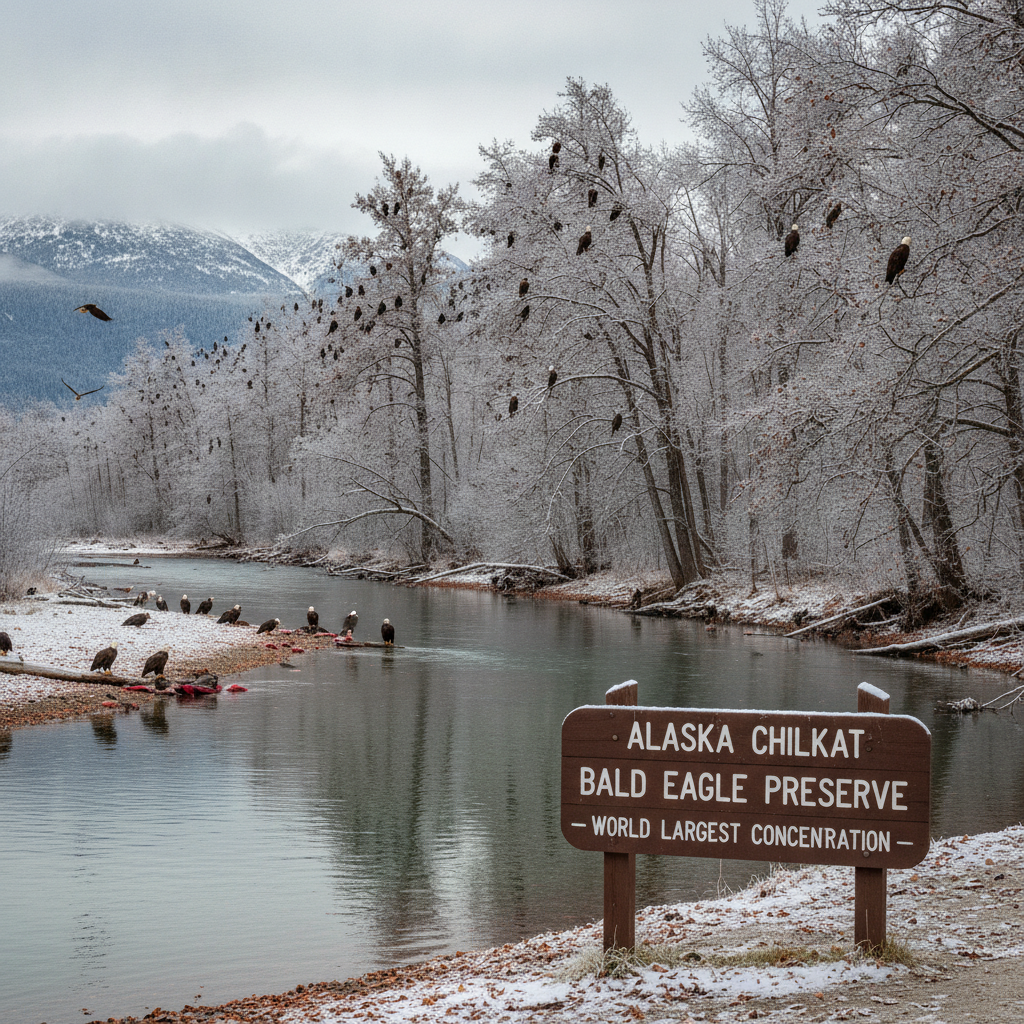
Haines, Alaska (at 122 Main Street, Haines, AK, 130 km north of Juneau by ferry, at the confluence of the Chilkat Inlet and Lutak Inlet): the small community of 2,600 at the northern tip of the Inside Passage and the head of the Chilkat Valley, known as the Eagle Capital of the World for the Alaska Chilkat Bald Eagle Preserve (at Mile 19-21, Haines Highway, outside Haines, AK, established 1982, 19,500 acres): the state preserve protecting the world's largest concentration of bald eagles -- the late-run chinook salmon in the Chilkat River (the river with an unusual upwelling of warm groundwater that keeps a section of the river ice-free through November-December when all other Alaska salmon rivers have frozen) attracts 3,000-4,000 bald eagles (Haliaeetus leucocephalus) from throughout the Pacific Northwest to congregate along a 5-km stretch of river in October-December, the largest single concentration of bald eagles in the world. The bald eagle (Haliaeetus leucocephalus -- literally white-headed sea eagle): the national bird of the United States (designated June 20, 1782, by the Continental Congress), with the Alaska population (approximately 30,000, the largest US population outside of British Columbia) representing the most successful bald eagle population in North America. The Bald Eagle Festival (held annually in November in Haines, the peak of the eagle concentration): the photography and birding festival drawing 800+ visitors per year to the small community, making November the second-busiest tourist month after summer. The Haines Highway (the 254-km highway from Haines north to Haines Junction, Yukon, connecting the Inside Passage to the Alaska Highway system): the only road connection between Southeast Alaska and the North American highway network south of the Alaska-Canada border at Beaver Creek, Yukon.
- 6
Juneau's Wildlife - Bears, Salmon, and the Rainforest Ecosystem
Wildlife in the Juneau area: the Tongass National Forest surrounding Juneau is one of the most productive wildlife habitats in North America, with black bears (Ursus americanus, population approximately 30,000 in Southeast Alaska, the highest density of black bears of any region in the United States), brown (grizzly) bears along the outer coast, Sitka black-tailed deer (Odocoileus hemionus sitkensis), mountain goats (Oreamnos americanus, visible on the cliff faces of Mount Juneau and Mount Roberts from downtown), bald eagles (nesting throughout the Tongass, with approximately 1 nesting pair per 5 km of coastline in Southeast Alaska -- the highest bald eagle nesting density in the world), river otters (Lontra canadensis), mink (Neovison vison), and the pine marten (Martes americana). The Mendenhall River salmon run: the salmon runs up the Mendenhall River (July-October for king, sockeye, coho, and pink salmon) are viewable from the Steep Creek trailhead at the Mendenhall Glacier Visitor Center -- the closest viewable wild salmon spawning run to a major visitor center in the United States, with bears frequently observed fishing in the creek 50-100 m from the parking lot. The Juneau black bear population: approximately 300-400 black bears range within the Juneau city limits, making Juneau-human bear conflicts more common than in any other Alaska city. Juneau homeowners practice bear-aware food storage (bear-proof trash cans are required by municipal ordinance), and bear sightings in downtown Juneau are not uncommon in late summer when bears follow the salmon runs. The rainforest ecosystem productivity: the Tongass old-growth forest produces approximately 5-10 tonnes of organic material per hectare per year -- approximately 3x the productivity of a temperate deciduous forest -- due to the combination of high rainfall, mild temperatures, and the nutrient input of decomposing salmon carcasses.
Walk this route with audio
Stories play automatically as you reach each stop — no tapping needed.
More in juneau
Juneau: Mendenhall Glacier, Alaska Capital City, Gold Rush History, Tongass Rainforest, Whale Watching, and Practical Info
Juneau: Arts and Culture, Tongass Conservation, State Museum, Rain Culture, Tracy Arm Fjord, and the Future of the Capital