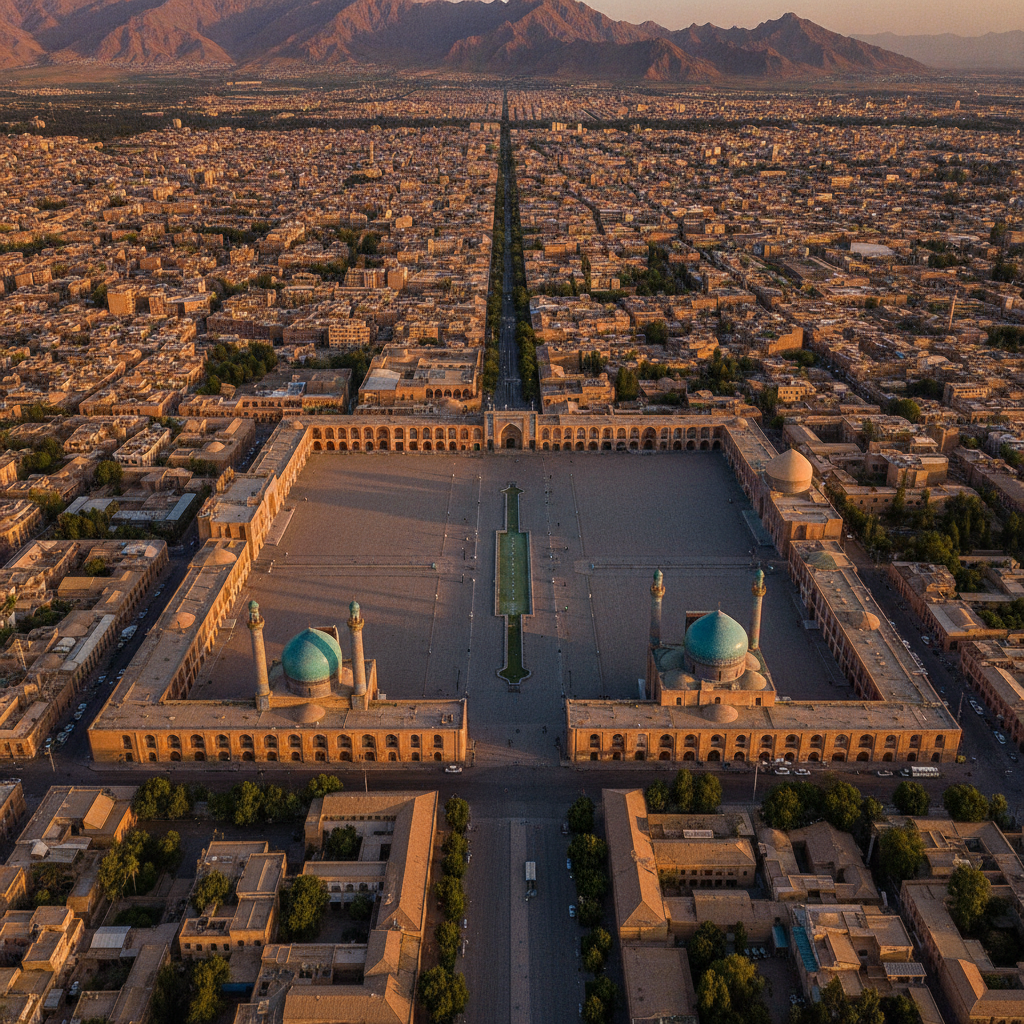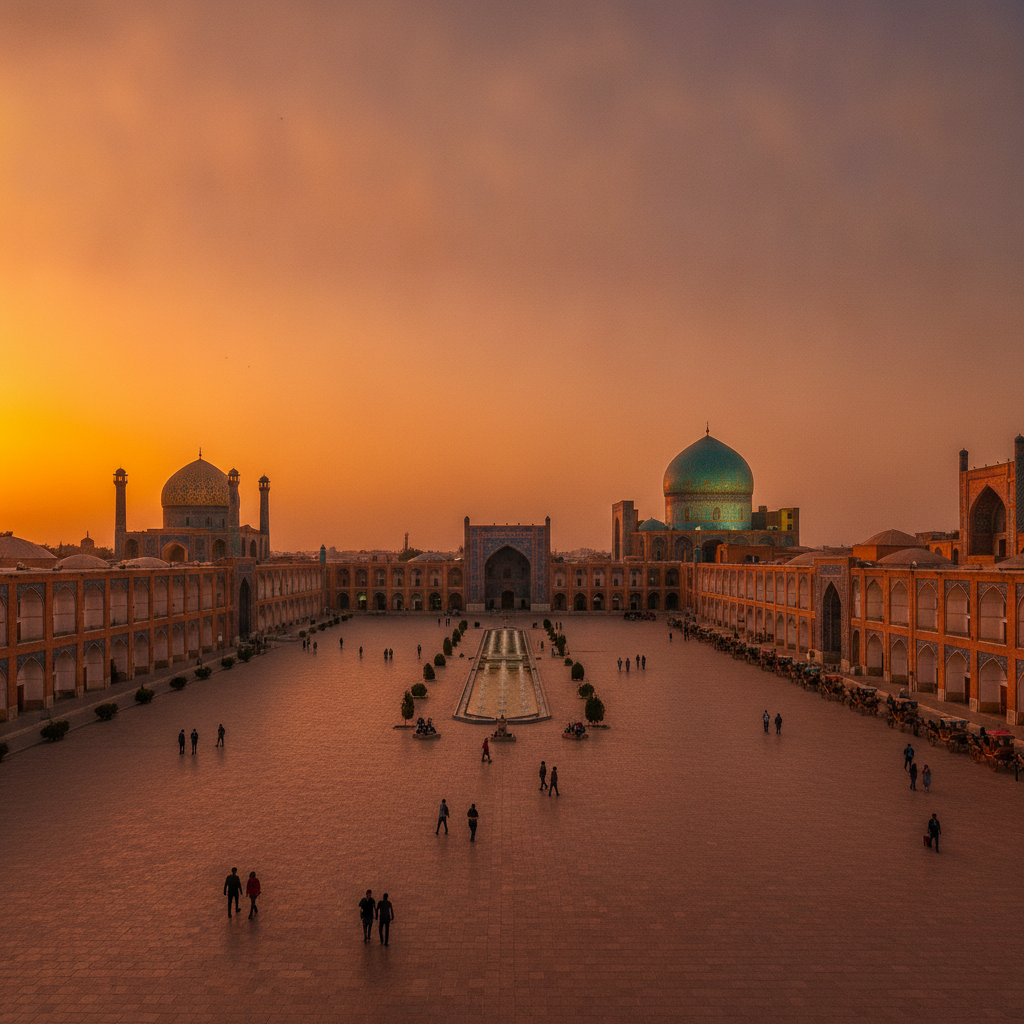
The Shah Mosque 7-Fold Echo Engineered to Amplify the Friday Sermon, the Sheikh Lotfollah Dome Changing Color from Cream to Pink Through the Day & the Naqsh-e Jahan Square Polo Goals Still Standing After 400 Years
The Shah Mosque 7-fold echo engineered by the dome geometry to amplify the Imam's Friday sermon; the Sheikh Lotfollah dome tiles shifting from cream to pink as the sun angle changes through the day; the original Naqsh-e Jahan polo goal posts (marble columns) still standing at each end of the square 400 years after Shah Abbas played polo here; the underground royal passage from Ali Qapu Palace to the Sheikh Lotfollah Mosque (the Safavid royal family never crossing the public square); the Ali Qapu music room perforated plaster niches serving as acoustic resonators for court musicians; and the 2km of thuluth calligraphy inside the Shah Mosque hand-carved by the calligrapher Alireza Abbasi.
- 1
Naqsh-e Jahan Square – The World's Second-Largest Plaza
The Naqsh-e Jahan Square heritage (the Imam Square — the greatest public space in the Islamic world and the supreme example of Safavid urban design): the square heritage guide. The square (the Naqsh-e Jahan Square (میدان نقش جهان — Image of the World Square) — renamed Imam Square (Meydan-e Imam) after the 1979 Revolution: the UNESCO inscription (the Naqsh-e Jahan Square with its surrounding monuments was inscribed on the UNESCO World Heritage List in 1979 — the first Iranian site inscribed: the dimensions (the square is 512m long and 163m wide — an area of 89,600m²: the second-largest public square in the world after Tiananmen Square in Beijing (440,000m²): the Safavid construction (Shah Abbas I (r. 1588–1629) designed the square as the centerpiece of his new Isfahan capital from 1598: the square was completed approximately 1629: the surrounding monuments (the four primary monuments surrounding the Naqsh-e Jahan: (1) the Shah Mosque (Masjed-e Imam) on the south side; (2) the Sheikh Lotfollah Mosque on the east side; (3) the Ali Qapu Palace on the west side; (4) the Qaysariyeh Portal (the main gateway to the Grand Bazaar) on the north side: the polo field (the Naqsh-e Jahan Square was designed and used as a polo field (chougan) — the stone goal posts at each end of the square (the marble columns at the two narrow ends) are the original polo goals — Shah Abbas played polo in the square and spectators watched from the Ali Qapu Palace terrace).
- 2
The Shah Mosque – Summit of Persian Architecture
The Shah Mosque heritage (the supreme masterpiece of Persian mosque architecture — the crowning achievement of the Safavid dynasty's 130-year building program in Isfahan): the mosque heritage guide. The mosque (the Masjed-e Shah (Shah Mosque — now called Masjed-e Imam (Imam Mosque) since 1979) on the south side of Naqsh-e Jahan Square: the construction (the mosque was built by Shah Abbas I between 1611 and 1629 — the design was by the master architect Ali Akbar Isfahani: the mosque required 18 years of construction with 18 million bricks and 475,000 painted tiles: the design problem (the Shah Mosque faces a famous orientational problem: the Naqsh-e Jahan Square is oriented northwest-southeast: the mosque must face Mecca (southwest) — the solution was an entrance vestibule angled 45 degrees between the square axis and the Mecca axis: the dome (the main dome of the Shah Mosque: height 42m above the prayer hall floor: the dome is a double dome (an inner dome over the prayer hall and an outer dome visible from the exterior): the tile acoustics (the dome acoustic system: the acoustic focal point directly beneath the center of the dome creates a 7-fold echo — the Imam's voice speaking a single word echoes 7 times around the dome before fading — the effect was designed for the amplification of the Friday sermon: the calligraphy (the primary calligraphic element of the Shah Mosque is the 2km of cursive thuluth calligraphy banding the interior walls — the inscription is the text of the Quran (the Al-Jumu'ah Surah) by the calligrapher Alireza Abbasi).
- 3
Sheikh Lotfollah Mosque – The Private Royal Chapel
The Sheikh Lotfollah Mosque heritage (the private royal mosque of the Safavid court — the most refined and intimate mosque interior in the Islamic world): the mosque heritage guide. The mosque (the Masjed-e Sheikh Lotfollah (Mosque of Sheikh Lotfollah) on the east side of the Naqsh-e Jahan Square — built by Shah Abbas I between 1603 and 1619 (8 years before the Shah Mosque was begun): the name (the mosque is named for Sheikh Lotfollah Maysi al-Ameli — the Lebanese Shia theologian brought to Isfahan by Shah Abbas to serve as his private religious advisor: the unique characteristics (the Sheikh Lotfollah Mosque differs from most Persian mosques in two important ways: (1) no minaret (the mosque has no minaret — it served as a private royal chapel not a congregational mosque — the call to prayer was not given here): (2) no courtyard (the mosque has no internal courtyard — the prayer hall is entered directly through the portal — a unique plan in Persian mosque architecture): the dome (the dome of the Sheikh Lotfollah Mosque: the exterior of the dome is covered in cream-colored tiles with an elaborate arabesque pattern in blue and black that changes color from cream to pink as the sun angle changes through the day: the interior dome (the interior dome is covered with the most elaborate tier-upon-tier muqarnas vaulting in Iran: the 16 windows in the drum below the dome fill the interior with a filtered golden light that changes quality through the day): the underground passage (the original royal access to the mosque was through an underground passage from the Ali Qapu Palace — the Safavid royal family entered the mosque directly from the palace without crossing the public square).
- 4
The Ali Qapu Palace – Safavid Royal Power
The Ali Qapu Palace heritage (the Safavid royal palace on the west side of Naqsh-e Jahan Square — the primary surviving monument of Safavid court architecture): the palace heritage guide. The Ali Qapu (the Ali Qapu (Ali Qapu — عالی قاپو — the Supreme Gateway): the palace is a 6-story structure built in stages between 1597 and 1660: the gateway (the name Ali Qapu refers to the palace's function as the gateway to the royal precinct — the palace forms the principal entrance to the royal garden and palace complex behind the square): the talar (the primary architectural feature of the Ali Qapu is the elevated talar (columned terrace or veranda) at the 3rd floor level: the talar is supported by 18 wooden columns with mirror-decorated column bases: the talar was the primary throne room and outdoor reception space of the Safavid court — Shah Abbas I held his ceremonial receptions on the talar with the Naqsh-e Jahan Square below: the music room (the most extraordinary interior space of the Ali Qapu is the music room (6th floor): the ceiling and upper walls are entirely covered with carved plasterwork (ganch) in the form of perforated niches (chini-khaneh) — the cut plaster niches are shaped like vases, wine glasses, and vessels and are arranged in intricate repeating patterns: the acoustic function (the perforated plaster niches serve as acoustic resonators and sound diffusers — the music room was designed specifically for the Safavid court musicians who performed for the Shah during the polo games and court receptions on the talar below).
- 5
The Isfahan Grand Bazaar – The Safavid Commercial Engine
The Isfahan Grand Bazaar heritage (the Bazar-e Bozorg-e Isfahan — the historical bazaar that served as the commercial engine of the Safavid Empire): the bazaar heritage guide. The bazaar (the Isfahan Grand Bazaar (Bazar-e Bozorg — بازار بزرگ) extends from the Naqsh-e Jahan Square northward through the old city: the length (the bazaar main arcade (the primary covered arcade connecting Naqsh-e Jahan to the old city congregational mosque) is approximately 2 km: the structure (the bazaar is organized in timcheha (covered arcade sections) and sara (larger domed caravanserai spaces): the Safavid period (the Isfahan Grand Bazaar was the primary commercial center of the Safavid Empire at its peak (early 17th century): the bazaar generated the tax revenue that funded Shah Abbas's building program including the Naqsh-e Jahan Square monuments: the specialized bazaars (the Isfahan Grand Bazaar is organized by commodity: the Bazar-e Zargarha (the gold and jewelry section): the Bazar-e Mesgarha (the copper section — the most atmospheric section of the Isfahan bazaar with the sound of hammering copper and the smell of metalwork): the Bazar-e Qalishooyanha (the carpet washing section): the Qaysariyeh Portal (the entrance gate from the Naqsh-e Jahan Square into the bazaar — the muqarnas portal of the Qaysariyeh was built in 1619 by Shah Abbas I — the paintings above the portal spandrels show Shah Abbas hunting and scenes of the Battle of Chaldiran (1514): the Timcheh-ye Hakim (the domed caravanserai at the mid-point of the bazaar — the finest surviving example of a Safavid commercial caravanserai interior).
- 6
Isfahan Practical Guide – Half the World in 2 Days
The Isfahan practical travel guide (the logistics and planning information for visiting Isfahan — the most architecturally significant city in Iran and one of the most important UNESCO Heritage destinations in Asia): the practical guide. The location (Isfahan (Esfahan — اصفهان) is 400 km south of Tehran: the transport (the primary connection from Tehran: the VIP bus from Tehran South Terminal (Payan-e Mosafarat-e Jonub) to Isfahan — 5–6 hours — departs approximately every 30 minutes from 07:00 to 22:00: the fare IRR 3,000,000–5,000,000 (USD 4–7 at the unofficial rate): the train: the Tehran-Isfahan Express (7 hours): the airplane: Iran Air and Mahan Air fly Tehran to Isfahan (45 minutes) — the fare approximately IRR 5,000,000–10,000,000 (USD 7–14)): the accommodation (the primary accommodation areas in Isfahan: the Naqsh-e Jahan area (hotels and guesthouses within walking distance of the square — the most convenient location): the traditional hotels (the Abbas Hotel — the most famous hotel in Isfahan — a former Safavid caravanserai converted to a luxury hotel): the budget options (the Si-o-se Pol guesthouse area near the bridges — the cheapest accommodations in Isfahan at USD 10–15 per night): the 2-day circuit (Day 1 — the Naqsh-e Jahan Square monuments (the Shah Mosque + Sheikh Lotfollah Mosque + Ali Qapu Palace — allow 5 hours total): the Grand Bazaar: the Darb-e Imam shrine: Day 2 — the Armenian quarter (Jolfa), the Safavid bridges (Si-o-se Pol and Khaju Bridge), the Chehel Sotun Palace, the Jameh Mosque of Isfahan (UNESCO), and the Imam Mosque (a second visit for the afternoon light on the dome tiles): the dress code (women must wear a headscarf and a covering coat (manteau) — the dress code is enforced more strictly in Isfahan than in Tehran).
Walk this route with audio
Stories play automatically as you reach each stop — no tapping needed.
More in Isfahan
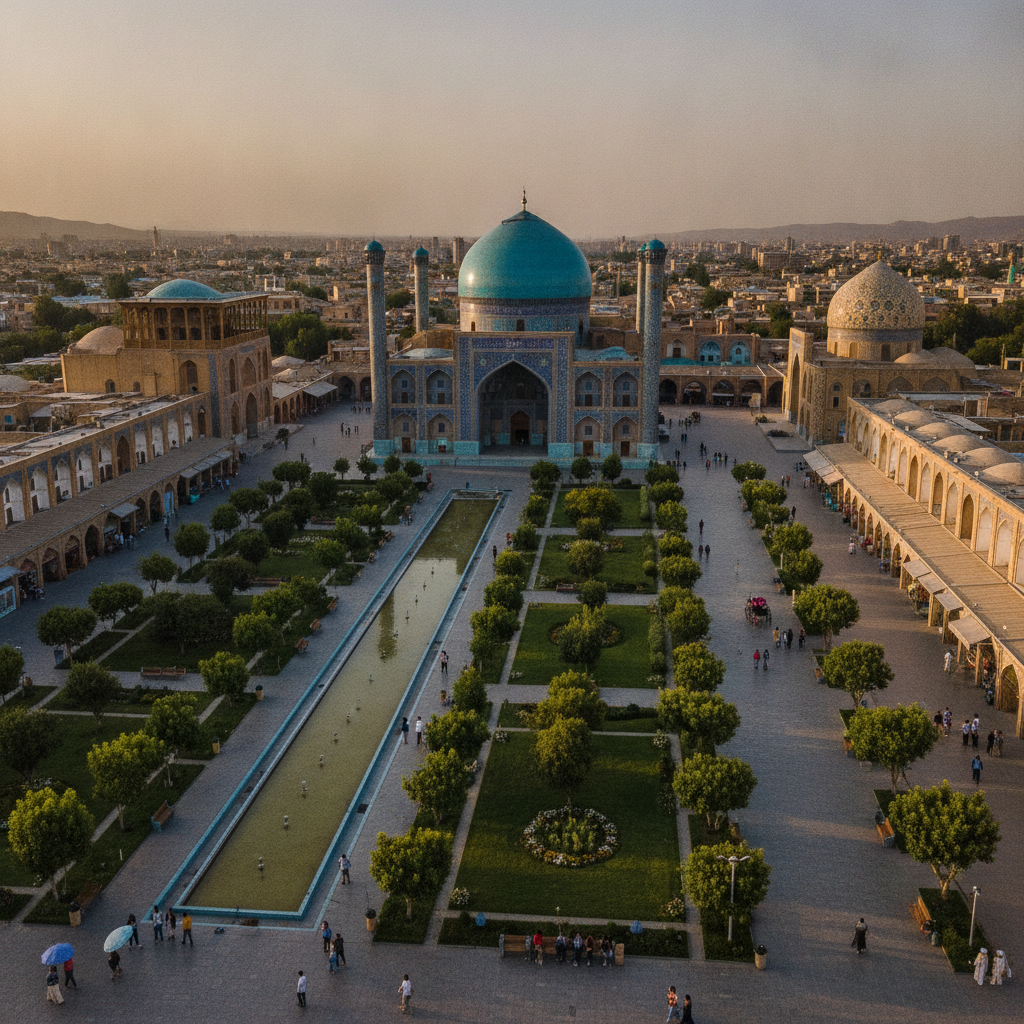
Isfahan Essential: Naqsh-e Jahan Square, the Imam Mosque, Ali Qapu Palace, the Zayandeh River Bridges, and the Most Beautiful Single City in the Islamic World
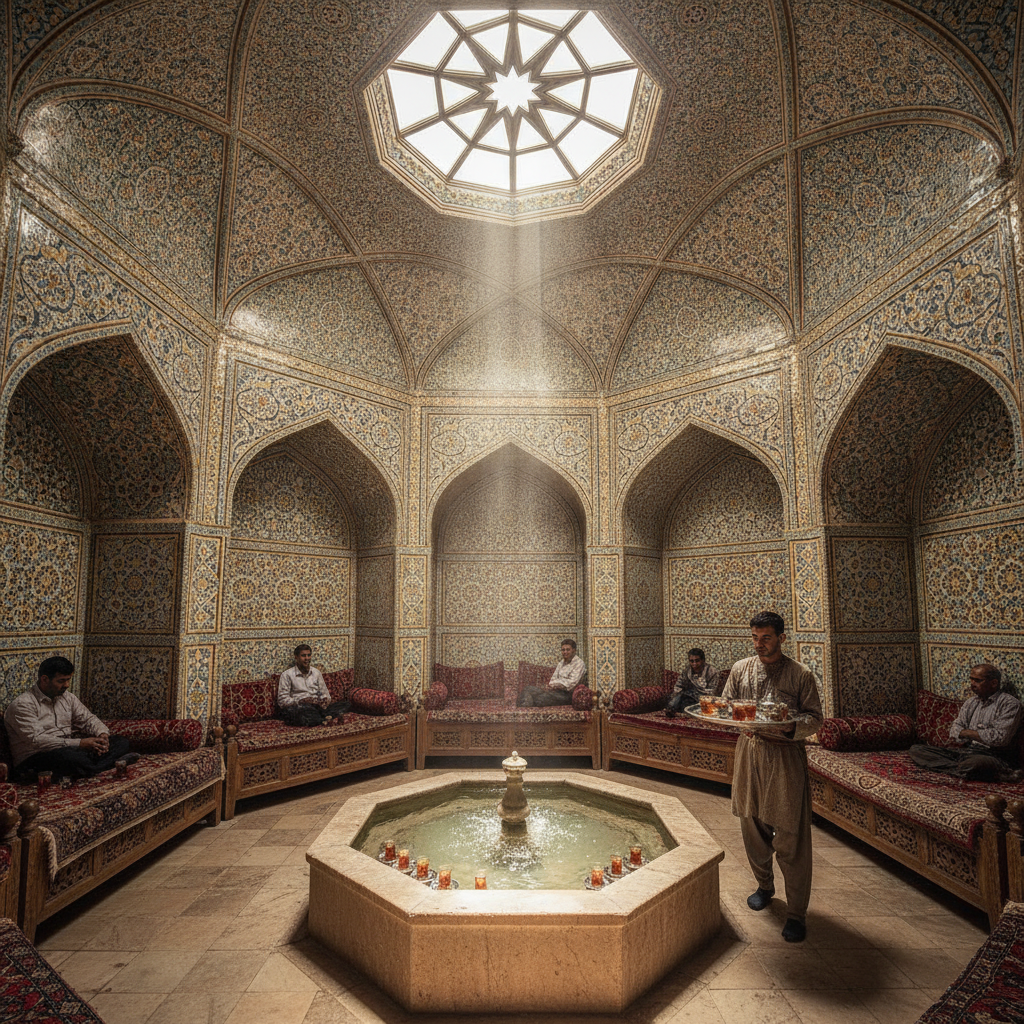
The Julfan Armenian Trading Network Extending from Manila to Amsterdam as the Most Geographically Extensive Private Network in the Pre-Modern World, Mulla Sadra Teaching the Philosophy That Still Dominates Qom Seminaries & the Persian Qanat Delivering Water by Gravity Through 40km of Underground Tunnels
Isfahan Arts: The Miniature Painting, Tile-Making, the Artisan Workshops, the Traditional Crafts, and the Most Comprehensively Craft-Rich Single Iranian City
Isfahan Food: The Persian Cuisine, Dizi Lamb Stew, Beryani, Zereshk Polo, and the Most Historically Refined Single Persian Culinary Tradition