Lantau Island: Big Buddha, Ngong Ping 360 Cable Car & Po Lin Monastery
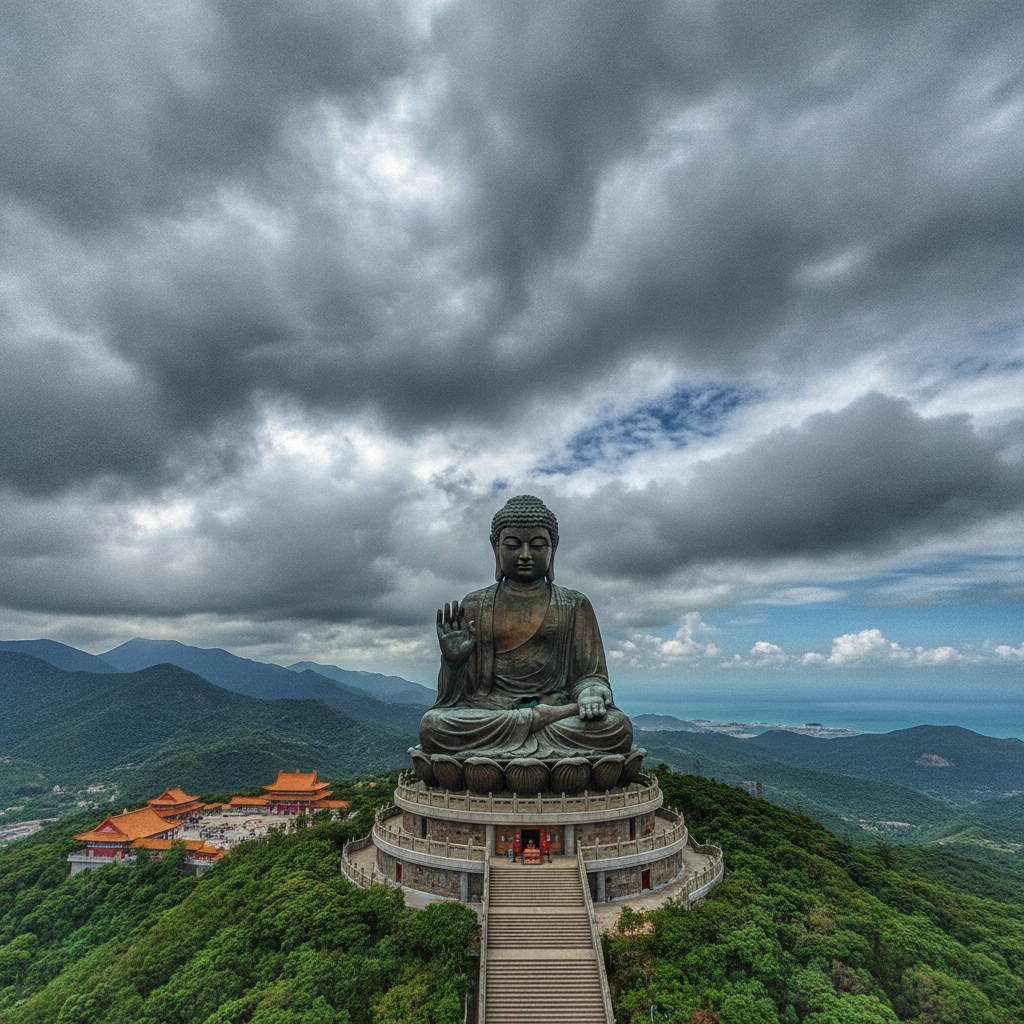
The Tian Tan Buddha on Lantau Island — at 34 metres the world's largest outdoor seated bronze Buddha, completed in 1993 after 12 years of construction — presides over the Ngong Ping plateau from atop 268 steps, visible from Macau on clear days. The journey by Ngong Ping 360 cable car (5.7 kilometres, the longest bi-cable gondola in Asia) across the mountains and harbour of Lantau Island is itself one of the most dramatic approaches to any monument in Asia.
- 1
Tung Chung MTR & Cable Car Base Station (Ngong Ping 360)
The Tung Chung MTR Station (Tung Chung Town Centre, Lantau Island, one of the few areas of Hong Kong built essentially from scratch on reclaimed land as part of the Airport Core Programme of 1989-1998: Tung Chung New Town was constructed simultaneously with the construction of Hong Kong International Airport at Chek Lap Kok, opening in 1998 as a planned community designed to house 200,000 people working at and around the new airport; the current population is approximately 87,000) — adjacent to the Ngong Ping 360 Cable Car Base Station (Tung Chung Terminal, the lower terminus of the Ngong Ping 360 gondola system, which opened on 18 September 2006 after an original construction period of three years; the system uses a 5.7-kilometre bi-cable gondola system — the second longest in Asia — that rises 500 metres above sea level from Tung Chung Bay to the Ngong Ping plateau in 25 minutes, passing directly over the Tung Chung Bay shipping lanes, the runway approaches of Hong Kong International Airport at Chek Lap Kok, and the forested mountain ridges of Lantau Country Park; the cable car was closed for major maintenance from December 2007 to June 2009 and has operated with crystal-cabin transparent floor gondolas since 2013).
- 2
Ngong Ping Village & Po Lin Monastery (1906/1924)
Ngong Ping Village (Ngong Ping Plateau, Lantau Island, the purpose-built tourism complex adjacent to the Po Lin Monastery, developed as a cultural theme park with recreations of Chinese architectural styles, teahouses, a walking with Buddha attraction, and various food and retail establishments, opened in September 2006 simultaneously with the Ngong Ping 360 cable car, located at an elevation of 500 metres above sea level on the western flank of Lantau Island in an area that was historically occupied by the monks of the Po Lin Monastery and the small community of Chan Buddhist practitioners who had followed the founding monks from the mainland) — adjacent to the Po Lin Monastery (Po Lin Monastery, Ngong Ping, Lantau, founded in 1906 by three Chan Buddhist monks — Yuet Kai, Yuet Ming, and Yuet Shou — who arrived from Jiangsu Province and established a small hermitage called 大茅蓬 (Big Thatched Shelter) at Ngong Ping; the monastery was formally established in 1924 under the name Precious Lotus Monastery (Po Lin) and has grown into the largest Buddhist monastery in Hong Kong; the main temple buildings (in the traditional Chinese Buddhist temple architectural style with red columns, green tiled roofs, and elaborate ridge decorations) were reconstructed in the 1970s and 1980s; the monastery operates a large vegetarian restaurant and guest accommodation for pilgrims).
- 3
Tian Tan Buddha (Giant Buddha) — 268 Steps (1993)
The Tian Tan Buddha (天壇大佛, Ngong Ping, Lantau Island, completed on 29 December 1993 after 12 years of construction beginning in 1981 under the direction of the China Aerospace Science and Technology Corporation — the same organization responsible for the Chinese space program, whose engineers were recruited for their expertise in casting large bronze structures; the statue is 34 metres tall (including its lotus throne, 26.4 metres for the seated figure alone), weighs 202 metric tonnes (including the staircase and supporting structure), and is the world's largest outdoor seated bronze Buddha — the largest outdoor seated bronze Buddha in the world, a record previously held by the Kamakura Great Buddha in Japan (11.4 metres) by a factor of more than three; the statue faces north towards the Chinese mainland; the lotus throne upon which the Buddha sits rests on a three-layered altar structure that contains a museum, a Buddhist art gallery, and six smaller bronze statues called 'Offering of the Six Devas' that ascend the 268 steps bearing gifts to the Buddha; the face of the statue was reportedly modelled on the features of a monk from the Shaolin Monastery who was known for his beatific expression) — reached by climbing the 268 steps of the ceremonial staircase (equivalent to a 20-storey building in height; despite the step count, the climb is accessible to most visitors in 15-20 minutes and offers progressively expanding views of the Ngong Ping plateau, the South China Sea, Tung Chung Bay, and on clear days the towers of Macau 60 kilometres distant across the Pearl River Delta).
- 4
Wisdom Path — Heart Sutra Columns (2005)
The Wisdom Path (Heart Sutra Columns, Ngong Ping, Lantau Island, inaugurated on 29 June 2005, the creation of Professor Jao Tsung-i, the foremost Chinese classical scholar of the 20th century, a polymath who was equally distinguished as a calligrapher, painter, musicologist, Sinologist, and poet; the installation consists of 38 wooden columns made from Hong Kong Incense Tree timber, arranged in an infinity-symbol (∞) pattern on a hillside overlooking the Tian Tan Buddha and the South China Sea; the columns bear the full text of the Heart Sutra — the most widely recited Buddhist scripture in the Chinese, Japanese, Korean, and Vietnamese Buddhist traditions, a 260-character distillation of the Prajna Paramita (Perfection of Wisdom) scriptures — carved in Professor Jao's calligraphy; the columns range in height from 8 to 10 metres; the tallest column at the centre of the infinity symbol is blank, symbolising the Buddhist concept of sunyata (emptiness) that is the central teaching of the Heart Sutra; the path encircling the columns takes approximately 20 minutes to walk and provides the most contemplative and visually spectacular walk on Lantau Island outside the cable car).
- 5
Lantau Trail & Sunset Peak (869m) / Lantau Peak (934m)
The Lantau Trail (a 70-kilometre circular hiking trail traversing the length and breadth of Lantau Island, divided into 12 sections ranging in difficulty from easy coastal walks to challenging mountain climbs, passing through Lantau Country Park — which at 15,200 hectares covers 43% of Lantau Island and is the largest country park in Hong Kong; the most popular sections of the trail include Section 3 (Pak Kung Au to Lantau Peak, 4.5 km, 1.5-2.5 hours, ascending Lantau Peak — 934 metres, the second highest peak in Hong Kong — from which the entire airport, the Tsing Ma Bridge, and on clear days Guangzhou can be seen) and Section 4 (Lantau Peak to Mui Wo, 7.5 km, 2.5-3.5 hours); Sunset Peak (869 metres, the third highest peak in Hong Kong) offers the most famous sunset view in Hong Kong — from the ridge between Sunset Peak and Lantau Peak, the sunset over the South China Sea and Pearl River Delta is considered by serious hikers to be one of the finest anywhere in East Asia; the Lantau Trail can be joined from the Ngong Ping plateau at several points and is the backbone of trekking activity on Lantau Island).
- 6
Tai O Fishing Village — Hong Kong's 'Venice of the Orient'
Tai O Fishing Village (Tai O, western Lantau Island, the oldest continuously inhabited settlement in the New Territories — with evidence of human habitation dating to the Song Dynasty (960-1279 AD) and references in imperial records to a salt production industry here from the Tang Dynasty — and the most distinctive traditional village in Hong Kong: Tai O is built on a small island and on the banks of a tidal creek, connected to the mainland of Lantau Island by a rope-pull ferry (the last manually operated rope-pull ferry in Hong Kong, operated by the Tai O police station for decades before being handed over to a community cooperative) that was replaced by a bridge in 1996 against the wishes of the village residents; the village is famous for its stilt houses (鋅棚 and 棚屋, corrugated iron and wood houses built on stilts over the tidal creek and the adjacent harbour — the last surviving example of this style of vernacular Hong Kong fishing village architecture, which was once common throughout the territory) and for shrimp paste production (虾酱, Tai O shrimp paste is regarded as the finest in Hong Kong and has been produced here for at least 200 years using the same basic process: salted shrimp fermented in large jars for six months, then dried in the sun on trays in the village — the smell in summer is unforgettable); the village can be reached by bus from Ngong Ping or Tung Chung, or by ferry from Central.
Walk this route with audio
Stories play automatically as you reach each stop — no tapping needed.
More in hongkong
Star Ferry, Tsim Sha Tsui Waterfront & Victoria Harbour: The Soul of Hong Kong
Victoria Peak, Peak Tram & Central: Hong Kong's Defining Panorama
Mong Kok: Ladies' Market, Goldfish Market, Flower Market & Bird Garden
Cheung Chau & Lamma Island: Hong Kong's Car-Free Outlying Islands
Central, SoHo & the Mid-Levels Escalator: Hong Kong's Vertical City