Ha Long Bay: 1,969 Islands from 350-Million-Year Coral Reefs, the Cave That Stored Mongol-Fleet-Defeating Wooden Stakes & the 1,600 Floating Village Residents Relocated by UNESCO Management
The limestone tower karst's 20-million-year tropical dissolution and the sea level rise 10,000 years ago that drowned the base of the towers creating the present bay; Hang Dau Go's wooden stakes General Tran Hung Dao used in 1288 to impale Kublai Khan's Mongol invasion fleet at low tide; the 6 floating village communities dismantled by provincial government between 2014–2018 as the environmental impact of raw sewage was deemed incompatible with World Heritage status; the Hang Luon hollow island's 2-hectare internal lagoon accessible by kayak through a 50-metre cave; the Cat Ba langur with 60–70 individuals remaining as the most critically endangered primate in Asia; and the seaplane approach from Hanoi at USD 200–300 as the most spectacular arrival in Vietnamese tourism.
- 1
The Limestone Karst Landscape – Geology of 1,969 Islands
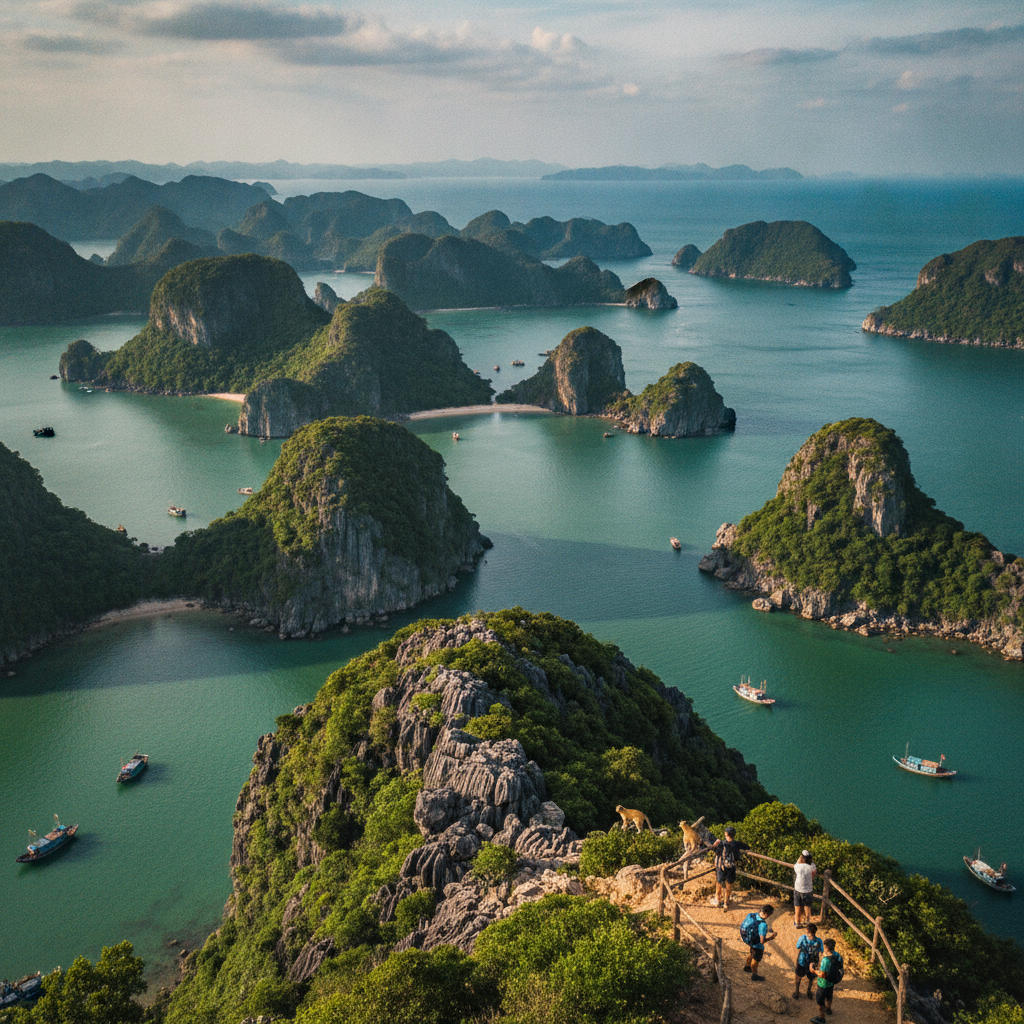
Ha Long Bay (the UNESCO World Heritage Site inscribed in 1994 and extended in 2000; a 1,553 km² sea area in Quảng Ninh province, northeastern Vietnam, containing 1,969 islands and islets of which 989 are named) is the most spectacular limestone karst seascape on Earth—the combination of the scale (1,969 towers rising from the sea), the height (some islets rising 100+ metres from the water), and the variety of forms (hollow caves, beaches, floating villages, and arches) creates a landscape that exceeds the expectation set by photographs. The geology: the Ha Long Bay limestone was deposited during the Carboniferous and Permian periods (350–250 million years ago) as coral reef accumulations in a tropical shallow sea; subsequent tectonic uplift raised the limestone above sea level; 20 million years of tropical weathering (karst dissolution by slightly acidic rainwater dissolving calcium carbonate) created the tower karst forms; the last glacial sea level rise (ending approximately 10,000 years ago) flooded the base of the towers, creating the present bay. The towers: each individual island is the remnant of a larger limestone plateau, now isolated by the dissolution of the surrounding rock; the towers are characterised by overhanging cliff bases (the result of wave erosion at the former sea level), vertical to overhanging walls (the result of the solution weathering pattern in tropical limestone), and flat vegetation on top (the karst plateau remnant).
- 2
The Overnight Cruise – Junk Boat Accommodation & the Bay at Dawn
The overnight cruise on Ha Long Bay—sleeping on a junk boat (the Vietnamese traditional wooden sailing vessel, now motorised but retaining the distinctive profile of the multiple-masted junk) anchored in a quiet bay between the karst towers—is the most essential Ha Long Bay experience: the day trip (accessible from Hanoi by 4-hour bus) provides the landscape overview, but the overnight cruise provides the experience of the bay at dawn (the hour before the day boats arrive—a genuine silence between the towers broken only by the fishing boats) and the experience of the dark sky (the absence of light pollution in the middle of the bay). The cruise market: approximately 500 boats operate on Ha Long Bay across all quality levels (the budget overnight cruise: USD 60–100/person for 2 days/1 night; the mid-range: USD 100–200/person; the luxury: USD 200–600+ for 3 days/2 nights on vessels with private cabin bathrooms, kayaks included, and gourmet Vietnamese meals). The Bai Tu Long Bay alternative: the adjacent Bai Tu Long Bay (the eastern continuation of the Ha Long Bay karst system, outside the World Heritage boundary—less regulated, fewer tourist boats, comparable landscape quality) is consistently recommended by the Ha Long Bay cruise operators themselves as the better overnight cruise experience for visitors who have already been to Ha Long Bay.
- 3
The Caves of Ha Long Bay – Hang Sung Sot & Hang Dau Go
The caves of Ha Long Bay—hollowed into the limestone islands by the combination of the wave erosion at the base and the dissolution weathering of the cave passages—are among the largest and most visited sea caves in the world: Hang Sung Sot (the Cave of Surprises—on Bo Hon Island, 25 km from Ha Long City; the largest cave on Ha Long Bay, with three chambers totalling 10,000 m²; discovered by the French colonial administration in 1901 and named by them 'Grotte des Surprises'; the stalactites and stalagmites are now illuminated with coloured theatrical lighting); Hang Dau Go (the Cave of the Wooden Stakes—on Dau Go Island; named for the wooden stakes stored here by General Tran Hung Dao in 1288 before the Battle of Bach Dang River, where he used the stakes to impale the Mongol fleet of Kublai Khan's invasion force at low tide). The Thien Cung cave (the Heavenly Palace Cave—on Dau Go Island, discovered by Ha Long fishermen in 1993—the most recently discovered major cave, with the most intact speleothem formations and the most dramatic internal space; the ceiling domes to 30 metres; the stalactite curtains are the most photogenic of any Ha Long Bay cave). The cave tourism management: the three major caves are all accessible by short walking path from the boat dock; each is visited by 500–1,000 people per day in peak season; the combination of the tourist traffic and the theatrical lighting has altered the cave environments (the LED lighting promotes algae growth on the speleothems—a documented degradation effect).
- 4
Ha Long Bay's Floating Villages – The Vung Vieng Community
The floating fishing villages of Ha Long Bay—communities of families living on wooden floating houses anchored between the karst towers, dependent on fishing and aquaculture for their livelihood—are the most distinctive human element of the Ha Long landscape and the most socially complex aspect of the bay's management. The villages: Ha Long Bay had approximately 1,600 people living in 6 floating village communities as of 2014 (Cua Van, Ba Hang, Vung Vieng, Cong Dam, Vong Vieng, and Ba Tri); all 6 villages were dismantled by the Quảng Ninh provincial government between 2014 and 2018 as part of the UNESCO World Heritage management plan, which identified the environmental impact of the floating households (raw sewage, fish farm effluent, and waste disposal directly into the bay water) as incompatible with the World Heritage status. The relocation: the village communities were relocated to purpose-built onshore housing in the Cua Van and Ha Phong areas; the relocation was controversial—the communities lost their fishing grounds, their social networks, and the way of life that had been their identity for generations; the fishing income has not been replaced by equivalent employment onshore. The tourism legacy: the empty floating village sites are now visited by cruise boats as 'heritage sites'; the kayak tour through the area where the communities once lived; the Vung Vieng village (the one floating village that has been preserved as a heritage tourism demonstration site rather than being dismantled) is the most frequently visited 'floating village' by cruise boats.
- 5
Kayaking Ha Long Bay – Hidden Lagoons & Sea Caves
The kayaking experience of Ha Long Bay—paddling through the water passages between the karst towers, entering the hidden lagoons through low cave entrances (requiring a low-tide crossing in some cases), and navigating the internal water spaces of the hollow islands—is consistently rated by visitors as the most memorable single experience available in the bay. The kayak geography: the hollow islands of Ha Long Bay (islands whose interior has been dissolved by cave formation, leaving a lagoon accessible through a cave in the cliff base) are the principal kayak destinations; the largest accessible hollow island is the Hang Luon (accessible through a 50-metre cave at low tide—the internal lagoon is 2 hectares, surrounded by vertical limestone walls rising to 150 metres, with monkeys visible on the ledges). The sea kayak routes: the standard cruise itinerary includes one 90-minute kayak session (included in most mid-range and luxury cruise packages); the independent kayak option (some cruise operators allow guests to kayak freely rather than in guided groups) allows more time in the lagoon interiors. The Ti Top Island: the man-made beach on Ti Top Island (a small island 8 km from Ha Long City; the beach is artificial—the sand was brought in for the tourist facility that has operated since the 1990s; accessible by the day cruise boats; 450 steps to the island summit for the best panoramic view of the surrounding karst towers).
- 6
Practical Ha Long Bay – From Hanoi Access to Cat Ba Island
Getting to Ha Long Bay: the standard route from Hanoi (the most logical base for Ha Long Bay access): the cruise bus (most operators run a direct bus from Hanoi hotels to Ha Long City pier—4–5 hours by road, 160 km; the new expressway (opened 2018) reduced the journey from 6–7 hours to 4–4.5 hours); the seaplane (Hai Au Aviation operates a 45-minute seaplane from Hanoi to Tuan Chau Island pier—USD 200–300 one way, the most spectacular approach to the bay). Getting around the bay: the cruise boat (the only way to explore the outer bay); the speedboat day trip from Ha Long City (for visitors on a tight schedule—reaches the main sites in a 5-hour day trip but misses the dawn and dusk moods). Cat Ba Island (the largest island in Ha Long Bay—354 km², with the Cat Ba National Park protecting its tropical forest interior; accessible by speedboat from Ha Long City in 45 minutes or by ferry from Haiphong in 1.5 hours): the best base for independent (non-cruise) exploration of the bay, with accommodation from USD 10 hostels to USD 150 resort hotels; the Cat Ba national park (established 1986) protects the Cat Ba langur (Trachypithecus poliocephalus—one of the world's rarest primates, with approximately 60–70 individuals remaining, the most critically endangered primate in Asia). When to visit: September–November and March–May (the transitional seasons with the best visibility and the calmest sea conditions); avoid January–February (the drizzle fog season—the mist is atmospheric but visibility can be poor for photography).
Walk this route with audio
Stories play automatically as you reach each stop — no tapping needed.
More in Ha Long Bay

Ha Long Bay's Daily Cycle: The 05:30 Tai Chi Deck, the Stone Beach Limestone Pebbles Between Vertical Karst Walls & the 10-Million-Year Geological Reckoning on the Drive Back to Hanoi
Ha Long Bay's Hidden Layers: Nixon Mining Haiphong Harbour in 1972, Akoya Pearls at 40% Below Japanese Prices & the Dragon Mother Legend That Explains Every Island You're Looking At
Ha Long Bay's Uncomfortable Truths: 500 Diesel Cruise Boats in a UNESCO Heritage Zone, the Dugong Functionally Extinct Since 2010 & the 1288 Battle That Repelled Kublai Khan's Third Invasion
Ha Long Bay Versus the World: 1,969 Islands Against Phang Nga Bay's 42, the 1992 Indochine Oscar That Built the Bay's European Reputation & the Month-by-Month Guide That Actually Matters