The 2,240-Year Canal That Made China's Southern Conquest Possible, the Li River Otters Nobody Talks About & the Shadow Puppets Made From Paper at the Same Temperature as the Han Dynasty
The Lingqu Canal's 219 BCE construction as the oldest operational navigational canal in the world; the fish-mouth water divider using the same centrifugal engineering principle as the later Dujiangyan but predating it by 37 years; the crested ibis recovery from 2 individuals in 1981 to 11,000 in 2023 as the most successful bird conservation in Asia; the smooth-coated otter as the rarest mammal in the Guilin region; the Yangshuo bamboo paper using the Tang Dynasty wet-press method unchanged; and the Nanning-Hanoi overnight train as the most atmospheric border crossing accessible from Guilin.
- 1
Guilin's Ancient City History
Guilin's history before the karst landscape became its primary identity (the city that served as the regional capital of Guangxi for most of its 2,100-year history): the political and architectural history beneath the tourist surface. The city's founding (Guilin was established as a Qin Dynasty military garrison in 214 BCE by the Qin general Zhao Tuo (赵佗) during the conquest of the Lingnan (south of the mountains) region): the Lingqu Canal (灵渠—the Qin Dynasty canal connecting the Xiang River (flowing north to the Yangtze) with the Li River (flowing south to the Pearl River)—the canal was dug in 219 BCE by the Qin commander Shi Lu under Zhao Tuo's supervision): the Lingqu Canal (located 57 km northeast of Guilin) is the oldest functioning navigational canal in the world (2,240 years old) and the engineering project that made the Qin conquest of southern China possible. The靖江王陵 (Jingjiang Prince's Mausoleum—the mausoleum of the Jingjiang Princes (the Ming Dynasty princes who ruled Guilin as their regional capital)—the most important Ming Dynasty archaeological site in Guangxi). The Jingjiang Prince City (靖江王城—the well-preserved Ming Dynasty palace complex within the modern Guilin city (now the campus of Guangxi Normal University)): the oldest and most intact Ming Dynasty palace precinct in southern China.
- 2
The Lingqu Canal – The Qin Dynasty's Southern Highway
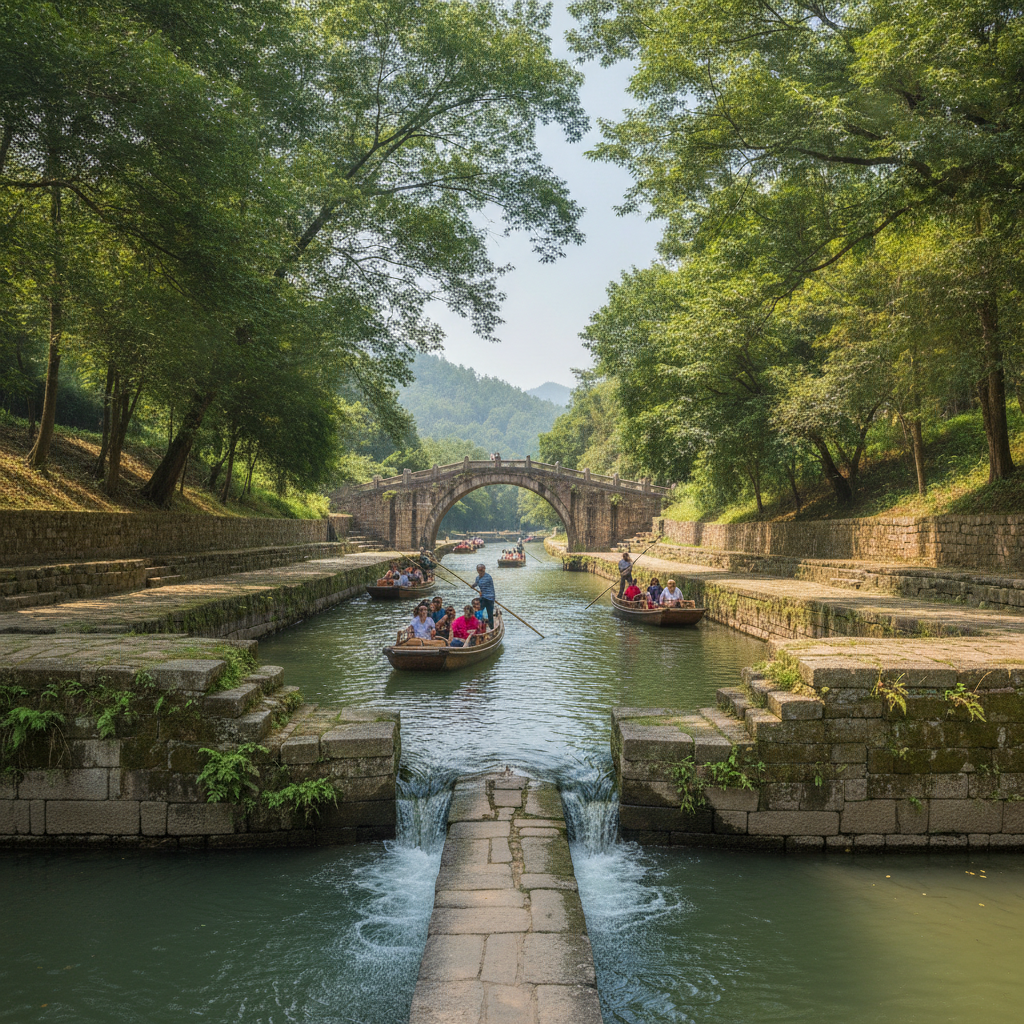
The Lingqu Canal (灵渠—'Magic Canal'—57 km northeast of Guilin near Xingan County): the most historically significant single engineering structure in the Guilin region and one of the most important pre-industrial waterways in world history. The engineering (the canal was built in 219 BCE to supply the Qin army's conquest of the Lingnan region—the army needed a water supply line from northern China (the Yangtze watershed) to southern China (the Pearl River watershed); the canal connects the Xiang River to the Li River across the Guangxi-Hunan watershed divide): the Fen Shui Yu (分水鱼嘴—'fish-mouth water divider'—the stone structure that divides the Xiang River flow 70%/30% into the Lingqu Canal and the Xiang River): the same centrifugal-force sediment-separation engineering principle later used by Li Bing at Dujiangyan (though the Lingqu Canal predates Dujiangyan by 37 years). The canal today (the 34-km main canal is still operational—the water flows from the Xiang River source through the 34-km canal channel to the Li River, bridging the continental watershed between China's 2 greatest river systems): the boat tour on the Lingqu Canal (the 45-minute punt-boat tour through the ancient canal).
- 3
From Guilin to Vietnam – The Overland Border Route
The Guilin-to-Vietnam overland route (the most used overland crossing between China and Vietnam and the historic trading route that connected the Guangxi highlands with the Red River Delta): the practical guide for travelers continuing south. The Nanning connection (Guilin to Nanning by high-speed rail: 2h10m; ¥123—the connection to the Guangxi capital and the primary gateway to the Vietnam border): the Nanning-Hanoi train (the overnight train from Nanning to Hanoi (Gia Lam Station)—16 hours, departing Nanning at 18:00): the most atmospheric international train journey accessible from Guilin. The Friendship Gate crossing (友谊关—the Pingxiang land border crossing between Guangxi and Vietnam, 180 km south of Nanning): the most historically significant border crossing in southern Asia (the gate has stood at this location since the Ming Dynasty). The alternative: the Guilin-Hanoi flight (Guilin Liangjiang Airport to Hanoi Noi Bai: approximately 2h15m, 3 weekly flights on Vietnam Airlines): the fastest connection between the Guilin karst and the Halong Bay karst (the geological continuation of the same limestone formation).
- 4
Guilin's Bamboo & Paper Heritage
The Guilin bamboo culture (the bamboo (竹) that forms the most ubiquitous natural material in the Guilin landscape—the bamboo groves that cover the valley floors between the karst towers, the bamboo that was used to build the Li River fishing rafts, and the bamboo that is the raw material for the region's most distinctive craft): the bamboo paper-making tradition. The Yangshuo bamboo paper (the traditional handmade paper production in the villages of the Yangshuo valley—the paper made from bamboo pulp using the same technique unchanged since the Tang Dynasty): the paper-making visit (the village workshops near Fuli where visitors can make bamboo paper sheets using the traditional wet-press method): the product (the semi-transparent bamboo paper used for Chinese ink-wash painting calligraphy and the Guilin shadow puppetry artwork). The shadow puppetry (皮影戏—the Guangxi shadow puppet theatre using figures cut from paper and animal hide, backlit to project silhouettes on a screen): the Guilin shadow puppet performance (the 40-minute traditional shadow puppet show at the teahouses and performance halls on West Street—the most accessible traditional performing art in Yangshuo).
- 5
Guilin Wildlife & Bird Watching
The Guilin natural environment beyond the karst geology (the wildlife of the subtropical forest and the Li River wetlands that is the least-documented dimension of the Guilin experience for international visitors): the bird and wildlife guide. The crested ibis (朱鹮, zhū huán—the crested ibis (Nipponia nippon): one of the rarest birds in the world, with the wild population recovering from a 2-bird nadir in 1981 to approximately 11,000 individuals in 2023 (the most successful bird conservation recovery in Asia)); the Guangxi crested ibis colony is concentrated in the Qinzhou area of southern Guangxi but individuals are occasionally recorded in the Guilin wetlands during winter migration. The Li River bird life (the Li River riverbanks support: the endangered Chinese egret (Egretta eulophotes), the common kingfisher (Alcedo atthis), the black-crowned night heron (Nycticorax nycticorax), and the osprey (Pandion haliaetus—the fish hawk visible from the Li River cruise boats catching fish)): the bamboo grove bird diversity (the bamboo groves between the karst towers support the cuckoo family (Cuculidae) at the highest density of any habitat type in Guangxi). The Li River otter (the smooth-coated otter (Lutrogale perspicillata) population in the upper Li River—the rarest mammal in the Guilin region).
- 6
Guilin Complete A-to-Z Practical Guide
The Guilin A-to-Z practical guide (the complete logistics for a first-time visitor): Access: Guilin Liangjiang Airport (international: Hong Kong 1h20m, Singapore 3h30m, Bangkok 3h; domestic: Guangzhou 1h20m, Beijing 2h30m, Shanghai 2h, Chengdu 2h). High-speed rail: Guilin North Station (HSR hub); Guilin Station (slower trains + the overnight sleepers to Shanghai/Beijing). Currency: Chinese RMB (yuan) only at all sites; ATMs available at major hotels and Bank of China branches in Guilin city. Internet: VPN required for Google, WhatsApp, and international social media in China. SIM: China Unicom tourist SIM available at Guilin Liangjiang Airport arrivals. The Li River cruise booking: book 1–2 days in advance through hotel or online—the cruise departs daily regardless of weather (rain = mist = better photos); no departure on extremely low water (typically February). The Yangshuo accommodation tip: staying in Yangshuo (not Guilin city) provides the most atmospheric base—the town is surrounded by karst towers, accessible to the Moon Hill, the Yulong River, and the cycling valley, and has the better evening entertainment (Impression Liu Sanjie + West Street). The Guilin weather: subtropical; rain year-round with peak April–June; avoid the typhoon season (July–September for the risk of multi-day rain).
Walk this route with audio
Stories play automatically as you reach each stop — no tapping needed.
More in Guilin
The Song Dynasty Painter Who Invented a New Brushstroke Technique Just for This Mist, the Alila Yangshuo in a Sugar Mill & the Longji Terrace Mirror in February When the Fields Are Flooded

The World's Tallest Bronze Pagoda on a Lake Island, the Cave That Sheltered Thousands During the 1944 Japanese Bombing & the Savory Tea That Takes Three Encounters to Like
The 300-Million-Year Acid That Sculpted Tower Mountains Found Only Here and in Halong Bay, the Dong Bridge Built Without Metal Nails & the Beer Fish Braised in the River It Came From
The 20-Yuan Note Landscape, the Cave With 77,000 Square Metres of Stalactites & the Red Yao Women Who Hold the World Record for Longest Hair