The Uffizi Gallery, Ponte Vecchio & Piazzale Michelangelo
The arc from the Uffizi to Piazzale Michelangelo traces the two banks of the Arno River through Florence's most celebrated art and architectural corridor: the Galleria degli Uffizi (the most important collection of Italian Renaissance painting in the world, housed in Giorgio Vasari's 1560 administrative building for the Medici), the Ponte Vecchio (the medieval bridge of goldsmiths and jewellers dating in its current form to 1345), and the Piazzale Michelangelo (the panoramic terrace on the Oltrarno hillside above the city offering the most celebrated view of the Florentine skyline).
- 1
Galleria degli Uffizi — The World's Greatest Renaissance Art Collection
The Galleria degli Uffizi (Piazzale degli Uffizi 6, established as a public art gallery in 1765 though the collection was assembled by the Medici from the 15th century onwards, with Cosimo I de' Medici commissioning Vasari's building in 1560 to house the administrative offices (Uffizi — 'offices') of the Florentine state and incorporating his growing art collection in the upper floor): the Uffizi's collection of approximately 1,700 works on display (from a total collection of approximately 100,000 items) constitutes the single most important collection of Italian Renaissance painting in the world; the canonical itinerary includes: Room 2 (Byzantine and proto-Renaissance, containing Cimabue's 'Santa Trinità Maestà' and Duccio di Buoninsegna's 'Rucellai Madonna' alongside Giotto's 'Ognissanti Madonna' — the three great altarpieces that Vasari used to illustrate the transition from Byzantine to Renaissance); Room 10-14 (Botticelli rooms, containing 'La Primavera' (c.1477-1482) and 'The Birth of Venus' (c.1484-1486)); Room 35 (Michelangelo's 'Doni Tondo', the only finished panel painting by Michelangelo and the work that introduced High Renaissance painting); and Room 83 (Raphael's portraits of Federico da Montefeltro and Battista Sforza (c.1472-1475), Raphael's 'Madonna of the Goldfinch' (c.1505-1506), and Titian's 'Venus of Urbino' (1538)).
- 2
Loggiato degli Uffizi & Vasari's Piazzale
The Piazzale degli Uffizi (the long narrow courtyard between the two wings of Vasari's Uffizi building, open at the south end onto the Arno and the Ponte Vecchio): the piazzale is one of the most elegant urban spaces in Italy — a long, colonnaded court with a double-storey loggia on both sides, the upper loggia containing the original niches with 19th-century statues of notable Tuscans (28 statues of Florentine and Tuscan artists, writers, scientists and humanists including Dante, Petrarch, Boccaccio, Brunelleschi, Leonardo, Michelangelo and Galileo); the southern end of the piazzale frames the Arno and the Ponte Vecchio in a deliberately theatrical composition that demonstrates Vasari's understanding of urban perspective; the long queues for the Uffizi snake through this space, and in the early morning before the gallery opens the piazzale with its street artists setting up their easels has a quality of theatrical stillness.
- 3
Corridoio Vasariano — The Secret Passage Above the Bridge
The Corridoio Vasariano (the Vasari Corridor, the elevated enclosed passageway connecting the Uffizi to the Palazzo Pitti across the Arno, constructed in 1565 by Giorgio Vasari in just five months to allow Cosimo I de' Medici to move safely between his office in the Uffizi and his residence in the Palazzo Pitti without descending to street level — a response to the assassination of his predecessor Alessandro de' Medici in 1537): the corridor is approximately 1 kilometre long and runs from the Uffizi through the Palazzo della Signoria complex, along the north bank of the Arno, across the Ponte Vecchio (where it runs along the upper floor of the bridge's east side, above the goldsmiths' shops, with oval windows overlooking the bridge), and continues through the Oltrarno to the Palazzo Pitti; the corridor is currently closed for restoration and structural works, scheduled to reopen (repeatedly delayed) in 2024-2025.
- 4
Ponte Vecchio — The Medieval Bridge of Goldsmiths
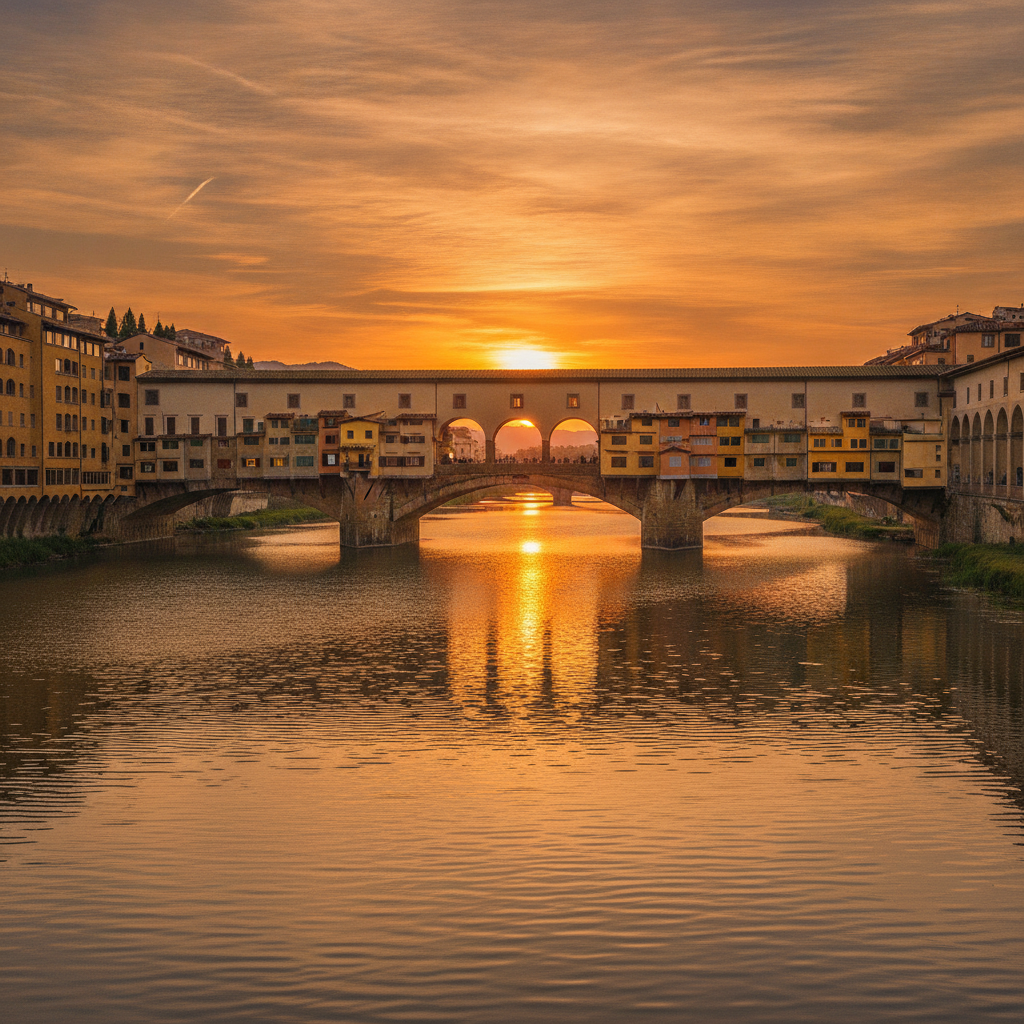
The Ponte Vecchio (the 'Old Bridge', dating in its current form to 1345 after the 1333 flood destroyed the earlier Roman and then medieval bridge on this site — the most historically important crossing point of the Arno in Florence, situated at the narrowest point of the river within the city and the site of a crossing since Roman times): the bridge is 95 metres long and 32 metres wide (approximately twice the width of a standard road bridge) and is unique among Florence's bridges in having never been destroyed in wartime — it was the only Florentine bridge spared by the retreating German army in August 1944, reportedly on Hitler's personal order; the bridge is lined on both sides with three-storey buildings housing goldsmiths and jewellery shops (a use established by Ferdinando I de' Medici in 1593 when he expelled the butchers and tanners who had previously occupied the bridge shops, in response to the smell; Vasari's Corridor runs above the east side of the bridge's upper storey; the three open arched windows at the centre of the bridge (the finestre vasoiane) offer the closest view of the Arno from the bridge level.
- 5
Oltrarno & the Boboli Gardens
The Oltrarno (the district of Florence 'beyond the Arno', on the south bank of the river — the quarter dominated by the enormous Palazzo Pitti, purchased by the Medici in 1549 and expanded through the 16th-18th centuries into the largest private palace in Florence and today housing six separate museums including the Palatine Gallery, the Silver Museum and the Gallery of Modern Art): the Boboli Gardens behind the Palazzo Pitti (the formal garden established by the Medici from 1549, designed initially by Niccolò Tribolo and continued by Bartolomeo Ammannati and Bernardo Buontalenti, and extended to its current form in the 17th and 18th centuries — today a 45,000 square metre park of formal Italian garden terraces, fountains, statues, grotto and an amphitheatre) constitute the finest Renaissance garden in Florence and one of the most important surviving examples of Italian formal garden design in existence.
- 6
Piazzale Michelangelo — The Panoramic Terrace Above Florence
The Piazzale Michelangelo (the panoramic belvedere on the south (Oltrarno) bank of the Arno, approximately 104 metres above sea level and approximately 60 metres above the city, designed by architect Giuseppe Poggi and inaugurated in 1869 as part of Poggi's urban renovation plan for Florence as the new capital of Italy (1865-1871)): the piazzale is the most celebrated viewpoint over the city of Florence, offering a panoramic view of the entire historic center from the Arno in the foreground to the hills beyond the city — a view that takes in the dome of the cathedral, the tower of the Palazzo Vecchio, the Bargello, Santa Croce and the surrounding hills; the piazzale contains bronze reproductions of Michelangelo's 'David' (the original is in the Accademia) and four allegorical figures from the Medici Chapel; the steps leading up from Piazza Giuseppe Poggi (the Rampe del Poggi, a sequence of curved ramps and terraced gardens designed by Poggi as part of the piazzale project) are one of the most pleasant walks in Florence.
Walk this route with audio
Stories play automatically as you reach each stop — no tapping needed.
More in florence
Santa Maria Novella, Via Tornabuoni & Ghirlandaio's Florence
The Duomo, Baptistery & Giotto's Campanile — Piazza del Duomo
Fiesole, the Chianti Hills & the Tuscan Countryside above Florence
Galleria dell'Accademia, Michelangelo's David & the Convent of San Marco
Museo Galileo, the Florentine Jewish Ghetto & the Via dei Benci