Palazzo Vecchio, Piazza della Signoria & the Bargello
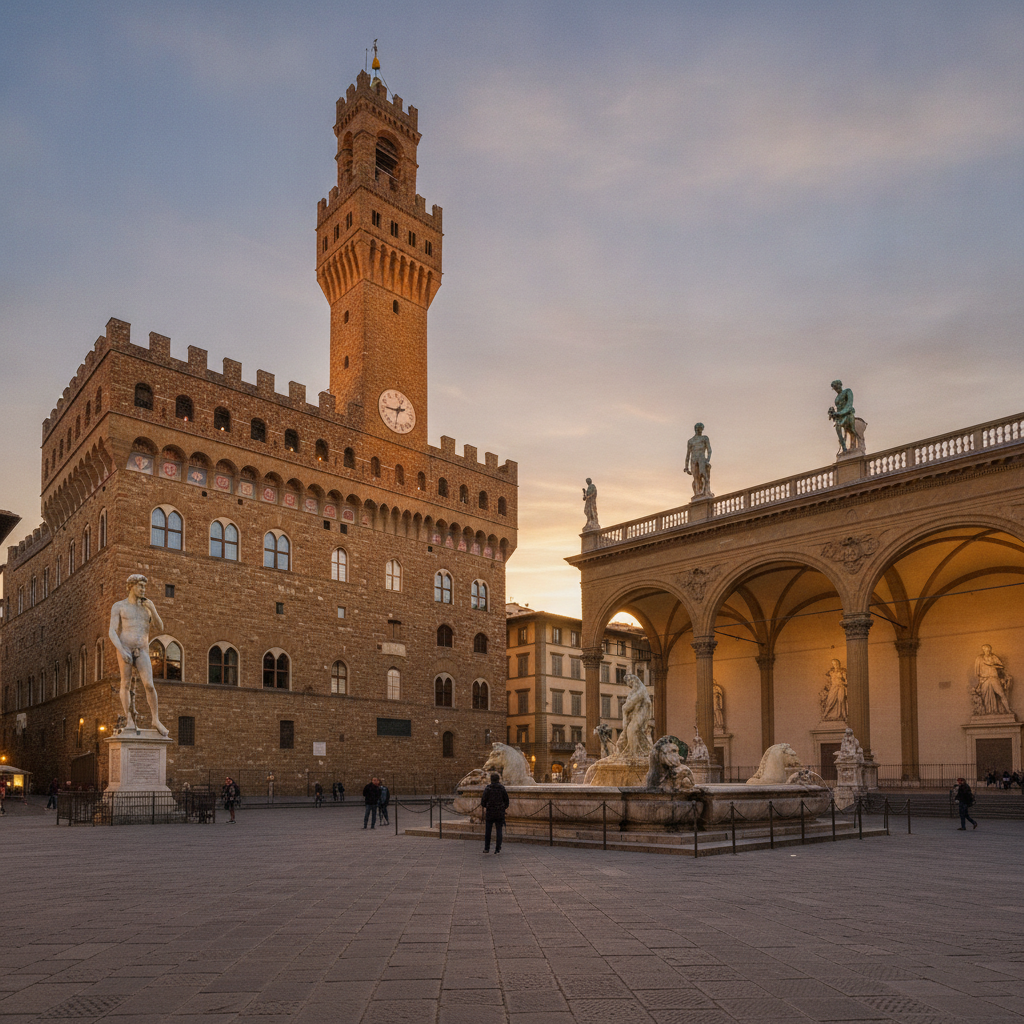
The Piazza della Signoria — the principal civic square of Florence, site of the medieval communal government and still the political and ceremonial heart of the city — is surrounded by the three most important civic monuments of medieval and Renaissance Florence: the Palazzo Vecchio (the 13th-14th century seat of Florentine government, still functioning as the city's town hall), the Loggia dei Lanzi (the 14th-century open-air sculpture gallery containing Cellini's 'Perseus' and Giambologna's 'Rape of the Sabine Women'), and the Bargello (the 13th-century civic palace that houses Florence's most important collection of Renaissance sculpture).
- 1
Piazza della Signoria — Florence's Civic Heart
The Piazza della Signoria (the central civic square of Florence, taking its name from the Signoria — the governing council of the medieval Florentine republic): the square has been the site of the most significant events in Florentine history — it was here that Savonarola conducted his 'Bonfires of the Vanities' (1497-1498), burning books, mirrors, cosmetics, and works of art deemed to encourage sin; it was here that Savonarola himself was burned at the stake in 1498 (a bronze disc in the pavement marks the spot); it was here that Michelangelo's 'David' stood from 1504 to 1873 before its transfer to the Accademia; and it is here that the most important outdoor sculpture collection in Florence is displayed: the Fountain of Neptune (1565) by Bartolomeo Ammannati (the Neptune figure itself ridiculed by Michelangelo — 'What beautiful marble you have ruined!'— but the bronze figures around the base by Giambologna and other hands); Donatello's bronze 'Judith and Holofernes' (c.1455-1460, the original now inside the Palazzo Vecchio); and Bandinelli's 'Hercules and Cacus' (1534).
- 2
Palazzo Vecchio — The Seat of Florentine Power
The Palazzo Vecchio (Piazza della Signoria, built 1299-1314 to the design attributed to Arnolfo di Cambio as the seat of the Signoria — the governing council of the Florentine republic — and known variously as the Palazzo della Signoria, Palazzo del Popolo, and (from 1540) Palazzo Ducale before receiving its current name 'Old Palace' when Cosimo I de' Medici moved the ducal residence to the Palazzo Pitti in 1565): the exterior — with its massive rusticated stone walls, crenellated battlements, and the 94-metre-tall asymmetric Torre d'Arnolfo — is the defining civic architectural statement of medieval Florence; the interior (museum open to visitors) was redecorated by Giorgio Vasari from 1555 for Cosimo I, including the Salone dei Cinquecento (the great council hall, 52 x 22 metres, with the walls and ceiling covered in Vasari's enormous battle paintings celebrating Medici victories) and the Studiolo di Francesco I (a jewel-box private study decorated in 1572 by Vasari and 30 other Florentine Mannerist painters).
- 3
Loggia dei Lanzi — The Open-Air Renaissance Sculpture Gallery
The Loggia dei Lanzi (the Loggia della Signoria, Piazza della Signoria, built 1376-1382 by Benci di Cione and Simone Talenti as a covered space for official ceremonies of the Florentine republic, named 'dei Lanzi' after the German mercenary lancers (Lanzichenecchi) who were garrisoned here under Cosimo I): the loggia's three arches contain the finest permanent open-air display of Renaissance and antique sculpture in existence: Benvenuto Cellini's bronze 'Perseus with the Head of Medusa' (1545-1554, cast in a single operation in Cellini's workshop after numerous failed attempts described in his famous autobiography — the most technically ambitious bronze casting of the 16th century); Giambologna's marble 'Rape of the Sabine Women' (1574-1582, the largest marble group of the Renaissance, carved from a single block and the first sculpture designed to be viewed from all sides rather than having a single frontal viewpoint); and several ancient Roman sculptures including the 'Sabine Women' and lion groups.
- 4
Bargello — Florence's Sculpture Museum
The Museo Nazionale del Bargello (Via del Proconsolo 4, the 13th-century civic palace that served as the seat of the Podestà (chief magistrate), the Capitano del Popolo, and (from 1574) the Bargello (chief of police), before being converted into a museum in 1865): the Bargello houses the most important collection of Renaissance sculpture in Florence and arguably in the world — the collection that makes it the essential complement to the painting-focused Uffizi; the ground floor court is dominated by Michelangelo's earliest surviving works including his 'Bacchus' (1496-1497, his first large-scale sculpture, carved in Rome and considered too realistically inebriated by contemporary standards), his marble 'Tondo Pitti' (c.1503-1505, a relief of the Madonna and Child), and his 'Brutus' (c.1539-1540, the only bust he ever carved, controversially depicting the assassin of Julius Caesar); the first floor contains the two famous competition reliefs for the Baptistery doors by Ghiberti and Brunelleschi (1401, the 'Sacrifice of Isaac' panels that effectively announced the Renaissance); and two of Donatello's masterpieces — the bronze 'David' (c.1440-1460, the first free-standing nude sculpture since antiquity) and the marble 'St George' (c.1415-1417).
- 5
Palazzo Vecchio Terraces & the Arnolfo Tower View
The Arnolfo Tower (the Torre d'Arnolfo, the 94-metre tower of the Palazzo Vecchio, accessible to visitors as part of the Palazzo Vecchio museum admission, with 223 steps to the top): the view from the Arnolfo Tower at the top of the Palazzo Vecchio is the most dramatically positioned urban viewpoint in Florence — unlike the Piazzale Michelangelo (which offers a wider panorama from a greater distance), the Arnolfo Tower provides a bird's-eye view directly over the Piazza della Signoria and the surrounding rooftops of the medieval city centre, with the dome of the Duomo looming directly overhead to the north and the Arno visible to the south; the tower climb also passes through a series of restored medieval rooms including a small prison cell (the Alberghetto, 'little inn' — a prison cell where prisoners of importance were detained, including Cosimo de' Medici the Elder in 1433 before his exile to Venice) and the original bell mechanism of the tower.
- 6
Badia Fiorentina & the Medieval Core
The Badia Fiorentina (the Benedictine abbey of Florence, Via del Proconsolo, founded in 978 by Willa, countess of Tuscany and mother of Ugo Marchese di Toscana, substantially rebuilt in the 13th-17th centuries): the Badia is the oldest monastery in Florence and one of the most historically significant religious institutions in the city — it was here that Dante first saw Beatrice (according to his own account in the 'Vita Nuova', he saw Beatrice dressed in white beside the Badia when both were children, and later saw her again on a bridge near the Badia); the church contains Filippino Lippi's 'Apparition of the Virgin to St Bernard' (c.1485, one of his major altarpiece paintings); the Chiostro degli Aranci (Cloister of the Orange Trees, 1430s, with a fresco cycle of the life of St Benedict attributed to Giovanni di Consalvo or the school of Fra Angelico) is one of the most serene spaces in Florence.
Walk this route with audio
Stories play automatically as you reach each stop — no tapping needed.
More in florence
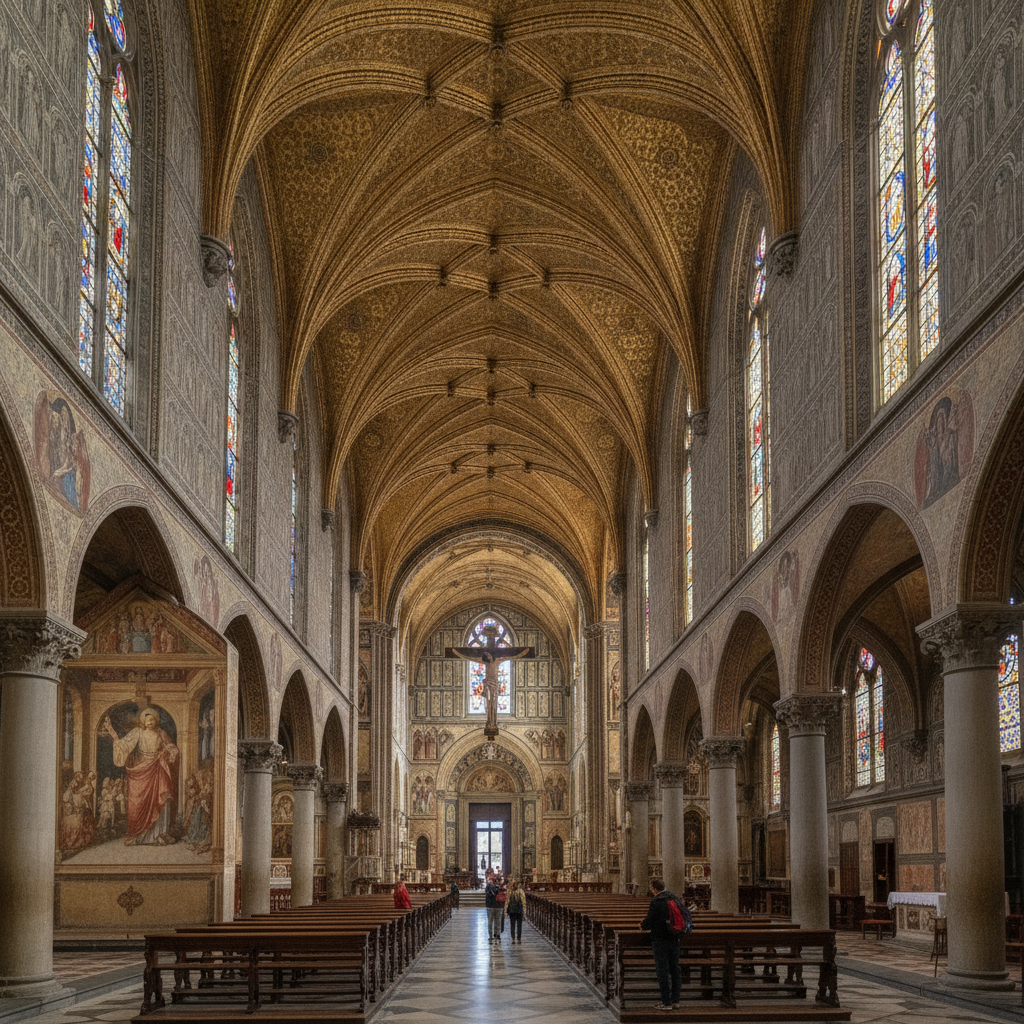
Santa Maria Novella, Via Tornabuoni & Ghirlandaio's Florence
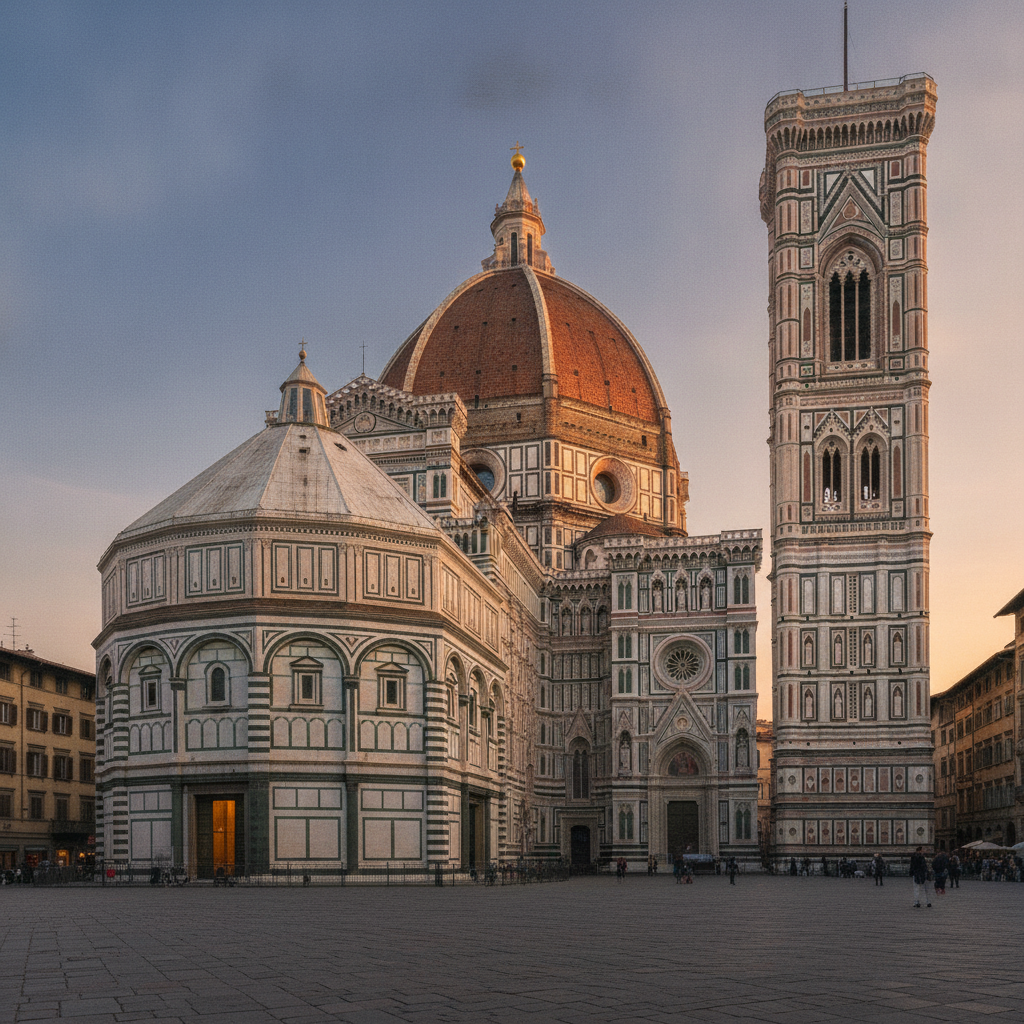
The Duomo, Baptistery & Giotto's Campanile — Piazza del Duomo
Fiesole, the Chianti Hills & the Tuscan Countryside above Florence
Galleria dell'Accademia, Michelangelo's David & the Convent of San Marco
Museo Galileo, the Florentine Jewish Ghetto & the Via dei Benci