Calton Hill — Edinburgh's Acropolis & Finest Panoramic View
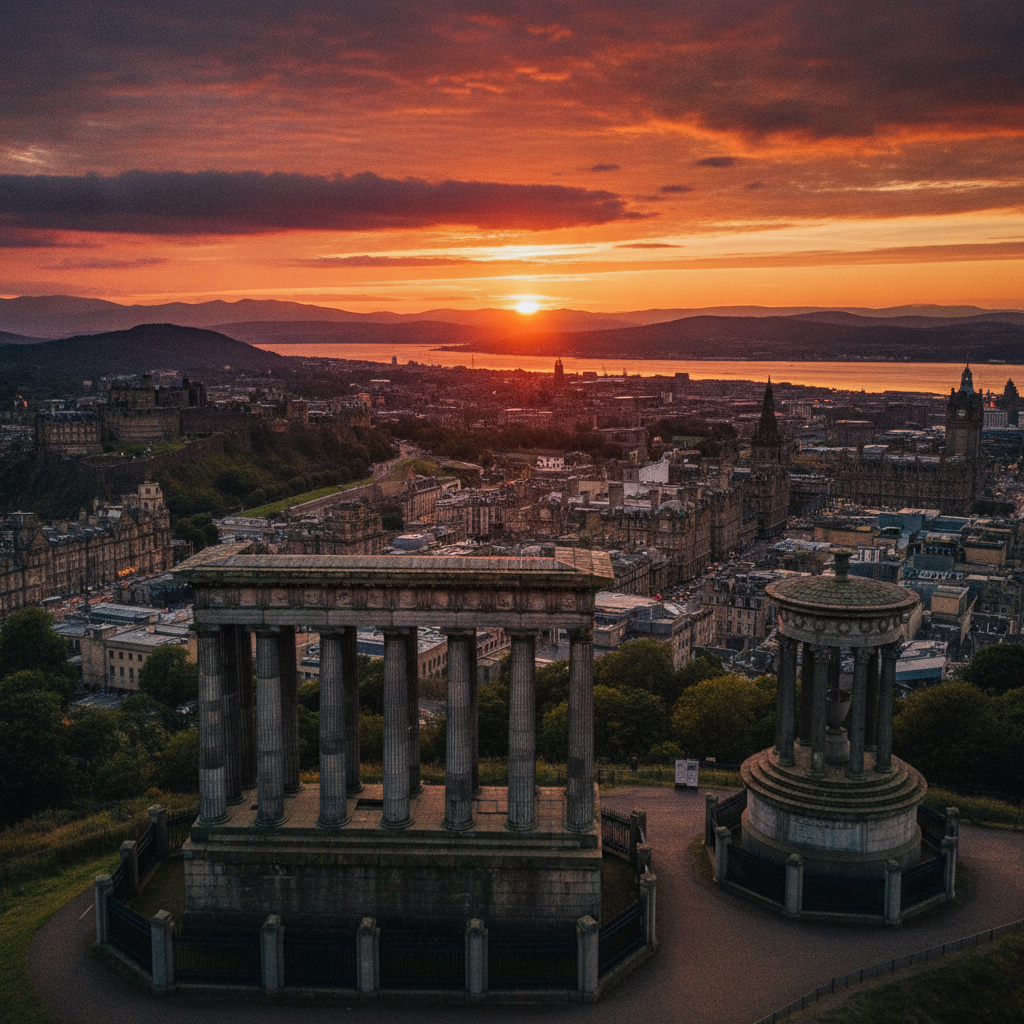
Calton Hill (the 100-metre hill at the eastern end of Princes Street, the most easily accessible of Edinburgh's seven hills, a 10-minute walk from Princes Street — the finest panoramic viewpoint in Edinburgh and the site of the monuments that gave Edinburgh the nickname 'Athens of the North'): the hill's monuments include the National Monument (the unfinished Parthenon colonnade), the Nelson Monument (the telescope-shaped tower commemorating the Battle of Trafalgar), and the City Observatory (the Victorian observatory built 1818 by William Playfair).
- 1
National Monument of Scotland — The Unfinished Parthenon
The National Monument of Scotland (the 12-column Doric colonnade on the summit of Calton Hill, modelled directly on the Parthenon of Athens, begun 1822 and abandoned unfinished in 1829 due to lack of funds — the most dramatic architectural ruin in Edinburgh and the monument that gave Edinburgh its nickname 'Athens of the North'): the National Monument was conceived as a memorial to Scottish soldiers and sailors killed in the Napoleonic Wars, and was designed by Charles Robert Cockerell and William Playfair to be a replica of the Parthenon; the fund-raising campaign raised £42,000 (of the £42,000 target — the monument cost exactly as much as was raised, which paid for the twelve columns and the back wall but nothing more); the 12 columns have stood in their unfinished state for nearly 200 years, becoming one of Edinburgh's defining landmarks and winning the affectionate nickname 'Edinburgh's Disgrace'; Edinburgh's resemblance to Athens (the volcanic hills, the classical monuments, the intellectual tradition of the Scottish Enlightenment) made the 'Athens of the North' comparison irresistible to Romantic-era Scottish writers and travellers.
- 2
Panoramic View from Calton Hill
The panoramic view from Calton Hill (the 360-degree view from the summit of Calton Hill, one of the finest city panoramas in Europe): looking west from Calton Hill, the view encompasses: the entire Old Town ridge (Edinburgh Castle on its volcanic crag at the western end, the line of medieval tenements and steeples descending the Royal Mile to Holyrood, Arthur's Seat and Salisbury Crags rising beyond Holyrood Park); the New Town's Georgian grid (the regular streets and squares descending northward from Princes Street to the Firth of Forth); the Scott Monument and Princes Street Gardens in the middle ground; and the Firth of Forth with the hills of Fife beyond on the northern horizon; looking east and south: the Calton Cemetery (with the tomb of the philosopher David Hume), the Scottish Parliament building (Enric Miralles' controversial 2004 postmodern building at the foot of the Royal Mile), Holyrood Park, and the Pentland Hills on the southern horizon.
- 3
Nelson Monument & City Observatory
Nelson Monument (the 32-metre telescope-shaped tower (1816, designed by Robert Burn) on the summit of Calton Hill, commemorating Admiral Horatio Nelson and the Battle of Trafalgar (1805)): the tower's telescope shape is a deliberate visual pun; a time ball (the large red ball on the top of the tower) drops daily at 1pm (the same time as the One O'Clock Gun fires from Edinburgh Castle, providing redundant time signals for ships in the Firth of Forth); the tower can be climbed (143 spiral steps) for views; the adjacent City Observatory complex (designed by William Playfair, 1818, in the Greek Revival style — the original City Observatory building (now the Collective Gallery, a contemporary art gallery)) and the Dugald Stewart Monument (the circular neoclassical temple on the slope of Calton Hill, designed by Playfair (1831) to commemorate the philosopher Dugald Stewart (1753-1828, one of the leading figures of the Scottish Enlightenment)) complete the remarkable assembly of Neoclassical monuments on the hill.
- 4
Scottish Parliament Building — Holyrood
Scottish Parliament Building (Holyrood, at the foot of the Royal Mile adjacent to Holyroodhouse Palace — the building of the Scottish Parliament (Pàrlamaid na h-Alba), which was reconvened in 1999 after 292 years of suspension following the Acts of Union of 1707 (when the Scottish Parliament merged with the Parliament of England to form the Parliament of Great Britain)): the building (designed by the Catalan architect Enric Miralles and his Edinburgh-based partner Benedetta Tagliabue, completed 2004, cost £431 million — the most expensive building ever built in Scotland) is the most debated and controversial piece of architecture in modern Scotland; its extraordinary design (leaf-shapes, boat-hull forms, upturned boat shapes in the window embrasures, Scottish vernacular references combined with deconstructivist forms) was deeply divisive when it opened; it has since been recognized as one of the most significant pieces of European architecture of the early 21st century and has won multiple major architecture prizes; the public galleries of the Parliament chamber are open to visitors when the Parliament is in session.
- 5
Calton Hill Beltane Fire Festival
Beltane Fire Festival (the annual festival held on Calton Hill on the night of April 30/May 1 — the revival of the ancient Celtic festival of Beltane (the Gaelic festival marking the beginning of summer, traditionally celebrated on May 1 with bonfires, the driving of cattle between fires for purification, and communal celebrations) as a contemporary ritual arts and performance event): the Edinburgh Beltane Fire Festival was revived in 1988 by a group of performers and has grown into an annual event attended by approximately 12,000 people, with fire performers, drummers, and costumed characters enacting an elaborate narrative ritual on the hill; the festival (in which a May Queen and Green Man lead a procession of fire around the hill, accompanied by hundreds of performers in white body paint wielding torches and fire) is one of the most spectacular and atmospheric outdoor events in Scotland, and one of the most successful revivals of a pre-Christian Celtic ritual in contemporary Europe.
- 6
Leith Walk & Easter Road — Edinburgh's East End
Leith Walk (the 1.2-km street connecting Edinburgh city centre (Picardy Place) to Leith — the primary arterial street of Edinburgh's east end, lined with Victorian tenements, independent shops, cafes, and restaurants, increasingly fashionable as Edinburgh's food and creative scene expands eastward): Leith Walk has undergone significant gentrification since 2010 (with the opening of Valvona & Crolla (the Italian deli and wine merchant founded 1934, the finest Italian food shop in Scotland), the Elm Bar and the Lioness of Leith (wine bars), and multiple independent restaurants) and is now one of the most interesting streets in Edinburgh for food, drink, and independent shopping; the Omni Edinburgh complex (at the top of Leith Walk, adjacent to Calton Hill) and the planned development of the former St James Centre site (the St James Quarter — the £1 billion retail and hotel development opened 2021, the largest development in Edinburgh's history) are reshaping the eastern edge of the New Town.
Walk this route with audio
Stories play automatically as you reach each stop — no tapping needed.
More in edinburgh
Edinburgh Castle, the Royal Mile & Holyrood — The Old Town
Edinburgh Festival, Fringe & Hogmanay — The World's Greatest Arts Festival City
The New Town — Georgian Edinburgh & the Scottish Enlightenment
Mary Queen of Scots & Scottish History
St Andrews, Golf & the Fife Coastal Path