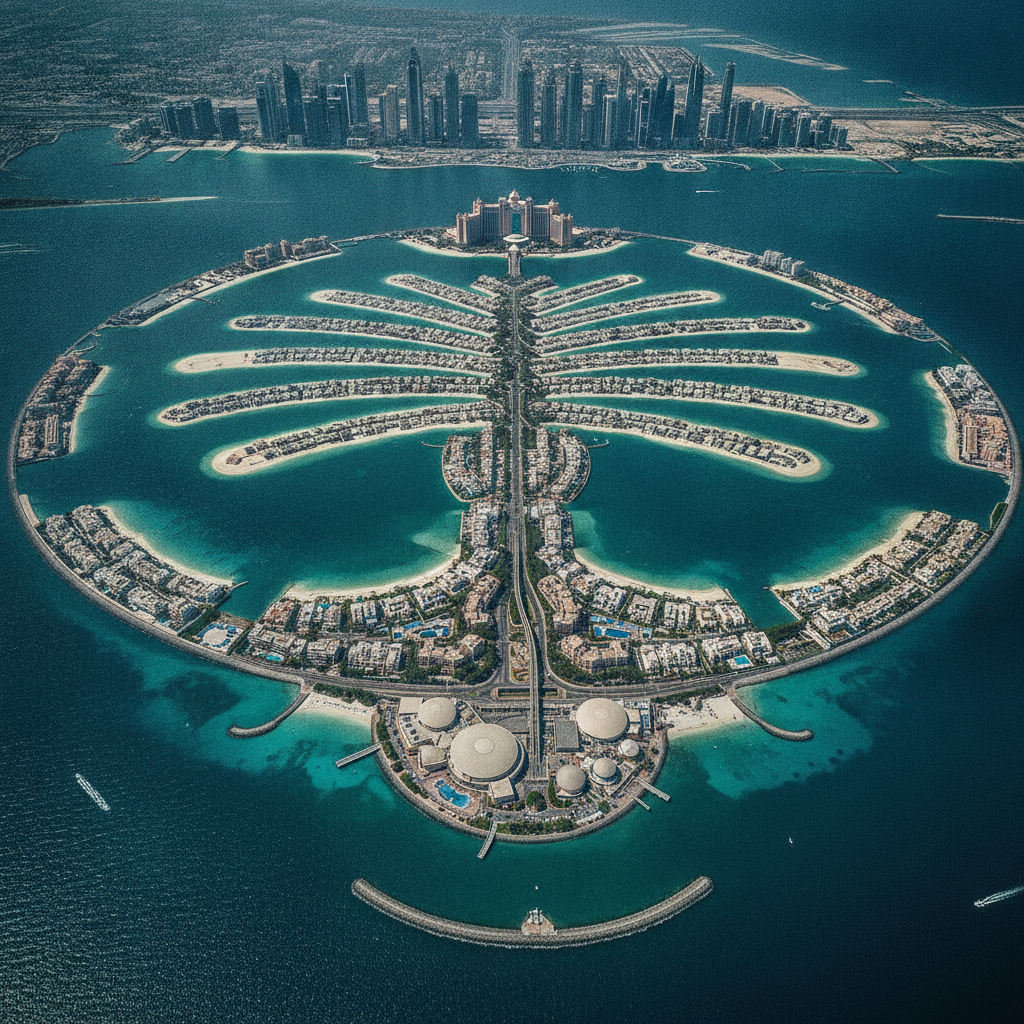
Palm Jumeirah: The World's Largest Artificial Island
The Palm Jumeirah, a palm-tree-shaped artificial island extending 5 kilometers into the Arabian Gulf off the coast of Dubai's Jumeirah district, was the world's largest land reclamation project when it was built by Nakheel Properties between 2001 and 2006 using 94 million cubic meters of sand dredged from the Gulf floor and 5.5 million tons of rock. The island added 78 kilometers of artificial coastline to Dubai's 67-kilometer natural shoreline — more than doubling the emirate's beach frontage — and created space for the Atlantis The Palm resort (1,500 rooms, the largest hotel in the Middle East when it opened in 2008), the Palm Monorail (the first monorail in the Arabian Peninsula), and approximately 4,000 residential villas and apartments across the 17 fronds of the palm shape.
- 1
Nakheel Mall & Palm Monorail — Gateway to the Palm
Nakheel Mall (2019), a mid-size shopping center at the base of the Palm Jumeirah trunk near the Palm Gateway Metro Station (the terminus of the Red Line extension from Dubai Marina), serves as the entry point for visitors arriving by metro. The Palm Monorail, a driverless 5.4-kilometer elevated railway connecting the Palm Gateway (at the trunk base) to Atlantis The Palm (at the northern crescent tip), makes four stops along the trunk and crescent: Palm Gateway, Al Ittihad Park, Nakheel Harbor & Tower (future), and Atlantis The Palm. The monorail was the first in the Arabian Peninsula when it opened in 2009; it carries relatively few passengers compared to the Dubai Metro (the Palm is car-oriented), but provides the only public transport connection to the island and a unique aerial view of the Palm's trunk and frond layout from above.
- 2
The Pointe & The View at The Palm
The Pointe (2019), a waterfront dining and entertainment complex at the southern tip of the Palm Crescent (the outer breakwater ring), provides the best ground-level views of Atlantis The Palm across the water: a cluster of restaurants, cafés, and retail units arranged around a central fountain that projects water jets choreographed to music in the evenings (Palm Fountain, the world's largest fountain by area, as of 2020). The View at The Palm, an observation deck on the 52nd floor of the Palm Tower (a luxury residential and hotel tower at the top of the Palm trunk), provides the best single elevated view of the entire palm shape from within the island — unlike the aerial photographs that define the Palm's image, The View gives the experience of standing inside the structure and looking out along the fronds. The Palm Tower's Nobu restaurant (120 floors below The View) is consistently one of Dubai's most popular Japanese restaurants.
- 3
Atlantis The Palm — The Resort That Defined the Palm
Atlantis The Palm (2008, designed by the architectural firm WATG), with 1,500 rooms arranged in two curved wings connected by a bridge arch visible from across the Gulf, was the hotel that defined the Palm Jumeirah in the global imagination: its opening party (November 2008, attended by 2,000 celebrities and broadcast live on global television) cost an estimated $20 million and introduced Dubai's hospitality ambition to an international audience that had only vaguely registered the Palm's existence. The resort contains the Aquaventure Waterpark (20 hectares, with 105 slides and rides, consistently rated one of the world's best waterparks), The Lost Chambers Aquarium (250 species in a 65,000-square-meter underwater environment themed around Atlantis mythology), a 17-restaurant dining complex including Nobu, Ronda Locatelli, and Seafire Steakhouse, and access to a 700-meter private beach on the outer crescent.
- 4
Palm Crescent — The Outer Ring Residences
The Palm Crescent — the outer breakwater ring of the Palm Jumeirah, a continuous 11-kilometer arc of reclaimed land that encloses the fronds from the Gulf waves — was originally intended as a residential area and is now home to some of Dubai's most exclusive hotels and residences: the Waldorf Astoria Dubai Palm Jumeirah, the Anantara Dubai The Palm Resort, the Sofitel Dubai The Palm, the Rixos The Palm, and the Kempinski Hotel & Residences Palm Jumeirah, arranged along the inner and outer edges of the crescent in a relatively unplanned sequence of hotel compounds that creates an unusual urban form — a resort strip with no street life, accessible only by car (or the Palm Monorail, which stops at the Atlantis end of the crescent). The outer crescent beach — facing the open Arabian Gulf — is the Palm's most dramatic: wide sand beaches with no buildings on the horizon.
- 5
Palm Fronds — The Residential Palm
The 17 fronds of the Palm Jumeirah — the residential spines radiating from the central trunk — are each approximately 800 meters long and 50-150 meters wide, accessible by a network of roads from the trunk boulevard. The fronds contain approximately 4,000 individual villas (4-6 bedroom, typically 400-700 square meters of living space, each with private beach access on its frond tip), ranging in price from $2 million to $30+ million, as well as a smaller number of apartment buildings and hotels. The frond villas were sold off-plan in 2001-2003, many to buyers who had never visited Dubai; the re-sale market for Palm villas is now one of the world's most closely watched luxury property indices. Palm Jumeirah frond addresses — '14 Frond N, Palm Jumeirah' — have become a status symbol recognized globally.
- 6
Palm Beach & Shoreline Apartments
The Shoreline Apartments, a series of low-rise residential buildings along the Palm trunk's beach edge (the inner part of the trunk, facing the fronds and the crescent), provide the Palm's most accessible beach to non-villa residents: the Palm Jumeirah Boardwalk, a 10.5-kilometer promenade running along the outer edge of all 17 fronds (accessible by foot and bicycle from multiple points on the trunk), provides the most complete experience of the Palm Jumeirah's scale at ground level — the view from the tip of Frond N or Frond P, looking back toward the mainland across the expanse of Gulf water, is among the most disorienting spatial experiences in Dubai: 5 kilometers of open water between you and the mainland, occupied entirely by the structure you're standing on.
Walk this route with audio
Stories play automatically as you reach each stop — no tapping needed.
More in dubai
Deira: Heritage Markets, Naif Square & the Multicultural Old Quarter
Al Fahidi, Dubai Creek & the Gold Souk: Dubai Before Oil
Expo City Dubai: The World's Fair Becomes a Permanent City
Business Bay, Dubai Canal & Design District: The Creative and Commercial New Center
Jumeirah Beach Road, Kite Beach & Burj Al Arab: Old Dubai Meets the Sea