Expo City Dubai: The World's Fair Becomes a Permanent City
Expo City Dubai, built on a 438-hectare site in the Dubai South district near Al Maktoum International Airport, hosted World Expo 2020 (delayed to 2021–2022 due to the COVID-19 pandemic) and was subsequently repurposed as a permanent mixed-use urban district — the only World's Fair site in history to have been fully converted to permanent use rather than demolished or partially preserved. The site, which hosted 192 national pavilions and 24.1 million visits during the Expo period, now contains the Al Wasl Plaza (a permanent cultural and events venue centered on the 130-meter projection dome), the Expo City residential district (housing for 35,000 residents by 2025), the Dubai Exhibition Centre, the Museum of the Future annex, and 18 permanent legacy pavilions maintained by their respective countries.
- 1
Al Wasl Plaza — The Dome at the Heart of Expo City
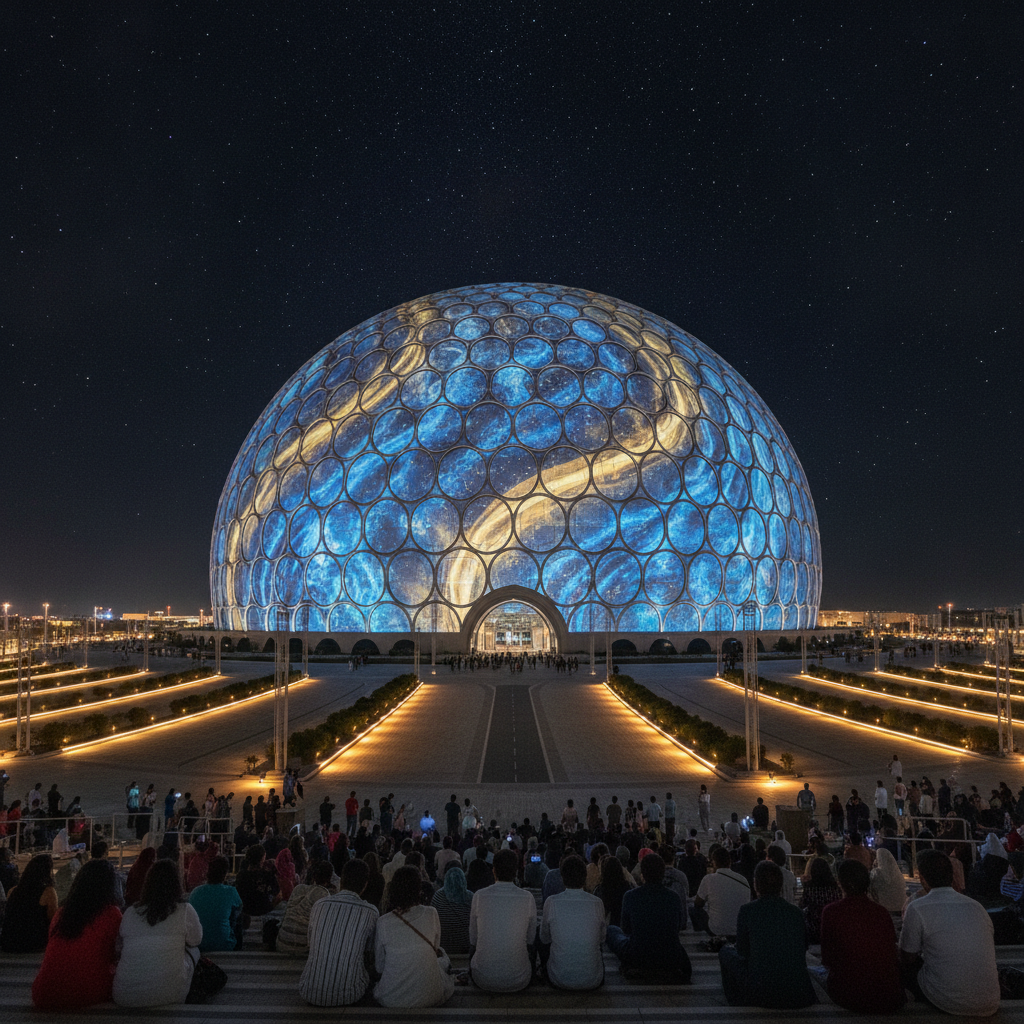
Al Wasl Plaza, the central public space of Expo City Dubai, is dominated by the Al Wasl dome: a 130-meter diameter lattice steel dome that is simultaneously the world's largest 360-degree projection surface (the entire inner surface of the dome is a screen for nighttime projection mapping shows), the central gathering space of the site, and the architectural symbol of Dubai's World Expo ambition. The dome's name ('Al Wasl' means 'connection' in Arabic) references the Expo's theme ('Connecting Minds, Creating the Future') and the historical name of the Creek connection point between Bur Dubai and Deira. The projection shows (typically at 9pm, 10pm, and 11pm) use the dome's inner surface to create immersive 360-degree audiovisual experiences themed around sustainability, innovation, and cultural connection — the technical execution is the most sophisticated projection mapping system in the world, operated by a team of 40 technicians and 20 content creators.
- 2
Sustainability Pavilion — Dubai's Net-Zero Building
The Sustainability Pavilion, one of three permanent thematic pavilions built by Expo City Dubai (the others being Opportunity and Mobility), was designed by Grimshaw Architects and is now a permanent museum and demonstration site for sustainable technology: a building with a 130-meter-diameter canopy of photovoltaic solar panels (generating 4 GWh of electricity per year, covering the building's full energy needs and exporting surplus to the grid), an atmospheric water harvesting system (producing 22,800 liters of water per day from the desert air), and an underground cooling system using phase-change materials that reduces cooling energy consumption by 40% compared to conventional systems. The pavilion's museum explores Dubai's environmental history and future goals (the UAE's 2050 net-zero commitment) in exhibits that are more honest about the challenges than most government-sponsored environmental exhibits.
- 3
Opportunity & Mobility Pavilions — Innovation and Transport
The Opportunity Pavilion, a permanent gallery exploring human potential, education, and economic inclusion, and the Mobility Pavilion (Alif), a museum of transport history and future mobility, are the other two major permanent structures at Expo City, connected to Al Wasl Plaza by the main radial avenues. The Alif Mobility Pavilion (designed by Santiago Calatrava) is particularly striking: a wing-shaped structure with kinetic facades that open and close during the day, housing exhibits on the history of human movement from walking to spaceflight. The building's Calatrava-designed structure — 110 meters tall, with wings that span 130 meters — is one of the most dramatic pieces of architecture on the Expo City site.
- 4
Terra — The Sustainability Pavilion Gardens
Terra (the Sustainability Pavilion's external landscape, designed by GROSS MAX of Edinburgh), a 150,000-square-meter garden surrounding the Sustainability Pavilion dome, is the most ambitious landscape project in Dubai: a mix of native and adapted drought-resistant plant species arranged in 'biomes' representing different climate zones (desert, tropical, Mediterranean, semi-arid), watered entirely by the pavilion's atmospheric water harvesting system, and maintained without chemical pesticides or herbicides. The garden, which is free to access, is the most biodiverse patch of planted landscape in the emirate outside the Dubai Safari park, and provides the only significant outdoor green space in the Dubai South development area.
- 5
Dubai Exhibition Centre & Dubai South
The Dubai Exhibition Centre (DEC), a 45,000-square-meter indoor exhibition facility at the edge of the Expo City site, is one of the world's five largest exhibition centres and serves as the primary convention and trade show venue for the Dubai South district. Dubai South (formerly Dubai World Central), the 145-square-kilometer development zone surrounding Al Maktoum International Airport, is one of the world's largest urban development projects: a planned city of 1 million residents (projected 2030) organized around the airport logistics cluster, a residential district, the Expo City site, and a dedicated aviation and aerospace manufacturing zone. Al Maktoum International Airport, currently operating a single runway, is planned to become the world's largest airport (capacity 160 million passengers per year, compared to Dubai International Airport's current 90 million) when fully completed.
- 6
Legacy Pavilions — The Nations Remain
Of the 192 national pavilions built for Expo 2020, 18 have been maintained as permanent structures by their respective countries and repurposed as cultural centers, offices, or exhibition spaces within the Expo City development: the Germany Pavilion (now a permanent German business hub), the France Pavilion (retained as a cultural venue), the Belgium Pavilion, the Italy Pavilion, the UAE Pavilion (designed by Santiago Calatrava, retained as a permanent UAE showcase), and several others. The remaining 174 pavilions were either dismantled (and their materials recycled or sold), converted to temporary use, or are awaiting repurposing decisions. The Expo City residential district, which will eventually house 35,000 people in apartment buildings, hotels, and serviced residences across the former Expo site, has begun construction on the northern portion of the site.
Walk this route with audio
Stories play automatically as you reach each stop — no tapping needed.
More in dubai
Deira: Heritage Markets, Naif Square & the Multicultural Old Quarter
Palm Jumeirah: The World's Largest Artificial Island
Al Fahidi, Dubai Creek & the Gold Souk: Dubai Before Oil
Business Bay, Dubai Canal & Design District: The Creative and Commercial New Center
Jumeirah Beach Road, Kite Beach & Burj Al Arab: Old Dubai Meets the Sea