Humayun's Tomb, Qutb Minar & Lodhi Garden — Delhi's Medieval Heritage
Delhi's medieval and early Mughal architectural heritage — Humayun's Tomb (1572, UNESCO, the first great Mughal garden tomb and the direct precursor of the Taj Mahal), the Qutb Minar complex (1193, UNESCO, the finest example of Delhi Sultanate architecture and the world's tallest brick minaret), and Lodhi Garden (the walled garden containing the tombs of the Sayyid and Lodhi dynasty sultans, 15th-16th century) — constitutes one of the greatest concentrations of medieval Islamic architecture outside the Middle East.
- 1
Humayun's Tomb — The Precursor to the Taj Mahal
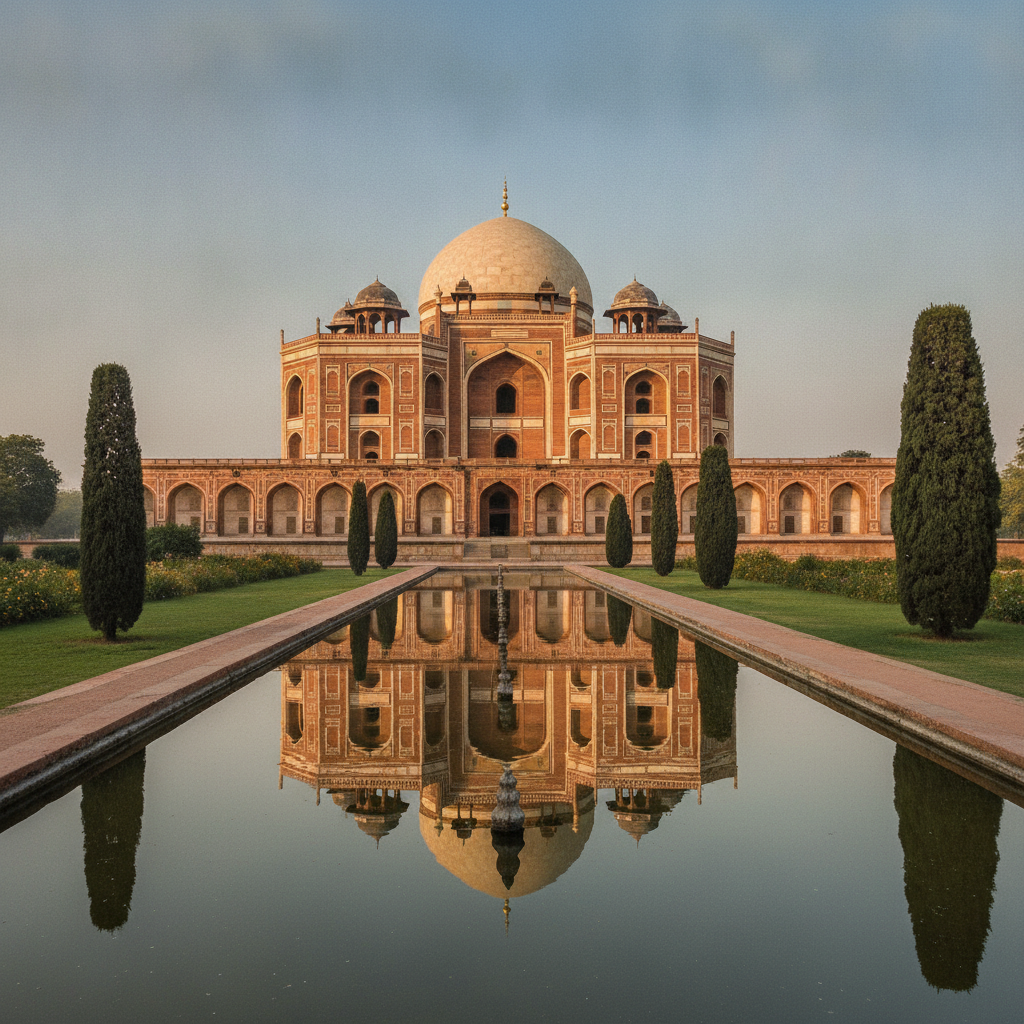
Humayun's Tomb (Maqbara-e-Humayun — Mathura Road, Nizamuddin, Delhi — UNESCO World Heritage Site (1993): the garden tomb built 1565-1572 for the Mughal Emperor Humayun (r. 1530-1540, 1555-1556) by his senior widow Bega Begum (also known as Haji Begum), designed by the Persian architect Mirak Mirza Ghiyas): the tomb is the first great Mughal garden tomb and the building that established the architectural type that would culminate in the Taj Mahal 80 years later; the structural innovations introduced at Humayun's Tomb include: the first double dome in India (the inner dome defines the interior space while the outer dome creates the exterior silhouette — the same technique used in the Taj Mahal), the first Mughal use of the Persian charbagh (four-part formal garden with central water channels) in India, the extensive use of red sandstone combined with white marble inlay, and the octagonal plan with corner kiosks that became canonical in Mughal funerary architecture; the complex (surrounded by numerous smaller tombs of later Mughal princes and officials) is a UNESCO World Heritage property recognized as 'an outstanding example of the evolution of Mughal architecture in India.'
- 2
Qutb Minar — The World's Tallest Brick Minaret
Qutb Minar (the 72.5-metre tapering brick minaret at the Qutb complex, Mehrauli, South Delhi — UNESCO World Heritage Site (1993), the world's tallest brick minaret and one of the finest towers in Islamic architecture, built 1193-1368 over multiple construction phases by successive Delhi Sultanate rulers beginning with Qutb ud-Din Aibak (the founder of the Delhi Sultanate) and completed by Iltutmish, with later additions and repairs by Firuz Shah Tughluq): the minaret (72.5 metres in five tapering storeys, each marked by a projecting balcony with muqarnas corbelling — the stalactite-like stone ornaments of Islamic architecture) was built to call the faithful to prayer at the adjacent Quwwat ul-Islam Mosque (the Might of Islam Mosque, the first mosque built in India after the Muslim conquest, built using materials from 27 demolished Hindu and Jain temples whose columns are still visible within the mosque's colonnade); the Qutb complex also contains the Iron Pillar of Delhi (approximately 402 CE — a 7.21-metre wrought-iron pillar of extraordinary purity (98% iron) that has not rusted in 1,600 years despite standing in the open air, an unsolved metallurgical mystery of ancient Indian craftsmanship).
- 3
Lodhi Garden — Tombs in a Park
Lodhi Garden (Lodi Garden — the 90-acre public park in the Lodhi Colony area of South Delhi, containing the garden-tombs of the rulers of the Sayyid dynasty (1414-1451) and the Lodhi dynasty (1451-1526) — the two final dynasties of the Delhi Sultanate before the Mughal conquest): the Lodhi Garden is simultaneously one of the finest public parks in Delhi (with mature trees, rose gardens, jogging paths, and ponds) and one of the most significant concentrations of 15th-16th century Islamic garden architecture in India; the primary monuments in the garden include: the Bara Gumbad (the Large Dome — the massive square gateway-tomb structure, 1494), the Sheesh Gumbad (the Glass Dome — the blue-tiled octagonal tomb of the Lodhi period), the Muhammad Shah's Tomb (the octagonal garden tomb of the Sayyid ruler Muhammad Shah, 1444 — the finest surviving example of Sayyid architectural style), and the Sikander Lodhi's Tomb (the large walled garden tomb of the Lodhi sultan Sikander Lodhi, 1517).
- 4
Mehrauli Archaeological Park & Seven Cities of Delhi
Mehrauli Archaeological Park (adjacent to the Qutb Minar complex, Mehrauli, South Delhi — 200 acres of historically stratified landscape containing monuments spanning 1,000 years of Delhi's history, from the pre-Sultanate Rajput fortifications of Lal Kot (10th century) through the Delhi Sultanate period to the Mughal period): Delhi is known as the 'City of Seven Cities' — seven major urban settlements that have occupied the Delhi region since approximately the 10th century, each built by a different dynasty (Anangpal Tomar (Lal Kot, c. 1060), Qutb ud-Din Aibak (Qila Rai Pithora, c. 1193), Ghiyas ud-Din Tughluq (Tughlaqabad, 1321), Muhammad bin Tughluq (Jahanpanah, 1326), Firuz Shah Tughluq (Firozabad, 1354), Sher Shah Suri (Shergarh/Purana Qila, 1538), Shah Jahan (Shahjahanabad, 1639)) — the Mehrauli Archaeological Park contains substantial remains of at least three of these cities.
- 5
Nizamuddin Dargah — Sufi Shrine & Thursday Qawwali
Nizamuddin Dargah (the shrine of Hazrat Nizamuddin Auliya, Nizamuddin West, South Delhi — the dargah of the 14th-century Sufi saint Nizamuddin Auliya (1238-1325), one of the most revered Sufi shrines in South Asia, attracting Hindu and Muslim devotees): Nizamuddin Auliya (the 'Sultan of Saints', the most beloved Sufi saint of Delhi, disciple of Baba Farid of Faridkot) attracted followers from across the subcontinent during his lifetime and inspired both Mughal emperors and Hindu devotees; the dargah complex (the shrine, the mosque, the tomb of the poet Amir Khusrau (the greatest Urdu and Persian poet of medieval India), and the tombs of the Mughal princess Jahanara Begum (Shah Jahan's daughter) and the Mughal Emperor Muhammad Shah Rangeela) is most extraordinary on Thursday evenings, when the qawwali (devotional Sufi music) singers perform in the courtyard of the shrine, creating one of the most spiritually powerful musical experiences available in India.
- 6
Hauz Khas Village — Medieval Reservoir & Modern Café Culture
Hauz Khas (Hauz Khas Village and the Hauz Khas Complex — South Delhi — the medieval royal reservoir (hauz = reservoir, khas = royal) built by Alauddin Khalji in 1296 and expanded by Firuz Shah Tughluq in the 14th century, surrounded by the ruins of the 14th-century madrasa and Firuz Shah's tomb on the banks of the reservoir): the Hauz Khas Complex (the medieval ruins surrounding the reservoir — a fortified madrasa (Islamic college), several mosques, the octagonal tomb of Firuz Shah Tughluq, and the ruins of various other Sultanate-era structures) is Delhi's most dramatically atmospheric medieval site — the ruins extending along the bank of the large reservoir lake, now a waterbird habitat with ducks, herons, and cormorants; the adjacent Hauz Khas Village (the organic bohemian neighbourhood that has developed in the alleys and buildings around the medieval complex) contains Delhi's densest concentration of independent design boutiques, art galleries, rooftop cafes, and nightclubs — making Hauz Khas simultaneously the most atmospheric medieval site and the most fashionable contemporary entertainment district in Delhi.
Walk this route with audio
Stories play automatically as you reach each stop — no tapping needed.
More in delhi
India Gate, Rashtrapati Bhavan & Lutyens' New Delhi
Agra Day Trip — The Taj Mahal, Agra Fort & Fatehpur Sikri
Red Fort, Chandni Chowk & Old Delhi — Mughal Imperial Heart
National Gallery of Modern Art, Safdarjung's Tomb & South Delhi
Delhi Street Food — Paranthas, Chhole Bhature & Old Delhi Culinary Heritage